SEAT Leon TDI Stylance
With its sporty lines and solid build, the SEAT is a strong contender

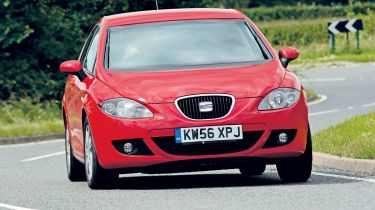
It’s easy to forget exactly how radical the Leon is. The previous model was seen by many as merely a rebodied Volkswagen Golf, but with a rather bland interior. However, the new car is every inch a SEAT. While it follows on from the Altea and Toledo, it’s better-looking than either of its larger counterparts, and there’s now no hint of the Golf’s boxy proportions anywhere in the curvaceous design.
The Spanish company actually refers to the Leon as a five-door coupé, and you can see why. The hidden rear door handles, along with a low roofline, give it a sporty appearance, while the front is dominated by the large, rounded grille and that unique bonnet design. Its distinctive shape is further enhanced by the slab sides and arching swage line that runs from the headlights right down to the rear wheelarches.
Inside, it’s equally different. And, as you’d expect from a VW Group product, fit and finish are excellent. However, our test car did develop a rattle from around the glovebox – it’s a problem we’ve experienced on several Leons. Still, the rest of the cabin is well laid out, while the dials are easy to read. The SEAT also has the best driving position on test, with the widest adjustment in the chair and steering column. For taller owners, it’s the most comfortable car for long journeys.
Visibility is a problem, though – thick A-pillars make pulling out of tight junctions tricky, while the rearward view isn’t great, either. Even more disappointing, however, is the 1.9-litre TDI diesel engine. SEAT describes it as ‘well proven’, but it’s simply getting old, and from start-up, the lack of refinement is instantly obvious. On the move, it seems crude compared with its rivals’ powerplants, and hard acceleration results in the dreaded diesel clatter.
The Leon feels lethargic, too, especially at higher speeds, and this was evident in our performance tests. The sprint from 0-60mph took a leisurely 11.3 seconds – about half-a-second slower than the Kia – and through the gears in our 30-70mph assessment, it was only 0.3 seconds quicker than the Citroen with its EGS transmission.
In-gear performance was more acceptable, but on the open road it feels the slowest here, and motorway journeys can be frustrating. Around town, the sudden power delivery also makes the SEAT hard to drive smoothly at slow speeds.
Things improve when it comes to the handling. The Leon has the best steering set-up, with good feedback making it the most involving car to drive. It’s also the most responsive and agile, boasting good levels of grip, plus minimal body roll. Other points in its favour are the positive five-speed gearbox and decent brake pedal feel. True, it did record the longest stopping distances, but it was the only car tested in the wet.
As with most SEAT models, the ride is pretty firm and can become a little uncomfortable around town and on rutted surfaces. It’s better on the motorway, but there is noticeable road noise.
At £14,495, the Leon is cheaper than both the Fiat and Citroen, although it’s still £250 more than the Kia. Still, you get plenty of kit for the money, with climate control, folding mirrors, cruise control and stability control as standard – none of the other cars can compete with this. SEAT can’t match Kia’s seven-year warranty – no manufacturer can – but it has gained a reputation for robust build quality and reliability. The question is whether this will compensate for the Leon’s flaws.
Details
Price: £14,495
Model tested: SEAT Leon TDI Stylance
Chart position: 3
WHY: Sporty Leon has plenty of style, and with bullet-proof build, it will prove a tough contender.
Economy
You may have expected that the ageing TDI’s lack of power would be balanced by good economy. But its 43.7mpg figure isn’t great, and translates to a 529-mile range.
Residuals
The Leon is still a very strong used contender. The 1.9 TDI holds on to more of its value than the 2.0-litre, and after three years is worth £7,030 – or 48.5 per cent.
Servicing
SEAT fared little better than Fiat in our dealer report, finishing 27th. Yet the Leon is the cheapest car here to maintain – the first three services add up to a total of £545.
Tax
Although the Leon emits more CO2 than the C4 and Cee’d, it sits in the same tax bracket. This means it’s only £10 extra every year to run as a company car.