Jaguar XKR
Flagship Brit is one of our class favourites, and a strong challenger

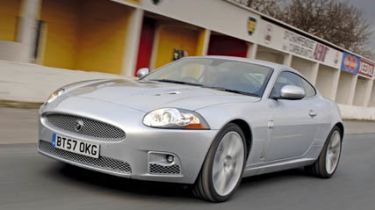
Last year, Jaguar sold just over 60,000 cars worldwide. That doesn’t sound like much; by comparison, Peugeot shifted as many 207s in the UK alone. But in terms of this test, the big cat is common as muck. Only 7,020 Aston Martins found homes in 2007, and 7,053 Maseratis were sold.
What’s more, the cheapest Aston costs £82,800, while the GranTurismo is the most affordable Maserati. Yet you can have a Jaguar on your driveway from just £21,500, while the XKR tested here is the company’s flagship model.
The coupé hardly looks downmarket. We prefer the styling of the standard XK to that of the range-topper, which is distinguished by a plastic chicken wire grille and stick-on rear spoiler. But it’s still an attractive shape. Turning to more practical considerations, the Jag’s boot has the same 300-litre capacity as the Aston’s, yet we found we could pack much more luggage into the XK. The trouble is, this leaves only 475mm of rear legroom – completely inadequate for adult passengers.
Still, the two occupants up front are very well catered for. The seats are sumptuous, cosseting and supportive, and equipment is more generous than in either rival. A keyless system is included, while buyers get the option of adaptive cruise control. On top of that, the layout is fuss-free and simple to use, with many functions taken care of by the touch-sensitive central screen.
Used - available now

2023 MG
HS
17,444 milesManualPetrol1.5L
Cash £14,130
2023 Mazda
CX-5
43,336 milesManualPetrol2.0L
Cash £18,000
2023 Mercedes
EQA
30,040 milesAutomaticElectric
Cash £23,220
2026 Toyota
Yaris
13,336 milesAutomaticPetrol1.5L
Cash £16,990Yet while the cockpit comes across as hi-tech, it looks and feels cheaper than those in rivals. The materials are more plasticky and the finish isn’t as elegant – it doesn’t have the hand-made quality of the Aston or Maserati.
The supercharged V8 doesn’t sound as good as the naturally aspirated units in the other models. Inside, the engine note is simply too muted. Yet while the N400 and GranTurismo need 5,000rpm showing on the rev counter before you can extract their true performance, the Jaguar is doing its best work 2,000rpm sooner. The supercharger provides effortless and instantaneous delivery, and gives the XKR the most usable real-world pace.
It’s not so good at slowing down, though. At the test track, we brought the car to a halt from 60mph in 34 metres – on a par with its rivals in this test. The problem is, the brakes aren’t especially resistant to fade, so the middle pedal becomes less responsive after a few miles of enthusiastic driving on twisting tarmac.
Yet these are the kind of roads the gearbox loves. The engine’s 560Nm torque output means fewer shifts are needed, but the transmission obeys your orders and reacts faster than the set-up in the Maserati. Pull the steering wheel paddle and it changes then, rather than when the engine management system decides.
In fact, the slick, well mannered six-speed automatic does a good job of summing up the driving experience. The XKR excels at taking the sting out of long journeys. Miles slip past as the adaptive dampers help the supple Jag glide along, with the engine pulling only 2,000rpm at 70mph.
At the same time, this car knows how to have fun. Although it’s more dignified and less challenging than the Aston, it slices through corners, and the meaty steering is great to use.
A price of more than £70,000 is certainly steep, but when put in context here it looks good value given the XKR’s formidable talents.
Details
Price: £70,097
Model tested: Jaguar XKR
Chart position: 1
WHY: The XK was Auto Express’s 2006 Car of the Year, and the flagship is a sublime all-rounder.
Economy
While the XKR was no more efficient than the Maserati on motorways, the Jag consumed less fuel. This is partly because it weighs over 200kg less, but is also due to the supercharged V8’s more relaxed power delivery. It returned 20.2mpg.
Residuals
On paper, the Jaguar’s residual of 57.6 per cent does not look so strong – but remember that’s for a 36,000-mile car. Most XKRs have typically covered less than half that distance, and go for around £55,000, which is about 78 per cent.
Servicing
Jaguar’s economies of scale (it sells more cars and has more dealers) mean the XKR is the cheapest of our trio to maintain. The 10,000-mile service intervals are short, but three checks come to £759 – one-fifth of what Maserati charges.
Tax
The XKR emits 294g/km. That’s over 50g/km less CO2 than its opponents here, but still puts it comfortably into the top band, which starts at 240g/km. As a result, business users are heavily penalised, and face a £9,814 tax bill.