Volkswagen Golf Bluemotion 1.9 TDI Match
Best model in VW’s new eco-friendly range is a tempting proposition

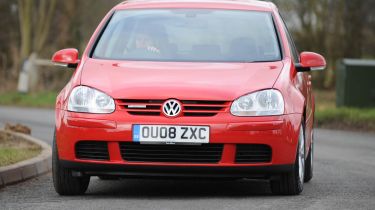
Having made its debut in 2004, Volkswagen’s Golf MkV needs no introduction. It’s the firm’s best-selling car in the UK, with 67,580 finding homes here last year. Yet although it’s a familiar sight on our roads, the Golf’s solid, classless and clean looks still draw praise.
The Bluemotion doesn’t mess with that winning formula, but an eagle-eyed VW fan might spot a few differences from the standard model. There are subtle badges front and rear, while the radiator grille has been reprofiled
to boost the car’s aerodynamics.
Improvements to economy and emissions aren’t achieved at the expense of comfort or safety, though, because the cabin is unaltered. Those fearing that the eco concerns might have led to flimsy plastics and the air-con being ditched have nothing to worry about.
Material quality is first-rate, and the dash design is straightforward and easy to live with. Thanks to a wide range of steering wheel and seat adjustment, the driving position is perfect, too.
In fact, from behind the wheel the only giveaway that you are driving the Bluemotion is a tiny eco gearshift indicator at the bottom of the trip computer screen. This advises you of the most economical point at which to change gear, thus minimising fuel usage.
Used - available now

2024 BMW
2 Series Gran Coupe
17,271 milesAutomaticPetrol2.0L
Cash £29,199
2026 BMW
i4
32,094 milesAutomaticElectric
Cash £27,599
2020 Skoda
Octavia Estate
54,062 milesAutomaticPetrol1.5L
Cash £12,999
2017 Jeep
Renegade
61,135 milesManualPetrol1.4L
Cash £7,150The rest of the eco-minded tweaks that have been carried out on the Bluemotion are hidden away. Underbody cladding and the revised grille help to reduce the car’s drag factor from 0.32Cd to 0.30Cd – but the majority of the other changes are found under the bonnet.
The 1.9-litre TDI features a revised turbo and remapped electronics, while the top three gears of the manual transmission benefit from longer ratios. This means claimed economy has improved from 56.5mpg on the 1.9 TDI
to 62.8mpg, while CO2 emissions have dropped from 132g/km to 119g/km.
These changes haven’t affected the Golf’s performance, as the 116mph top speed and 10.8-second 0-60mph time remain the same. And despite the longer gearing, you don’t really notice any mid-range acceleration differences on the open road. But with 104bhp and 250Nm of torque it trails the BMW by 39bhp and 50Nm, and the Bluemotion is sluggish compared to its rival.
Where the 1-Series engine feels torquey and smooth, the ageing VW unit is breathless and strained, and it has a distinct diesel rattle – the TDI isn’t the last word in refinement. So it’s a shame that bosses currently don’t have any plans to introduce Bluemotion technology to the newer common-rail 2.0-litre oil-burner.
The safe, reassuring handling of the Golf hasn’t been compromised by the Bluemotion revisions. There are harder-compound tyres designed to reduce rolling resistance, but VW has resisted the temptation to fit narrower or smaller-diameter rubber that could upset the dynamics. As a result, the newcomer turns in, grips and brakes just like the standard car.
Even though all Bluemotion models get sports suspension as standard to lower ride height and help reduce drag, the Golf is smoother than the 118d. It’s softer around town and the suspension soaks up bumpy roads more easily than the rigid BMW. However, it can’t match the sharp rear-wheel-drive character of the 1-Series.
So although it has less power and fewer eco goodies than the 118d, the Golf is cheaper and roomier. And while it isn’t as involving to drive, the more pliant ride means it’s comfortable. Is that enough to make the Bluemotion our winner?
Details
Price: £16,745
Model tested: Volkswagen Golf Bluemotion 1.9 TDI Match
Chart position: 2
WHY: New Bluemotion is the most economical Golf ever, and costs £520 more than the standard car.
Economy
The Golf and 118d major on mpg returns, and both have combined official figures of 62.8mpg. During our test, the Bluemotion averaged 42mpg, compared to the 49.6mpg achieved by the 118d.
Residuals
Strong resale figures have long been a strength for the Golf, and the Bluemotion will be no different. A return of 49.6 per cent means the VW will retain more of its value than the BMW.
Servicing
As with the 118d, the Golf has variable intervals. A quote of £335 for three services is marginally cheaper than the BMW’s, but VW’s dealers finished 20th out of 32 in Driver Power 2007.
Tax
A tax disc for the Golf will cost you £35 a year. And while both cars sit in the bottom diesel tax bracket, the VW’s lower price means lower-band fleet drivers pay less, at £479 a year.