Mitsubishi Lancer Sportback GS2
Does family car make as much sense with five doors as four?

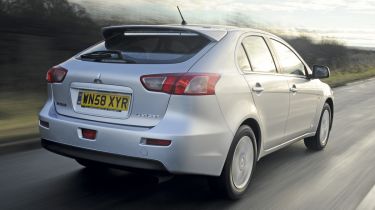
At what point does arriving fashionably late become rude? Mitsubishi has ignored compact family car buyers for so long that many customers will have run out of patience. So, is the new Sportback better late than never?
First impressions are mixed. The hatch looks awkward from every angle, with its bloated tail appearing out of proportion with the angular nose. While more expensive models feature sporty side sills, our plain GS2 test car resembles a Nineties design.
Climbing aboard does nothing to dispel this, as the Sportback shares much of its interior with the Lancer saloon – and hard plastics dominate. While it feels solid and has neat instruments, the quality of the finish is questionable and some switchgear is dated. The GS2 also falls short in terms of safety kit: there are seven airbags, but ESP stability control isn’t even an option!
In the back you get more legroom than in the SEAT, although average-sized adults will struggle for headroom. The boot is better proportioned, as the oversized rear creates plenty of space. With the back seats in place, its 344-litre capacity is on a par with the Leon’s; fold them flat, and its 1,349-litre maximum is 183 litres bigger.
Used - available now

2021 Volkswagen
Tiguan AllSpace
56,980 milesAutomaticDiesel2.0L
Cash £21,300
2023 Toyota
RAV4
21,811 milesAutomaticPetrol2.5L
Cash £24,197
2022 MG
HS
28,305 milesAutomaticPetrol1.5L
Cash £14,597
2023 Vauxhall
Corsa
9,109 milesManualPetrol1.2L
Cash £12,850The Lancer should really deliver on the road. Years of success on rally stages across the globe have made the hot Evo a legend, but can the hatch emulate its success? On the face of it, the 141bhp 1.8-litre petrol engine has the upper hand on the turbo SEAT as the Leon can muster only 123bhp.
However, the Japanese car doesn’t make this advantage count. At the test track it took 10 seconds exactly to cover 0-60mph – sixth-tenths-of-a-second slower than the Leon. Our in-gear figures revealed even bigger discrepancies, and highlighted the lower torque output of the Lancer.
The smooth revving 1.8-litre unit isn’t as responsive as the SEAT’s clever 1.4 TSI. But high-speed refinement is a Mitsubishi strength, even though its five-speed box has one less ratio. The supple suspension also gives a comfortable ride, smoothing out the worst bumps effectively. This works with a well balanced chassis to offer tidy handling. There are two major flaws in the dynamic package, though.The over-light steering provides minimal feedback and the brakes performed poorly on our damp test track. The Lancer took 59.4 metres to stop from 70mph – that’s 5.8m further than its rival.
On paper, the Sportback makes more sense. Not only is it cheaper to buy, it has an unlimited mileage warranty – unlike the SEAT – and gets three years’ roadside cover to the Leon’s two. A great servicing deal (£245 for the first three checks) adds to the appeal, while Mitsubishi’s dealer network is larger and scored better in our Driver Power 2008 survey. Can this make up for the Lancer’s poor cabin, weak pace and ungainly styling?
Details
Price: £13,701
Model tested: Mitsubishi Lancer Sportback GS2
Chart position: 2
WHY: Sportback is Mitsubishi’s first proper family hatch. Does it live up to the Evo legend?