Hyundai Santa Fe (2006-2012) review
The Hyundai Santa Fe is a well equipped large SUV that offers a lot for your money – but is probably best kept on-road

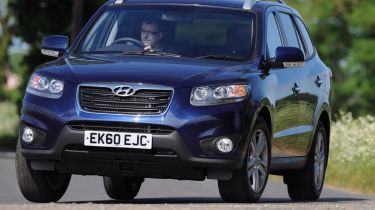

The original Hyundai Santa Fe was the car that started the Korean company's rise towards becoming a credible competitor to more established brands. The current car took the basic formula and built on it in almost every way. Although it lacks the desirability of a VW or BMW SUV, it's well equipped, reasonably priced, practical and handles well on the road. Its off-road ability isn't quite up to the standards of some competitors, but the Santa Fe is really intended as a large family vehicle rather than a serious mud-plugger, and fulfills the former function very well indeed.
Engines, performance and drive
There's a choice of gearboxes – six-speed manual or six-speed automatic – but only one engine: a 2.2-litre diesel motor. It produces 194bhp, so the Santa Fe is surprisingly fast for a car of this size - and with the more responsive manual 'box it'll cover 0-60mph in just 9.8 seconds. However, whichever transmission you go for, there's no getting away from the car's weight and high centre of gravity in corners. Together with softly sprung suspension, this leads to excessive body roll, but the trade-off is a very smooth and comfortable ride on all road surfaces. Grip is good thanks to four-wheel drive.
MPG, CO2 and Running Costs
For such a large and powerful car, the Santa Fe is surprisingly affordable to run, The diesel engine will return over 40mpg and its low CO2 emissions keep your annual road tax bill to a reasonable level, too. Residual values are solid yet not class-leading, but you can maximise them by going for a high-spec seven-seater car. All cars come well equipped, though - even the entry-level models get 17-inch alloys and six airbags. An unlimited-mileage five-year warranty keeps unexpected repair bills at bay, and Hyundai routine servicing costs are low. Combine all that with a good-value initial purchase price, and you have a car that makes a lot of sense from a financial perspective.
Interior, design and technology
Hyundai has given the Santa Fe smart and distinctive lines, with angular headlights at the front, a neat grille and an unfussy window line that tapers slightly to the rear of the body. Like any SUV, it's more imposing than a regular family car. All models get alloy wheels and body coloured bumpers, while a compact front grille completes the look. Although it will never match a BMW X3 or Audi Q5 for head-turning ability, the Satnta Fe is a handsome car nonetheless. The interior design is a little lacking in flair or insipiration, but materials used are of good quality and the layout is logical.
Practicality, comfort and boot space
The optional third row of seats offered in the Santa Fe obviously boosts its practicality, but they are quite tricky to get in to, so should be for occasional use only. Boot space is fantastic – 969 litres with seats in place, rising to a cavernous 2,247 litres with them down. Rearranging the seats to make the most of this space is a painless process. Adults have plenty of head and legroom in the first two rows, but the rearmost row a bit of squeeze and better suited to transporting small kids only.
Reliability and Safety
The Santa Fe has been around for some time now, so it misses out on the maximum five-star Euro NCAP result, scoring four stars in the the industry standard crash test. That shouldn't be a major cause for concern, however, as all the latest safety kit is present and correct, including front, side and full-length curtain airbags. There's also the reassurance that four-wheel drive adds in wet or icy conditions. The unlimited-mileage five-year warranty shows Hyundai's confidence in the mechanical robustness of the Santa Fe, and if you sell the car before it has run its course, the next owner can benefit, too.
More reviews
Car group tests
In-depth reviews
Long-term tests
Road tests
Used car tests
Which Is Best
Most Economical
- Name1.6 TGDi Plug-in Hybrid Premium 5dr 4WD Auto
- Gearbox typeSemi-auto
- RRP£53,175