Bulb test: H4 blue
Bright headlights could be a lifesaver on a dark winter night, but which bulbs can you rely on?

All the electronic anti-skid, anti-lock and traction control wizardry that helps to make today’s cars safer than ever counts for nothing if you can’t see where you’re going.
While the on-board computer, with its array of sensors and airbags, helps if you do get into trouble, preventative action could be as simple as changing a £20 bulb.
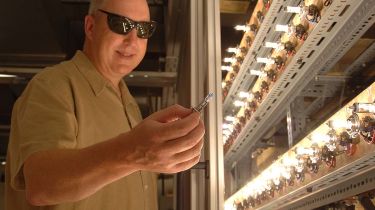
But, as we found out in this special report, the difference between the best and worst is huge. So which should you choose? To carry out a test like this, you need highly specialised kit, so we conducted an independent assessment at Philips’ hi-tech 75-metre light tunnel at its research centre in Aachen, Germany. Our test concentrated on H4 or 472 bulbs.
These have been around since the Sixties and have two filaments, one for dip and the other for main beam. They are used in cars with single headlamps. Although the design has been around for 40 years, the technology hasn’t stood still.
Makers have developed Plus 30, 50 and 60 per cent bulbs. These figures refer to the amount of light 75 metres ahead of the driver. This is achieved by reducing the size of the filament and burning it harder. Xenon gas, meanwhile, prolongs bulb life and is sometimes referred to in the name of the bulbs.
These should not be confused with gas-discharge xenon headlamps: their light source is an arc, not a filament. So which are the shining stars? Read on as all is revealed.
The test
The dipped beam was key. Using a perfect ‘etalon’ bulb, built to European standards, we set up a VW Lupo lamp in the tunnel. We then replaced the bulb with each sample, just like drivers do, without realignment. Bulbs were not rated if either sample then produced a light pattern outside EC rules. The beam rating is based on a combination of the light at 50 and 75 metres ahead of the car, averaged over the two samples. Prices are for two bulbs, and we have given the source as a guide. Samples were bought to prevent suppliers ‘cherry-picking’ bulbs.
Verdict
Best blue buys go to Osram and Philips.
Blue
1. Osram Cool Blue
2. Philips BlueVision