Volkswagen e-up! 2013 review
Volkswagen e-up! was always designed for electric power, and now we find out what it’s like on road
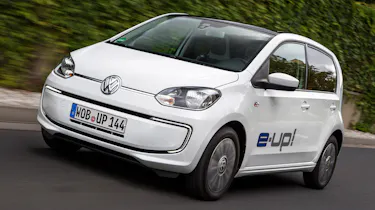

For a certain type of driver, who lives in a city, has money to spend and owns a second car for the weekends, the new e-up! will be ideal. For everyone else, the classic electric car limitations of price, charging time and range will get in the way. From behind the wheel, though, it’s nippy, refined and lots of fun.
While Audi and Porsche are spearheading the VW Group’s efforts with plug-in hybrids, Volkswagen has picked up the baton for electric cars. An all-electric e-Golf, due in November, debuted at last week’s Frankfurt Motor Show, but first to arrive will be the e-up!.
To rate its chances, we took the production car for a spin on the German city’s busy roads. Buy an e-up!, and you won’t get the stickers on the side, but you should still be able to spot it instantly. All electric VWs will have C-shaped LED lights up front, plus slippery, aero-optimised alloys. The batteries are under the floorpan, between the axles, so boot space is the same as on any up!, expanding from 250 litres to 950 litres with the seats folded.
But the e-up! weighs 210kg more, at 1,139kg – that’s just 66kg less than a Golf 1.2 TSI. Hauling you along is an 81bhp electric motor, which drives the front wheels via a single-ratio gearbox. The quoted 0-62mph time of 12.4 seconds might sound a little sluggish, but it’s eight-tenths quicker than that of the 74bhp petrol up!, and it feels it. Squeeze the throttle, and the car surges away from a standstill, spinning its wheels if the surface is wet. And it’s that hit of 210Nm of torque at zero rpm that makes the e-up! the perfect choice for weaving through jams and darting from point to point around town.
Used - available now

2020 Jaguar
F-Pace
76,000 milesAutomaticDiesel2.0L
Cash £9,995
2019 VAUXHALL
VIVARO
86,112 milesManualDiesel1.6L
Cash £6,995
2023 FORD
TRANSIT CUSTOM
99,962 milesManualDiesel2.0L
Cash £12,995
2016 PEUGEOT
PARTNER
31,900 milesAutomaticElectric
Cash £5,495The car’s simplicity is really appealing, too. With its bright, minimalist interior, great seating position and straightforward powertrain, the up! feels as though it was designed from the outset to run on battery power – which, of course, it was, hence the neat packaging. All that extra weight hasn’t ruined the supple ride, either.
It still glides over bumps in the road like a car twice its size. And without a three-cylinder engine thrumming away in front of your nose, refinement has improved significantly, too. The up! has always liked to be chucked around, and that hasn’t been lost in the conversion from petrol to electric power. In fact, the lower centre of gravity means it feels marginally more stable in corners.
The steering is light, but due to the car’s size you always feel connected to the front wheels. There are no fewer than five levels of regenerative braking force to choose from – D, D1, D2, D3 and B. In the default D mode, the effect is only activated once you touch the brake pedal. Select B, and the moment you come off the throttle it’s as if you’ve given a firm prod to the brakes. It takes some getting used to.
However, in stop-start traffic there’s really no need to touch the brakes at all; you simply let the regenerative braking do the work for you and charge up the batteries as you go. Drive carefully, and you can expect around 100 miles from a charge. To help maximise range, Eco and Eco+ modes limit power from the motor.
Topping up the batteries takes nine hours from a 240V household socket. That’s all pretty standard fare for an electric car. What’s not is the price. The e-up! is expected to cost anywhere from £18,000 to £20,000 after the Government’s £5,000 electric car grant. That’s expensive – especially when, for a few grand more, you could have the more spacious BMW i3.