BMW 320d ED vs A4 TDIe 2012 twin test
Does BMW still build the best green compact exec? We find out as the 320d ED meets Audi’s latest A4

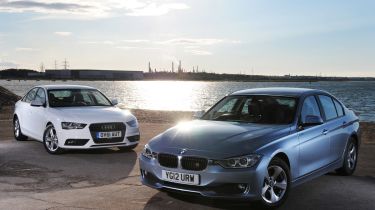
Strict taxes on CO2 emissions are now playing a huge role in deciding which cars we buy – and no class of the market has been affected more than the compact executive saloon sector.
When the first-generation BMW 320d EfficientDynamics was launched back in 2010, few people could have predicted that it would become such a huge sales phenomenon. This standalone model is now one of the most popular versions of the 3 Series, accounting for more than a third of the saloon’s sales.
That means the pressure is on for this new model to deliver. We were very impressed with the standard car, which swept its rivals aside to claim victory in our first test – so can the ED repeat the feat?
Standing in the newcomer’s way is the most efficient version of the recently facelifted Audi A4. Both cars have been engineered to produce the lowest amount of CO2 possible without sacrificing their performance or premium image, and both are hugely attractive company choices as a result. But which is the better all-round package?
BMW 320d ED
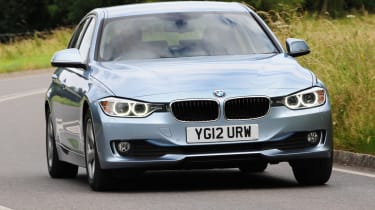
We already know the sixth-generation BMW 3 Series is a fantastic car, as it was crowned Best Compact Executive model at our New Car Awards 2012. It’s bigger and better built than before, plus is packed with standard kit. But has this increase in size and space taken the green edge off the EfficientDynamics version?
Used - available now

2020 BMW
3 Series
68,000 milesAutomaticPetrol2.0L
Cash £17,490
2024 BMW
3 Series
58,185 milesAutomaticDiesel2.0L
Cash £26,090
2024 BMW
3 Series
43,412 milesAutomaticPetrol2.0L
Cash £22,816
2022 BMW
3 Series
65,335 milesAutomaticPetrol2.0L
Cash £15,110On paper, it doesn’t seem like much progress has been made as the most frugal model in the new range has the same power and torque output as the outgoing car. Also unchanged is the headline 109g/km CO2 figure – but that still means the BMW is the cleanest car in the compact exec class.
As with the standard car, the ED boasts sharp and athletic looks. However, it’s the only model in the line-up to come without the combination of 17-inch alloys and run-flat tyres – and its smaller 16-inch wheels look a bit lost in the arches. Still, the special eco tyres promise 15 per cent lower rolling resistance – which boosts fuel efficiency – without any loss in performance, and the tall sidewalls make for a comfortable ride.
The underside of the 320d ED has been streamlined to minimise drag, while the sculpted front bumper and covers at the rear create a diffuser-like effect.
Yet apart from the special wheels, the newcomer is almost impossible to distinguish from the regular 320d, so its remarkable environmental credentials can remain a secret.
Stretching the wheelbase by 50mm over the old car has also paid dividends inside, where rear passenger space has been greatly improved. Boot capacity has also grown, with the car now capable of carrying a decent 480 litres of luggage.
The BMW does have a higher loading lip than the Audi, although options like the interior storage pack help to enhance flexibility. This £650 extra brings 40:20:40-split folding rear seats, plus luggage nets behind the front seats and across the boot – although the folding rear bench can be bought on its own for £390.
Up front, the dash is orientated towards the driver, but the smart rows of switches and slender multifunction steering wheel mean the design feels just as upmarket as the Audi’s. It’s more modern, too, and BMW’s excellent iDrive cabin controller – mounted next to the gearlever – is more user-friendly than the A4’s standard centre console info screen.
Another new piece of technology is the Drive Performance Control system. We’ve been impressed by this in other 3 Series, with its three settings – ECO PRO, Comfort and Sport – giving different characteristics to the steering, throttle and electronic safety systems.
Select ECO PRO mode and artificial resistance is added to the 320d ED’s throttle, while the climate control and gadgets like heated seats are switched to their most efficient setting. This tool also allows you to plot your fuel economy according to the trip computer over a set period of time, and even set a speed reminder with fuel-saving tips.
But what if you’re not trying to maximise fuel efficiency? Well, although the car is bigger than before, it’s also 50kg lighter, at 1,490kg, so it’s faster – despite the fact the ED’s six-speed box has longer gearing than in other 3 Series.
The BMW has 27bhp more power and 60Nm more torque than the Audi – at 161bhp and 380Nm – so we weren’t surprised that it was seven-tenths faster from 0-60mph at the test track, recording a time of 8.8 seconds. The 320d pulled harder in-gear as well.
The stop-start system felt a bit abrupt compared to the Audi’s, while the engine is gruff at low revs. But once you’re up to speed, the 3 Series settles into a composed cruise.
Push on and the precise brakes and direct electromechanical steering give you the confidence to exploit the finely balanced chassis. This nimble handling remains the BMW’s strongest selling point, yet while it encourages keen driving, the car still returned a very respectable 56mpg in our hands.
Some buyers may be put off by the higher price, but the 320d ED is a cheaper company car choice, uses less fuel, is backed by a great-value pre-paid service pack and has stronger residuals. It’s looking good for the BMW.
Audi A4 2.0 TDIe SE
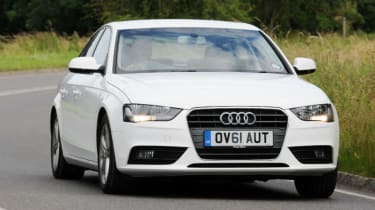
The Audi A4 has been a thorn in the side of the BMW 3 Series for years – but in terms of carbon emissions, it has always come off second best.
The original A4 TDIe was Audi’s first attempt at an eco-friendly special and actually went on sale before the 320d ED. Yet with official economy of 61mpg and a CO2 output of 119g/km, it wasn’t much cleaner than the standard diesel.
So to ensure that the A4 is more competitive this time around, Audi is now offering the updated 2.0-litre TDIe in two states of tune. The cleanest version is still the 134bhp model we’re testing here, which promises economy of over 65mpg and 112g/km emissions.
The TDIe is only available in SE trim, so it’s harder to spot the subtle changes that have been made to the exterior styling for the 2012 A4. A reshaped bumper featuring flatter air intakes and a tweaked headlight design set the newcomer apart from the old car, while smart 17-inch alloys are standard.
As is the case with the BMW, there are no tell-tale badges to alert other drivers to the fact this is a low-emissions model. In fact, the only exterior difference from a regular A4 is that the suspension is lowered by 20mm to help improve the aerodynamics and save fuel.
Inside, the light grey dashboard looks a little sombre after you’ve spent time in the driver-focused cockpit in the BMW, but as you would expect from any Audi, the build quality is top notch.
It also matches the 320d ED for standard equipment. Bluetooth, cruise and climate control and rear parking sensors are all included. Upgrade to SE Technik trim and you’ll pay £1,100 extra, but benefit from leather seats and DVD-based sat-nav – and all of this kit costs a lot more as separate options in the BMW.
The interior is as spacious and practical as before, and although rear headroom is a bit tight the Audi does come fitted with 60:40 split/folding rear seats as standard.
Once you’re on the move, the car initially impresses. Its engine is smoother and more refined than the BMW’s at lower revs, plus wind noise is well suppressed. All the major controls have a light and precise action that makes the car easy to drive, but the whole set-up is geared towards driver comfort rather than handling poise.
Although owners can vary the amount of steering resistance by changing the settings in the £220 optional Drive Select system, none of the presets offers much feedback.
At the track, the Audi trailed the BMW in all of our acceleration tests. We rated the cars in wet conditions, and we’re certain the difference in performance would have been even wider if the tarmac had been dry.
But the A4 was also left behind at the pumps. Over our mixed test route, it returned 47.8mpg – that’s over 8mpg less. Servicing costs are higher and residualsweaker, plus the TDIe emits 3g/km more than the 320d ED, at 112g/km. So despite its lower price, it’ll be a more costly company car, and that could be the deciding factor in this test.
Verdict
In the closely fought company car arena, only two vital statistics really matter: fuel economy and CO2 emissions. Judged on these criteria alone, the ultra-efficient BMW takes a comfortable victory.
Yet there’s more to the 320d ED’s win than its superior efficiency. For instance, its boasts the kind of driver engagement that can turn an everyday journey into a great drive, while the larger cabin and boot make it a surprisingly family friendly choice. It’s also backed by a great-value service pack and much stronger residual predictions.
That’s not to say the Audi isn’t without merit. It’s a comfortable and capable choice, and our SE-spec test model also represents decent value for money – not always what you expect from Audi. But it costs more as a company car, has a heavier thirst for fuel and is nowhere near as engaging to drive.
This result is further proof of the 3 Series’ sheer dominance over the market, and BMW’s expertise in efficiency is clear across its model line-up. None of the car’s rivals has yet managed to come close to offering the same combination of low emissions and lively on-road performance. It’s not often that the cheapest car to own in a range is also the best to drive, and few cars appeal to heart and head quite as easily as the new 320d ED.
Winner: BMW 320d ED ★★★★★
The EfficientDynamics is clearly the current pick of the new 3 Series range. Despite boasting class-leading CO2 emissions, it demands almost no compromises in terms of performance and driving dynamics, and improvements in build quality and practicality over the previous-generation model mean it now becomes the default choice in the compact executive sector.
2nd: Audi A4 2.0 TDIe ★★★★The revised A4 gets closer than any rival to knocking the 3 Series off top spot. It matches the BMW for desirability, and in SE trim offers comfort and refinement at an affordable price. But it’s not as good to drive and is more expensive as a company car. The more powerful version bridges the performance gap, yet costs more to buy and run.
Facts and figures
BMW 320d ED | Audi A4 2.0 TDIe |
| On the road price/total as tested | £28,080/£35,775 |
| Residual value (after 3yrs/36,000) | £13,198/47.0% |
| Depreciation | £14,882 |
| Annual tax liability std/higher rate | £841/£1,682 |
| Annual fuel cost (12k/20k miles) | £1,349/£2,249 |
| Ins. group/quote/road tax band/cost | 31/£435/B/£20 |
| Cost of 1st/2nd/3rd service | £350 (5yrs/60k) |
| Length/wheelbase | 4,624/2,810mm |
| Height/width | 1,416/1,811mm |
| Engine | 4cyl in-line/1,995cc |
| Peak power/revs | 161/4,000 bhp/rpm |
| Peak torque/revs | 380/1,750 Nm/rpm |
| Transmission | 6-spd manual/rwd |
| Fuel tank capacity/spare wheel | 57 litres/foam |
| Boot capacity (seats up/down) | 480 litres/N/A |
| Kerbweight/payload/towing weight | 1,490/550/1,600kg |
| Turning circle/drag coefficient | 11.3 metres/0.26Cd |
| Basic warranty (miles)/recovery | 3yrs (unltd)/3yrs |
| Service intervals/UK dealers | Variable (1yr)/154 |
| Driver Power manufacturer/dealer pos. | 14th/18th* |
| Euro NCAP: Adult/child/ped./stars | 95/84/78/5 |
| 0-60/30-70mph^ | 8.8/7.1 secs |
| 30-50mph in 3rd/4th | 3.2/5.6 secs |
| 50-70mph in 5th/6th | 6.1/8.7 secs |
| Top speed/rpm at 70mph | 143mph/1,700rpm |
| Braking 70-0/60-0/30-0mph | 60.0/44.2/10.3m |
| Noise outside/idle/30/70mph | 65/44/56/65dB |
| Auto Express econ (mpg/mpl)/range | 56.0/12.3/702 miles |
| Govt urban/extra-urban/combined | 54.3/80.7/68.9mpg |
| Govt urban/extra-urban/combined | 11.9/17.8/15.2mpl |
| Actual/claimed CO2/tax bracket | 135/109g/km/15% |
| Airbags/Isofix/rear parking sensors | Six/yes/yes |
| Automatic box/stability/cruise control | £1,525/yes/yes |
| Climate control/leather/heated seats | Yes/£1,265/£300 |
| Metallic paint/xenon lights/keyless go | £610/£495/£470 |
| Sat-nav/USB connection/Bluetooth | £1,550**/yes/yes |