Porsche Cayenne
The Porsche Cayenne proves itself to be a serious, if slightly unattractive, off-roader
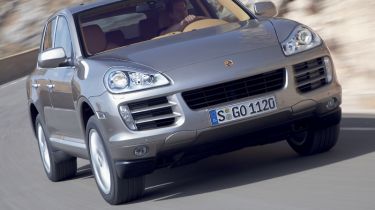

Despite the restyled looks, the Cayenne is still no beauty queen. However, if you like your off-roaders fast and furious, the Porsche takes some beating. The entry-level V6 model benefits most from the changes, but despite slightly improved fuel economy, it’s still expensive both to buy and run. So although the Cayenne is undoubtedly talented, the revisions do little to broaden its overall appeal. What it really needs is a decent diesel option.
It's never easy getting it right first time - just ask Porsche! Engineers at the firm have taken decades to hone its other cars to perfection and while the Cayenne is an impressive SUV, it's also an ugly duckling.
So, a mid-life makeover was the perfect opportunity for designers to turn it into a swan. But has it made the transformation?
While the revised car still won't win any beauty contests, its projector-style headlamps - which are directional on the flagship Turbo - combine with restyled bumpers to set the model apart from the original. The rear gets a diffuser-style bumper, fresh light clusters and a bigger spoiler.
Other changes on the Turbo include horizontal indicators at the front, as well as a pair of bonnet bulges.
Inside, there's nothing to distinguish the revised Cayenne, but it does boast a raft of enhancements under the skin. We drove the entry-level car, and its V6 has grown from 3.2 to 3.6 litres.
A power hike of 40bhp is enough to cut an entire second off the sprint from 0-62mph, which now takes 8.1 seconds. There's no trade-off at the pumps, either, because the fuel consumption (22mpg) has been marginally improved across the line-up.
On the road, the revisions are hard to ignore and the extra power makes the smooth V6 engine more eager, especially low down the rev range. The handling is just as impressive as before thanks to the precise steering and smooth ride, and to help tame the extra performance, buyers can now specify Porsche Dynamic Chassis Control (PDCC) as an option.
This operates as an active anti-roll system on the road, and really works well. It's only available with the firm's air-suspension, but is so effective that you are constantly surprised by how nimble the big SUV feels.
Elsewhere, the mid-range S model boasts a 4.8-litre V8 with 385bhp - up by 45bhp - which powers it from 0-62mph in 6.6 seconds. The flagship uses the same V8, but with twin turbos it delivers 500bhp and completes the benchmark sprint in only 5.1 seconds. Unfortunately, while engine out- puts have increased, so have prices. The 3.6 model now starts at £37,100 compared to £35,560 for the old car, while the Turbo costs a whopping £74,650 - an increase of £3,780.