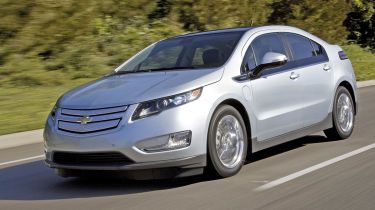
At last, electric cars are going mainstream! The Chevrolet Volt promises to be the first affordable, mass-production battery vehicle to go on sale. And Auto Express was among the first to get behind the wheel of a showroom-ready model.
Being a plug-in hybrid, the Volt avoids the normal pitfall of an all-electric car – limited range. When the batteries are running low, a 1.4-litre engine kicks in. But it doesn’t drive the wheels; instead it charges the battery. If it’s a formula you’re familiar with, that’s because the mechanically identical Vauxhall Ampera will hit UK showrooms late next year.
The 150bhp motor, coupled to the front axle, draws power from 300 batteries packaged inside a T-shaped box that runs through the belly of the car.
The cells are water-cooled to prevent overheating problems.
Incredibly, only half the power produced is used for propulsion. The rest is split between the air-con, brake servo and power-steering systems.
The 0-62mph sprint takes 8.5 seconds, and top speed is 100mph – impressive figures when you consider the Volt’s 1,700kg kerbweight.
Turn the ignition key, and the starter button glows green. Push it, and the central display loads up in a similar way to a computer game – a green bar chart on the left shows your remaining range, and a green ball on the right indicates how economically you are driving.
The first sign of life is when you push the accelerator pedal, and the Volt scurries off at a surprising rate. All 370Nm of torque is available from 0rpm of course, which means the traction control is called upon when moving off the line in damp conditions.
On the move, it’s eerily quiet, with wind noise, tyre roar and suspension clunks the only sounds you can hear. Chevrolet claims the first US cars, due for delivery in November, will be even more refined. The driving experience has clearly been tuned for comfort rather than speed. Whereas the Astra – with which the Ampera and Volt share parts – feels composed in bends, the Volt suffers from body roll. However, it’s more comfortable at all other times.
If you do feel the need to press on, though, a sport mode, activated via a button on the dash, releases 20 per cent more power from the batteries for swifter progress.
Chevrolet claims the Volt has an electric-only range of around 40 miles – that’s after a two to four-hour charge from a mains socket. Yet this relies heavily on relatively warm ambient temperatures and a light right foot. But the short range is less of a problem than you’d think.
As soon as the batteries run below 30 per cent charge, the 1.4-litre petrol engine fires up and settles to a 1,600rpm idle, while it tops up the power as you continue to drive. On steep inclines, the motor can reach as much as 4,000rpm to meet the battery demands. Once charge hits 85 per cent or above, the engine turns itself off and you continue on your way.
When the Volt arrives here in spring 2011, prices will start at around £35,000. There are clearly more entertaining ways to spend your money, but that would be missing the point.
The average daily distance covered by European motorists is around 20 miles, according to Chevrolet – so if you only ever use the Volt for short trips, visits to the petrol station forecourt will be a rare event.

For more breaking car news and reviews, subscribe to Auto Express magazine. We'll give you six issues for £1 and a free toolkit!
Delighted to see this kind of technology making it to the market. Conventional hybrids always appear to me to be the worst of both worlds - basically a petrol-powered car with all the weight of gearbox and transmission plus a load of batteries too.
Electric cars have been with us for over 100 years (the Madelvic factory in Edinburgh opened in 1899) but still aren't a realistic proposition for most of us because of their limited range and long charging time. So a small petrol engine to recharge the batteries seems to simplest and lightest arrangement - it's amazing it's taken this long to get there. Now we might start seeing more imaginative and original layouts - does the engine really need to be under a bonnet at the front if it' so small and not connected to any wheels?
What planet are you from?
I actually got to see the pre-production version of the Volt this summer at a GM technology event. My impression was that this isn't your typical GM car. It appeared to be well put together and carefully engineered. My only concern is that the price will be something like ,000 US dollars when it comes out, which is a lot considering the Prius is around ,000. I suspect many celebrities and wealthy people will buy the first of these Volts but they are going to have to get the price down if they really want this to be a "electric car for the masses".
Series hybrid is the way to go. Considerably simpler, lighter & cheaper than a parallel hybrid. A small ICE can be very efficient & clean when running at an optimised fixed speed / load. Electricity storage technology is some way off rivalling petrol / diesel when it comes to energy storage density. If it were truly a competitor, that would be the end of the automotive ICE!
The problems that will be faced by the industry in general is the cost (which will soar with automotive demand due to extremely limited availability) of both Lithium (see http://www.jackliftonreport.com/category/articles/metals-minerals/lithium/ ) for batteries and Rare Earths (see http://www.jackliftonreport.com/category/articles/metals-minerals/rare-earths/ ) for the motor magnets. However the need for motor magnets can be side stepped (see http://www.choruscars.com/index.shtml )
hi Why has no one looked at the same type of technology as for ships and trains, as some of these use gas turbine power driving electric propulsion systems.Gas turbines love to run at fixed speeds, and are quite efficient ,and can be multifueled & are vibration free it may be worth looking at. The unit could be the size of a small turbo topping up the battery.
astonish
The volt seems like it is a really good attempt at bringing something to market that is long overdue. A vast improvement to the golf carts that were available just a few years ago.
A system like this is far better then an all battery system, or a part time/part time situation. Looks like this could help out GM big time.
Thanks for the good article,
Denis
£35000, They're kidding right??? look, I know development costs must've been high, after all the Volt is cutting edge, but if car manufacturers are to entice us into electric vehicles they are going to have to provide them at a realistic price point. Until then, the more eco-friendly amongst us will have to settle for the somewhat murkier shade of green offered by the current crop of Hybrids...
...I seem to be repeating myself (frantically scurries around for a lame excuse)... "TODAYS SPECIAL IS A 2 FOR 1 OFFER!!!!" There, that about covers it... ;)
A series hybrid is MUCH simpler & cheaper to build & service than a parallel hybrid. The technology is relatively basic. With the ICE running solely in a fixed mode, fancy engine control systems, complex injectors, variable valve technology, elaborate catalysers etc etc all become redundant. The gearbox might be disposed of too. With all that weight saving, there probably won't be a much weight change compared to existing, after the battery weight is added. The engine compartment may well disappear! It is quite revealing when, "half the power produced is used for propulsion. The rest is split between the air-con, brake servo and power-steering systems."
Gas turbines are viable, but can be noisy. If one were to disintegrate, there could be some very high speed shrapnel flying about...
Renault say that they will have diesel priced electric cars for sale in 2011 and then of course there is the Chinese BYD - why should we pay £35,000 - If they sell 10,000,000 in the 1st year - as they could if it was priced below £20K, they could recoup most of their development costs, otherwise it will just be another GM failure and another nail in the coffin.
Why did GM have to spoil the design of this vehicle? It is so ugly I would never even consider buying it although I think the technology is brilliant. There is however a much more attractive alternative, the Fisker plug-in hybrid, which looks lightyears better and is not much more expensive, and it is already being produced and sold.
Does anyone have a really BIG calculator and lots of brain cells?
If I bought a diesel car that cost say £20,000 and it did for arguements sake 50mpg (or whatever you feel approiate for a simlar car to the volt). How many miles would I need to cover to begin to break even? And if you can work it out, shuffle the figues around. I have actually just bought a year old car with stupidly low miles for £13K that will do 50mpg, fancy chucking that into the calculator?
Anyone got any views on resale values? Service of cells? Or is it just gonna be Brad and Angelina who buys them for a few years.
The likely price for this car in the US will be low ,000s. If GM think they can sell it here for £35k then either they are mad or it's another case of rip-off Britain.
@Spike412 - It depends on your driving habits and whether you fill up at night (off-peak electric). Assuming you do under 40 miles a day, and this crazy headline price is correct, you would need to cover over 130,000 miles to break even with current diesel prices.
@Raywave - it looks much better in black and I think the Vauxhall/Opel version looks better all round. By the way, the Fisker is not yet in production - they have only just announced a battery deal. It will also be twice this price.
The system seems to be removing numbers...
That should say "The likely price for this car in the US will be low thirty thousands dollars".
@Spike412 - If you do the same sums with your 13 grand car, the answer is over 183,000 miles.
I agree with most of the previos comments. The car is so expensive. I would like to see a lighter weight, simpler machine that has no engine to top up the battery. The weight saved on removing the petrol engine would give it longer range on a home charge. With current battery technology its definitely possible to have at least a 50 mile range on one charge if the car is designed well. That would be sufficient for loads of drivers even if only for the 2nd car in a family. Renault will offer an electric only car soon but will not sell us the battery, we have to lease it. That surely isn't for our benefit, I would say its to give them a further income stream from renting the batteries to us. Slow progress!
This car will be just like the prius when it hit the US. Wealthy and famous people will line up out the doors to buy the thing. The same happened when the Prius came out. Its a very different car. The only one of its kind so far.
Likewise, The Prius was subsidized heavily by the Japanese government. The Volt has also gotten a lot of subsidies from the US government. They have gotten money for many of the car's major components such as the battery and electric motors.
So for at least the first generation or until manufacturing efficiency and cost cutting measures are brought inline, I'd expect the Volt to be somewhat costly at first but still probably sell well to the early adopters before coming down to price levels that are acceptable to the typical car buyer. Personally I can't wait for the car to come out. If they priced it at say- ,000, I'd buy one immediately because I have a 80 mile daily commute and having a car that would drive for half of that distance without using gas would ultimately be a huge savings to me.
PRICE. PRICE. PRICE. Who in their right mind is going to pay this sort of money, perhaps bankers and manic obsesives (who will go to any lengths in their belief they are saving the planet) WELL HELLO YOUR NOT! instead of wasting millions on these battery powered cars most of us cant afford put the money to better use producing a hydrogen car then price it so poeple can afford to buy it, (But it still wont save the planet)
when we say fully running on Li battery does it cover the A/C and the electrical equipment or dry run!!?? only from point a to point b without using any other equipment?!
As efficient as a full-electric car, but with the practicality of a petrol-powered model, the Volt is a massive step forward. Although it seems expensive, pioneering technology always is, and the savings at the pump should help make up for this. On top of that, it’s smooth, fast, comfortable and easy to drive. Don’t dismiss this Chevy as merely another hybrid – it’s the most important model for years.
Series Hybrid
Series hybrid is the way to go. Considerably simpler, lighter & cheaper than a parallel hybrid. A small ICE can be very efficient & clean when running at an optimised fixed speed / load. Electricity storage technology is some way off rivalling petrol / diesel when it comes to energy storage density. If it were truly a competitor, that would be the end of the automotive ICE!
The problems that will be faced by the industry in general is the cost (which will soar with automotive demand due to extremely limited availability) of both Lithium (see http://www.jackliftonreport.com/category/articles/metals-minerals/lithium/ ) for batteries and Rare Earths (see http://www.jackliftonreport.com/category/articles/metals-minerals/rare-earths/ ) for the motor magnets. However the need for motor magnets can be side stepped (see http://www.choruscars.com/index.shtml )
By Ralph on 19 January, 2010, 10:47am