Ford Focus 1.6 Zetec Climate
Best-seller scores on driver appeal, but does it fall down in other areas?

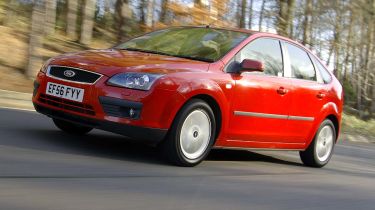
We’ve said it before, and we’ll say it again: Ford’s decision to tone down the looks of the original Focus was a backward step. With the first-generation model, the company proved that being radical didn’t result in sales falling through the floor, and yet top brass still decided that a conservative strategy was best second time round. Imagine the long faces there must have been in the Ford design studios the day pictures of the Civic landed on their desks.
But although it’s unimaginative, the Focus is improved in one crucial area. Ford wanted it to come across as a more upmarket, quality product, and its chunky stance (it’s the widest car here) certainly helps in that regard.
The extra width is noticeable as soon as you open the boot. There’s 1,045mm between the wheelarches; only the Civic has more space. The floor is relatively high, though, so the fact the Focus has a greater carrying capacity than both the Golf and Auris comes as a bit of a surprise.
As for passenger room, again the Ford struggles to forge an advantage. The 720mm knee space measurement (from the base of the seatback to the back of the front chair) sees the Focus bring up the rear in this test with the Auris, plus the transmission tunnel is intrusive, as it is on the Golf.
Used - available now

2021 Tesla
Model 3
80,000 milesAutomaticElectric
Cash £13,500
2021 Tesla
Model 3
67,000 milesAutomaticElectric
Cash £13,000
2021 BMW
1 Series
28,652 milesAutomaticPetrol1.5L
Cash £19,697
2018 Mercedes
C-Class Saloon
60,995 milesAutomaticDiesel2.1L
Cash £14,997The large glass area lets in plenty of light, yet this can’t compensate for the drab trim and dull design. And the driving environment isn’t much better. While the Golf and Civic exude quality and style respectively, the Focus seems rather mundane. We like the soft-touch dash and chrome air vents, but these high-grade materials don’t extend to out-of-the-way places as they do in the VW.
Ergonomically, though, there’s little to fault. The figure-hugging seats are well padded and deliver a fine driving position, a child would have no difficulty deciphering the straightforward switchgear and all-round visibility is arguably the best here.
Ford’s latest Ti-VCT engine technology (it stands for Twin Independent Variable Cam Timing) is meant to deliver not only improved power and torque, but also better fuel economy. In this company, however, those claims ring slightly hollow. The 1.6-litre’s 113bhp and 155Nm outputs are identical to the Golf’s (making it the joint weakest motor here), and neither performance nor fuel economy proved particularly impressive.
Nevertheless, the unit is smooth and pleasant to use – not least because it’s mated to such a slick gearbox. OK, so it only has five ratios, but a precise clutch action means smooth shifts are easy to achieve. The brakes are also rewarding and proved very strong; the Focus came to a halt from 70mph in only 47 metres – a distance that many sports cars fail to match.
But the icing on the cake is the way the Ford drives. At a stroke, it makes up for the dreary cabin and uninspiring styling, showing exactly where the company chose to spend its money.
The suspension is so well oiled, gliding over surfaces where its rivals, even the Auris, fidget and fight. It takes the sting out of rough roads,
is never caught off-balance and carves through corners cleanly and effortlessly.
In terms of driver appeal, the Focus is by far the most polished and involving car in this test – and that’s true of every single model in the 61-strong hatchback range. But despite this mass-market image, the Focus isn’t very attractively priced. We’d urge you to shop around for deals.
Details
Price: £15,095
Model tested: Ford Focus 1.6 TI-VCT Zetec Climate
Chart position: 2
WHY: While Ford wasn’t very brave with its styling, you can’t argue with the Focus’s talents in other areas.
Economy
As with the Auris, the Focus didn’t impress with its economy. Returns of 32.3mpg over 600 miles didn’t even match the urban claims. The five-speed gearbox was again a factor.
Residuals
Popularity is the Focus’s downfall – second-hand supply is plentiful. Our Zetec Climate retains only 34.2 per cent of its cost new, and will lose a hefty £9,993 over three years.
Servicing
Three visits to the main dealer will cost Focus owners £466. The 12,500-mile intervals are average, but the network isn’t rated for its customer service in our Driver Power surveys.
Tax
While it sits one tax bracket higher than the Civic, the Focus costs £855 less to buy. That means company owners pay more or less the same, at £597 in the lower band.