BMW 135i Coupé
All-new two-door serves up unique looks and a mighty engine.

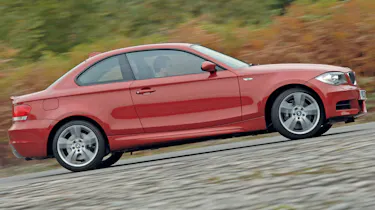
Considering the tempting list of automotive ingredients that make up BMW’s new two-door 1-Series, it should be great to drive. But let’s not forget that, as a coupé, the car’s first task is to look stunning and make you feel good.
The TT is a past master at this, yet the same can’t be said of the BMW. While beauty is in the eye of the beholder, few would argue that the two-door appears ungainly alongside the Audi and has little sense of individuality or excitement.
BMW has made things awkward for itself by trying to retain as much of the hatch’s practicality as possible. The back seats offer enough space for adults, and as the coupé is 133mm longer than the five-door, the boot is 40 litres bigger, too. Its 370-litre capacity is larger than the Golf’s, and split-fold seats add to the appeal, even if the BMW doesn’t have the versatility of hatch rivals.
But this focus on space has compromised the exterior design. The 1-Series Coupé doesn’t attract many admiring glances, and the shape is too similar to that of the two-door 3-Series.
The range-topping 135i does benefit from a few alterations, though. Its lower spoiler juts further forward, the grille is wider to aid engine cooling and vents replace the foglights to channel air to the brakes. What’s more, thanks to the award-winning 302bhp 3.0-litre twin-turbo, the 135i is no ordinary coupé.
The powerplant is dazzling – easily the best thing about the whole car. It’s wonderfully smooth and sophisticated, sounds cultured and is hugely potent. At 1,560kg, the BMW is far from light, but it blasted from 0-60mph in only 5.1 seconds and hit 100mph a mere 7.4 seconds after that.
To put its performance in perspective, that’s in the same league as the Porsche Cayman S and Aston Martin V8 Vantage. Unsurprisingly, the Audi and VW were left trailing behind.
Even more impressive than the engine’s top-end urge is its flexibility and responsiveness. There’s no lag, hesitation or gaps in a powerband that’s perhaps the broadest of any engine. Peak torque of 400Nm arrives at 1,300rpm, and it’s maintained all the way to 5,000rpm.
In daily driving conditions, this means sixth gear pulls hard from 35mph, plus there is never any need to change down and fuel consumption isn’t excessive. We rate this as the best real-world engine available today.
It’s backed up by a crisp six-speed manual box (an auto will be available in March) and excellent brakes, which are sensitive without being grabby.
The way the 135i goes and slows is simply exceptional – so it’s a pity the chassis isn’t up to the same standard. We’re loathe to say it, but as with the M3, the 135i can’t deliver on its promise.
Admittedly, it’s a quiet motorway cruiser, has long gearing (70mph pulls only 2,450rpm) and a superb driving position, plus is well balanced, while its compact size means it’s wieldy to drive. But the suspension isn’t that supple. The BMW gets pitched around on any surface that’s less than perfect, so the steering requires constant correction, which limits your confidence in the car. It doesn’t truly come alive – instead, it feels slightly numb and disinterested.
What doesn’t help is the fact the cabin is so plain, with none of the TT’s sense of occasion. The fat steering wheel and hard-edged gearlever aren’t comfortable to hold, either. And although it costs £29,745, the 135i isn’t that well equipped.
Details
Price: £29,745
Model tested: BMW 135i Coupé M Sport
Chart position: 3
WHY: For now, the 135i is the only petrol 1-Series Coupé, and it hits dealerships in two weeks’ time.
Economy
Even though our BMW test car’s engine felt very tight – it had racked up only 800 miles, after all –it proved slightly more economical than the TT. What’s more, our return of 28.1mpg is even more impressive given the car’s heavy kerbweight.
Residuals
The 135i Coupé is too new for our experts to predict accurate figures, but it’s unlikely to match the TT and Golf GTI on the used market. We’d estimate residuals of 51 per cent – five per cent above the 130i hatch. That sees it lose £14,575.
Servicing
BMW’s Service Inclusive scheme is good value, with three years’ check-ups coming to a total of £495. If you opt for the maintenance package, the price doubles, but consumables such as the brakes, clutch and wipers are covered.
Tax
Considering the power the 1-Series offers, CO2 emissions of 220g/km are low. But it’s still taxed at 31 per cent, and that – along with its list price – means business users face big bills. Every year, higher-rate owners have to shell out £3,688.