Porsche 911 E
Simple, clean lines continue inside the car; rear-mounted engine gives strong pace and a unique cornering feel.

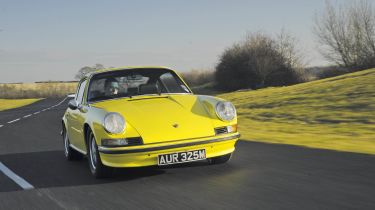
It was a landmark day in the world of sports cars. On 12 September1963, the new 901 took pride of place on Porsche’s stand at theFrankfurt Motor Show. Due to a trademark dispute with Peugeot – whichobjected to the model having a zero as the middle number – the machinewas quickly renamed 911... and a legend was created.
The 1973 example you see here represents the initial production run, which lasted from 1964 to 1973.
Itended when new American safety regulations were introduced. In order toconform with the rules, Porsche brought out the black-bumper generation– and the early 911 shape was consigned to history.
As aresult, the simple lines of the car pictured here are arguably thepurest of all. And its appeal was immortalised on film when SteveMcQueen drove a 1970 911 S through the deserted, tree-lined roads ofFrance in the opening scenes of the film Le Mans. The Porsche thenendeared itself to race fans when Vic Elford powered one to victory inthe 1968 Monte Carlo rally. As a result, for many, the older a 911 is,the better.
As the debut model was produced for nearly adecade, there’s a huge range of variants, costing anything from £15,000to £250,000. Later examples have wider wheelbases, and there wereplenty of engine options. Early cars featured 2.0-litre units, whichwere succeeded by 2.2 and 2.4 versions.
Used - available now

2023 Jaguar
F-Pace
31,381 milesAutomaticPetrol2.0L
Cash £30,790
2024 Volvo
XC60
15,043 milesAutomaticPetrol2.0L
Cash £36,990
2017 Audi
A4 Avant
70,929 milesManualDiesel2.0L
Cash £12,697
2020 Volkswagen
Polo
42,862 milesManualPetrol1.0L
Cash £12,097There’s a choice ofTarga, E, T and S designations, and Porsche fans can argue for daysover which is best. The classic Coupé shape is our preference, though.Its beautifully flowing lines, combined with the delicate detailing ofthe metal door handles, chrome bumpers and narrow tail-lights, all addto the attraction. The model in our photographs is a 1973 2.4-litre Ethat’s been stiffened, lowered and fitted with a set of Fuchs forgedalloys. When the car was restored in 1991, the engine was upgraded toS-spec – and the result is for sale at Porsche specialist AutoFarm for£30,000.
However, it’s not only the styling that makes thefirst-generation 911 so desirable. From behind the wheel, the Porschefeels light, agile and fast. And the noise of the air-cooled boxerengine sitting behind the driver guarantees an on-road experience fewclassic cars can match.
Even today, the DNA of the classicoriginal 911 is clearly evident in the latest 997 generation – andthat’s something not many other motor manufacturers have achieved.
Owner profile by Josh Sadler
The appeal of the original 911 isclear to Josh, who owns Oxfordshire Porsche specialist AutoFarm. “Turnin on trailing brakes, feel the engine weight begin to take charge –then floor the throttle!” he beams.
“With the back wheels bitingharder from increased weight transfer, you simply balance throttle withgrip, and the Porsche launches you from the corner in a way no othercar can.”
Josh’s showroom is in Weston-on-the-Green, where this example is currently available for £30,000.