Porsche 911 review
The Porsche 911 is the consummate sports car because it’s beautifully built, engaging to drive, and highly desirable

Our opinion on the Porsche 911
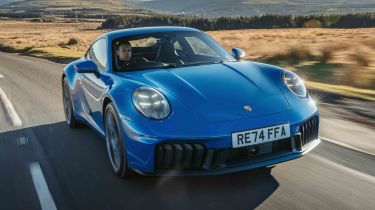
More than 60 years after the Porsche 911 made its debut, it remains the definitive sports car. It’s moved with the times in every measurable area, from performance and efficiency to safety and equipment, yet never lost its driver focus or badge appeal. The sprawling range can be tricky to get your head around, but this sheer level of choice simply illustrates the huge breadth of abilities that this car offers.
About the Porsche 911
The 911 is the model that defines Porsche. After more than 60 years in production it still forms the centre point of the brand’s range – a model to which other Porsches are constantly referenced. So despite profitable exploits with SUVs and electric vehicles, Porsche is still at its purest in the form of a 911.
A major part of the Porsche 911’s iconic status is built on its technical layout. It’s one of few modern cars with a six-cylinder ‘boxer’ engine that has horizontally opposed cylinders, and one of even fewer that mounts that power unit behind the rear wheels. Not only does this distinctive layout define the 911’s handling characteristics, but also creates some practical advantages that the car has over comparable front- or mid-engined rivals. By slinging the engine out behind the rear axle, Porsche is able to squeeze two occasional rear seats inside the cabin, while up front is a sizable boot (or frunk).
Used - available now


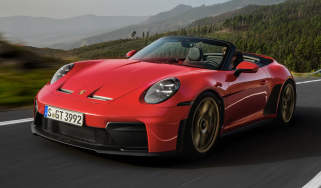
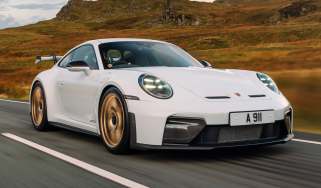
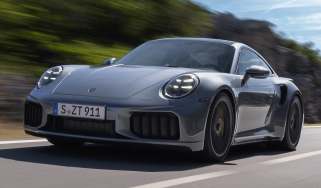
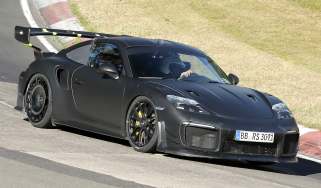
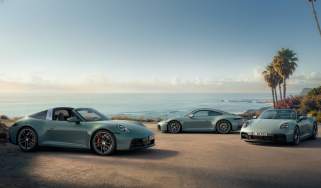
The expansive range is split between three body styles: coupe, convertible and Targa. The coupe is the core of the range, and is itself offered in two different widths, one for the standard Carrera models and the other for the wider top-spec Turbos. Porsche’s GT models actually use both widths – the Porsche 911 GT3 narrow and GT3 RS wide. The low-volume Sport Classic, meanwhile, used its own bespoke pressing set to the same dimensions as the wider Turbo during its short lifespan. The Porsche 911 Cabriolet has two width options, as well.
We’ve driven many versions of the Porsche 911 since the 992 version came out, and in a variety of ways. One particularly fierce battle occurred when we tested the 911 Cabriolet against a BMW M4 Convertible. Both of these cars offer drop-top performance thrills, but the 911 took the win due to its generally better all-around driving experience.
Porsche 911 prices and latest deals
The enormity of the Porsche 911 line-up means prices can vary rather significantly. You’re looking at around £104,000 for the entry-level Carrera, and this number continually climbs all the way up and over the £200,000 mark as you head towards the Turbo models and special editions.
Regardless of its prestige status, though, you can still save plenty by buying your dream Porsche 911 with the Auto Express Buy a Car service. We also have plenty of used 911 models to choose from, and we can even help you to sell your car.
Performance & driving experience
Pros |
|
Cons |
|
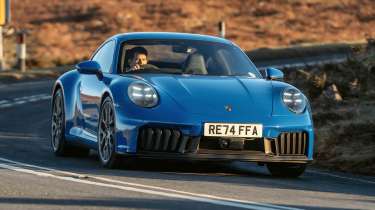
The key component in each of the three threads within the Porsche 911 range is the engine. Carrera, Turbo and GT models each feature a different type of flat-six engine, and each of these units responds in very different ways, offering different strengths. Let’s start with Carrera.
Most Porsche 911 Carrera models utilise a twin-turbocharged 3.0-litre flat-six engine that’s tuned to respond in a very linear and controlled manner. It does this with two small turbochargers that are primed for quick responses at relatively low boost pressures. The tell for how these engines perform is not the power but the torque curve, as the peak (450Nm) is reached from as low as 1,950rpm in the base Carrera and Carrera T. The slightly uprated unit in the S (530Nm) is only a few hundred rpm behind at 2,300rpm. Power in all models is relatively restrained by modern standards, with the base and T models producing 389bhp, and the S producing 473bhp.
As something of a sign of the times, the 911 GTS features hybrid power. If that makes it sound like an economy special, we can assure you it’s nothing like that because it’s not even as frugal as the regular Carrera. Instead, it’s a 534bhp, 610Nm model using a single-turbo 3.6-litre flat six with electric assistance to the benefit of performance, while the system only adds 50kg to the car’s kerbweight.
All Carrera models are fitted with an eight-speed dual-clutch transmission as standard, but the T comes instead with a seven-speed manual. As with many modern Porsches, the manual adds a certain level of driver engagement, but it also has very long gear ratios that blunt in-gear performance. Porsche says this is an unfortunate side effect of needing to hit emissions targets, and that it uses these annoyingly long ratios because it has to, not because it wants to. Just to make things even more complicated, base, S and GTS models are also available with an optional all-wheel drive system that’s predominantly rear-biased in its torque-split.
The Porsche 911 Turbo, as its name suggests, uses a twin-turbocharged flat-six, but the engine is larger at 3.7 litres. This larger capacity gives the engine even more performance, but it’s actually the more sophisticated turbochargers that define its personality.
The VTG (Variable Turbine Geometry) turbochargers are designed to give the Turbo and Turbo S more of an old-fashioned rush of torque after an initial pause of turbo-lag, just like 911 Turbos did in the past. The fact that these engines are so much more heavily boosted makes this a genuine side effect rather than something engineered-in, but the VTG element reduces lag to a manageable amount.
Turbo models feature the PDK transmission and a standard all-wheel drive system, with the limited-run Sport Classic eschewing both to offer a manual, rear-wheel drive combination that did come with a lower power and torque figure. 911 GT models feature a naturally aspirated 4.0-litre flat-six with 503bhp for the GT3 and 517bhp in the GT3 RS. These engines have a completely different character to the turbocharged units, with a more visceral sound and razor-sharp responses.
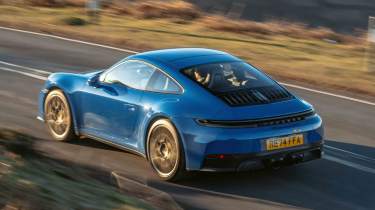
The lack of a turbo does make them much less torquey, with 450Nm (GT3) and 465Nm (GT3 RS). The GT3 RS, in fact, has the least torque of any Porsche 911 but this is made up for with revs. And more revs. Both cars reach a stratospheric 9,000rpm. The GT models also have their own transmissions, dropping a ratio compared to the other 911 models with their six-speed manual or seven-speed PDK boxes (the RS is PDK only) and they’re also rear-wheel drive only.
The GT models have totally distinct engineering. Both the standard GT3 and RS feature a unique double wishbone front suspension design. RS models have all manner of active aero that nearly matches that of a competition GT3 race car, and actually eclipses Porsche’s own Cup racing car. Porsche also offers the 911 S/T, effectively a GT3 RS without its huge wing, with a more road-biased interior, and a manual gearbox with shorter ratios. It’s the ultimate 911 road car.
Convertible and Targa models have obvious compromises in their structural rigidity and extra weight, so from a pure driving engagement standpoint are a bit of a no-go. But for those who really feel that the appeal is in an open-top 911, they’re more than good enough to recommend.
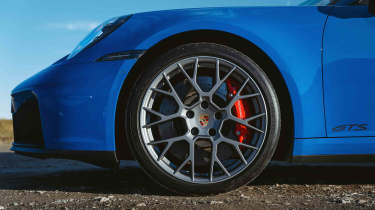
For the first time, the non-GT 992 911s also use different sized front and rear wheels. Most leave the factory on a staggered set of 20- and 21-inch wheels – the latter using huge 305-section tyres, which partly explains its great traction. The fact that the 911 rides so well on huge alloys like this is very impressive, too. Only the entry-level Carrera can be optioned with a smaller set of 19/20-inch wheels.
| Model | Power | 0-62mph | Top speed |
| 911 Carrera Coupe | 394bhp | 4.1 seconds | 183mph |
| 911 Targa 4S | 480bhp | 3.7 seconds | 191mph |
| 911 GT3 | 510bhp | 3.9 seconds | 194mph |
Performance, 0-60mph acceleration and top speed
When it comes to a 911’s acceleration times, there are a few rules of thumb. When comparing a Coupe to Convertible and Targa models, add 0.2 seconds to the 0-62mph time due to the extra weight, and cars fitted with the manual transmissions are all between 0.4-0.5 of a second slower due to the slower shift speeds and longer gearing.
Take the ‘basic’ 911 Carrera, if you can call it that. It gets from 0-62mph in 4.1 seconds in standard form, or 3.9 seconds with Sport Chrono. Top speed is 183mph. The manual-only Carrera T is a touch slower, with a 4.5-second 0-62mph time, but people choosing this model probably won’t care. Step up to the Carrera S and the times drop, at 3.5 seconds from 0-62mph, and the usual two-tenth drop for Sport Chrono-equipped cars, while top speed climbs to 191mph.
We’ll not list figures for every other model in the range, but the key ones are probably the hybrid GTS (Sport Chrono standard, 0-62mph 3.0 seconds, 194mph, and identical in all-wheel drive Carrera 4 GTS form), 3.4 seconds and 193mph for the GT3 with PDK (3.9 and 194mph for the manual), 3.0 seconds and 184mph for the GT3 RS (whose aero pegs back its top speed in favour of downforce).
Town driving, visibility and parking
As the 911 has grown over the years it’s become a little less wieldy than it once was, and the lower, further-back driving position than those older, nose-against-the-windscreen Porsches makes them feel physically larger still. Yet the 911’s still fairly compact by modern car standards and it’s far from difficult to drive in regular, everyday situations, with good visibility in all directions (slightly compromised in the Targa and Convertible), and parking sensors and cameras to help you out in low-speed manoeuvring.
Country road driving and handling
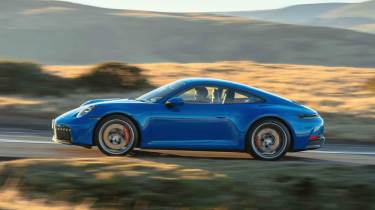
With such a broad range, every 911 drives a little bit differently on a twisty road – some amounting to sweet spots in the range and others that should be avoided. Broadly speaking, though, all 911s have such high thresholds of grip that you have to be driving at quite some speed to unsettle them. In wet or cold weather, the 911’s inherent balance is more tangible, with the front end still needing to be managed for understeer and the tail displaying a pendulum effect due to the rear-heavy weight distribution. Yet these quirks do not show themselves in general day-to-day or even fast road driving. They only arise when you provoke the car in slippery conditions.
To drive, we’d say the entry-level Carrera isn’t quite the sweet spot it once was, as the performance from its engine just isn’t enough to make the chassis come alive. Four-wheel drive Carreras do have added security under hard acceleration, but the extra mass is just about evident and takes the edge off the 911’s agility further still.
Turbo S models are immensely fast, but the chassis control systems can rob some valuable feel from the driver – even if they remain about the fastest road car on sale point-to-point. Instead, it’s the rear-wheel drive Carrera GTS, Carrera S and GT models that are the highlights of the current 911 range. For purity, we’d suggest forgoing any optional chassis support hardware such as the dynamic chassis control or rear-wheel steering, but so configurable is a modern 911 that it’s really just a matter of personal taste.
Motorway driving and long-distance comfort
911s make great long-distance cars thanks to their performance and well-designed seats, but they’re not luxury GTs. Road roar is noticeable even in entry-level cars and can get quite loud in GT models, especially on coarse UK surfaces, though they quieten down a little on the smoother continental roads and you do get used to the sound after a while.
Ride quality is less firm on the motorway than around town, but the more focused versions with rose-jointed suspension and other firm mounting points can really thump over expansion joints and other irregularities. A 64-litre fuel tank does endow the 911 with a decent cruising range though.
"Putting the engine (and therefore much of the weight) over the rear axle means it can feel a little light in the nose at times, but grip is exceptional in dry conditions." - Richard Ingram, deputy editor.
MPG & running costs
Pros |
|
Cons |
|
The Porsche 911 is no fuel economy hero, but in the context of its rivals and its own capabilities, most are remarkably efficient. The 911’s engine upgrades might unlock more power but they also improve fuel consumption. Carrera models have fuel economy figures of up to 28mpg (230g/km) for a PDK Carrera S, reducing to 26.2mpg (244g/km) for a GTS Cabriolet at its worst.
The 911 Turbo drinks at a rate of 23.0mpg (271g/km), which perhaps isn’t bad considering the supercar performance on offer, however, use that performance to the full and those numbers quickly drop much deeper towards single figures than you’ll manage in a Carrera.
Finally, the GT3’s 20.6mpg makes it among the least efficient, but without a turbocharger, these figures are more static under a variety of driving scenarios than you might expect.
| Model | MPG | CO2 | Insurance group |
| 911 Carrera Coupe | 26.9mpg | 229g/km | 50 |
| 911 Targa 4S | 25.3mpg | 248g/km | 50 |
| 911 GT3 | 20.7mpg | 310g/km | 50 |
Insurance groups
It’s no surprise that with this level of performance on offer, the desirability and the price, the 911 falls into the top group 50 insurance bracket no matter which model you’re after. That means it’ll not be a cheap car to insure, but then neither are any of its rivals at this level of the market.
Tax
As with insurance, first year tax will sting with the 911 because the initial VED road tax rate is affected by CO2 emissions. The most fuel-efficient model in the range, the 911 Carrera, faces a bill amounting to thousands of pounds, while all models over 255g/km, including Turbos and GT3s, are subject to an even higher rate.
It should come as no surprise that every Porsche 911 is also subject to the luxury car tax surcharge in its second to sixth years on the road – though at £620 a year, this bill won’t seem so bad compared to the first-year rate. If you’re an incredibly fortunate company car driver, you won’t find any Benefit-in-Kind (BiK) relief here. Instead, you’re better off looking towards EVs like the Porsche Taycan.
Depreciation
Few will argue that the Porsche 911 is a hugely desirable car (whether you can afford one or not). This appeal is backed by our market data on depreciation, which shows the 911 should retain 53 to 67 per cent of its initial value after three years or 36,000 miles.
You’ll also be the envy of Mercedes-AMG GT owners here, as this rival only manages 35 to 51 per cent after the same length of time.
To get an accurate valuation on a specific model check out our free car valuation tool...
Interior, design & technology
Pros |
|
Cons |
|
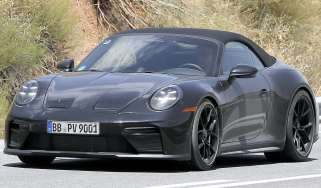
The 992-generation 911 has been with us since 2019 and still looks fresh. Had it been brought back after decades away like the Fiat 500 or Renault 5, we’d probably be calling it retro by now, but instead the 911 has been in constant evolution for more than 60 years, so it’s not retro, but simply timeless.
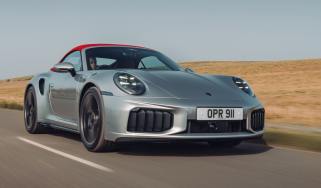
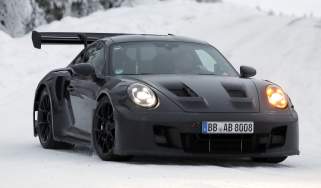
Not everyone likes the sloping roofline or large, round (ish) headlights, but it’s also instantly recognisable, and Porsche has resisted cluttering the basic Carrera shape with meaningless details – by the standards of the 2020s, it’s a very clean design. When Porsche does play with the basics, such as the aerodynamic alterations for GT3 and RS models, the 911 carries them well – the end result always looks more ‘racing car’ than ‘got carried away on a bodykit website’.
Naturally, Porsche has almost endless customisation options, so while the 911 is at its purest in silver, the company’s configurator, and the thousands of options within, can create something altogether more striking – if not always entirely tasteful.
Interior and dashboard design
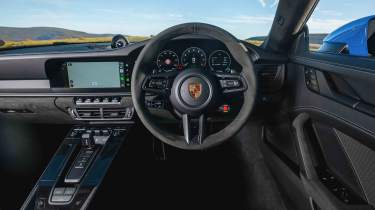
Whereas the last three generations of 911 have focused on a vertical centre stack of controls in the cabin, this 992 returns to its older ancestor’s roots with a more classic horizontal design.
That’s been made possible by a 10.9-inch landscape-format touchscreen infotainment system. It’s clearly been inspired by the setup in the firm’s Porsche Panamera and Porsche Cayenne models, although it’s not quite as large here.
It’s just as advanced and easy to use though. The touchscreen is nicely integrated and with most functions operated by the panel, it has allowed Porsche’s designers to de-clutter the cabin. There are fewer buttons on the transmission tunnel, and the climate controls have been simplified.
The interior has had a rather simple but effective rethink, and that extends to storage. The door bins have been modified slightly and will take phones and wallets, while the glovebox is a decent size. There’s enough storage for a car of this type, which helps make the 911 the usable package it is.
Porsche resisted for quite some time, but in 2024 an update to the 992 made one significant change: the instrument cluster is now all-digital. That means no analogue rev counter in the middle, and while Porsche has replicated its design digitally, it’s still a bit of a shame – design elements aside, the cluster is now no more special than something you’d find in a much cheaper Hyundai i20.
Materials and build quality
Quality has taken yet another step up, too. The surfaces are cleaner, the dash is lined with leather and there are plush-feeling materials on the centre console where the new shift lever is located, for example.
Along with the retro-inspired design, Porsche has revived some more classic interior trim combinations, with wood veneers now available. It sets the cabin off nicely, while you can of course choose cool metal finishers and all manner of different leather colours to tailor your car’s cabin to your tastes.
Infotainment, sat-nav and stereo
The Porsche 911 992.2 is the most advanced and connected 911 ever. Online navigation fed by swarm data for traffic services is complemented by Apple CarPlay and Android Auto smartphone connectivity, plus a host of other functions that make the 911 easier to live with. There’s even a free track telemetry app that’ll record your laps and overlay data if you fancy venturing onto the circuit to explore the 911’s performance.
The latest PCM system is easy to manipulate on the move, while the displays on either side of the now-digital rev counter are controlled by button clusters on either side of the steering wheel. The menus are logical and you quickly get the hang of navigating around the system.
You can also use the display to alter the driving mode – there’s an updated rotary drive mode selector on the steering wheel, allowing you to move the car between the new Wet mode, Normal, Sport, Sport Plus and Individual (the latter coming as part of the Sport Chrono pack). Using the touchscreen you can also toggle the sports exhaust, if it’s fitted, and the dampers.
“The driving position is fantastic; you sit lower than in the BMW M4, and the pedals are better aligned with the steering wheel” - Dean Gibson, senior test editor.
Boot space & practicality
Pros |
|
Cons |
|
The Porsche 911’s cabin space ultimately limits it to being a two-seater with tiny rear seats suitable for very occasional use, but this still gives it a leg up against two-seater rivals, and the seats can be folded if a more flexible storage space is needed.
Another typical 911 trait is its brilliant visibility. Because there’s no engine in front of you, the scuttle can be placed low down, giving you a clear view over the low bonnet of the subtle humps that house the headlights and the road ahead. The rear window isn’t quite so low, so rearward visibility is more restricted than in some modern sports cars, but with comparatively big rear windows it’s easy to see out.
Drivers who like to sit low will be mightily impressed by the ability to sink the seat extremely far down into the cabin. The basic driving position is pretty much perfect, too, with the steering wheel having lots of adjustment and coming out to you at an almost perfect 90-degree angle.
If you plan to use your 911 as a GT car, though, it’s worth noting that the enormous rear tyres do mean that road noise in the cabin is something of an issue. Carreras and Turbos are the most refined, but even with the laminated glass option, don’t go expecting Bentley Continental GT levels of calmness. Cars fitted with lightweight glass or reduced sound deadening – that’s basically the Carrera T and GT models – well, best fit the optional Bose sound system as the tyre roar will overwhelm the interior ambience.
Dimensions and size
The 992 Porsche 911 has grown 20mm longer and 45mm wider on the front axle than its 991.2 predecessor, although the wheelbase is the same. There’s no narrow-body version like there used to be, so the two and four-wheel drive cars are all based on the same shell, which uses a mixed-metal construction with less steel and much more aluminium to help keep the weight increase relatively modest over the 991.2.
| Dimensions comparison | |||
| Model | Porsche 911 | Mercedes-AMG GT | Aston Martin Vantage |
| Length | 4,573mm | 5,054mm | 4,495mm |
| Width | 2,033mm | 1,984mm | 1,980mm |
| Height | 1,338mm | 1,447mm | 1,275mm |
| Wheelbase | 2,460mm | 2,950mm | 2,710mm |
| Boot space | 135 litres | 182 litres | 350 litres |
Seats & passenger space
Cabin space in the front is good. There are no complaints here and the ergonomics are fundamentally sound. While Porsche has changed the cabin design, the layout is basically identical. This 911 is actually 4mm taller than its predecessor, so there’s a little more headroom too.
The trademark small rear seats mean this is a sports car that can carry more than just two people (provided they aren’t too big), which not many rivals can do. Access isn’t the easiest, but the seats are OK for short journeys around the corner.
Boot space
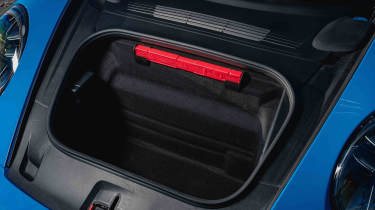
Due to its rear-engined layout, the 911’s luggage space is in the nose – and there’s 135 litres available. But what you need to know is that there’s enough space for two bags and a few other items, so weekends away or a small shop won’t be a problem.
Of course, there are always those back seats to use if your bags spill over into the cabin. The back rests can be folded down to create a flat ledge that runs to the base of the tapered rear glass, while the space underneath the folded back rests can be packed with stuff, too. Or you can just leave them in place. The boot itself is easy to load as the nose is low, it’s a regular shape and access is simple.
“The optional 18-way electric sports seat side bolsters are a little tight and may not suit larger frames – we’d advise trying the standard set-up before stumping up thousands more for something that might compromise comfort.” - Richard Ingram, deputy editor.
Reliability & safety
Pros |
|
Cons |
|
Although there have been many tweaks to the engine, the basic architecture of the Porsche 911’s 3.0-litre flat-six is now powering its second-generation of 911. The unit has already proved reliable, although some owners of early cars experienced electrical niggles that seem to have been ironed out now that the 992’s been in production for a few years.
The 911 and the Porsche brand as a whole haven’t appeared in the Driver Power customer satisfaction survey for a while, so we can’t say for sure what the current ownership experience will be like. However, the Porsche brand finished in an impressive fourth place (out of 32 brands) in our 2024 best manufacturer results, suggesting the brand has experience in keeping its customers happy.
Much of the 911’s interior tech is related to that in Porsche’s SUVs and luxury cars. The screens are clearly powered by rapid processors, as they respond quickly and almost never crash – you can expect the same in the 911.
It’s unlikely that Euro NCAP will test the 911, but we’d expect that with all its safety assistance tech it would receive a good score. Safety has undergone a big improvement, and while the body’s steel content is down from 66 per cent to 30 per cent (helping offset the weight gain from other areas like the new gearbox), it’s just as strong.
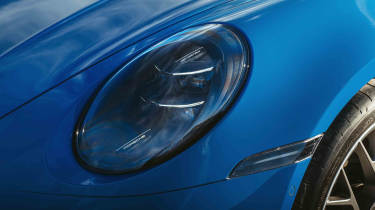
Plus, there are more technology and assistance systems, including autonomous braking with pedestrian detection. You can add to this with lane-keeping assist, blind spot monitoring, night vision assist, adaptive cruise that now works down to a standstill and LED matrix headlights. Standard LED lights are included in the price.
Another point that’s worth mentioning is the wet driving mode. Acoustic sensors in the 911’s wheel arches can pick up when you’re driving on a consistently wet surface rather than just through a puddle, and will recommend you activate the setting.
This alters the settings of the ESP, the traction control, the Porsche Torque Vectoring system and a number of other functions to ensure the car stays as stable as possible when accelerating hard. It’s well integrated and the system’s action is smooth. We tried it on a wet track and it felt natural and safe.
Buying and owning
- Best buy: Porsche 911 Carrera
We couldn’t possibly steer you away from a 911 GT3 if you had the means, for example – it’s one of the great modern performance cars and represents incredible value for a car that can easily take on cars that cost twice its list price in terms of thrills and driver involvement. Likewise, the GTS has always been a sweet spot in the 911 range, and the latest car’s hybrid power hasn’t changed that, and offers enough performance to make you question stepping up to a 911 Turbo.
But there’s appeal in purity, too, and while the basic 911 Carrera is hardly some stripped-out, back-to-basics driver’s car, it still offers a great blend of blistering performance, everyday usability, and that classic 911 shape to make it our most recommendable choice.
Porsche 911 alternatives
Competitors such as the Audi R8 have been retired, but the remaining options are as tempting as ever. The Aston Martin Vantage and Mercedes-AMG GT are both a little softer and more expensive, but remain great everyday performance car choices. Meanwhile, the BMW M4 is a highly talented performance coupe and is slightly cheaper.
Key updates of the Porsche 911 review
26 March 2026: Updated to included the latest model range and pricing information.
Frequently Asked Questions
Porsche’s warranty package provides three years’ worth of unlimited mileage cover, which is pretty good for a high-performance sports car.
Deals on the 911 and alternatives