BMW 320i xDrive vs rivals: 2013 group test
We try five different four-wheel-drive systems to find out which tackles UK winter driving best

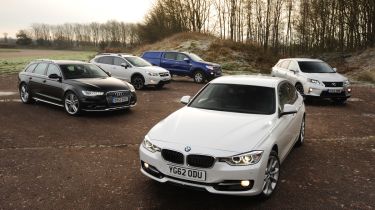
Increasingly cold and frosty winters have made car buyers keen to invest in the security of all-wheel drive – and car makers have been happy to cater to this trend.
BMW has sold four-wheel-drive versions of its cars for many years, but from this year it will be offering the system in the UK, on the 1 Series and 3 Series.
Due to the demands of the US market, the first model to arrive is a 2.0-litre petrol, but the technology will soon be rolled out across the range.
This is a big step for a brand that’s revered for its thrilling rear-drive handling, so for the 4WD 3 Series’ first test, we decided to look at the different 4x4 systems on the market and examine in detail how they work on and off-road.
The cars we’ve assembled represent varied approaches to the same job. Audi has a rich four-wheel-drive heritage, and the A6 Allroad’s quattro set-up offers sporty dynamics and plenty of grip.
Another brand with 4WD in its blood is Subaru. Its XV crossover is the only car in its class to feature permanent 50:50 split 4WD.
Completing the line-up are two opposites: the Ford Ranger is a tough pick-up for the most extreme off-road conditions, while the Lexus RX 450h is an efficient and refined hybrid.
BMW 320i xDrive
If this 320i is anything to go by, Audi should be worried about the arrival of xDrive in the UK. The system offers lots of grip without sacrificing the BMW’s dynamics. The car feels so planted, you can corner confidently, even in icy conditions. Forthcoming diesels will set the bar higher.
Used - available now

2020 BMW
3 Series
40,000 milesAutomaticPetrol3.0L
Cash £26,490
2024 BMW
3 Series
36,557 milesAutomaticDiesel3.0L
Cash £36,495
2020 BMW
3 Series
36,057 milesAutomaticPetrol2.0L
Cash £19,995
2020 BMW
3 Series
36,404 milesAutomaticDiesel2.0L
Cash £21,995While a four-wheel-drive BMW that’s not an SUV is a bit of a novelty in the UK, customers on the Continent have been able to buy iX saloons and estates since the eighties.
The prohibitive cost of adapting the system to right-hand drive meant BMW had left Audi to scoop up sales of 4WD executive cars – but not any more. BMW feels the economies of scale have tipped in the buyer’s favour, and the latest 3 Series is its first car to be offered with four-wheel drive on the UK market.
Initially, the 320i’s 181bhp 2.0-litre turbo petrol will be the only engine available with the system. BMW admits that forthcoming diesel versions should prove more popular, but even without a hefty torque figure, the advantage of four-wheel drive is soon clear.
Just like the Audi A6 Allroad, the 3 Series xDrive has been designed primarily with on-road driving in mind. In normal use, power is split 40:60 between the front and rear axles.
A multi-plate wet clutch acts as a centre differential, which manages the transfer of power between the front and rear wheels.
In extreme conditions, it can shift up to 100 per cent of the available power to whichever set of tyres has more grip.
Unlike the Audi’s set-up, the BMW system is reactive – it relies on a set of sensors linked to the traction control system to detect when the wheels start to lose grip before it transfers the power to where it’s needed most. This results in a delay between the initial loss of traction and the system kicking in – but you’d be hard-pressed to notice the slightly slower response compared to the Audi’s set-up.
On a wet road, the benefits of this car over the rear-wheel-drive one are obvious. There’s a lot more front-end grip, and if you get on the power early out of a corner, there’s no hint of the oversteer that you come to expect from the standard model. Yet this extra grip hasn’t spoiled the BMW’s balance, while perfectly weighted controls and an eager engine mean the xDrive is as rewarding as any 3 Series. It looks almost identical, too: the only visual difference between this and a normal 320i is the slim xDrive badge on the bootlid.
Still, there are some penalties to pay. Most noticeably, the system adds a hefty 70kg to the car’s overall kerbweight. This has an impact on fuel economy, which falls to 41.5mpg, while CO2 emissions rise one tax bracket from 147g/km to 159g/km.
The £28,400 xDrive also costs a significant £1,535 more than the standard 320i, although it still undercuts the equivalent Audi A4 2.0 TFSI quattro by nearly £2,000.
Unlike the other cars in this test, the BMW has no off-road aspirations (it’s the lowest car here and has the least ground clearance), but it’s still a worthy addition to the range. Audi finally has strong competition when it comes to all-wheel-drive saloons, and we’re looking forward to trying diesel and Touring estate models fitted with xDrive.
Audi A6 Allroad
Laden with clever technology and boasting a four-wheel- drive pedigree spanning 30 years, the Audi A6 Allroad is a stylish alternative to a regular SUV. Yet despite adjustable air-suspension, it never felt as good off-road as the Subaru or Ford. A standard A6 Avant quattro offers better value.
Quattro has been an integral part of Audi’s development from a bit-part player to a global sales phenomenon. The brand now offers 4WD on every car it sells.
But while the quattro badge remains the same, different models have different types of four-wheel drive. However, the latest A6 Allroad uses a transmission that can trace its ancestry back to the successful Quattro rally cars of the early eighties. Over the years, it’s evolved to deliver serious performance in all road conditions. And the raised ride height means the A6 Allroad is also capable of taking on the occasional bit of light off-roading.
Like the Subaru XV, the Audi has permanent all-wheel drive, but it uses a Torsen (TORque SENsing) differential, which splits the power 40:60 between the front and rear wheels. This is intended to make the A6 feel like a sporty rear-wheel-drive model on the road, but in challenging conditions, up to 80 per cent of the 3.0 TDI diesel engine’s power can be sent to the back wheels when required.
The advantage of a Torsen mechanical differential over an electronic system is that it diverts the power instantly. So rather than reacting to road conditions, it’s constantly shifting drive to the axle with more grip at any given moment. This system was first introduced on the Audi RS4 in 2007 and has since been used by all the larger models in the range, from the A4 to the big Q7 SUV.
Yet while the set-up works very well on the road, the earlier quattro-equipped cars could easily get stuck, as the diff didn’t always send power to the other wheels if one of them lost grip entirely. To counteract this problem, early cars had a locking rear diff, but modern Audis – such as this A6 – feature a clever electronic differential lock (EDL). This uses the brakes and ABS sensors to limit wheelspin and make sure plenty of power is supplied at all times.
At speeds below 50mph, EDL is constantly turned on to ensure the Allroad doesn’t get stuck. The beauty of this system is that you rarely notice it’s working: at the track, the A6 had lots of grip and remained totally stable, even during committed cornering at high speed. The system also worked in tandem with the car’s seven-speed S tronic box to post a rapid 0-60mph time of 5.9 seconds.
But when you take the A6 off-road, it’s a bit less successful. The standard Drive Select button has an Allroad setting that raises the air-suspension and relaxes the car’s throttle response and steering to suit trickier driving conditions. There’s also a hill-descent control feature that displays your current tilt angle.
Yet despite these sophisticated electronics, the wide cross-section road tyres struggled in the mud. And not all buyers will want to risk heading off-road in such an expensive estate car – our test model was £65,515.
Still, the Audi has few equals as a capable all-weather road performer, and we think the quattro drivetrain deserves its reputation.
Subaru XV
We've criticised the XV in the past for its high price and cheap cabin, but there’s no doubting its off-road prowess. Light weight plus high ground clearance and permanently split 4WD made it unstoppable on our off-road course, and it felt tough enough to withstand all the abuse.
Few brands apart from Land Rover are as strongly associated with four-wheel drive as Subaru. It’s been 41 years since the company launched its first all-wheel-drive model in the UK, in the form of the Leone coupe and saloon, way back in 1972.
Since then, Subaru’s many successes in the World Rally Championship have made it synonymous with fast and affordable all-weather sports cars, while its mainstream models have a strong off-road reputation.
From the outside, the Subaru XV certainly lives up to that no-nonsense pedigree, with thick plastic bumper protectors, 17-inch alloys and roof rails as standard on all but the entry-level 1.6-litre petrol model. Inside, you sit lower down than you might expect, but there’s still an excellent view of the road ahead, thanks to narrow A-pillars and large side windows.
The unique combination of a four-cylinder boxer engine and symmetrical all-wheel drive makes the XV a real outsider in the crossover class: none of its rivals has permanent 50:50 split four-wheel drive sending power to all of its wheels, all of the time. So unlike the BMW 3 Series, the Subaru needs nothing to shuffle power around if the tyres start to lose grip.
Other things that set the Subaru apart are its best-in-class ground clearance (it can ride over higher obstacles than the brand’s taller Forester) and fully independent front and rear suspension. The latter makes it surprisingly agile when driven hard on tarmac roads.
But if you hit an icy patch, the engine cuts power to the affected wheel and keeps the XV on the straight and narrow – something we were able to demonstrate several times in the sub-zero temperatures on our test.
A screen in the centre of the dash shows the four-wheel-drive system working, and highlights any wheel that’s losing traction. This worked well on our off-road course, as we could use the display to judge when to apply the power to keep the wheels turning.
Everything inside the XV feels pretty tough, yet there’s no hill-descent control system or low-range gearbox, so you have to be careful to control the car’s speed – especially when descending very steep or muddy inclines.
The Subaru is the lightest car of the five that we tested here. It weighs a considerable 130kg less than the BMW, at 1,415kg. This, combined with small dimensions, allowed it to scrabble up the same trails as the Ranger managed. And although it lost grip more often, it felt much more manoeuvrable than the big pick-up thanks to its compact size, light steering and short-throw gearbox.
On the road, the ride is a little firm and a lack of cruising refinement is the price you pay for the low weight. But when the going gets tough, the XV is still head and shoulders above its crossover rivals, thanks to its 4WD.
Whether this is enough to justify the car’s hefty £29,995 price tag and heavy rate of depreciation is a different matter, though.
Ford Ranger
While the enormous Ford is the most basic 4x4 in our line-up, it was undeniably the most effective at hauling itself up steep inclines and wading through water obstacles. But once you head out on the road, its agricultural ride quality and gearbox quickly wear thin.
The roots of four-wheel drive are in working vehicles, with a history that stretches all the way back to the first military Jeeps and trucks that needed to access places ordinary cars simply couldn’t reach.
Today, pick-up trucks like the Ford Ranger are a lot more refined and comfortable than their ancestors, but they still use the most basic mechanical all-wheel-drive systems. Unlike the other cars here, the Ranger has no clever electronics to help its suspension cope with rough surfaces. Instead, the huge, 5.4-metre-long body sits on top of a separate ladder frame, with simple leaf springs at the rear.
Despite this basic approach, everything about the Ranger has been tailored to hard off-road use, and the Ford’s styling makes its intentions clear. It stands nearly six feet tall, towering over the other cars here, while the bluff front end and chunky tyres make it look like it would be unstoppable off-road.
Under the skin, the Ranger’s drivetrain is as rugged and unsophisticated as its looks. There’s a simple switch on the dashboard that allows the driver to choose which of the four wheels are being driven by the 2.2-litre engine at any given time. The 4x2 setting drives the rear wheels for normal road conditions. The 4x4 high-range mode is for tackling loose surfaces and muddy tracks, while the 4x4 low-range setting is reserved for when the going gets really tough: it shortens the ratios and damps throttle response to allow for more careful progress on steep hills.
Each change is carried out electronically by a transfer box, not a locking differential, but the fly-by-wire controls mean you can switch between modes at speeds of up to 70mph. This makes it easier to respond to changing surfaces. However, using 4x4 mode on the road increases steering weight and makes the Ranger harder to drive in normal conditions.
Other systems such as hill-descent control and switchable traction control ensure that the Ranger stays on the right path on slippery slopes. But as we discovered on our off-road course, the Ford has so much mechanical grip that it rarely needs any electronic assistance.
The 2.2-litre diesel produces just 148bhp, but only the Audi A6 Allroad has a higher torque output. Plus, the Ranger’s 375Nm arrives from as low as 1,500rpm, which really helps the pick-up to haul itself over obstacles. We put the Ford through its paces on a very muddy and rutted course, and it barely lost traction. Ground clearance of 229mm and a maximum wading depth of 800mm also helped.
However, long overhangs mean the Ford’s approach and departure angles (for climbing hills and traversing ditches) are half those of a Land Rover Defender. A 12.7-metre turning circle also limits its manoeuvrability somewhat.
Still, the Ranger is more refined than a Defender, even if the firm, bouncy ride is a world away from the supple BMW and Audi.
Lexus RX 450h
The hybrid Lexus gave a good account of itself in its last road test appearance, but here it’s expensive and comfortably outclassed. Electric motors help in mild conditions, but torque steer and a clumsy CVT gearbox mean the RX 450h is only really suitable for dry tarmac.
Our final four-wheel-drive contender is definitely the odd one out. While most manufacturers agree that diesel power works best for off-roaders, Lexus has taken a different path, by using a pioneering petrol-electric hybrid in its RX 450h.
The benefits are clear, though: despite the fact it produces a healthy 246bhp, emissions of 145g/km mean it’s the cleanest car here.
It’s also the cleanest four-wheel-drive SUV on sale – costing just £135 a year to tax. Plus, the Lexus can run on electric power alone at speeds of up to 25mph, which makes for extremely quiet and refined driving in town.
The company’s hi-tech approach also extends to the four-wheel-drive system. It’s called E-Four Permanent All-Wheel Drive, and comprises a 3.5-litre V6 petrol engine that powers the front wheels, plus three electric motors – two on the front axle and another 50kW one that turns the rear wheels. Yet all this assistance only kicks in when extra acceleration or traction are required. Sensors constantly monitor how much grip each tyre has, but as in the BMW, the system is reactive, so the Lexus only becomes a true four-wheel-drive vehicle once slip has been detected.
You can really feel the difference in the way the RX drives. If you’re too demanding with the throttle, for instance, it’ll start to torque steer while you wait for drive to be sent to all four wheels – a strange feeling in a 4x4.
The driver can choose from four different settings for the drivetrain: EV, Eco, Snow and Sport. Snow mode constantly feeds power to every wheel for maximum grip in icy weather, while the on-board energy monitor shows you how the system is working in real time.
There are limits to what the part-time 4WD can cope with, though. Lexus makes no secret of the fact that the RX 450h was designed with smooth tarmac rather than muddy country lanes in mind. With no extra body protection and limited ground clearance, it’ll struggle to negotiate anything more than a wet field.
Still, there’s nothing wrong with how it performs on the road. It matched the BMW’s 7.9-second 0-60mph time, which is even more impressive when you consider that the 2,205kg Lexus is 157kg heavier than the Ford Ranger due to its large battery packs.
Direct steering and a decent amount of grip mean the RX corners neatly enough, while the F Sport model we tested comes with stiffer suspension than the standard car. Opt for Premier trim instead, and you get supple air-suspension, adaptive dampers and a self-levelling rear for when you’ve lots of luggage.
The hybrid drivetrain’s final trick was its surprising efficiency – thanks to driving the front wheels most of the time. In our hands, the Lexus returned 27mpg, which is more than the Audi or Ford. But like all hybrids, the RX is expensive compared to conventional rivals, and if you need to head off the beaten track, there are much better cars for the job.
Verdict
There’s no overall winner of this test, as our cross-section of models is so different. However, these cars demonstrate that there’s an all-wheel-drive model to suit every need.
For reassuring on-road handling, the new BMW 320i xDrive is excellent, and it doesn’t compromise on BMW’s ultimate driving machine philosophy. If you’re more adventurous, the Audi A6 Allroad is a very comfortable cruiser that can also handle light off-road work. This mix of skills is taken a step further by the Subaru XV, but its deficiencies in other areas are a lot to live with.
The Ford Ranger will take any off-road punishment thrown at it, and at the other end of the spectrum, the Lexus RX 450h is a technology pioneer offering superb comfort and low running costs – at a high purchase price.
Facts and figures
| BMW 320i xDrive Sport | Audi A6 Allroad 3.0 TDI | Subaru XV 2.0D SE Lux Premium | Ford Ranger 2.2 TDCi Limited | Lexus RX450h F Sport | |
| On-the-road price/total as tested | £28,400/£35,790 | £45,005/£65,515 | £29,995/£30,495 | £26,899/£28,279 | £51,995/£52,605 |
| Residual value (after 3yrs/30k miles) | £12,127/42.7% | £19,982/44.4% | £10,018/33.4% | £9,603/35.7% | £21,474/41.3% |
| Depreciation | £16,273 | £25,023 | £19,977 | £17,296 | £30,521 |
| Annual tax liability (std/higher rate) | £1,240/£2,479 | £2,418/£4,836 | £1,371/£2,742 | N/A/N/A | £2,073/£4,145 |
| Annual fuel cost (12k/20k miles) | £2,170/£3,616 | £3,077/£5,128 | £2,179/£3,632 | £3,052/£5,087 | £2,687/£4,479 |
| Ins. group/quote/road tax band/cost | 30/£349/G/£170 | 30/£460/G/£170 | 36/£358/F/£135 | 12/N/A/K/£270 | 42/£576/F/£135 |
| Cost of 1st/2nd/3rd service | £350 (5yrs/60k) | £149/£299/£149 | £246/£361/£284 | £249/£299/£349 | £194/£359/£194 |
| Length/wheelbase | 4,624/2,810mm | 4,940/2,905mm | 4,450/2,635mm | 5,359/3,220mm | 4,770/2,740mm |
| Height/width | 1,429/1,811mm | 1,452/1,898mm | 1,615/1,780mm | 1,815/1,850mm | 1,685/1,885mm |
| Engine | 4cyl in-line/1,995cc | V6/2,967cc | 4cyl in-line/1,998cc | 4cyl in-line/2,198cc | V6/3,456cc |
| Peak power | 181/5,000 bhp/rpm | 242/4,000 bhp/rpm | 145/3,600 bhp/rpm | 148/3,000 bhp/rpm | 246/6,000 bhp/rpm |
| Peak torque | 270/1,750 Nm/rpm | 580/1,750 Nm/rpm | 350/1,600 Nm/rpm | 375/1,500 Nm/rpm | 317/4,800 Nm/rpm |
| Transmission | 6-spd man/4WD | 7-spd auto/4WD | 6-spd man/4WD | 6-spd man/4WD | E-CVT/4WD |
| Fuel tank capacity/spare wheel | 60 litres/run-flats | 65 litres/space saver | 60 litres/sealant | 80 litres/full-size | 65 litres/space saver |
| Boot capacity (seats up/down) | 480 litres/N/A | 565/1,680 litres | 380/1,250 litres | 1,200 litres/N/A | 496/1,760 litres |
| Kerbweight/payload/towing weight | 1,545/540/1,700kg | 1,855/650/2,500kg | 1,415/545/1,600kg | 2,048/1,152/3,350kg | 2,205/495/2,000kg |
| Turning circle/drag coefficient | 11.7 metres/0.29Cd | 11.9 metres/0.31Cd | 10.6 metres/0.31Cd | 12.7 metres/0.40Cd | 11.4 metres/0.32Cd |
| Basic warranty (miles)/recovery | 3yrs (unltd)/3yrs | 3yrs (60,000)/3yrs | 5yrs (100,000)/3yrs | 3yrs (60,000)/1yr | 3yrs (60,000)/3yrs |
| Service intervals/UK dealers | Variable/153 | Variable/121 | 12,000 (1yr)/59 | 20,000 (1yr)/222 | 10,000 (1yr)/51 |
| Driver Power manufacturer/dealer pos. | 14th/16th | 15th/18th | 11th/8th | 25th/26th | 2nd/1st |
| Euro NCAP: Adult/child/ped./stars | 95/84/78/5 | 91/83/41/5 | 86/90/64/5 | 96/86/81/5 | N/A |
| 0-60/30-70mph | 7.9/7.9 secs | 5.9/6.0 secs | 9.2/8.9 secs | 12.2/13.4 secs | 7.9/7.0 secs |
| 30-50mph in 3rd/4th | 4.4/5.8 secs | 2.4/3.2 secs | 4.3/6.4 secs | 4.6/6.0 secs | 2.9 secs (CVT) |
| 50-70mph in 5th/6th/7th | 7.3/9.2 secs/N/A | 4.3/5.8/8.0 secs | 7.6/9.3 secs/N/A | 9.1/12.2 secs | 4.1 secs (CVT) |
| Top speed/rpm at 70mph | 144mph/2,600rpm | 147mph/1,750rpm | 120mph/2,000rpm | 109mph/2,100rpm | 124mph/N/A |
| Braking 70-0/60-0/30-0mph | 47.5/34.7/9.1m | 45.2/33.0/9.1m | 52.6/38.1/9.8m | 54.1/39.7/9.8m | 54.0/40.0/10.4m |
| Noise levels outside/idle/30/70mph | 61/44/61/70dB | 70/47/60/69dB | 63/42/57/67dB | 67/43/42/65dB | N/A/36/54/65dB |
| Auto Express econ (mpg/mpl)/range | 33.4/7.3/441 miles | 25.0/5.5/357 miles | 35.3/7.8/466 miles | 25.2/5.5/443 miles | 27.0/5.9/386 miles |
| Govt urban/extra-urban/combined | 32.1/50.4/41.5mpg | 38.2/50.4/44.8mpg | 41.5/56.5/50.4mpg | 28.0/36.7/33.2mpg | 43.5/47.1/44.8mpg |
| Govt urban/extra-urban/combined | 7.0/11.0/9.1mpl | 8.4/11.0/9.8mpl | 9.1/12.4/11.0mpl | 6.1/8.0/7.3mpl | 9.8/10/6/10.1mpl |
| Actual/claimed CO2/tax bracket | 195/159g/km/22% | 303/165g/km/27% | 214/146g/km/23% | 300/224g/km/N/A | 242/145g/km/20% |
| Airbags/Isofix/rear parking sensors | Six/yes/yes | Six/yes/yes | Seven/yes/yes | Seven/yes/yes | 10/yes/yes |
| Auto gearbox/stability/cruise control | £1,525/yes/yes | Yes/yes/yes | No/yes/yes | £1,000/yes/yes | Yes/yes/yes |
| Climate control/leather/heated seats | Yes/£1,265/£300 | Yes/yes/£300 | Yes/yes/yes | Yes/yes/yes | Yes/yes/yes |
| Metallic paint/xenon lights/keyless go | £610/£495/no | £655/£1,255/yes | £500/yes/yes | £480/no/no | £610/yes/yes |
| Sat-nav/USB connection/Bluetooth | £1,550/yes/yes | £1,175/yes/yes | Yes/yes/yes | £900^/yes/yes | Yes/yes/yes |