Hyundai Veloster Turbo (2012-2015) review
The Hyundai Veloster Turbo is the range-topping performance version of the unusual 2+1-door coupe

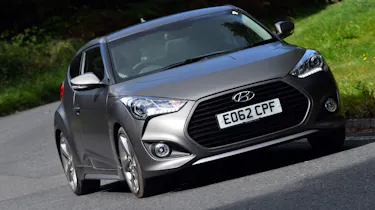

Thanks to its dramatic looks, lengthy equipment list and unique 2+1 door configuration, the Hyundai Veloster had the potential to offer something a bit different. But while it stood out from Hyundai’s family car range, the underpowered engine range disappointed. Now, there’s a Turbo model with even more dramatic styling, more equipment and - most importantly - a 184bhp 1.6-litre turbo petrol engine that propels the Veloster Turbo from 0-62mph in 8.4 seconds. It’s more expensive than a Volkswagen Scirocco 1.4 TSI, but it’s more powerful and better equipped.
Engines, performance and drive
The Veloster Turbo is powered by Hyundai's new direct-injection 1.6-litre turbo petrol engine, which develops 184bhp and 265Nm of torque. That gives it 33 per cent more power and - more importantly - 59 per cent more torque than the standard car’s engine. The performance stats aren't especially sparkling, with the 0-62mph sprint taking 8.4 seconds and a top speed of 133mph, and the turbo spins up from low revs, so the power delivery is linear and doesn't offer the shove in the back you would expect from a turbocharged car. However, the extra torque means that the Turbo feels faster on the road, and allows you to use a lower gear when accelerating out of bends. The engine makes a good noise, too, although tyre roar becomes intrusive at higher speeds and grip isn’t always in plentiful supply.
MPG, CO2 and Running Costs
The Veloster Turbo sits in road tax band G, so it costs £170 a year to tax. The 1.6-litre engine does offer good performance, but if you go easy on the throttle, Hyundai claims an average economy figure of just over 40mpg. At £21,995, the Turbo SE does seem quite expensive. But SE stands for special equipment, so it comes loaded with kit, making it cheaper than a Scirocco 1.4 TSI when you compare them spec-for-spec. If you don’t need all of the equipment, an entry-level Turbo will join the range later in 2013, starting from less than £20,000.
Interior, design and technology
The Veloster is one of the most striking cars on sale. It’s one of the most overt expressions of Hyundai’s current ‘Fluidic Sculpture’ design language, which includes a trapezoidal grille, flowing creases in the bodywork and intricate lights. And the Turbo model only enhances the Veloster’s quirky looks, with more dramatically sculpted front and rear bumpers, bigger alloys and the option of Hyundai’s first matte paint finish. The Veloster isn’t quite a sports car and isn’t quite a hatchback, which means it isn’t quite as well resolved as the Volkswagen Scirocco. The assymetric door design is well integrated into the car's shape, though, with blacked-out door pillars disguising the extra door on the passenger side.
Practicality, comfort and boot space
To make the Veloster stand out from the crowd, it has a novel door layout, with two doors on one side and one on the other. But unlike the MINI Clubman, Hyundai has engineered the door layout for the UK, so the two doors open to the pavement, while the driver has one large door. This boosts access to the rear seats, although the driver's seat does slide forward if you can't get in from the passenger side. Space up front is good, but the rear seats are a squeeze for taller passengers, as the tailgate restricts headroom. The boot is 320 litres, which is eight litres more than the VW Scirocco. However, the Vauxhall Astra GTC is considerably more practical, with a 380-litre boot.
Reliability and Safety
Like the standard Veloster, the Turbo gets a full five-star Euro NCAP rating. Safety kit is generous and includes plenty of airbags and electronic stability control as standard. Hyundai finished a decidedly average 14th in the 2013 Driver Power reliability survey - but that was still ahead of BMW, Volkswagen and Ford. As with all other new Hyundais, the Veloster Turbo comes with a five-year, unlimited mileage, triple-care warranty package for added peace of mind.