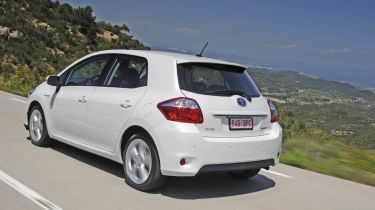
Don't be fooled by the mild-mannered exterior – you’re looking at the automotive equivalent of Clark Kent, eco-warrior!
While Toyota’s Auris HSD might not turn many heads on the high street, its hybrid powertrain promises to revolutionise family motoring with some super-low running costs. Auto Express took a drive to find out if the VW Golf-sized hybrid lives up to its claims.
Video: watch CarBuyer's video review of the Toyota Avensis
The Auris, which shares the same Hybrid Synergy Drive system as the larger Prius, needed only a few tweaks to incorporate its nickel metal hydride battery, creating the first mass-produced compact family hybrid in the process. Backing up its eco credentials is the fact that, unlike the Prius, the Auris HSD is not shipped here from Japan, but instead is built at Toyota’s UK plant in Burnaston, Derbyshire.
Changes include LED daytime running lights, a new grille, more aero-efficient front bumper and a larger tailgate-mounted spoiler. There’s a choice of 15 or 17-inch alloys, too. The former results in 74.3mpg and CO2 emissions of 89g/km, thanks in part to Michelin low-rolling-resistance tyres.
However, the vast majority of the 30,000 Auris HSDs which Toyota expects to sell in the UK every year will get the larger rims, as seen on our test car. But while these do compromise economy – 70.6mpg and 93g/km – both sizes still qualify for road tax exemption. All models are lowered 5mm for better aerodynamics, too.
Inside, the rev counter has been replaced with a special gauge which shows whether the car is regenerating power, using electricity or calling on the engine’s extra reserves. There’s also a revised centre console which features the same gearknob as the Prius, plus buttons to manually select electric-only, Eco or Power modes and operate the electric handbrake. The boot isn’t too badly compromised by the addition of the battery. It’s obviously smaller but there’s still enough space to accommodate bags of shopping, while the rear seats fold to take larger items.
Pressing the starter button results in nothing other than illuminating the dash. Put thecar in Drive, though, and it moves off virtually silently, with only a muted whirr from the electric motor entering the cabin.
Around town, good visibility makes negotiating busy streets easy. Toyota claims that the car will travel 1.2 miles in electric-only mode, and the quiet, fuss-free way it does this makes city driving relaxing. The only caveat is that pedestrians are often caught out as they can’t hear you coming.
On the motorway, the HSD is a refined, comfortable cruiser – but don’t expect diesel-like fuel economy. And as a mainstream Golf competitor, the Auris needs to be able to deal with all types of roads, too.
On inclines the motor needs plenty of throttle to move the car’s 1,380kg weight, which results in a thrashy engine note as the unit powers through the CVT gearbox, and on twisty roads the handling is imprecise with a lot of body roll. Around town, the Auris is in its element. Its quiet and refined drivetrain beats that of a conventional diesel.
Ultimately, though, this hybrid is bland to look at, and out of town the harsh engine noise and poor handling negate its appeal as a true mass-market contender. It’s a better everyday car than the Prius, yet lacks the classless quality and all-round ability of the Golf.
Rival: VW Golf BlueMotion
WITH a few eco tweaks, VW has created a Golf that’s just as clean as the Auris. More significantly, it brings virtually zero compromise to cleaning up your act. As a mainstream all-purpose car, the Golf beats the Auris hands down.

Tell us about your car in our Driver Power survey.
For an alternative review of the latest Toyota Auris visit our sister site carbuyer.co.uk
For more breaking car news and reviews, subscribe to Auto Express magazine. We'll give you 6 issues for £1 and a free gift!
The article forgets to mention the zero congestion charge, the lower emissions and zero tax. Plus much more power than either the Golf or Focus. Plus servicing costs are much lower due to no cambelt no clutch brake pads that last 60000 miles (due to regenerative braking). Not to mention the higher spec and massive savings for business use. It sounds like a perfect urban car and it's built here!!!
Welshrob has got a point. A good point too. I understand that it may have the performance of a 2.0 diesel as well, but this would be an interesting alternative to the Prius.
I feel for Toyota, I think they build great cars, even today amongst the press haters. Welshrob, do you work for Toyota? Come on... this new Hybrid looks ok, just ok. Might have more power than Golf or Focus, but which would you rather have sat on the drive.. honestly? We used to own a T Sport Corolla (up to last month) and it has been excellent for over 3 years. Never missed a beat. Now this Auris comes along and is supposed to be different. New. Next Generation. Well, we drove one (a diesel) and for me, this car is a total marketing disaster from start to present. We just didn't want it. They should have just called it the new 'Corolla' and no-one would have said a thing against it or have higher expectation. Instead, they tried to remarket it and turn it into something it is not, although this model at least looks like it is trying apart from 15 inch rims. My new car's smallest wheel is an 18" standard rim. The one we tried was a service courtesy car and we couldn't gel with it. It was an 'SR180' too which was apparently the top of the range at that time. I don't think it handled quite as well, certainly was better visibility but then you sit so high you feel you're on it rather that in it if that makes sense. The plastics were hard/horrible, it rattled and turned no heads at all no matter how nice Toyota think it is or how strong the engine was (which was very good to be fair).
This Hybrid for me is too little too late. 5 year warranty across the range... desperation from Toyota I feel. They need to get back to making reliable, well thought-out cars, with some desirability, decent styling/better looks and re-introduce the Celica, MR2, Supra and 3door Rav type models which people WANTED to buy over just 'reliability'. I loved my old Celica, bring it back Toyota!
Top Toyota Tip: Get a Styling house such as Bertone or Pinifarina to style the cars, then you engineer them! That way you make a properly reliable car with jaw-dropping looks like an Aston. Peugeot have just done it with the new RCZ (well, looks wise at the very least)... why can't you?
I think you missed the point Will. We'd all like a car with Italian style Japanese reliability Ferrari power and Pushbike running cost. Let's check back after a year of increased taxes fuel prices and environmental badged penalties. I think a 10% benefit in kind business use tax 70 mpg on petrol zero road tax and congestion charge might look a little more attractive on the drive than a vw badge. It seems like a lot of technology and performance and is cheaper than it's diesel rivals.
A contribution from a happy Prius owner... When comparing Toyota hybrids don't forget that they are effectively automatics (no clutch!) so comparisons should bear this in mind. In stop-start traffic they are in their element; it is stress-free for the driver, passengers and the transmission! Also they are more economical in this mode. We have 2 vehicles - the other is a Peugeot 307 1.6 petrol. On an identical commute (half urban, half congested motorways) the Prius does 60mpg and the Pug 35 - I imagine a diesel Golf would do about 45. For this type of journey the savings are real! But if you spend your time at 90mph on the motorway, get a different car.
I hate people getting stuff wrong so much, I had to register for the site to comment on this video.
The best way to get good fuel economy from the Toyota HSD system is NOT to drive like a granny. Accelerate reasonably briskly, then keep the speed constant - preferably using cruise control. Brisk (but not flat out) acceleration puts the engine in its most efficient power band, and constant speed after that avoids the creeping acceleration that really brings your average down. Plus, you don't annoy anyone this way.
Using battery power as much as you can is also not a good strategy. You only get back about 25% of the energy you put in, and a lot of this comes from the engine rather than the brakes.
I've done 50,000 Prius miles and the average MPG has not gone under 60 all summer so far, with about 80% 70mph motorway driving and the rest town driving. Usually down to 54 ish in the winter.
Oh yeah, and remember that diesel pollutes a heck of lot more than petrol (smog-forming chemicals and particulates), and it also often costs a lot more energy to make since a lot is produced by breaking up heavier oils with a lot of energy.
So 60mpg of petrol is much cleaner and more eco friendly than 60mpg of diesel.
And another thing - even though Priuses are made in Japan, the factory is 50% solar powered and has a whole host of other eco processes including sending no waste to landfil.
my previous car was a five year old Prius having had three other Toyota models in their range.
I was very keen to road test the new Auris Hybrid; having got acquainted with the driving technique of the Prius I assumed the change would be enjoyable, which at first it was, taking the usual careful approach to a new car.
Excellent urban driving, smooth quiet. but when I wanted a more brisk performance on the motorway, what a disappointment.
The engine thrashed away for no noticeable increase,the Prius was more flexible . Give it time for the computer to catch up, I was told; I`m sorry but this was wearing a bit thin, I really thought there was something wrong.But I guess I am at fault with my technique; so I would welcome any intelligent tips.
The HSD is the shining green star in Toyota’s compact family car range. It’s priced competitively against 2.0-litre diesel rivals, and offers a different hybrid proposition to the Prius, mainly because it looks like a normal car. Just like its stablemate, the Auris is great around town. But the familiar hybrid foibles remain, with a harsh note under acceleration and average economy. So on the motorway, good though the newcomer is, we’d still recommend a diesel instead.