Toyota Auris Hybrid (2012-2018) review
The latest Toyota Auris Hybrid is efficient but it still falls behind rivals for quality and excitement

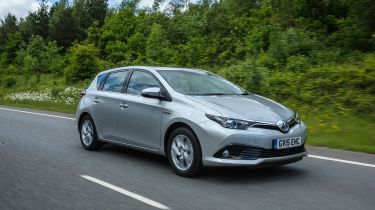

Toyota Auris Hybrid Review
The Auris is one of only a few hybrids in the compact hatchback class, but Toyota would like you to consider it as a ‘mainstream’ choice, rather than an exotic or premium alternative.
Apart from its efficiency, the Auris struggles to keep up with the mainstream class leaders for driving thrills, performance and quality. The styling is a big improvement over the old Auris and Toyota’s reliability record is enviable, but that won’t be enough to tempt buyers who are after something a little more thrilling and upmarket.
However, for drivers with a no-nonsense, no-frills approach to their family motoring, the Auris Hybrid makes sound financial and practical sense – particularly for company car drivers.
The Toyota Auris Hybrid ploughs a lonely furrow as a mainstream family hatchback with a hybrid powertrain. Although you can now get a Volkswagen Golf or Audi A3 with such an engine, those cars are focused more on dynamic thrills and are much more expensive as a result.
This is the second generation of Auris Hybrid. The first arrived in 2010 as a latecomer to the old shape Auris line-up, and was built alongside the other cars in the range at Toyota’s Burnaston plant here in the UK.
Used - available now

2026 Cupra
Ateca
18,559 milesAutomaticPetrol1.5L
Cash £21,500
2020 Land Rover
Range Rover Evoque
68,053 milesAutomaticDiesel2.0L
Cash £14,697
2019 Mercedes
C-Class Estate
54,595 milesAutomaticPetrol1.5L
Cash £16,997
2023 Ford
Puma ST
26,542 milesManualPetrol1.5L
Cash £17,397The current Auris was revealed in 2012 at the Paris motor show, with sales starting in early 2013. It’s based on Toyota's MC platform that also underpins a four-door version still known as the Toyota Corolla in Japan, but here in the UK we’re only offered the five-door Auris hatchback and its Touring Sports sister model. The Auris range is still built at Burnaston in Derbyshire.
The Hybrid version uses Toyota’s familiar Hybrid Synergy Drive (HSD) set-up from the Prius, featuring a 1.8-litre petrol engine, 650v electric motor and nickel metal-hydride batteries. The only available transmission is a constantly variable (CVT) automatic, and this set-up allows for the lowest CO2 emissions in the class and some seriously impressive fuel consumption figure.
If it all still sounds a little ‘alternative’, it’s worth remembering that with millions of Toyota hybrids already on the roads around the globe, the technology is tried and tested.
Originally you could only buy the latest Auris Hybrid in Icon or Excel trim, but the hybrid powertrain is now an option across the entire Auris range.
The entry-level is therefore the Auris Active Hybrid, while the Auris Excel Hybrid is the range-topper. In between, there are trim levels called Icon, Business Edition and Design, offering increasing levels of equipment and comfort.
Engines, performance and drive
One good thing about moving from the regular Auris to the Hybrid is that you don’t have to change your driving style to make allowances for the hybrid system. However, there’s no avoiding the fact that the quality of the drive is starkly different to its rivals.
When you start the car, you don’t hear the engine fire into life. A beep and a ‘ready’ light indicate that it’s running, and if there’s enough charge in the battery, all you’ll notice is the whirr of the electric motor as you pull away.
When the charge drops, the engine cuts in, and while it’s quiet and smooth, there is a slight shudder as it engages. There’s no manual gearbox option - instead, Toyota persists with a CVT, so whenever you accelerate, the engine revs freely while the car gets up to speed. It sounds like it’s being thrashed, but for little benefit, as the Auris doesn’t feel quick off the mark.
The Toyota is much better when you take things easy, which makes sense as it’s an environmentally focused machine. Keep the needle of the power dial in the Eco section, and it’s quiet and smooth, although the firm suspension means it’s not as comfortable as many rivals.
Sadly, the taut ride doesn’t translate into an engaging driving experience. The Auris bounces and wallows in corners and suffers from excessive body roll, too. That can be put down to the extra weight of its hybrid drivetrain.
With lifeless, ultra-light steering and brakes that are extremely sharp and offer little pedal progression, there’s not much fun to be had driving the Auris Hybrid.
Engines
You're limited to one choice here. Every Auris Hybrid has a four-cylinder 1.8 litre petrol engine that produces 98bhp and 142Nm of torque, supplemented by an AC synchronous motor. The motor offers 80bhp and 207Nm, and is powered by a 6.5Ah battery that gets its charge from the engine or from braking – you don’t have to plug it in.
The results may be efficient, but it’s not terribly quick. Still, Toyota reckons the Auris Hybrid will hit 62mph in 10.9 seconds so it can keep up with the traffic. The car also has a potential 111mph top speed, but you’d be missing the point.
MPG, CO2 and Running Costs
The financial benefits of running a hybrid are largely determined by where you drive the most. We've tested the Toyota Auris Hybrid on town and country roads, but the majority of miles were on motorways and dual carriageways.
Sadly, this didn’t show the Auris in the best light, and we only managed 44.9mpg. That can be put down to the fact the engine runs continuously at higher speeds, and the nature of the CVT gearbox means it instantly pulls higher revs as soon as you press the throttle.
If you do most of your driving in stop-start traffic, the figures improve dramatically. The electronics attempt to cut the engine and rely on electricity in most situations, and we returned 83.9mpg on one city run in the Auris.
The worst 'official' average fuel economy figure in the Auris Hybrid line-up is 72mpg (and some trim levels will do 81mpg), while CO2 is rated from 79g/km.
Company car users will see especially big benefits in running the Toyota, as even higher-rate taxpayers will face an annual tax bill £200 cheaper than a comparable Golf diesel, thanks to the Auris’ low company car tax bracket and low list price.
The benefits for private buyers aren’t quite as strong as the Benefit-in-Kind advantage is irrelevant, and the fuel savings will take some time to accumulate and pay back the hybrid price premium.
The hybrid powertrain is now available across all Auris trim levels, but you have to upgrade to the Excel model for luxuries such as two-zone climate control or keyless entry.
Insurance groups
Insurance groups for the Auris Hybrid depend on the trim level you choose. The Icon is group 7, while the highest rating is for the Icon Plus with leather upholstery and panoramic roof, which falls into group 14.
Depreciation
Interest in hybrid models remains high across the used market, and this is currently keeping residual values a little higher than for traditional models – which should also hold true for the Auris range.
To get an accurate valuation on a specific model check out our free car valuation tool...
Interior, design and technology
The overall shape of the Toyota Auris Hybrid is a typical compact hatch, but it’s been enhanced with distinctive styling front and rear. It shares its looks with the Verso MPV, with a pointed nose, angular headlights and a large grille below the front bumper, while at the rear are sharp LED tail-lamps.
On top of this, Hybrid models get their own unique touches in the form of blue highlights on the Toyota badges front and rear, and HSD badges on the front wings and tailgate.
The Excel model comes with 17-inch wheels, while Icon trim gets smaller 15-inch rims with skinny tyres that help to keep emissions low.
Inside, the Auris is a disappointment compared to many of its rivals – particularly if you have a fondness for Germanic order. The design is a bit messy, with the mix of rectangular air vents on the centre console and ball-type vents at either end of the dash being a good example of where the feel is less cohesive and premium than – say – VW Group cars.
Even more fussy are the climate controls, while the dated digital clock is set apart from the other displays, far to the left of the driver.
That said, it’s fair to add that the Auris interior seems generally well built. Plastics aren’t up to the quality of the Volkswagen Golf, but they’re better than you’d expect to find in a Kia or Hyundai.
Sat-nav, stereo and infotainment
All versions except the entry-level Auris Active come with a seven-inch touchscreen infotainment centre. Toyota’s touchscreen system is clear and easy to use, while the central display between the dials is almost on par with the Golf GTE’s similar digital read-out.
While the Auris Icon trim level comes with the touchscreen, a rear-view parking camera and Bluetooth phone connectivity, you need to opt for the Business Edition or Design trim to have sat-nav thrown in.
Practicality, comfort and boot space
Unlike its predecessor, the latest Auris Hybrid’s extra running gear (specifically the battery pack) doesn’t cut into the available interior space, so it offers exactly as much practicality as the rest of the range.
Up front, that means a comfortable driving position with full adjustment for both seat height and the steering wheel, and a good view out of the road ahead.
You might want to gripe about the small back window and tiny rear wiper though - it doesn’t clear very much of the glass. Most Auris’s come with a reversing camera though, which alleviates the problem.
The hatchback Auris is offered as a five-door car only, and the doors open wide to make accessing the rear seats easy – whether you’re getting in yourself, or wrestling with a child seat.
The Auris also benefits from an array of compartments and cubbyholes for bits and pieces.
Dimensions and size
The Auris hatchback is 4,330mm long and 1,760mm wide, which is pretty average for the compact hatchback class. The Ford Focus is 4,358mm long and 1,823mm wide, while the VW Golf is 4,255mm long and 1,799mm wide.
Leg room, head room & passenger space
With five doors, it’s easy enough for passengers to access the back seats in the Auris, and there’s reasonable shoulder-room for two adults – or three at a pinch.
Legroom and headroom are acceptable too, but the Auris doesn’t set any records for its accommodation.
Kids are catered for with ISOFIX seat mountings in the rear.
Boot space
The Auris Hybrid’s 360-litre boot is the same size as the standard car’s, which means it’s a bit smaller than the boot in the SEAT Leon or VW Golf, but bigger than the one in the Ford Focus. When the 60:40 split rear seats are folded down in the Auris, the volume increases to 1,200 litres.
The space itself is easy to access thanks to a low and wide tailgate opening, while the boot floor is shallow so there’s no obstructive lip to heave heavy items over.
With the seats folded the boot isn’t flat, but the Auris is available with a special additional platform that slots in above the boot floor and raises it to be level with the folded back seats. Flat floor sorted!
The specialised powertrain and CVT gearbox mean the Auris Hybrid isn’t suitable for towing.
Reliability and Safety
Toyota has a very strong reputation for reliability, with the firm’s confidence in its own cars borne out by the satisfaction of its owners. In our Driver Power 2015 customer satisfaction survey, the Auris range as a whole was ranked a strong 45th out of 200 rival cars. If you’re looking for reliable, trouble-free family motoring the then the model is well worth considering.
The Toyota brand as a whole placed 17th out of 33 manufacturers, which is a little down on previous performances.
This latest version of the Auris earned a five-star EuroNCAP crash test rating, and is only slightly behind the well-regarded VW Golf with its percentage scores for adult and child occupant protection. The Auris scored 92 per cent for adult occupants, and 84 per cent for children, while the Golf managed 94 per cent and 89 per cent. Pedestrian safety was rated at 68 per cent rating for the Auris and 65 per cent for the Golf.
Seven airbags and stability control were designed into the Auris from the off, but recently the Auris has been upgraded with an optional Toyota Safety Sense (TSS) pack. This covers some of the more up-to-date and high-tech systems that were previously unavailable on the Auris range, such as adaptive cruise control and emergency brake assist.
Although the EuroNCAP crash test was not carried out on a hybrid version, we’re not aware that the hybrid installation poses any significant extra risk to safety.
Warranty
Thanks to an enviable reputation for reliability – in spite of some recent high profile recalls – Toyota’s entire range comes with a five-year, 100,000-mile warranty.
Furthermore, the brand covers the Auris’s hybrid system for eight years and 100,000 miles, while the battery is warranted for five years.
Servicing
Auris Hybrid servicing costs should only be marginally higher than other models in the Auris range. There is a fixed price for intermediate services at £169, while a full service costs £219. (Regular Auris models cost £145 and £205.)
You can also get scheduled maintenance with monthly instalments, but the price depends on the level of cover.