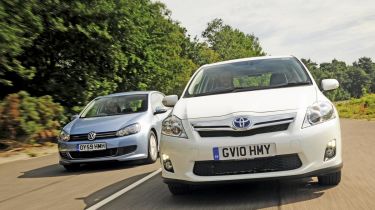
If you’re a motorist with an eye for fashion, you’ll have noticed that green is the new black. Rising fuel prices and increased taxes mean that fuel-efficient, eco-friendly cars are more popular than ever.
Toyota’s answer to environmentally aware buyers has been its clever Hybrid Synergy Drive, which combines an internal-combustion engine with an electric motor. First seen in the bold Prius, the technology-packed drivetrain has now been squeezed into the firm’s conventional Auris family hatch, which bosses claim will broaden the appeal of petrol-electric power. With CO2 emissions of 89g/km and a promised 74.3mpg, Toyota believes the newcomer will have owners of traditional diesel hatches turning green with envy.
But the oil-burner isn’t dead and buried just yet. The excellent VW Golf BlueMotion is our current fuel-efficient family champ. Take a look at the figures and you’ll see the German firm claims exactly the same 74.3mpg economy, while its CO2 emissions of 99g/km still mean free road tax. Factor in the standard Golf strengths of refinement, quality and composed driving dynamics, and it’s clear the VW represents a tough test for the Toyota.
So, which of our contenders is more effective at reducing its impact on the environment – and your wallet?
For an alternative review of the latest Toyota Auris visit our sister site carbuyer.co.uk
For more breaking car news and reviews, subscribe to Auto Express magazine. We'll give you 6 issues for £1 and a free gift!
Why does AE only consider one exhaust component - CO2? What about NOx and HC? A hybrid wil surely be cleaner overall when genuine pollutants rather than just CO2 are considered.
Jake, the point is that Toyota have the most efficient + greenest production plants in the world, therefore, if the production itself may be polluting, it would be compensated with the most environmental-friendly factories. Secondly, batteries come with an 8 year warranty and replacement costs around 1500€ but there are very few cases when the battery needed replacement since 1997. The maintenance costs in VW are much more expensive than those for Toyota apart from the fact that this bloody BlueMotion is a diesel and if you drive faster than 100 km/h, fuel consumption increases dramatically, and diesels are always more expensive to maintain. Last but no least, we are dealing with green cars and (here is the nonsense of all these articles which proclaim VW better than Toyota in stupid aspects such as appearence) the electric motor is combined with a non-diesel motor which DO NOT produce many of the negative emissions which diesels do...
First comment - I reckon that this result makes the Auris greener! Diesel fuel produces approx 10% more CO2 per litre when burnt, as it contains more carbon atoms. The Auris seems to get 6% worse MPG, but that's still less CO2 and much lessNOX, particulates and other nasties.
Second comment - how on earth do motoring journalists get such appalling mpg's from their cars? I drive a Prius - similar drivetrain to Auris - and I easily exceed 60mpg driving sensibly (mixed town / motorway driving). If I emulate Audi owners and drive aggressively, this might drop to 55mpg. Driving like a total t**t might get 50 .... but 41mpg??? Had he forgotten to release the parking prake?
Which pollutants do you want to choose? Carcinogenic hydrocarbons (produced by petrol cars, and released when refuelling or even when standing still) or the small amounts of NOx and particulates (given the fitment of DPFs) from a diesel? More expensive to maintain? Both cars have engines, brakes etc. but the Auris requires a service every 10,000 miles, the VW on variable servicing typically every 18,000. And I've been driving diesel cars since 1994 simply because they are highly efficient at a constant-speed cruise of 70mph+, but even at 100mph+ (not kph!) fuel consumption does not "increase dramatically" any more than any other car. Apart from, presumably, the Priuses which I always see crawling along at 60mph in the slow lane. Unless you drive in town (in which case, why not get the bus?) then diesel is still, as this test demonstrates, the best.
If its German its good if it isnt German then forget it.
Needless to say the Golf wins against everything, why?
Because its boxy,boring and totally bland. Thats why VW sell, and the quality very rarely gets in to any of the real best top 10 for reliability, so who is right and who is wrong? Me I would go for a long list of cars before a VW.
I could never be a Prius or any other petrol/electric Hybrid owner. They tend to be heavy (battery) slow, and when driven with any form of normality, not fuel efficient. Diesel running and maintainance costs are less than petrol engined cars. Ideally, a diesel/electric hybrid will be the better solution, as the diesel produces far higher torque and far lower revs. The Toyota is a great solution, but it isn't the best!
OUR two family cars take very different approaches to achieve their eco-friendly credentials – and yet they deliver similar fuel economy and CO2 emissions. The Auris is Toyota’s most conventional hybrid model to date, which will no doubt attract buyers who wouldn’t normally consider petrol-electric power. And once you’ve adapted your driving style a little, the HSD delivers decent fuel returns and a good turn of speed. The concept of driving in electric-only mode has strong appeal, too – although the car doesn’t do enough to beat the excellent Golf. In BlueMotion trim, it delivers low CO2 emissions and strong efficiency, but with no compromise in the driving experience. On top of this, you get big-car refinement, peerless build quality and a practical cabin. The VW takes a comfortable and well earned victory
1. VW Golf Bluemotion
TAKE a drive in the BlueMotion and you’d be forgiven for not realising it’s an eco-special, because the refined and composed hatchback drives as well as any other Golf in the range. The only clues are the supermini-sized fuel bills and free road tax. Our sole criticism is the miserly list of equipment included as standard.
2. Toyota Auris HSD
THE Auris is easily the most appealing Toyota hybrid yet. By packaging its unique drivetrain into a compact hatchback, the company is sure to attract buyers of conventional diesel models. The trouble is, the car can’t match the Golf’s classy appeal or practicality.

How many CO2s does it take to build them?
Would be interesting to know how many CO2s it takes to build these cars. I bet thats where the hybrid is really let down!
And when the batteries fail in 5 years time, I bet they are really cheap to replace!
By JakeBtn on 12 August, 2010, 8:02am