Skoda Octavia vs VW Golf vs Honda Civic: 2013 group test
The all-new Skoda Octavia adds more luxury to the spacious, top-value package. But can it beat the Mk7 Volkswagen Golf and Honda Civic?

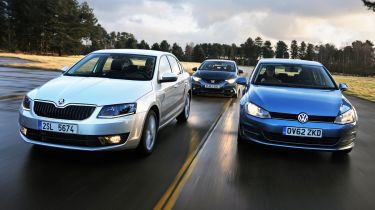
In the cut and thrust of the compact hatch market, a car needs a unique selling point to stand out. The Skoda Octavia's has always been to offer acres of space at a value price, but the new model builds on this by adding a level of luxury never before seen from the brand.
In its first test, the Octavia meets two cars that also offer their own unique take on the class. The Honda Civic brings a futuristic edge to the mix thanks to its radical looks, while the all-new 1.6 i-DTEC diesel promises decent performance and low running costs.
Completing our line-up is our current class favourite, and the benchmark to test the Skoda’s upmarket aspirations: the VW Golf.
The two cars are built on the same platform, so should offer similar performance on the road, but does the new Octavia deliver the premium feel that will finally propel it past its classy cousin?
Verdict
The new Octavia is another giant step forward for Skoda. Class-leading rear space and practicality are now matched by a high-quality interior with equipment to embarrass cars in the sector above.
The efficient 1.6-litre TDI diesel isn’t as refined or powerful as the impressive new engine in the Civic, plus the Octavia isn’t as rewarding to drive as the Golf. But for those wanting a sensible and cheap-to-run family car, it’s close to perfect.
Used - available now

2023 Skoda
Octavia
55,615 milesAutomaticPetrol1.4L
Cash £14,700
2018 Skoda
Octavia
37,000 milesAutomaticPetrol1.4L
Cash £11,667
2020 Skoda
Octavia
59,179 milesManualPetrol1.5L
Cash £10,990
2020 Skoda
Octavia
55,555 milesManualPetrol1.0L
Cash £9,250Yet the Volkswagen is slightly better. It’s almost as practical, is sharper to drive and has more premium appeal. And while it’s more expensive to buy than the Octavia, strong residuals and low running costs offset any extra outlay.
Sadly, the Honda finishes third. Despite its smooth and punchy engine, the quirky Civic can’t match its rivals for all-round appeal.
So the Golf does just enough to take the top spot – although its time at the top could be short, with the stylish new SEAT Leon just around the corner.
First place: Volkswagen Golf
The Mk7 Golf wins by the narrowest of margins here. If you don’t need the Skoda’s extra luggage space, then the VW is hard to fault. It’s not at its best in 1.6 TDI guise, but it’s still more refined and more rewarding to own than any other car in the class.
The VW Golf used to be the default family car choice. Plenty of rivals had more style or charisma, but none could match its all-round ability. Yet in recent years, the competition has closed in by attempting to deliver the same blend of dependability and desirability. So, has the Golf lost its advantage?
Well, it still has the edge on exterior styling – the new MkVII has been honed with fine details like the angular tail-lights and sharp creases in its flanks. It’s more compact than the Octavia, so it looks lower and more purposeful, plus there’s no denying the premium appeal of the Volkswagen badge.
Inside, the car is almost identical to the Skoda Octavia, but the centre console is angled towards the driver and the switchgear on the steering is a bit more complex. After the messy cabin of the Honda Civic, the Golf’s sensible and clear layout is a masterclass in logic. Better still, the perfect driving position and fine all-round visibility make it much easier to weave through narrow and congested streets.
Hi-tech gadgets like adpative cruise control feature as standard, but there are some notable absences from our SE-spec car, including front foglights, climate control and parking sensors – all of which the Octavia includes.
There’s not quite as much space in the rear as the Skoda has, but the VW has much more headroom than the Civic. It also provides lots of useful stowage space, including a pair of large, flock-lined pockets in the front doors. But while its 380-litre boot capacity is large enough in isolation, in this encounter it’s the smallest.
The 1.6-litre TDI model comes with simple torsion beam rear suspension, just like its rivals (higher-powered versions use a sophisticated multi-link set-up). As a result, there’s not much between our three cars on the road. However, the beautifully cushioned ride and well weighted steering give the Golf a slender dynamic advantage, even if the tall ratios of the five-speed manual gearbox strangle some of the engine’s mid-range muscle.
The VW is also 192kg lighter than the Honda, at 1,295kg, and that helps it feel more nimble through corners.
But would this extra dynamic appeal make you choose the expensive Golf over the bigger and cheaper Skoda? While the VW doesn’t cost a lot to run and has rock-solid residual values, so does the Octavia. Also, the brand’s dealers haven’t scored as well as Skoda’s in our annual Driver Power customer satisfaction surveys, which could be enough to convince some buyers.
So does this mean the Golf is about to lose its hard-won family hatchback crown?
Second place: Skoda Octavia
Huge space and great value have always set the saloon-like Octavia apart in this class, and the new model has been improved in every department. While it doesn’t offer the last word in refinement and could be more fun to drive, the margins are so small that few buyers will mind at this price.
Since the first Octavia arrived in 1996, Skoda has sold over 3.7 million models globally – so this third-generation car has some very big shoes to fill.
Naturally, the brand has been reluctant to make sweeping changes to its winning formula. That means at first glance you may struggle to tell the latest Skoda Octavia apart from its predecessor. However, the familiar styling cues hide some fairly dramatic changes under the skin.
The newcomer shares its platform with the latest Audi A3, VW Golf and SEAT Leon, and has grown up. It’s now 90mm longer and 45mm wider than before, while the wheelbase has been extended by 108mm, too, which gives the Octavia class-leading space in the rear, as well as good refinement.
This extra bulk is nicely concealed by the clean and simple design, and on closer examination some very smart new details emerge. A chrome strip runs along the window line and finishes with a fin-like flourish towards the C-pillars, and the monochrome Skoda logo now sits separately from the protruding grille.
It’s just a shame that the distinctive LED rear lights cost £150 extra, while the standard 16-inch alloys on the SE model we tested get lost in the expansive bodywork. Even the 17-inch rims on the Elegance car in our pictures look a little dinky. Still, the new Octavia has taken a giant leap upmarket inside. The cheap plastics that characterised the old car have been replaced by swathes of high-quality, soft-touch materials that are the equal of anything in the Golf.
Adding to the premium feel is the standard equipment on offer – dual-zone climate control, a DAB radio and Bluetooth are all included. Plus, popular optional extras such as sat-nav (£550) and heated seats (£200) cost less than in the VW or Honda.
However, Skoda hasn’t forgotten its roots and the Octavia is more practical than ever. With the rear seats folded, the boot offers a maximum capacity of 1,580 litres – over 200 litres and 300 litres more than in the Civic and Golf respectively. And the car’s family credentials are boosted by clever features like the reversible boot floor and a parcel shelf that stows neatly behind the rear seats, plus an ice scraper fitted inside the fuel filler flap.
Longer rear doors make it much easier to get into the back than in the Volkswagen, plus taller passengers have more knee room.
This unrivalled practicality gives the Skoda a fantastic selling point – but can it finally outshine its high-profile sister car on the road? The 1.6-litre TDI produces exactly the same 104bhp and 250Nm of torque as the Golf, but because the Octavia we tested was fitted with the quick-shifting DSG automatic gearbox it was significantly faster than both its rivals in-gear.
While upshifts are smooth and fast using the £300 optional paddles, the engine sounds gruff and thrashy when you accelerate and our sound meter showed, it was slightly louder than the Golf at a steady 70mph cruise. The ride is also a little firmer in the Octavia and you can feel bumps in the road being transmitted into the cabin.
As with the Golf, you can alter the steering weight and throttle response via three different driving modes on the central touchscreen. Yet even in Sport mode, the steering never offers quite the precision of the VW’s. The margins are narrower than you might expect, though, plus most family car owners are likely to be more interested in its spacious and solid interior than the fact it’s not quite as sharp to drive as the VW.
And the Golf will be even more difficult to recommend to these buyers when you consider that a model with the DSG box is £1,425 more expensive than the equivalent Skoda. The manual Octavia 1.6 TDI emits just 99g/km, but even the DSG version we tested emits 102g/km, and we returned an impressive 48mpg over an extended route.
The new Skoda is better than before in nearly every way, yet still undercuts its nearest rivals. Will that be enough to steal the VW’s thunder?
Third place: Honda Civic
The excellent new 1.6-litre i-DTEC engine isn’t enough to make the Civic competitive with its rivals. Although this was the fastest and most efficient car here, the confusing dash and lead-footed suspension make it hard to recommend over the more supple Golf or roomy Octavia.
In a market where excellence is the norm, the Honda Civic is easily overlooked. But it’s an intriguing alternative, with its big boot and neat cabin touches, while the brand has introduced an all-new 1.6-litre diesel – with lower emissions and fuel consumption – in a bid to make the car even more attractive.
The British-built hatchback still ploughs its own furrow in terms of design. While the styling is toned down from the previous generation, the Civic is a world away from the saloon-like Skoda Octavia thanks to its short bonnet, large windows and stumpy rear end.
Climb inside, and the dashboard is also radically different to those of the Volkswagen Group models. There’s a low-resolution colour screen on the centre console and dozens of buttons, and while it looks as though Honda has taken a scattergun approach to their positioning, it’s actually pretty easy to find your way around.
The two-level dashboard adds a futuristic touch, but the steering wheel cuts between the displays, and some drivers will need to position the wheel in their laps to prevent it from obscuring the speedometer.
The seats are comfortable, although we weren’t keen on their soft fabrics, and while visibility out front is good, the divide in the tailgate cuts through your rear view. Honda has added a windscreen wiper to the rear, but it sweeps the upper part of the glass; you spend more time looking out of the lower section.
In the back, the Civic trails its rivals for passenger space, and the narrow doors make access trickier, too. Still, while the 477-litre boot trails the Skoda’s capacity by 113 litres, a double floor with a deep lower section and a low boot lip give the Civic a practical edge.
Honda’s first diesel – the refined and eager 2.2 i-CTDi – was a revelation, and this new 1.6 i-DTEC is just as smooth, although it’s not that far ahead of the VW Group engine. It’s hooked up to a smooth-shifting six-speed box, and has a healthy dose of mid-range torque.
At the test track, we managed to cover 0-60mph in 10.6 seconds in the Honda – that’s a second faster than in the other cars – while acceleration through the gears was equally impressive.
Unfortunately, the rest of the driving experience doesn’t live up to the engine’s potential. Light steering makes low-speed driving a breeze, but there’s no fun to be had, while unsettled suspension means the Civic isn’t as composed as its rivals over bumps.
Our ES-spec model costs £105 more than the Skoda, at £20,595, and comes fitted with a similar amount of equipment as standard. Emissions are on a par with the Golf’s and slightly better than the Octavia’s, while the six-speed gearbox helped the Honda deliver a best-on-test fuel return of 52.2mpg.
So this 1.6 i-DTEC is clearly the best model in the Civic range. The question is whether it’s a strong enough contender to make an impact here.
Facts and figures
| Skoda Octavia 1.6 TDI SE DSG | Honda Civic 1.6 i-DTEC ES | Volkswagen Golf 1.6 TDI SE | |
| On the road price/total as tested | £20,490/£22,340 | £20,595/£21,095 | £20,500/£21,590 |
| Residual value (after 3yrs/36,000) | TBC | £9,741/47.3% | £10,209/49.8% |
| Depreciation | TBC | £10,854 | £10,291 |
| Annual tax liability std/higher rate | £572/£1,144 | £534/£1,068 | £532/£1,063 |
| Annual fuel cost (12k/20k miles) | £1,614/£2,690 | £1,484/£2,473 | £1,645/£2,741 |
| Ins. group/quote/road tax band/cost | 13/£416/B/£20 | 16/£355/A/£0 | 13/£406/A/£0 |
| Servicing costs | £499 (3yrs/30k) | £695 (5yrs/62k) | £329 (3yrs/30k) |
| Length/wheelbase | 4,659/2,686mm | 4,300/2,595mm | 4,255/2,637mm |
| Height/width | 1,461/1,814mm | 1,470/1,770mm | 1,452/1,799mm |
| Engine | 4cyl in-line/1,598cc | 4cyl in-line/1,597cc | 4cyl in-line/1,598cc |
| Peak power/revs | 104/3,000 bhp/rpm | 118/4,000 bhp/rpm | 104/3,000 bhp/rpm |
| Peak torque/revs | 250/1,500 Nm/rpm | 300/2,000 Nm/rpm | 250/1,500 Nm/rpm |
| Transmission | 7-spd auto/fwd | 6-spd man/fwd | 5-spd man/fwd |
| Fuel tank capacity/spare wheel | 50 litres/sealant | 50 litres/sealant | 50 litres/space saver |
| Boot capacity (seats up/down) | 590/1,580 litres | 477/1,378 litres | 380/1,270 litres |
| Kerbweight/payload/towing weight | 1,245/625/1,800kg | 1,487/442/1,500kg | 1,295/580/1,500kg |
| Turning circle/drag coefficient | 10.4 metres/0.29Cd | 11.3 metres/N/A | 10.9 metres/0.27Cd |
| Basic warranty (miles)/recovery | 3yrs (60,000)/3yrs | 3yrs (90,000)/3yrs | 3yrs (60,000)/1yr |
| Service intervals/UK dealers | 20,000 miles (2yrs)/135 | 12,500 (1yr)/196 | Variable/223 |
| Driver Power manufacturer/dealer pos. | 1st/3rd | 6th/6th | 18th/25th |
| Euro NCAP: Adult/child/ped./stars | N/A | 94/83/69/5 stars | 94/89/65/5 |
| 0-60/30-70mph | 11.6/11.6 secs* | 10.6/10.2 secs* | 11.5/11.5 secs* |
| 30-50mph in 3rd/4th | 4.3/5.0 secs | 4.4/6.4 secs | 4.7/8.1 secs |
| 50-70mph in 5th/6th/7th | 7.4/9.7/13.2 secs | 8.3/11.2 secs/N/A | 11.7 secs/N/A/N/A |
| Top speed/rpm at 70mph | 121mph/2,000rpm | 129mph/2,000rpm | 119mph/2,050rpm |
| Braking 70-0/60-0/30-0mph | 55.4/39.7/10.8m | 54.3/38.5/9.9m | 57.2/39.6/10.2m |
| Noise outside/idle/30/70mph | 69/47/66/69dB | 68/46/69/68dB | 65/43/59/64dB |
| Auto Express economy/range | 48.0/10.7/528 miles | 52.2/11.6/574 miles | 47.1/10.5/518 miles |
| Govt urban/extra-urban/combined | 61.4/80.7/72.4mpg | 70.6/85.6/78.5mpg | 61.4/85.6/74.3mpg |
| Govt urban/extra-urban/combined | 13.5/17.8/15.9mpl | 15.3/18.8/17.3mpl | 13.5/18.8/16.3mpl |
| Actual/claimed CO2/tax bracket | 158/102g/km/14% | 145/94g/km/13% | 161/99g/km/13% |
| Airbags/Isofix/rear parking sensors | Seven/yes/yes | Six/yes/yes | Seven/yes/£445^ |
| Automatic box/stability/cruise control | Yes/yes/£180 | No/yes/yes | £1,415/yes/yes |
| Climate control/leather/heated seats | Yes/no/£200 | Yes/no/no | £400/£2,050/£370** |
| Metallic paint/xenon lights/keyless go | £495/£1,190/£300 | £500/no/no | £500/£785/£350 |
| Sat-nav/USB connection/Bluetooth | £550/yes/yes | £675/yes/yes | £735/yes/yes |