SEAT Mii review
The SEAT Mii offers the same clever interior and efficient 1.0-litre engine as the VW up! and Skoda Citigo
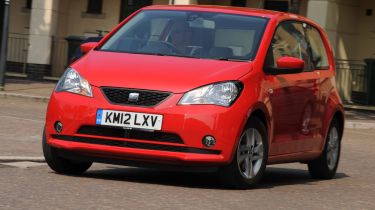
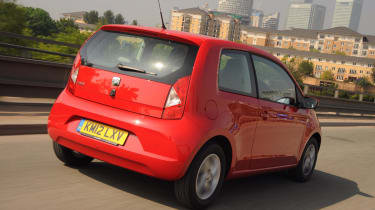
The SEAT Mii is the latest of a trio of city cars from the Volkswagen Group, following in the footsteps of the brilliant VW up! and Skoda Citigo. All three share the same platform and lively three-cylinder engines, but the Mii gets a lower starting price and a dash of Spanish style to set it apart from its siblings. It takes its design cues from the larger Ibiza and Leon, with a striking front end that’s dominated by SEAT’s trademark grille and swept-back headlamps, while the rear gets distinctive zig-zag taillight. It’s available in three and five-door bodystyles but both measure just 3.5-metres in length, which makes it perfect for city driving. It’s surprisingly spacious inside, though, with plenty of rear legroom and a 251-litre boot. A sporty Mii FR concept was revealed at the 2012 Worthersee tuning event in Austria, and could lead to a production model before the end of this year. Although the show car was mechanically identical to the standard Mii, it did get an array of styling tweaks, including 16-inch wheels, Tornado red paint, FR-badging inside and out, and plenty of black trim on the wheelarches, boot and side sills.
Our choice: Mii 1.0-litre 59bhp SE 5dr
Styling
Although the Mii, up! and Citigo look very similar in profile, the little SEAT has a character all of its own. The manufacturer’s design language is clear to see at the front, where a much narrower ‘arrowhead’ grille is flanked by a pair of oversized headlights. The Mii doesn’t get the VW’s glass tailgate finish, but it does benefit from neat rear light clusters with a distinctive zig-zag pattern. There are five trim levels to choose from: S, SE, Ecomotive, Sport and limited-edition Toca. As you’d expect given the low price, entry-level cars are very basic, but SE models come with 14-inch alloys, electric front windows, tinted glass and air-conditioning. Sport versions get bigger wheels, a glossy grey finish across the dash and steering wheel and stiffer, lower suspension. Toca editions also get rear parking sensors and a five-inch touchscreen SEAT Portable System, which attaches to the top of the dashboard and includes sat-nav, Bluetooth phone and audio streaming functions and a Micro SD card slot for music storage. There’s also a choice of styling packs, which are designed to help customers personalise their car, inside and out.
Driving
With its nimble handling and direct steering, the Mii is great fun to drive. The excellent visibility and light controls make it a breeze to drive around town, while the low road and wind noise means it’s just as impressive on motorways, too. The ride is very comfortable but the soft suspension means it does have a tendency to lean quite heavily into turns. The only engine option is a 1.0-litre three-cylinder engine, which can be had with 59bhp in S, Ecomotive and SE specs or 74bhp in the SE auto, Sport and Toca models. The latter has a 0-62mph time of 13.2 seconds, which might sound slow but feels much quicker around town and rarely feels underpowered – although it does need to be revved hard to deliver its best. We particularly like the engine’s lively off-beat warble as the revs rise, too, as it gives it real character. The slick five-speed manual is a joy to use, but the five-speed sequential automatic is slow to react and expensive.
Reliability
The Mii’s compact dimensions haven’t blunted it safety performance, and it was awarded a five-star Euro NCAP crash test rating. It received 89 per cent for adult occupant protection and a score of 86 per cent in the safety assist category. Driver, front passenger, side and curtain airbags are fitted as standard, along with ABS and Isofix child seat fixings, but it’s a shame that entry-level cars have to do without electronic stability control. Buyers can also specify the optional Safety Assist system, which automatically applies the brakes at low speeds if it thinks a collision is imminent. SEAT has struggled recently in customer satisfactions surveys. It came a lowly 24th out of 30 in the 2012 Driver Power manufacturer results, having tumbled 10 places in only 12 months to finish just behind Citroen and Alfa Romeo. However, most of the complaints seem to focus on two areas, and neither of which should bode too much of a concern for Mii buyers. The brand’s biggest problems were its cars’ higher than expected running costs and its network of under-performing garages, both of which it’s working very hard to improve. The Mii uses the same mechanicals as the VW up! and Skoda Citigo, and the design is very simple, which means there should be less to go wrong.
Practicality
Despite its size, the Mii is a surprisingly practical little hatchback. Although it measures just three-and-a-half metres long, it’s far more spacious than similarly sized rivals like the Fiat 500 and almost as practical as some cars of a class above. There’s easily enough room to seat four adults in comfort, with excellent headroom and visibility for driver and passengers alike. As you’d expect, opting for the five-door model makes getting into the rear seats much easier, but it’s a shame that passengers sitting there have to make do with pop-out windows. The 251-litre boot can be expanded to create a massive 951-litre load area, which is considerably more than the 500’s 185 and 550 litres. SE cars and above get 60:40 split-folding rear seats (entry-level S cars have a folding bench), while all versions get a clever double-layered floor, which means you can choose between extra capacity or a flat loading bay. There are also big storage bins in the doors for water bottles and other personal items.
Running Costs
The Mii is remarkably efficient for a petrol car. The standard 59bhp model offers claimed economy of 62.8mpg and emits 105g/km of CO2, while the higher-powered model manages 60.1mpg and 108g/km. The Mii Ecomotive is the only model to squeeze under the 100g/km tax-free threshold, though. That gets a fuel-saving stop-start system and is only available with tiny steel wheels, which helps it to return a claimed fuel economy figure of 68.9mpg and CO2 emissions of 96g/km. Other running costs like insurance, parts and servicing should be minimal, which the Mii a perfect car for first time buyers. SEAT also offers a range of deals, such as free servicing and competitive finance rates, but it’s a shame that entry-level cars are so poorly equipped.


Disqus - noscript
Had a good look at one of these yesterday for the first time. Like the VW and Skoda clones it manages to look worse in reality than in pictures, perhaps more so.
Rather like the description in the review of the engine note being "warbling". Makes a change from "thrum" as a euphemism for "coarse"!
I drove a Citigo as a hire car for two weeks on holiday. It was virtually brand new so I was initially impressed. After a few days it became apparent that the engine idled like a diesel, the gearing is terrible, the interior is basic and boring, the driving position poor if you are taller than a smurf and generally looks low quality.....and still they are not cheap (although may look cheap against the rest of the over priced VAG stuff)
Look elsewhere!
i don't get was is so cool about these 3 horrible cars. there is nothing new and groundbreaking... they are soo boring as most of vw ..
Probably the must ugliest trio of cars in the world
I think most girls would rather have a Fiat 500.
Eurojunk.
Uninspiring to look at:- yes
Euro:- yes
Junk:- Much too early to say
Eurojunk:- overused cliche
Rented an Up recently, and loved it.
A very basic interior but the lack of gadgets was fine with me, as good ergonomics are what I look for.
As for performance, provided I revved its nuts off, the Up went like stink on my mostly rural drives.
Same comments as I made about the Skoda version. Spread too thinly, should have been made more special.
Could never be worse than a Fiat 500, I think that I would prefer a 1970's Lada to that thing.