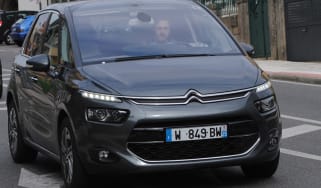
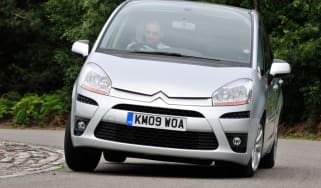
Citroen C4 SpaceTourer (2013–2019) review
It's changed its name from Picasso, but the Citroen C4 SpaceTourer still offers MPV practicality in style

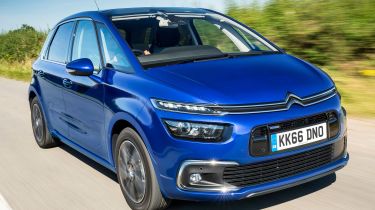

The Citroen C4 SpaceTourer sounds new, but it's just a new name for the C4 Picasso. It's still a great family car that delivers space, style, comfort, low running costs and a brilliantly thought-out interior. The 1.6-litre BlueHDi diesel is the engine to go for, as it delivers a winning blend of performance and efficiency, and Flair trim offers luxury car kit.
The C4 SpaceTourer is a fine example of Citroen doing MPVs well. It’s one of the most spacious and economical mid-sized people carriers on the market, and it’s also an interesting looking car with a futuristic interior. Thanks to a small facelifts in 2016 and again in 2018 (when the SpaceTourer name was added) it still feels fresh, with a new look and the latest in-car tech.
The BlueHDi 100 diesel is the most efficient model in the range, claiming 74.3mpg fuel economy and CO2 emissions of 99g/km. The Citroen is also impeccably refined and comfortable, so if you take all of that into account, it does everything a family car should do well.
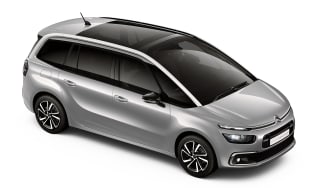
Also available is the seven-seat Grand C4 SpaceTourer, which will appeal to larger families who need more space.
The Citroen C4 SpaceTourer is a leader in the MPV class. No other people carrier can deliver the same kind of practical touches as the C4 Picasso, whether you choose the standard five-seat model or the extended seven-seat Grand C4 SpaceTourer.
Used - available now

2021 BMW
M240i
16,531 milesAutomaticPetrol3.0L
Cash £23,990
2020 Honda
Jazz
23,327 milesAutomaticPetrol1.3L
Cash £13,595
2023 Citroen
e-C4
43,031 milesAutomaticElectric
Cash £11,397
2022 Citroen
C3 Origin
21,845 milesManualPetrol1.2L
Cash £10,797Citroen used the Picasso name from its people carriers since 1999, before it was dropped in 2018. The original Xsara Picasso delivered practicality and a modicum of style, while the C4 Picasso that arrived in 2006 stepped that up a level. But it was the second generation that arrived in 2013 that really set the bar for style in the MPV class. But there's much more to the newly christened C4 SpaceTourer than simply space-age looks, as it has a huge amount of practicality, too. That's why it has won the Auto Express best MPV award every year since it was launched.
The C4 SpaceTourer was given a mild update in 2016 to keep it at the front of the MPV class. Citroen offers the car in three trims - Touch Edition, Feel and Flair - and all models get dual-zone climate control, rear parking sensors, touchscreen infotainment, cruise control and individual rear seats that all fold completely flat.
Feel models add sat-nav, a panoramic windscreen and larger alloy wheels, while the top-spec Flair gets an electric tailgate, tinted rear windows and a massage seat function, among other goodies. The Grand C4 SpaceTourer gets the same trims as the five-seat model.
The petrol engine range consists of a 1.2-litre three-cylinder turbo with either 110hp or 130hp, although only the entry-level Touch Edition gets the lower power output. The diesel range comprises 1.6 and 2.0 BlueHDi units. The 1.6 BlueHDi has either 100hp or 120hp, although again the former is only offered in Touch Edition trim. The 2.0 BlueHDi is a 150hp engine. All engines bar the 110hp PureTech appear in the Grand C4 SpaceTourer.
The lower powered BlueHDi is the only engine to come with a five-speed gearbox, the rest of the range features a six-speed manual as standard. However, Citroen's EAT6 automatic is available on the higher powered 1.2 PureTech and 1.6 and 2.0 BlueHDis, although not in all trim levels. The auto doesn't have too much of an impact on emissions when compared to the manual, either.
Citroen C4 SpaceTourer alternatives
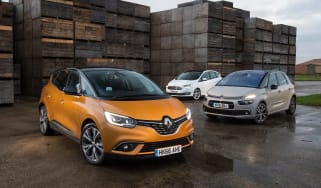
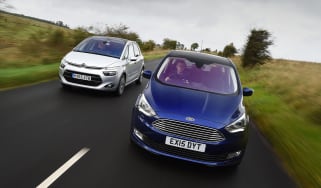
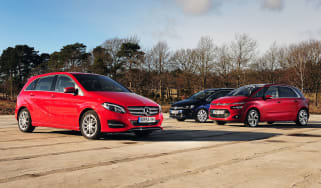
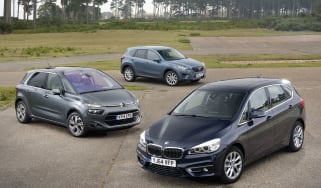
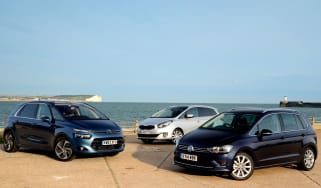
Rivals for the Citroen C4 SpaceTourer are wide-ranging in the MPV sector. It's a direct opponent for the latest Renault Scenic, plus the Ford C-MAX, BMW 2 Series Active Tourer, Volkswagen Touran and at a stretch the Mercedes B-Class. Then there are the small seven-seat MPVs with occasional rear seats, such as the Kia Carens, Ford Grand C-MAX, BMW 2 Series Gran Tourer and Toyota Verso.
The larger Grand C4 SpaceTourer challenges models such as the Renault Grand Scenic, Ford S-MAX/Galaxy duo, SEAT Alhambra, VW Sharan and Vauxhall Zafira Tourer.
Engines, performance and drive
Citroen’s cars have always tended to be comfortable, and the C4 SpaceTourer upholds that reputation. It's a car that majors on comfort rather than performance. Thanks to the softer ride, you never feel like driving quite as hard as you would in a Ford C-MAX, for example. Even so, the C4 SpaceTourer still clings on well in bends despite some body roll, and while its steering is lifeless, it is at least accurate.
Slow things down a bit and you can revel in the strong refinement and supple ride. The Citroen soaks up bigger bumps and undulations with ease, but deeper potholes and sharp ridges can send a shudder through the cabin. Wind and road noise are also well suppressed, and on a long journey it’s more relaxing than the latest Renault Scenic.
Elsewhere, the panoramic windscreen on Feel models and above and thin A-pillars offer unparalleled visibility, although the multitude of controls on the steering wheel can be a touch confusing.
Engines
The basic 128bhp 1.2-litre petrol engine is actually one of the best. Even though it has only three cylinders, it’s hushed around town and punchy enough on the open road – making overtaking simple and straightforward. Specify this PureTech model in Feel trim and it’s also the cheapest C4 SpaceTourer to buy, plus it’s quicker from 0-62mph than all but the most powerful diesel and petrol versions, taking 10.1 seconds.
Although the 98bhp 1.6-litre BlueHDi 100 diesel has the lowest CO2 emissions and best fuel economy in the range, it isn’t much of a performer. It’s quite sluggish in comparison to the other models in the range, covering 0-62mph in 12.7 seconds, and as you have to push the engine a bit to get the car moving, this takes the edge off the Citroen’s otherwise excellent refinement.
The 118bhp version of the same engine is a much better bet – it’s still very economical but is much more flexible, with a lot more pulling power, and is capable of 0-62mph in 11.3 seconds. The smooth engine pulls well from low revs, while the long-throw six-speed manual gearbox has a reasonably precise action. Load the Citroen up with a full complement of passengers and it’ll struggle a little on steeper inclines, although it’s no worse than similarly powered rivals.
At the top of the range is a 148bhp 2.0-litre diesel engine, known as the BlueHDi 150. Although this isn’t quite as frugal as the 1.6-litre versions, it’s still very cheap to run and quite a bit faster, with plenty of mid-range pull and a 0-62mph time of 9.7 seconds.
The fastest C4 SpaceTourer is the 163bhp 1.6-litre THP petrol, which claims 8.4 seconds for the benchmark sprint. But it’s only available as an automatic and is by far the most expensive version to run, so it doesn’t make a great deal of sense in an MPV such as this.
MPG, CO2 and Running Costs
The most efficient C4 SpaceTourer is the BlueHDi 100. According to Citroen’s official figures, this model returns 74.3mpg fuel economy and emits just 99g/km of CO2 – no mean feat for such a large car.
Our choice would be the BlueHDi 120, though – it feels much faster day-to-day and promises an identical 74.3mpg. The most potent diesel C4 Picasso, the BlueHDi 150, is barely any less efficient, as it’s capable of 70.6mpg and 102g/km.
Buyers who are watching the pennies on running costs shouldn’t discount the petrol models, though. Even the brilliant PureTech 130 will return 56.5mpg and emits just 115g/km of CO2. If you spend most your time in town, this is the car we’d go for.
The most expensive and most powerful C4 SpaceTourer THP 165 emits 130g/km or 134g/km depending on the trim, and claims 50.4mpg or 48.7mpg fuel economy, so it’s the least efficient model by a long way.
Insurance groups
The C4 SpaceTourer range starts in insurance group 14 for the entry-level Feel model with the 130 PureTech engine. This rises to group 15 for the BlueHDi 100 diesel and the PureTech petrol in Flair spec.
The BlueHDi 120 models sit in group 17 or group 18 depending on the trim level, while the BlueHDi 150 versions range from group 17 to group 24. Buyers are looking at group 22 insurance for the THP 165 petrol model. For comparison, the C4 SpaceTourer's main rival, the Ford C-MAX, will usually work out cheaper to insure as it spans groups 11-20.
Depreciation
Citroen models have traditionally struggled to hold on to their price over the years, but our experts predict that the C4 SpaceTourer will buck the trend, largely because it’s such a desirable choice in the MPV class. Residual values stand at 40.8 per cent after three years, which are only slightly behind the Volkswagen Touran.
To get an accurate valuation on a specific model check out our free car valuation tool...
Interior, design and technology
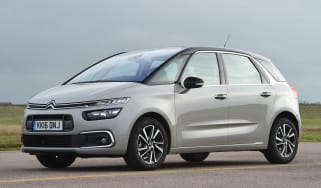
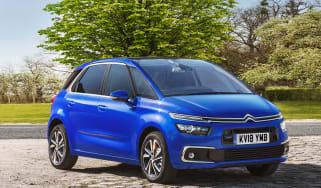
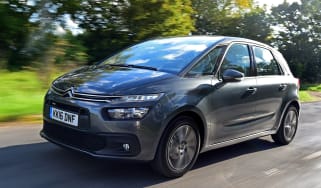
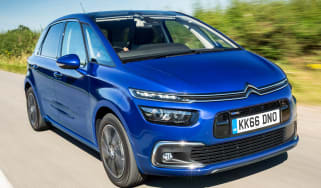
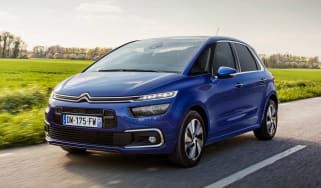
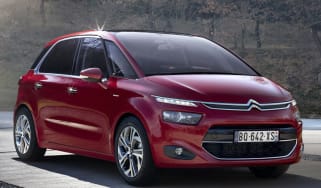
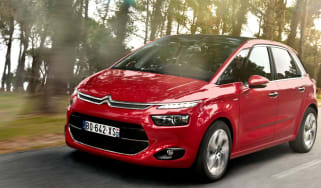
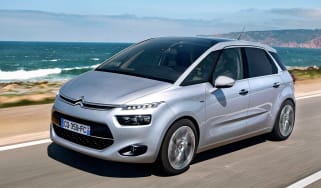
Even compared with the eye-catching new Renault Scenic, the boldly styled Citroen stands out. It proves that style can come in many different forms, and thanks to the car’s design elements, there’s lots to grab your attention here. All versions get alloy wheels and LED running lights, while the Flair model is identified by its larger 17-inch rims and panoramic glass roof.
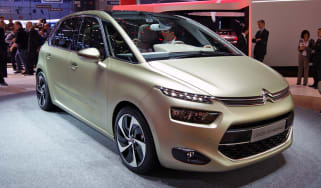
The high-set chevron grille and LED running lights are combined with small headlamps and a wide lower air intake that give the C4 Picasso’s rounded nose a futuristic appearance that certainly stands out compared to some of the less adventurous choices in this market. Think of the front end of any of Citroen’s recent concept cars, and you’ll be half right.
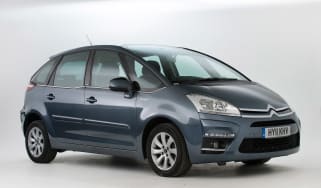
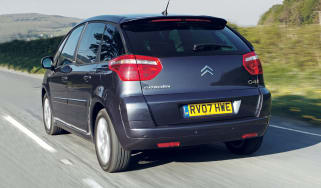
The C4 SpaceTourer's rear end is a little less avant-garde – it’s not that dissimilar to the previous-generation model’s – but overall it fits well with the rest of the car, and the new 3D-effect lights are a nice touch.
Citroen’s smart use of glass on the C4 SpaceTourer adds to the space-aged feel established by the front end, and the C-shaped silver window trim looks like something from one of the upmarket DS models.
Styling cues from the DS range have also been carried over to the interior of the C4 SpaceTourer. The dashboard is a simple mixture of curves and angles, and has a centrally mounted instrument binnacle.
Inside, the top-spec Flair model feels plush and upmarket. The cabin has a real high-quality ambience, thanks in no small part to the soft-touch plastics used to cover the dashboard and the hi-tech twin screen set-up. The lower touchscreen controls everything from the entertainment system to the climate control and navigation, while the top unit displays driving data.
The flagship C4 SpaceTourer isn’t exactly short of kit, either. Parking sensors and a reversing camera are standard, as are cruise and climate control. In addition, there are massage seats, keyless go, sat-nav, USB, a DAB radio and Bluetooth.
The touchscreen centre console has a high-quality feel that helps the C4 SpaceTourer take the fight to rivals from Ford and Volkswagen, and it ensures the dash stays clutter-free. The steering wheel, however, can seem a little complex, as it has a lot of buttons to navigate.
In general, the C4 Picasso is well screwed together, while it features decent-quality plastics and comfortable seats. All models come with a panoramic windscreen that extends to just above the front seats, although blinds can be used to block out intrusive sunlight.
Citroen adds to the car’s airy and relaxed atmosphere by making good use of a large glass area that includes quarterlight windows in the A-pillars; these give the car a sense of space its rivals can’t match.
Sat-nav, stereo and infotainment
The C4 Picasso's infotainment system received an even bigger update than the rest of the car in 2016. All models come with a seven-inch central touchscreen that controls all the major functions, from the climate control to the stereo.
Apple CarPlay, Android Auto and Mirrorlink now feature across the range, making it a doddle to connect your smartphone and access its major functions – in the case of the iPhone, this means text messages, maps and music are beamed to the screen, as are apps like Spotify.
In addition, Feel and Flair models benefit from the separate, configurable 12-inch HD screen that sits higher up in the dashboard and displays all the driving data. Crucially, it also houses the standard sat-nav, which features an excellent 3D layout and crystal clear graphics.
Citroen's system isn’t perfect, however. As with earlier units, the touchscreen is often slow to react, requiring two or three prods to respond. The need to enter a separate menu just to adjust the climate control is also irritating.
Practicality, comfort and boot space
The C4 SpaceTourer scores on family-friendly details. Parents will love the three rear Isofix seat mounts in the rear, while the central dials allow kids to watch mum or dad’s speed. Other helpful features include rear picnic tables, a pop-out torch in the boot and the huge front quarter light windows, which provide a great view at junctions. As with the Renault, there are also handy hidden storage solutions in the rear footwells.
There’s a large bin under the centre console, complete with a 12V power supply and USB socket, as well as drawers under the front seats, deep door bins and lots of cup-holders. Unfortunately, as with many Citroen models (and French cars in general), a big fusebox renders the glove compartment almost useless.
Top-spec models get individual climate controls in the rear, built-in roller blinds in the back doors and an extra ‘conversation mirror’ that allows the driver and front passenger to keep an eye on children seated behind them.
The C4 SpaceTourer is a five-seater, but if you need to carry more passengers then there’s always the Grand C4 SpaceTourer, which is essentially a seven-seat version of the same car.
Dimensions and size
The C4 SpaceTourer is 4,428mm long, 1,826mm wide and 1,625mm tall. That makes it significantly longer than the Ford C-MAX, and about as wide and tall. It’s also longer and wider than the Volkswagen Touran.
Leg room, head room & passenger space
Unlike many of its rivals, the Picasso gets a trio of identically sized seats in the back rather than a smaller central seat, so it can accommodate three Isofix child seat mountings. And because there’s no transmission tunnel, you get loads of legroom in the back, so even tall adults will be comfortable. The individual rear seats slide back and forth, too.
Boot space
At the rear, the clamshell tailgate lifts out of the way (electrically on top-spec models) to reveal a wide opening and low load lip. Boot space can be extended from 537 to 630 litres by sliding the rear bench forward, while folding the seats down presents a completely flat load area and a vast, 1,851-litre capacity. The boot light also doubles as a neat, handheld rechargeable torch.
The Citroen comfortably outdoes the Ford C-MAX in terms of boot space, as that provides 432 litres, although the Volkswagen Touran offers 695 litres and a huge 1,989 litres with its rear seats folded flat.
Reliability and Safety
Citroen finished in 20th place overall in the manufacturers’ chart of our Driver Power 2015 satisfaction survey. While that doesn’t sound great, it’s six places up on its 2014 ranking. Owners praised the brand’s brilliant running costs, with poor scores for build quality, performance, road handling and ease of driving letting the side down.
The C4 SpaceTourer placed 77th in the Driver Power top 200 – badged as the C4 Picasso, obviously, and comfortably in the top half of the individual model chart – with owners ranking it highly for practicality, ride quality, seat comfort and, of course, running costs.
Euro NCAP awarded the car five stars in its independent crash tests, and all models have six airbags, stability control and a speed limiter. The top-spec trim level adds the likes of adaptive cruise control, forward collision alert and blind-spot monitoring. Lane-departure warning and adaptive headlamps are part of the £300 optional Serenity Pack, while surround-view cameras are £450 more.
Warranty
The Citroen C4 SpaceTourer comes with a three-year/60,000-mile warranty. That’s the same level of cover as you get with direct rivals such as the Ford C-MAX and Volkswagen Touran, but the Renault Scenic and Toyota Verso MPVs offer longer warranties. You get a four-year/100,000-mile package with the Renault and a five-year/unlimited mileage guarantee with the Toyota.
Servicing
Citroen recommends servicing petrol versions of the C4 SpaceTourer every year or 20,000 miles. Diesels also need attention annually, with the 1.6-litre HDi models’ service intervals set at 16,000 miles and the 2.0-litre versions’ at 20,000 miles.
Pre-paid maintenance plans for new Citroens or models up to a year old that have yet to have their first service cost £400 or £11.11 a month. That buys the scheduled services for three years and up to 35,000 miles. For cars over three years old, a basic check-up costs £115 and a full service sets you back £195. Citroen also offers bundle deals with annual MoT tests, so owners can pay £149 for a basic service with an MoT or £229 for a full service and an MoT.
More reviews
Car group tests
Long-term tests
Road tests