Kia Rio review (2011-2017)
The Kia Rio is a decent-value supermini, with a long warranty and efficient diesel engines. But rivals are more fun


The first Kia Rio isn't well remembered. An awkwardly-styled part-hatch, part-estate, its one saving grace was its incredibly low price - it certainly wasn't its driving dynamics or interior styling.
The second generation model was a vast improvement, but had no character - and no real reason to buy it over the class leaders from Europe and Japan.
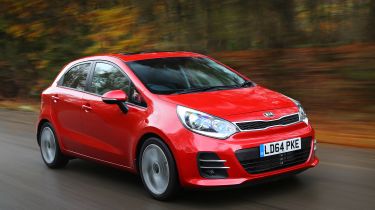
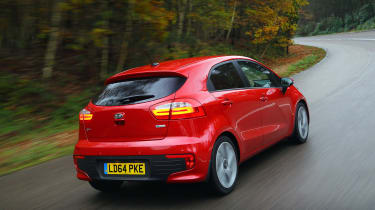
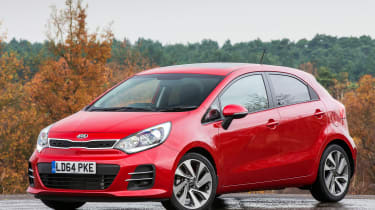
However, third time was the charm and the current Kia Rio is a much better car than its predecessors. It benefits from really slick styling, competitive pricing, plenty of equipment and isn't bad to drive, either. It also comes with the incredibly generous 7-year/100,000 mile warranty that's part of the appeal of any Kia.
The trouble is, in the years since it hit showrooms, the Rio has been rather left trailing. Newer supermini rivals such as the Volkswagen Polo, Skoda Fabia, Honda Jazz, Renault Clio and Ford Fiesta all seem to have leapfrogged it in at least one area. Worse still, sister company Hyundai has launched a new i20 hatch that offers slicker styling and a much improved, much more spacious interior.
Besides all that, the Rio seemed to get a little lost in Kia’s own range. While the likes of the Cee’d, Sportage and new Sorento were off winning awards, plaudits and customers, the supermini felt as if it was left behind.
Used - available now

2022 BMW
3 Series
51,481 milesAutomaticPetrol2.0L
Cash £18,000
2024 Volkswagen
Golf
33,003 milesManualDiesel2.0L
Cash £14,743
2024 Hyundai
Kona
14,742 milesManualPetrol1.0L
Cash £15,197
2025 BMW
2 Series Active Tourer
8,837 milesAutomaticPetrol2.0L
Cash £20,300Kia hasn’t done much over the years to spruce up the styling or the cabin, and the lack of a truly modern petrol engine hasn’t helped – although this will be addressed imminently with the introduction of the Hyundai-Kia Group’s new 1.0-litre three-cylinder turbo. Still, as far as small cars go, the Rio is sensible, well made and pleasant to drive. And for many buyers in this market, that long, long warranty will remain a key selling point.
It’s easy to overlook the Kia Rio in the company’s modern model line-up. While the Cee’d family hatchback, Sportage crossover and Sorento SUV have all been comprehensively updated in recent times, and represent strong choices in their respective classes, the Rio only benefited from a minor nip and tuck in 2015, and has been rather left behind in the supermini market. Yet it still represents really solid, value-for-money motoring, and is even moderately good fun to drive.
The Kia isn’t as spacious as the recently launched Mk3 Honda Jazz, and also trails the latest version of its close cousin, the Hyundai i20, in terms of practicality. Plus, it’s not as thrilling from behind the wheel as the Ford Fiesta, which sets the class benchmark in this field.
• Best superminis on the market
However, it’s still a very capable small car, and buyers for whom the priority above everything else is simple, hassle-free ownership are likely to be attracted by its impeccable reliability record and the peace of mind provided by the industry-leading seven-year Kia warranty.
Engines, performance and drive
The Kia Rio is reasonably good to drive. Its chassis is surprisingly talented and alive, and the car delivers a decent amount of enjoyment when pushed along a country back road. The weak link, as it is with most models in the Kia range, is the steering: the set-up is just too light, too rubbery and too distant for a keen driver to be able to access what the chassis can do. Perhaps that’s not the most important thing in a small, affordable family runaround, but if other models in the supermini market can provide communicative steering – such as the Ford Fiesta and Mazda 2 – why not the Kia?
The ride is pleasingly supple over most surfaces, although if you specify larger alloy wheels to give the car a more sporty look, comfort can suffer.
Engines
If you’re going to buy a Rio, a diesel is the more tempting option at the moment. The dinky little 1.1-litre CRDi is a capable engine with the potential for decent fuel economy. It thrums away happily to itself if you drive gently, although if you push the car hard, it can become quite vocal. With just 74bhp, it isn’t the strongest performer off the line, although it has a very healthy 180Nm of torque – significantly more than the 1.25 petrol model – which gives it a useful extra kick of mid-range pace.
The 107bhp 1.4-litre petrol Rio delivers the quickest acceleration in the range, taking 11.2 seconds to cover 0-62mph. But again it’s short on torque, so the 1.1-litre diesel makes for the better driving companion in everyday situations.
You could upgrade to the 1.4 CRDi diesel, which produces 89bhp and 240Nm of torque, but it’s a good few hundred pounds more expensive, depending on the model, and it’s less economical than the 1.1 CRDi. Then again, Rio buyers who spend most of their time driving in town may find the 1.25-litre petrol makes more sense financially; it costs nearly £1,500 less to buy than the 1.1-litre diesel, and the CRDi will take years to pay back that difference in fuel savings.
MPG, CO2 and Running Costs
The 1.1-litre CRDi diesel in the Kia Rio is incredibly cheap to run – with the strongest fuel economy and the lowest CO2 emissions – but buyers have a choice of versions.
Go for this engine in 1 specification, and Kia claims an impressive fuel consumption figure of 85mpg, as well as only 86g/km of CO2. Yet upgrade to a 1 Air, 2 or SR7 model with the same 1.1 CRDi diesel, and you’re looking at a drop in efficiency to 78mpg and a hike in emissions to 94g/km.
Confused? There’s no real need to be: the difference in emissions has no effect on the annual road tax bill for this small-capacity diesel Rio, as it’s still under the magic 100g/km barrier, so there’s still no charge for VED. Plus, few drivers are likely to notice the 8mpg step down in claimed economy when they tot up their real-world fuel returns.
What’s odd is the 1.4-litre CRDi diesel. It’s equipped with the same ISG stop/start system as the 1.1 and, as it’s slightly larger and theoretically less stressed, you’d think it would be at least as economical. But it’s not – according to the official figures, it records 74mpg on average and emits 98g/km of CO2. That’s still impressively frugal and means this Rio is still exempt from road tax, but the 11mpg difference in economy seems rather large.
The petrol engines also throw out a conundrum. You’d expect the 1.25-litre version to be the cleanest and most efficient choice here, but it’s not. In fact, it claims exactly the same 56mpg economy as the 1.4 petrol, and emits 1g/km more CO2, at 115g/km. Again, there’s no tax difference – buyers will pay £30 a year in VED for either model – but in real-world driving, and given the rather gutless nature of the 1.25, we’d expect significantly better day-to-day fuel economy from the 1.4.
Insurance groups
You won’t find many cheaper cars to insure than the Kia Rio. The 1.25 and 1.1 CRDi models hover around insurance groups 2 and 3, while the highest you’ll go is group 9 for a top-spec 1.4 petrol.
Depreciation
Our experts predict that the Kia Rio will be worth around 38.8 per cent of its new price after three years, which is a bit behind the curve for a small family hatch. Rivals such as the Skoda Fabia, Honda Jazz and Volkswagen Polo will generally hang on to around 42 per cent of their value, even with the Kia’s generous seven-year warranty taken into account. That makes a personal contract plan (PCP) an appealing way to buy, to protect your investment.
Interior, design and technology
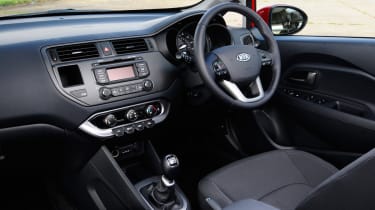
Prior to the 2015 facelift, the Rio was primarily about being simple and sturdy on the inside. Luxuries extended to a USB connection for the stereo and audio controls on the steering wheel; that was about it.
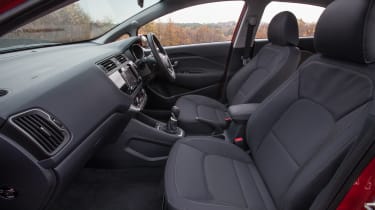
But the revamp helped to bring things bang up to date. While the Rio had always been solidly put together, the plastics and overall design took a significant step forwards, plus a new steering wheel really lifted the cabin ambience – it’s borrowed from the Cee’d and incorporates a raft of buttons and controls. The main surfaces of the dashboard gained a lot of pleasing soft-touch materials, which also helps. It’s still not the most exciting cabin layout, and it falls short of the standard set by the Volkswagen Polo and new Honda Jazz, for example, but it’s certainly competitive.
Basic equipment includes a trip computer, electric front windows and electronic stability control. The 1 Air models add air-conditioning, while a Rio 2 gets alloy wheels, electric mirrors with LED indicators, foglights, a leather steering wheel, an armrest and a cooled glovebox. A 3 adds auto air-conditioning, parking sensors, bigger alloys, heated seats and automatic wipers, while a top-of-the-range 4 gets leather seats, keyless ignition and a heated steering wheel.
Sat-nav, stereo and infotainment
Again, the 2015 facelift brought a whole new level of tech to the Kia Rio. Even the basic car is still pretty well specified as far as infotainment goes. Although the stereo looks pretty plain, and only has four speakers, it comes as standard with a USB port, allowing easy playback of tracks, podcasts and audiobooks from your smartphone.
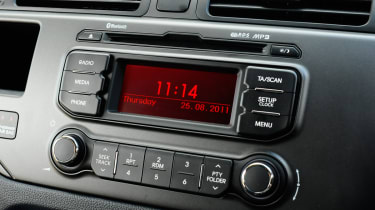
All models have Bluetooth connectivity, so you can not only make hands-free calls from your phone but also stream music wirelessly, while even the basic Rio 1 comes with a DAB radio. Upgrade to a Rio 3 and for less than £14,000 you get a seven-inch touchscreen infotainment system complete with sat-nav, which includes European mapping and traffic alerts.
Practicality, comfort and boot space
There seem to be two distinct groups of superminis these days: the likes of the Honda Jazz and Hyundai i20, which offer interior space on a par with cars in the class above, and smaller, more traditional models. The Kia Rio falls into the latter camp, so it’s spacious, but perhaps not quite as spacious as you’d like it to be.
Size
At just over four metres long, the Rio is one of the bigger superminis on the market. It’s longer than a Mk1 Ford Cortina of the sixties, which is a measure of just how big ‘small’ cars have become in recent years. But that’s not entirely reflected in the cabin.
Leg room, head room & passenger space
The front seats of the Rio are very comfortable and the relatively flat and upright dash design means that there’s a pleasant feeling of spaciousness, even for taller drivers and front seat passengers. Push the front seats all the way back, and driver or passenger have more than a metre of legroom.
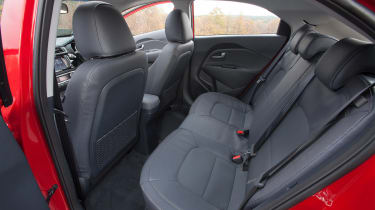
Space isn’t quite so generous in the back, although it should be enough for most passengers; there’s room to match that of a Ford Fiesta or Volkswagen Polo. But the Rio is left trailing by the Honda Jazz and its Hyundai i20 cousin, both of which offer significantly more space. When Kia replaces this car, with the new model set to feature the same platform as the latest i20, we’d expect cabin space to be comparable.
Boot
The boot is also surprisingly small. Although a volume of 288 litres should be enough, it’s not much more than you get in the MINI five-door, and it’s a surprise when load capacity figures in this class don’t start with a three these days.
There is a 60:40 split fold rear seat as standard, but when you flip it forwards you don’t get a flat load floor all the way through, and the space expands to 923 litres – just below the magic 1,000-litre mark. This isn’t bad within the context of the class, but there are better options available if load space is your ultimate concern.
Reliability and Safety
If you’ve ever considered buying a Kia, then you already know its cars come with a generous warranty. But the Rio has such an impressive reliability record that you’re unlikely to need the peace of mind of the manufacturer cover. The car has been on sale since 2011 in its current form, and in that time no major mechanical issues have been reported, so you can expect solid, reliable performance from your Rio.
There are just a couple of things to watch for – the stereo systems have been known to suffer from glitches (related Hyundais often have the same issues), which is a minor irritation. Meanwhile, if you’re buying one of the diesel models, make sure you do enough long-haul mileage to keep the engine operating at proper thermal efficiency, or the diesel particulate filter could clog, which can be expensive to fix.
The Rio performed well in the Auto Express Driver Power 2015 satisfaction survey. It achieved a rating of 89 per cent, which translated into a ranking of 59th in the top 200. That certainly suggests owners are pretty happy with their cars.
Safety certainly won’t be a concern. The Rio achieved a five-star Euro NCAP crash test rating in 2011, and all models come with side and curtain airbags, as well as the usual driver and passenger airbags, plus ESP, Isofix child seat mountings, hill start assist and tyre pressure monitors.
Warranty
The seven-year warranty is a key selling point of any Kia. You do need to keep up your servicing with a main dealer to maintain the full warranty, though, and it’s worth remembering that the package is limited to 100,000 miles. Sister company Hyundai offers unlimited mileage cover as part of its five-year warranty. Mind you, the Kia guarantee has an unlimited mileage for the first three years, so if you’re buying on a PCP deal, there’s essentially no difference.
Servicing
Kia sets service intervals for the Rio at 10,000 miles or 12 months for petrol models and 20,000 miles or 12 months for the diesels. Buyers looking to budget for their maintenance bills in advance can choose from two pre-paid servicing packages: the Care-3 plan covers the first three services for £299, while the Care Plus scheme takes care of the first five check-ups for £599. These packages cover all regular replacement items, including engine oil, oil filters, sump plug washers and air filter elements. Also included in the price is the cost of the car’s first MoT.