Used Renault Scenic (Mk4, 2016-2019) buyer's guide: look no further if you want versatile MPV
A full used buyer’s guide on the Renault Scenic covering the Scenic Mk4 that was on sale between 2016 and 2019

Verdict
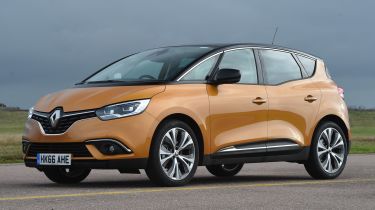
The current Renault Scenic is an all-electric SUV and is very different from the model it replaced, but the fact that there’s no significant appetite for the Mk4 is a shame, because it’s good to drive, bursting with practicality and excellent value. It seems SUV-focused buyers no longer want MPVs of any size. As a result, second-hand Scenics are much more unusual than you might think, and that’s unfortunate. The Mk4 looks really smart and it offers a level of cabin versatility that’s generally not available in the compact SUV sector – especially if you want seven-seat accommodation. We liked the Grand Scenic enough to commend it in our 2017 Best MPV category in our New Car Awards, and it’s still worthy of your consideration.
Manufacturers generally play safe with their cars because getting it wrong can prove disastrous – but not all companies are the same. Renault stands out when it comes to taking risks and innovating, and while some of its business decisions have been questionable over the years (such as the Avantime and Vel Satis), this French firm has also created some all-time greats.
These include the 1960s R4 and R16, while in the 1990s it came up with the Scenic, a brilliant, Mégane-based MPV. Rivals latched on, and soon there were numerous small MPVs on the market – but changing tastes mean virtually all have now disappeared, including the Scenic and its bigger, seven-seat brother, the Grand Scenic.
History
The Scenic Mk4 arrived in December 2016. Priced from £21,445, it kicked off with a 1.3-litre TCe engine available in 114bhp and 128bhp forms. There was also a 1.5 dCi diesel model producing 128bhp, 109bhp or 158bhp; the latter two versions were available with an EDC (Efficient Dual Clutch) automatic transmission.
Used - available now

2019 SEAT
Leon
71,623 milesAutomaticPetrol2.0L
Cash £11,897
2023 Polestar
2
51,230 milesAutomaticElectric
Cash £18,697
2023 Ford
Kuga
24,637 milesManualPetrol1.5L
Cash £16,797
2019 BMW
1 Series
82,675 milesManualDiesel1.5L
Cash £8,697February 2018 saw the introduction of a new turbocharged petrol unit with direct injection, which promised more power and improved economy. Displacing 1.3 litres and known as the Energy TCe, it came in both 114bhp and 138bhp form. The latter, badged TCe 140, was available with manual or EDC automatic transmissions.
From November 2018 the line-up was revised to consist of Play, Iconic and Signature trims, but within a year the Scenic had been dropped from Renault’s UK range. The Grand Scenic was axed in spring 2020.
Prices
The Renault Scenic Mk4 is rare on the used market, but you can get a good second-hand example for less than £8,500 through our Buy a Car service. The Renault Grand Scenic is more readily-available, with prices starting from just over £9,000.
Check the price of a specific Renault Scenic with our free car valuation tool...
Which one should you buy?
We wouldn’t steer you away from any of the powertrains. All of them give reasonable performance and refinement, and as you’d expect, the diesels offer significantly better economy, too. The EDC transmission is smooth and easy to live with as well.
The entry-level Expression+ comes with dual-zone climate control, automatic headlights and wipers, powered windows front and rear, electrically adjustable and heated door mirrors, plus a seven-inch touchscreen with DAB and Bluetooth.
Dynamique Nav adds front and rear parking sensors and navigation, while the Dynamique S Nav gets a rear camera, head-up display, privacy glass, 8.7-inch screen, panoramic roof, Bose 11-speaker hi-fi, ambient cabin lighting and integral sun blinds for the side windows. The Signature Nav has LED headlights, electrically adjustable front seats and leather trim.
Alternatives to the Renault Scenic
Arguably, many rivals are mid-sized SUVs, but we’ll stick with compact MPVs here. That opens up a few great options including the Kia Carens, which is reliable, top value and well equipped. The Ford S-Max is stylish, great to drive and relatively plentiful, while the Volkswagen Touran is solidly constructed, easy to live with and available with a range of excellent engines.
One of the more popular seven-seaters was the Vauxhall Zafira, which is good value and very versatile, while the Citroen Grand C4 Picasso (which came in five-seat form as the C4 Picasso) is another stylish and good-value option. A more left-field option is the Mazda 5, while BMW’s 2 Series Gran Tourer is worth a look – but more costly.
What to look for
Wheels
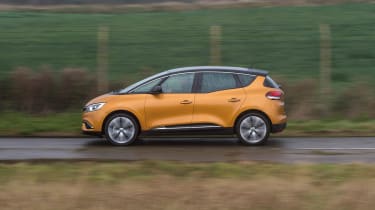
All Scenics feature 20-inch alloys, which can make the ride a bit fidgety on rough roads. Replacement tyres are £100 a corner.
Diesels
All diesel Scenics and Grand Scenic Mk4s are Euro 6 compliant, so you should be able to drive in Clean Air Zones without fees.
Towing
Regardless of the powertrain, all pre-spring 2019 Scenic and Grand Scenics are able to pull up to 1,850kg. This was then cut to 1,800kg.
Common faults
Some owners mention issues with ECUs and sensors, while keyless-locking systems can play up, as can Bluetooth connections. All Scenics get large 20-inch wheels, so keep an eye out for kerb damage, and listen for any dashboard rattles.
Interior
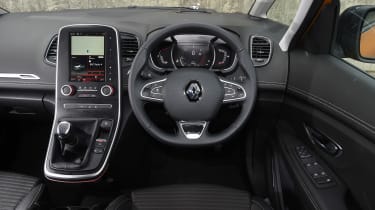
Moving up the range makes a big difference to the quality of the materials and the cabin ambience. Yet whatever you buy you’ll get plenty of space for five adults, while the third row of seats in the Grand Scenic is fine for children, or small adults on short journeys. The fit and finish is good, while boot space is impressive. The Scenic and Grand Scenic also features a sliding middle row, so boot space is extremely variable – and class competitive.
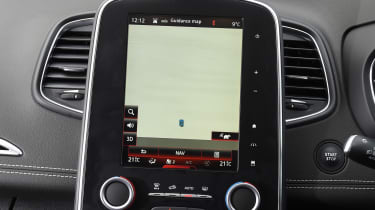
The Scenic was fitted with a seven-inch portrait-style infotainment touchscreen as standard, while an 8.7-inch unit was available on higher-specification models.
Running costs
All Scenics and Grand Scenics need to be serviced every 12 months or 16,000 miles, whichever comes first. Services alternate between minor and major, regardless of engine. Whereas the minor service is just an oil and filter change, the major adds new air and pollen filters. The brake fluid also needs to be replaced every three years or 80,000 miles, while fresh coolant is required every five years or 96,000 miles.
Diesels need new cambelts every six years or 96,000 miles; petrols are chain driven.
Recalls
Renault has recalled the Scenic Mk4 three times so far. The first time was in September 2017, when 610 cars (including some Méganes and Kadjar SUVs) made between September and November 2016 were recalled because of faulty curtain airbags. In the event of a collision, these could potentially fail to deploy.
In November 2019, Renault recalled 116 Scenics built between September 2018 and June 2019. This time it was because the NOx (nitrogen oxide) sensor hadn’t been tightened up properly on the production line, so it could sometimes work loose; it simply needed to be tightened up for the issue to be resolved. The most recent campaign came in June 2020, when 197 Méganes and Scenics were recalled because the fuel hose could chafe, leading to leaks. The fix was a straightforward hose replacement.
Driver Power owner satisfaction
This Scenic’s lack of sales success in the UK is betrayed by the fact that the fourth-generation model has never appeared in any of our new or used Driver Power surveys. When these MPVs were current, Renault was generally getting mid-table scores at best, and came 20th out of 29 firms in our 2021 Brands survey. Owners liked the ride quality and handling, but had less positive things to say about the drivetrains.
Renault Scenic review: what we said
Extracts from our Renault Scenic test drive in November 2019
The Scenic upholds Renault’s reputation for producing practical and desirable MPVs. It rivals the Citroen C4 SpaceTourer for style, while its interior is fractionally ahead for quality and upmarket appeal. It’s also spacious, well equipped and cheap to run. Yet it’s undermined by its inconsistent ride and poor refinement, plus it can’t match the SpaceTourer for family-friendly features.
Behind the 2016 Scenic’s shapely body and massive 20-inch wheels, it’s a practical proposition with loads of useful storage areas and seats that flip and fold easily. Legroom is a little tight in the back for adults, though, and a Citroen C4 SpaceTourer is more spacious. The interior is solidly built in the main, too, with plenty of the latest tech to keep driver and passengers happy.
Engines, performance and drive
Renault isn’t just looking to innovate with the Scenic’s looks; it’s also hoping that the MPV can offer a nicer driving experience than a similarly-sized crossover or SUV. By sitting lower to the ground it has a lower centre of gravity, and Renault doesn’t have to combat body roll by fitting stiff suspension.
That’s only in theory, and given that the Scenic shares its underpinnings with the Megane, you’d expect the family-friendly MPV to deliver comfort and refinement at the expense of sharp handling and driver fun. But on the move it never feels as quiet and composed as its smaller brother or its MPV rivals.
The electrically assisted steering is direct and well weighted, so you can place the Scenic accurately, plus there’s surprisingly little body roll. However, its vast 20-inch alloys are wrapped in relatively narrow 195-section tyres, so the Renault runs out of grip sooner than most rivals. It does remain safe and predictable, though, and the stability control cuts in smoothly.
More of a shock is the firm, brittle ride, which causes the car to fidget and thud over imperfections that a Citroen C4 SpaceTourer or Ford C-MAX soak up without fuss. There’s also some road roar, while the thin windscreen pillars suffer from wind noise on the motorway.
Still, visibility is good thanks to the large expanse of glass and tall windscreen, although it doesn’t come with the nifty sliding blinds you’ll find in a Citroen C4 SpaceTourer. It can be tricky to work out where the bonnet line ends as the windscreen is pushed so far forward and that makes tight manoeuvres in parking bays less than fun.
Power and 0-62mph
The Scenic’s petrol and diesel range was updated in 2018 to help the car deliver a better mix of performance and economy. The 1.3 TCe 140 turbo petrol, producing 138bhp, and the 118bhp 1.7 Blue dCi 120 diesel are available in all three trim levels that the Scenic is offered in. As well as 138bhp, the 1.3 TCe petrol has 240Nm of torque, and it manages the 0-62mph sprint in 10.1 seconds. Choosing the EDC auto adds a tenth of a second to this time.
The diesel is a better fit for the Scenic, even though it's not as powerful. The Blue dCi is smooth and refined, plus the six-speed box benefits from a neat shift action. However, you’ll have to make full use of the transmission to keep pace with traffic. The 118bhp engine isn't the most powerful motor when compared to rivals, but the 300Nm torque figure is useful. Still, a 0-62mph time of 11.1 seconds is nothing to write home about, but that slug of torque will help in everyday driving, especially when the car is fully laden.
Renault briefly offered a petrol-electric ‘Hybrid Assist’ variant of the older 1.5 dCi 110 diesel for £1,000 extra. This mild hybrid uses an integrated starter generator and regenerative braking to assist the engine wherever possible – that means it can’t run in silent electric only mode like a Prius, for example.
MPG and CO2
You may be a bit disappointed if you bought the Scenic instead of an SUV hoping for better fuel economy: in reality, the latest WLTP test procedure puts the MPV behind its SUV counterparts. The 1.3 TCe manages up to 41.5mpg in the latest test and emits 135g/km of CO2. These figures are poorer than those quoted for the Renault Kadjar with the same unit.
Add the EDC auto and the Scenic's fuel economy is marginally worse at 40.9mpg, but emissions are slightly better at 131g/km.
If it’s frugality you’re after, however, as ever we’d recommend choosing a diesel engine. The Blue dCi manages up to 51.4mpg on the combined WLTP test cycle and emits 126g/km, while adding the EDC auto to the diesel sees economy tail off to 47.9mpg and emissions remain at 126g/km.
Interior, design and technology
Renault’s design boss Laurens van den Acker has gone to great lengths to explain why the exterior look of the Scenic is so important. The only way to save the MPV sector is to make these cars more desirable, he reckons, and he’s even gone as far as saying that if this Scenic doesn’t sell, then MPVs deserve to die altogether.
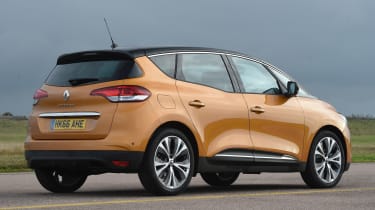
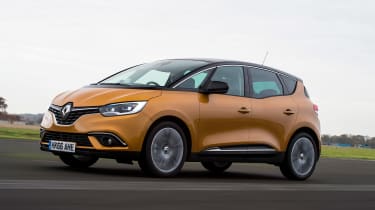
You can see what he’s getting at when you first clap eyes on the Scenic. The bulbous front-end is even more striking than the Renault Kadjar, while the windscreen is steeply raked and there are loads of curves and creases.
At the back the design is softer and more rounded, while it’s raised up slightly to give it presence. You could go as far as calling it elegant, although this is still an MPV. It certainly gives the Citroen C4 SpaceTourer a run for its money, and is far less staid than many other MPV rivals.
The 20-inch wheels are as big a design trait as the bodywork – they’re the same size as the ones you get on a Bentley Mulsanne, for example. There are several designs available, and they can even be personalised with handy inserts that clip on and off.
Inside, things aren’t quite as stylish. Most of the plastics are dark and the design isn’t particularly interesting. Still, it looks smart enough and feels considerably better built than the previous generation car, with only a few squeaks and rattles on our early test model letting things down. It just lacks a bit of the plushness and airiness of the C4 SpaceTourer's interior.
The design is much the same as its Megane sister model, only with a less driver focused and more upright, family-friendly shape. Renault has elected to ditch the old centrally-mounted speedo and use digital instruments in the conventional place behind the wheel, which it says improves the driver’s control of the car. Top models are very well kitted-out, thanks to electric memory leather seats, a panoramic glass roof, a Bose sound system and a head-up display, plus the new portrait-style touchscreen.
Sat-nav, stereo and infotainment
Play and Iconic versions of the Scenic feature a 7-inch infotainment touchscreen as standard, but Signature models get the portrait-style 8.7-inch R-Link 2 set-up first seen in the Megane. Compared with the units in the Citroen and Ford, the Renault has the crispest graphics, the most user-friendly menus and most responsive screen, which includes a pinch and swipe function.
As with its rivals, the screen features a number of tabs that work as shortcuts to the main functions (sat-nav, stereo and climate controls). Connecting your phone is straightforward, as is programming a destination into the nav, although we found the TomTom-powered unit often failed to highlight snarl-ups until we were in them.
All versions of the R-Link 2 system feature a 12-month subscription to the R-Link store, for access to a variety of free and paid for apps, from weather updates and Michelin guides to a concierge service and E-mail. One criticism is that there’s no Apple CarPlay or Android Auto option.
The system is fairly easy to operate, although it can be slow to swap between menus, which spoils the experience somewhat.
Practicality, comfort and boot space
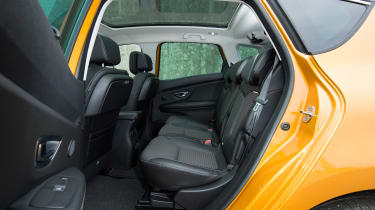
This is where an MPV has to shine regardless of how desirable it is on the outside, and the Scenic largely delivers on the practicality front. For starters, it’s longer and wider than the old model, while the boot is class-leading for a five-seat people carrier.
Up front you’ll find acres of leg and headroom, while the seats have a wide range of adjustment although there’s no fancy electric footrest like on the Citroen C4 SpaceTourer. The Scenic has quite an SUV-like driving position, too, which will appeal to those torn between the two classes.
In the back, space isn’t quite as good as the best in the class, but at least there’s a wealth of storage spaces dotted about the cabin, including a central console with 13-litres of space in it that slides smoothly back and forwards depending on what you need from it. There are also compartments under the front seats and rear seat floor, plus a glovebox that slides outwards like a filing cabinet. Further neat touches include little secondary sun-visors that slide out of the main ones to block the small bit of window by the rear-view mirror that usually lets the sun in.
The folding mechanism for the three rear seats is a doddle to use, and as an option the Scenic’s rearmost chairs can be folded electrically either with buttons in the boot or via a menu on the central touchscreen.
Size
The Scenic is 20mm wider than the old model, 40mm higher off the ground and has a 32mm longer wheelbase, yet the rear overhang is 16mm shorter. Buyers can also opt for the seven-seat Grand Scenic, which adds an additional 228mm of bodywork. By comparison, the Citroen C4 SpaceTourer is slightly longer than the standard Scenic but not as wide or as tall.
Legroom, headroom and passenger space
The Scenic offers plenty of head and legroom for passengers despite top models coming fitted with a panoramic glass sunroof. Kneeroom is a touch compromised by the large dashboard, but overall most shapes and sizes should be able to get comfortable.
The back isn’t quite as commodious, however, as there isn’t a huge amount of legroom for taller adults even with the three seats slid back and reclined as far as they go. A Citroen C4 SpaceTourer is better in this regard. Headroom is reasonable but not class-leading, although shoulder room is much better than before thanks to the increased body width.
Boot
The Scenic offers a class-leading seat-up bootspace capacity of 572-litres, although you have to bear in mind that figure is without the removable boot floor and tyre inflation kit. The boot is well-shaped, but the load lip is a little high and with the seats folded down there’s a bit of a lip to lift items over. The rear bench can be folded at the touch of a button, but this gives a maximum capacity of 1,554 litres – 297 litres less than in a C4 SpaceTourer.
Come and join our WhatsApp channel for the latest car news and reviews...