Mercedes A-Class review
The Mercedes A-Class is a premium hatch that is full of quality, with great on-board technology and a range of frugal engines

Our opinion on the Mercedes A-Class
The Mercedes A-Class has always been a compact hatch with one major selling point – that three-pointed star on the nose. But while its predecessors all lacked a little substance behind the badge, this latest generation is far more worthy of being considered against the class best.
Step inside and the A-Class remains a very classy place to be. The interior design and overall quality is impressive, and the infotainment system is relatively easy to use. Some rivals are more fun to drive, and several are more comfortable, but the A-Class remains very strong in terms of both refinement and efficiency.
About the Mercedes A-Class
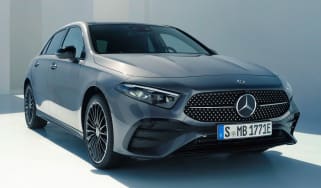
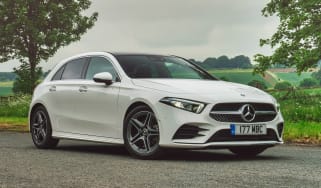
The latest Mercedes A-Class is the fourth generation of Mercedes’ smallest car. While the first two examples took on a mini-MPV design direction (with clever, if not particularly desirable, results), the current A-Class has adopted a more conventional five-door hatchback shape in order to compete directly with the Audi A3 and BMW 1 Series.
It was launched in 2018 and received an extensive update in 2022. Mercedes has launched the latest CLA saloon using its compact car platform tech, but there are no plans to replace the A-Class hatch. The A-Class saloon has already faced the axe.
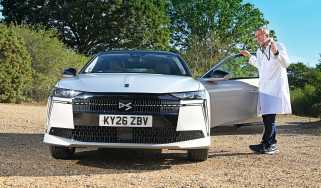
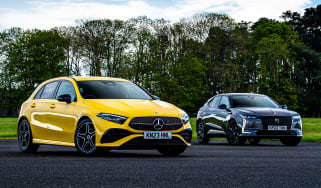
We’ve tried out many iterations of A-Class throughout its long lifespan, including a premium hatchback twin test of an AMG Line Executive Mercedes A-Class against a DS 4.
Performance & driving experience
Pros |
|
Cons |
|
There’s no shortage of choice when it comes to A-Class powertrains, which include petrol, diesel, and plug-in hybrid options – which is more than you’ll find with the BMW 1 Series. In the usual Mercedes fashion, the A-Class places a far greater focus on comfort rather than entertainment, so if you’re seeking driving thrills, you’ll need to look towards the expensive Mercedes-AMG variants or a 1 Series.
| Model | Power | 0-62mph | Top speed |
| A180 | 134bhp | 9.2 seconds | 134mph |
| A200 | 161bhp | 8.2 seconds | 140mph |
| A250 e | 215bhp | 7.4 seconds | 140mph |
Performance, 0-60mph acceleration and top speed
The entry-level A 180 manages 0-62mph in 9.2 seconds with a 134mph top speed, while upgrading to the 161bhp A 200 petrol version sees the sprint time improve to a more sprightly 8.2 seconds and 140mph. All perform well on paper, but the torque deficit relative to the A 200 d means that these A-Class derivatives need working hard at times to get up to speed. This effort is hastily announced through a loud, thrashy tone, which spoils the refinement a bit.
Used - available now

2021 Mercedes
A Class
40,917 milesAutomaticDiesel1.5L
Cash £14,267
2023 Mercedes
A Class
43,089 milesAutomaticPetrol1.3L
Cash £17,400
2023 Mercedes
A Class
13,972 milesAutomaticPetrol1.3L
Cash £20,992
2021 Mercedes
A Class
58,486 milesManualPetrol1.3L
Cash £12,432Thankfully, the mild-hybrid system in the A 180 and A 200 works very smoothly, cutting the engine out while stationary and restarting it quickly, while smoothing out some of the lumpiness that earlier examples of the A-Class with this engine-and-gearbox combination suffered from.
The plug-in hybrid A 250 e provides a healthy amount of performance. The car accelerates from 0-62mph in 7.5 seconds thanks to a combination of a 1.3-litre, 4-cylinder turbo petrol with an additional electric motor, which in total produces 215bhp. In EV mode, it tops out at 87mph, going on to 143mph with combustion power.
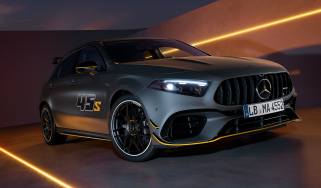
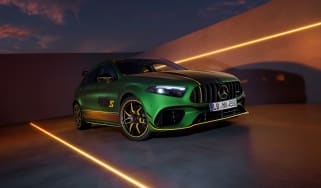
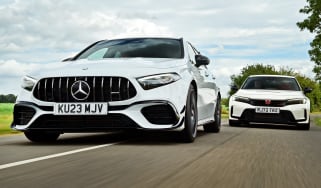
For those after a little more performance, either the 302bhp Mercedes-AMG A35 or 415bhp Mercedes-AMG A45 should fit the bill nicely, with 0-62mph times of 4.7 seconds and 3.9 seconds, respectively. To find out more about these versions, feel free to follow the links provided.
Town driving, visibility and parking
Regardless of whether you have a less expensive model with the simpler torsion beam rear suspension or the more sophisticated multi-link rear suspension found on Premium Plus and Mercedes-AMG models, the A-Class tends to fidget over bumps at low speeds rather than smothering them, and this is especially noticeable with larger wheels.
One thing that does work in this Mercedes’ favour as a city dweller, though, is that its precise and lightweight steering makes it very easy to park.
Country road driving and handling
Like-for-like, the current A-Class is 20kg lighter than the old one, even though it’s grown in every direction. While the handling is an improvement on what came before, this still isn’t an exciting car. It’s got plenty of grip, but the suspension is biased more closely towards security than fun. The aforementioned light steering is also a bit devoid of feedback, which depletes the engagement factor even further.
Motorway driving and long-distance comfort
If there’s one aspect of the A-Class that impresses the most from behind the wheel, it’s refinement. On a motorway cruise, it’s class-leading: a 0.25 drag coefficient means that there’s barely a whisper of wind noise. The engines settle down to a barely audible hum, and the most obvious – but not intrusive – sound comes from the tyres.
“The A-Class has a low driving position, so being able to see traffic lights and the area beyond the A-pillars on screen is genius for a car used in traffic daily.” - Darren Wilson, creative director.
MPG & running costs
Pros |
|
Cons |
|
The strong figures across the standard A-Class range are no doubt partly thanks to a slippery body shape to help the aerodynamics. If you're prioritising efficiency, the plug-in hybrid A 250 e will appeal as Mercedes claims an all-electric range of up to 52 miles – and a staggering official combined fuel economy of 117.8mpg.
That latter figure is somewhat meaningless, however, as with frequent charges, you could potentially run this car for months without filling it up with fuel even once.
The more traditional A-Class diesel is still pretty frugal and offers excellent returns from a tank of fuel. The A 200 d achieves a claimed maximum of up to 57.7mpg.
The A 180 and A 200 petrol models use 48-volt mild-hybrid tech and a more proactive start-stop system to help with fuel consumption. There's nothing to really separate the A 180 and A 200 in terms of fuel efficiency with both capable of around 45 to 48mpg.
Naturally, the performance-oriented AMG A 45 S model is the least efficient of the range, although a claimed 30.7mpg on the combined cycle is still a good return when you consider it produces a staggering 415bhp.
| Model | MPG | CO2 | Insurance group |
| A 180 Sport Executive | 48.7mpg | 131g/km | 19 |
| A 200 Sport Executive | 48.7mpg | 131g/km | 23 |
| A 250 e AMG Line Executive | 117.7mpg | 55g/km | 31 |
Electric range, battery life and charge time
The plug-in hybrid A-Class uses a 15.6kWh lithium-ion battery to feed a single electric motor, and this offers a WLTP combined electric range of up to 52 miles. To get the most out of the A 250 e's hybrid system in terms of both range and fuel economy, you’ll need to charge it as often as possible.
The A 250 e has a maximum charging speed of 11kW, and a 10 to 100 per cent top-up takes under two hours if you use a typical 7.4kW home wallbox. A domestic three-pin socket will take five and a half hours to do the same job.
| Model | Battery size | Range | Insurance group |
| A 250 e AMG Line Executive | 15.6kWh | 52 miles | 31 |
| A 250 e AMG Line Premium | 15.6kWh | 48 miles | 31 |
| A 250 e AMG Line Premium Plus | 15.6kWh | 48 miles | 32 |
Insurance groups
The A 180 falls into insurance groups 19 to 21 (out of 50), while the A 200 tops out at group 25 in its highest trim level. These are pretty much in line with the BMW 1 Series, which sits between groups 21 and 29.
However, opting for the A 250 e pushes the A-Class up and over group 30, which will really ramp up your premiums.
Tax
Mercedes’ upmarket status naturally results in premium pricing, so you’ll need to tread carefully if you wish to stay below the £40,000 luxury car tax threshold. AMG Line Premium models and above have a list price above this line, while lower-specification models are also at risk if you add one too many options. Doing this will add a £440 surcharge to your annual tax bill.
The A 250 e PHEV is the best option for company car buyers who fancy an A-Class. However, this still doesn’t come close to a fully electric car for company car tax savings. For the most forgiving Benefit-in-Kind (BiK) bills, you’ll need to look towards electric hatchbacks like the DS 4 E-Tense or Cupra Born instead.
Depreciation
Despite its badge prestige and general popularity, our market data show that the Mercedes A-Class retains only 38 to 46 per cent of its original value after three years or 36,000 miles. Compare this to the BMW 1 Series, which manages 45 to 49 per cent, and this outcome is a little disappointing.
To get an accurate valuation on a specific model check out our free car valuation tool…
Interior, design & technology
Pros |
|
Cons |
|
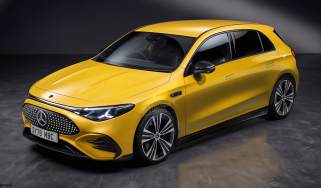
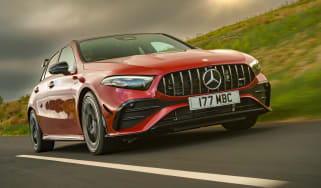
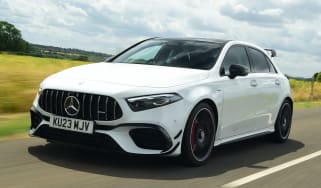
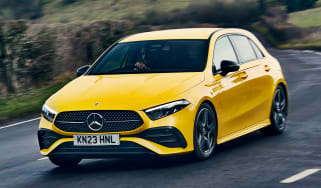
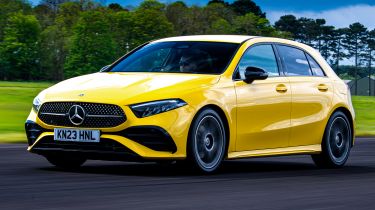
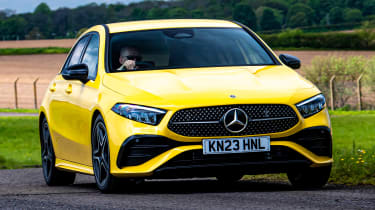
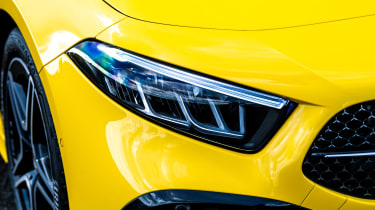
The fourth-generation A-Class sports a design which amounts to a fairly conservative evolution over the old model. It’s a bit sharper to look at while the lights are pointier and slimmer. The hot AMG versions get a sporty body kit and a lairy wing, but overall it’s a look which will neither set pulses racing nor put off existing customers.
Non-metallic Polar White and Night Black paint hues are standard for the A-Class range, with a handful of other exterior colours available. However, there's not much in the way of other opportunities to personalise your car.
Interior and dashboard design
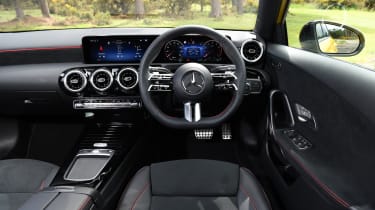
The interior design is a real A-Class highlight. It’s unique, attractive, well-laid out and feels immaculately put together with lots of soft-touch plastics. The giant leap forward in appearance, however, is thanks in no small part to the fantastic dual-screen MBUX infotainment system – more on that later.
Materials and build quality
Despite being one of the least expensive options in the Mercedes line-up, the A-Class still feels very well put together. There’s no shortage of premium-feeling materials used, and the cabin wouldn’t feel out of place in one of the brand’s bigger and pricier offerings.
Infotainment, sat-nav and stereo
Called ‘MBUX’, the A-Class infotainment system is very impressive. All A-Class models feature a pair of 10.25-inch screens positioned side-by-side for an almost continuous widescreen display: the screen in front of the driver shows various driving information and data, while the central display caters for the infotainment functions.
The main menu has three large widgets for phone connectivity, navigation, and audio functions. Swiping through them is slick, but not quite smartphone fast. Meanwhile, loading times are fine, but the navigation system speed is pegged back by loading three route options at once. It would be quicker if it started with the optimum route, then provided alternatives.
The screen has an excellent resolution, so Apple CarPlay and Android Auto look sharp. The driver’s screen is just as clear, and allows the driver to show the trip, navigation or driving functions in a number of combinations.
The steering wheel also gets touch-sensitive panel controls like those found in the flagship Mercedes S-Class, while higher-spec models feature augmented-reality navigation. When approaching junctions, the system displays images from a forward-facing camera onto the screen, and superimposes arrows onto the display in real time to inform the driver of the direction they need to take.
Boot space & practicality

Pros |
|
Cons |
|
The A-Class is exclusively available as a five-door hatch due to the demise of the saloon version. Up front, the driving position is great – there’s plenty of adjustment for both the seat and the steering wheel, so it’s easy to get comfy. Mercedes has made an effort to slim down the plastic trim around the pillars, and as a result, visibility, particularly over the shoulder, has improved. However, it can feel a little claustrophobic in the back compared to some of the A-Class’ rivals because of the front seats – their shape and size block out a lot of the light.
In terms of cubby spaces, the A-Class is pretty standard for the class. There’s a big central storage bin, a couple of cup holders ahead of the infotainment touch pad, and a smartphone-sized space at the base of the dash. The front door pockets are roomy enough for a large bottle, but the back pockets are small.
It's worth noting that while refinement is good on most models, the A 35's large 19-inch wheels roar on the move – a trait that's pretty tiring on longer journeys. The car's sporty bias also means it feels a bit fidgety on the move, detracting from long-distance comfort.
Dimensions and size
The A-Class hatchback is longer than the old model. It’s also larger than the A3 Sportback in every dimension, but unfortunately this isn’t reflected in its boot capacity.
| Dimensions comparison | |||
| Model | Mercedes A-Class | Audi A3 | BMW 1 Series |
| Length | 4,428mm | 4,352mm | 4,319mm |
| Width | 1,992mm | 1,984mm | 2,081mm |
| Height | 1,452mm | 1,441mm | 1,434mm |
| Wheelbase | 2,729mm | 2,630mm | 2,670mm |
| Boot space | 355 litres | 425 litres | 380 litres |
Seats & passenger space
Mercedes states that there’s more elbow and headroom in the back compared to the previous A-Class. However, the limited amount of knee room means that when filled with four six footers, it’s more cramped than the Audi. Headroom is fine, unless you’re in the raised middle seat. That central berth is narrow too, so it’s not a comfortable place to sit.
On the plus side, it’s really easy to fit a child seat. The Isofix mounts are clearly exposed by plastic openings, and the doors open fairly wide.
When we pitted the Mercedes A-Class head-to-head against the DS 4 E-Tense in a twin test, we found that the A-Class offers more headroom and its cabin is wider too, measuring 1,425mm compared to 1,390mm in the DS 4. That said, the DS 4 is more generous when it comes to knee room, giving 575mm to 836mm depending on the position of the driver’s seat compared to 563 to 817mm in the A-Class.
Boot space
One criticism of the previous model is that the boot wasn’t just smaller than most of its rivals, but also hard to make use of due to a narrow opening. The latest car addresses both of these issues to an extent – the opening is a useful 20cm wider, and the total volume is up to 355 litres. That’s a nominal 25 litres fewer than front-wheel drive A3 models, but more than quattro-equipped cars. There’s also a tiny bit of underfloor storage for hiding away smaller items.
The rear seat backs fold in a 40/20/40 split, but the boot floor isn’t quite flat. With the seats down and the car loaded to the roof, capacity increases to 1,195 litres – still five litres less than the Audi.
We also measured the boot space of the A-Class ourselves when we pitted it against the DS 4 E-Tense in our twin test. We found that while the DS 4’s boot is wider than the A-Class’s, the Mercedes gained points back by having a longer boot and lower load height too, which makes it easier to load heavier items in.
Towing
The A 180 petrol is rated to tow 1,400kg, while the A 200, A 200 d and A 250 e have a maximum towing capacity of 1,600kg, and AMG models 1,800kg. These are pretty respectable figures for a premium supermini.
“We did feel the need to stop more than usual for some leg stretching, and I’d have moved my seat back a notch or two if I’d had the room.” - Darren Wilson, creative director.
Reliability & safety
Pros |
|
Cons |
|
All versions of the A-Class come loaded with safety kit: an active bonnet, forward collision warning, autonomous emergency braking (AEB), auto headlights, and a glut of airbags are standard throughout the range. Also included is ‘Mercedes me connect’; an in-built system which not only keeps the driver within easy contact of approved breakdown services, but is also able to contact the emergency services in the event of a serious accident.
Sadly, the five-star Euro NCAP safety rating the Mercedes A-Class achieved in 2018 has since expired due to the testing criteria having become much more stringent since the initial test was carried out.
Buying, prices and deals
- Best buy: Mercedes A 200 Sport Executive
A-Class prices start from around £32,000 for the base Sport Edition trim and the A 180 powertrain. The A 200 D diesel opens at around £35,500 while the A 250 e plug-in hybrid is at least £41,500. For an AMG hot hatch model, you’re looking at £48,000 for the A 35 and a sobering £65,000 for the A 45 S.
Our best buy pick is the A 200, which gives you the same efficiency as the entry-level A 180 but with useful extra performance for not much extra cash. Sport Executive trim also gives you sharp looks and a good range of kit without bumping the price up too far.
There’s a lot to be said for the A 250 e plug-in hybrid if you can charge it regularly and do a lot of trips under 50 miles. Doing this will make this car highly cost-effective to run. The same goes for the Mercedes-AMG A 35 hot hatch, which is a hugely capable driver’s car that’s a lot more accessible than the full-blown A 45 S.
Whichever model takes your fancy, you can build your perfect Mercedes A-Class via our Buy A Car service and save right now.
Mercedes A-Class alternatives
The classic alternatives to the A-Class are the BMW 1 Series and the Audi A3, but you also have models like the DS 4, which aim to give the same sort of premium experience in a hatchback. Then there are the more mainstream hatches like the Volkswagen Golf and Peugeot 308.
The electric DS 4 E-Tense and Cupra Born are further options for those who will benefit from the lower BiK rates these cars provide, and can take advantage of cheaper charging at home.
Key updates of the Mercedes A-Class review
19 June 2026: Latest driving impressions and pricing information.
Frequently Asked Questions
While A-Class buyers once had the choice of a hatchback or saloon, the latter was axed in 2025.
Deals on the A-Class and alternatives