Used Skoda Fabia (Mk3, 2015-2021) review and buyer's guide
A full used buyer’s guide on the Skoda Fabia covering the Fabia Mk3 that was on sale between 2015 and 2021

Verdict
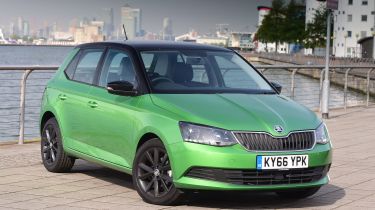
The supermini segment is one of the most competitive of all, because it’s bursting with appealing contenders. But Skoda has risen to the challenge with the Fabia, and it’s a truly brilliant all-rounder that’s very much worthy of your attention. The Fabia is so good that it scooped Carbuyer’s Best Small Car award in 2017, thanks to its focus on practicality and value. As a brand, Skoda has always done well in our Driver Power surveys, partly due to its reliable cars and an excellent dealer network. Like most mainstream superminis, the Fabia won’t make your heart beat any faster, but if you’re looking for a car that’s cheap to run and offers painless ownership, you could do a lot worse than put one of these smart-looking Skodas on your drive.
Skoda has a rich and varied history, having set up as a bicycle manufacturer back in 1895, when the company was known as Laurin & Klement. Since then, the company has gone through various phases, but today it’s best known as a producer of affordable cars.
For a while its products were cheap and not especially cheerful – but they’ve always been tough, and this characteristic stayed in place when the company became part of the Volkswagen empire in 1991.
Used - available now

2021 Skoda
Fabia
25,898 milesManualPetrol1.0L
Cash £11,200
2018 Skoda
Fabia
39,809 milesManualPetrol1.0L
Cash £8,436
2025 Skoda
Fabia
14,500 milesManualPetrol1.0L
Cash £13,688
2025 Skoda
Fabia
18,526 milesManualPetrol1.0L
Cash £14,809Sitting alongside SEATs, Audis and VWs, Skodas have long shared the major components of their cousins, and the Fabia supermini is typical of this, which means it comes with efficient engines, good build quality and plenty of user-friendly features.
History
The third-generation Skoda Fabia reached UK showrooms in January 2015. The range consisted of 59bhp or 74bhp 1.0 MPI non-turbo and 89bhp or 109bhp 1.2 TSI turbocharged petrol engines, or there was a 1.4 TDI diesel unit with 89bhp or 104bhp. Initially there was just a five-door hatchback available, but in March 2015 an estate arrived with the same engines, bar the 59bhp 1.0 MPI.
Trim levels for the estate version were S, SE and SE L; for the hatch they were S, SE and Elegance (which was quickly rebranded SE L), with a sporty Monte Carlo edition added in August 2015. A facelifted petrol-only Fabia arrived in September 2018, with a 1.0 TSI engine replacing the 1.2 TSI unit, and extra standard equipment, including navigation on the SE L.
Which one should I buy?
The 1.0 MPI engine lacks muscle, and is only really suited to short journeys. Any of the turbocharged (TSI and TDI) engines are much more punchy and better to live with. Similarly, the DSG auto is great and so is the manual.
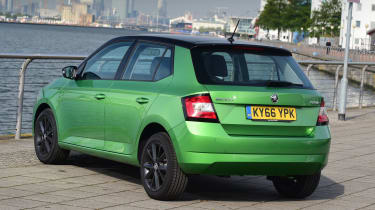
The entry-level Fabia S is quite basic, so we’d go for at least an SE. The S comes with Bluetooth, a DAB radio, electric front windows and remote central locking, but the SE adds air-conditioning, 15-inch alloys, better infotainment (including Apple CarPlay and Android Auto) plus an upgraded alarm.
SE L cars also come with climate control, 16-inch alloys, cruise control, keyless go and LED daytime running lights. Over the SE, the Monte Carlo has a panoramic roof, privacy glass and sports seats.
Alternatives to the Skoda Fabia
Closely related to the Fabia is the SEAT Ibiza, which comes with the same engine and gearbox choices, sharp styling (especially in three-door SC form) and plenty of practicality (it also came as an estate).
Think of the five-door only VW Polo as a pricier Fabia with a plusher cabin, while the Audi A1 is another step above that. Beyond the VW Group, the MINI hatch is relatively expensive but very desirable and plentiful, while you can’t talk about superminis without mentioning the Ford Fiesta. It’s one of the greatest cars available at any price, because it’s relatively roomy, great to drive, well made, and there are loads on the market.
Other strong supermini contenders include the Peugeot 208, Renault Clio, Vauxhall Corsa, Toyota Yaris, Kia Rio and Hyundai i20 – or for maximum versatility consider the ultra-reliable Honda Jazz.
What to look for
Bodystyles
All three generations of the Skoda Fabia have come as either a five-door hatchback or a versatile small estate.
Emissions
From the outset the 1.4 TDI diesel was Euro 6-compliant, so it should be fine to use in any UK clean air zones for the time being.
Safety
Initially, autonomous emergency braking wasn’t included on the Fabia S, but all facelifted (post-September 2018) cars have it as standard.
Wheels
Every Fabia comes with a tyre repair kit, but Skoda did offer space-saver spare wheels and full-sized items as optional extras.
Interior
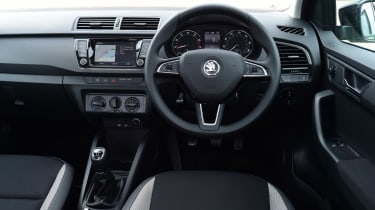
Practicality is a Fabia strong point. When it was launched it featured the biggest boot in its class, at 330 litres, which expands to 1,150 litres with the back seats folded. This doesn’t result in a compact cabin, though, because there’s room for four adults to sit in comfort – although five is a bit of a squeeze and cubby space isn’t great.
What is impressive is dash and instrument clarity, while getting comfy is easy because all Fabias come with a height-adjustable driver’s seat, plus a steering wheel that adjusts for reach and rake. All Fabias built from 2018 came with a 6.5-inch touchscreen system with Bluetooth and DAB radio.
Running costs
Fabia owners can opt for fixed or variable maintenance regimes. The former is set at 12 months or 12,000 miles (whichever comes first); the latter is aimed at high-mileage drivers and allows for up to two years or 18,000 miles between services. Most owners opt for the former, which requires two minor services, then from the third year (or 30,000 miles) the services alternate between minor and major, which are priced at £184 and £243 respectively.
Fresh brake fluid is required after three years then every 24 months, at £60. All Fabia engines have a cambelt, which on the diesel should be replaced every 130,500 miles, but there’s no time interval; dealers charge £449 for this. Petrol engines need a new belt every five years (with no mileage interval) at a dealer cost of £479.
Recalls
The third-generation Skoda Fabia has been recalled on just one occasion so far in its lifetime, and that was in May 2019. It was a campaign that also included a number of other Skoda models – namely the Octavia, Kodiaq, Rapid and Superb, and just 393 cars in all were affected.
These cars were all built in January and February 2018, and the reason for the recall was that they were fitted with an airbag that might not inflate quickly enough in the event of an impact. Skoda’s solution was to replace the steering wheel, because it was only the driver’s airbag that was affected. There isn’t a UK-specific website to check if a Skoda has been recalled, but there is one that’s Europe-wide. You can find it at www.skoda-auto.com/services/recall-actions – just put in the VIN and it’ll tell you if any Skoda is subject to an outstanding recall.
Driver Power owner satisfaction
The Fabia Mk3 didn’t appear in the 2020 Driver Power new car survey, but it came 64th in 2019, having peaked in 11th place in 2017. The Fabia ended up 46th (out of 100) in the 2019 Driver Power used car survey, the undoubted highlight being its low running costs, while the infotainment and safety systems impressed. Most other aspects got mid-table ratings, although ventilation and versatility scored poorly.
Used Skoda Fabias for sale
2021 Skoda
Fabia
25,898 milesManualPetrol1.0L
Cash £11,2002018 Skoda
Fabia
39,809 milesManualPetrol1.0L
Cash £8,4362025 Skoda
Fabia
14,500 milesManualPetrol1.0L
Cash £13,6882025 Skoda
Fabia
18,526 milesManualPetrol1.0L
Cash £14,809
2021 Skoda
Fabia
18,350 milesManualPetrol1.0L
Cash £10,490
2025 Skoda
Fabia
6,930 milesManualPetrol1.0L
Cash £13,899
2021 Skoda
Fabia
25,782 milesManualPetrol1.0L
Cash £9,799
2018 Skoda
Fabia
65,400 milesManualPetrol1.0L
Cash £7,545
2018 Skoda
Fabia
41,498 milesManualPetrol1.0L
Cash £7,199Skoda Fabia (2015-2021) review: What we said
Extracts from our 2019 in-depth review of the Skoda Fabia Mk3...
The Skoda Fabia is a well proven supermini contender that builds on the dependable nature of its predecessors with more tech and a surprisingly enjoyable drive. It’s very roomy, handles tidily, has a couple of decent engines, and mid-spec trim levels and above are well stocked with kit.
A facelift in 2018 couldn’t quite transform the Fabia into the class-leader, but it still remains a refined and sensible supermini. The VW Polo is marginally more comfortable and gets more advanced infotainment tech, but the Skoda is cheaper to buy in the first place. Some rivals offer fancier tech and are more fun to drive, but as a safe, dependable small family hatchback, the Fabia is still very hard to fault.
About the Skoda Fabia
Even though it’s due for replacement in 2021 the Fabia, whether it's the five-door hatch or the practical estate, is still one of the best superminis for sale in the UK today. It offers lots of practicality, decent space inside and a pair of 1.0-litre petrol engines that will satisfy most needs. And while there's no vRS hot hatch, the Fabia is still a decent handling yet refined supermini, which helps to make it a front-runner in the class. That said, the current generation is being phased out in favour of an all new Fabia that’s due in 2021, but canny buyers should be able to use that fact in their favour when negotiating a price with dealers as they run down stock. Talking of which, buying from stock is the only way you can get your hands on a new Fabia now, as the factory isn’t taking any orders until the new one comes out.
This current third generation Fabia arrived in 2014, and was given a minor freshen up in 2018. This mid-life facelift saw the engine range revised with just 1.0-litre petrol engines available, more practical touches added to the interior, and the most subtle of exterior revisions.
Rivals for the Fabia are plentiful, and are led by the UK's best-selling car, the Ford Fiesta. Other mainstream models include the Vauxhall Corsa, Citroen C3, Nissan Micra and Toyota Yaris, while in-house rivals are offered in the shape of the SEAT Ibiza and VW Polo, although the latter is a bit pricier. Elsewhere, the Kia Rio and Hyundai i20 are practical choices, while the Honda Jazz has a more upright body. The Mazda 2 is a sporty alternative, and the Peugeot 208 and Renault Clio are also available.
Under the skin, the Skoda Fabia uses a mix of tech taken from the last model and the VW Group’s MQB platform. As already mentioned, the engine range changed in 2018, with the 1.2 TSI petrol and all diesels dropped and just 1.0-litre petrol units offered, each gaining exhaust particualte filters to pass the latest emissions regulations. The 1.0 MPI 59bhp three-cylinder unit is only available in the hatchback range, while the boosted 1.0 TSI originally came in 94bhp and 108bhp forms, before the more powerful unit was also dropped earlier in 2021. There was little to separate them in terms of economy or performance, and the 94bhp version is the one we'd have chosen anyway. Both remaining Fabia powertrains are front-wheel drive and come with a five-speed manual gearbox as standard, but the 94bhp variant is also offered with a seven-speed DSG auto 'box.
Prices for the Fabia start from almost £14,700, with the estate incurring a premium of around £1,000 over the hatch. Trims comprise S, SE, SE Drive, SE L and Monte Carlo, with the limited run Colour Edition available on the hatchback. S models are rather sparse, but SE comes with air con, a leather-trimmed steering wheel, rear parking sensors and Smartlink + smartphone connectivity.
Go for the plush SE L version and it comes with keyless go, cruise control and smarter trim. The Monte Carlo is a sporty model that's based on SE with a body kit and contrasting black roof and wheels, but apart from LED running lights it’s otherwise similar to the SE. Sadly, Skoda said there was not enough demand for a hot Fabia, so there hasn’t been a vRS option this time around.
Engines, performance and drive
The latest Skoda Fabia is a very accomplished car to drive. It benefits from a chassis that’s well developed, although it's worth noting that the Fabia only gets an evolution of the last car's platform with some additional MQB components, rather than being a complete MQB model like its sister cars, the SEAT Ibiza and Volkswagen Polo.
Precise steering and the lower kerbweight of the latest Fabia mean it handles more neatly than the previous version, proving light on its feet and nimble in town. But sporty handling arguably isn’t as important as comfort in a supermini, and while the Fabia isn't quick, it more than compensates in terms of ride quality.
The damping is forgiving, and the Skoda rides like the Polo. It smothers bad surfaces well, with the dampers controlling body and wheel movement nicely, offering lots of support when driving faster and decent refinement on the motorway. As with the Polo, the steering is direct and the five-speed manual gearbox (or six-speed for the most powerful petrol) serves up positive shifts. For those wanting an automatic supermini, Skoda offers the Fabia 94bhp version with a seven-speed DSG transmission.
At speed, the Fabia is impressively composed, again with the feel of a larger car than it is. This is why you may want to choose the more powerful engine to make it more of an all-rounder: the 1.0 MPI unit struggles when speeds rise. Cabin noise isn't quite as well suppressed from the occupants as it is in a Polo, but it's still an impressive long-distance car for its size. As for brakes, lower-power models have discs at the front but drums at the rear, reflecting the likelihood they’ll be driven more slowly.
Engines, 0-60 acceleration and top speed
The 1.0-litre MPI petrol engine that works so well in the Up and Citigo do struggle a little in the larger Fabia. The five-door supermini isn’t too much of a step up in weight, which helps a bit, but there’s still no escaping the base car’s meek 16.4-second 0-62mph pace.
Our tip is to choose the 1.0 TSI turbo with 94bhp - or in 108bhp guise if you’re buying a used Fabia. The figures say it all: the 1.0 TSI 95 (that number representing its power in metric horsepower) produces 160Nm of torque, instead of the 1.0 MPI's 95Nm – and does so from lower down the rev range. The TSI 110 version delivers even more shove with torque at 200Nm.
While the MPI and TSI engines are throbby and characterful thanks to their three-cylinder layouts, the 1.0 TSI is much more appealing because you don't need to rev it so hard as to make the engine note intrusive. It fades into the background and often, because it demands so few revs around town, is as refined as a much larger car. A used TSI 110 may prove better on a motorway than the 95 TSI though – it benefits from a six-speed gearbox, and the extra power means you don't have to work it quite as hard.
Skoda's five- and six-speed gearboxes are snappy and ultra-light in the usual Volkswagen Group way, with an accurate and precise shift. This helps the TSI 95 model achieve a 0-62mph time of 10.7 seconds, while the now deleted TSI 110 version shaved a full second off and managed the sprint in 9.7 seconds. When mated to the seven-speed DSG automatic transmission, the TSI 95 reaches 0-62mph in 11.1 seconds.
MPG, CO2 and running costs
The Skoda Fabia uses the latest-generation Volkswagen Group engine tech – no dated hand-me-downs here, which ensures fuel economy is strong across the board. Under WLTP testing, which provides more realistic and achievable figures, the Fabia still manages no less than 44.1mpg, with lower-powered models pushing efficiency beyond 53mpg.
The basic 1.0 MPI 60 is a 53.3mpg car emitting up to 134g/km of CO2. The 1.0 TSI, in either of its power outputs, is impressively close to the MPI's fuel-efficiency. The currently available 95PS manual version has a claimed economy figure of 52.3mpg, with emissions rated at 138g/km, while the automatic variant is slightly down on these figures with a best of 49.6mpg and CO2 emissions at 145g/km. For used buyers, the more powerful 110PS engine was quoted at 51.4mpg with CO2 of emissions of 141g/km.
Diesel engines are no longer offered with the Fabia, while the revised range doesn't see a fuel-efficient Greenline model as part of the line-up, either. If you choose the Fabia Estate, then fuel economy figures stay the same.
Interior, design and technology
The latest Fabia sports a sharper-edged design than its predecessor, more in keeping with the Mk1. The large Octavia-style chrome grille is distinctive and the deep, crisp side featureline is smart. We also like the ‘kick’ at the base of the rear side window, a feature seen on other Skodas. The changes to the design in 2018 are subtle to even the keenest Fabia fan: the front grille became wider, the lights slimmer, and the back bumper features some extra reflectors.
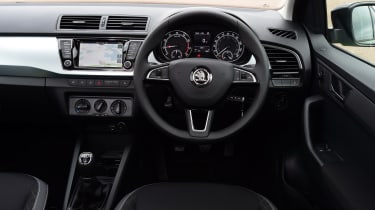
Inside, the dashboard design changed little in the 2018 round of updates. A couple of new interior trims and colours were added, the dials feature revised graphics, while those sat in the back benefit from a couple of extra USB ports. The design itself is a little bland: Skoda chooses to focus on simple, user-friendly designs, so swoopy style is substituted for plain layout and coherency. Straightforward heater controls and big, chunky switchgear familiar from other Volkswagen Group models ensures it’s fuss-free to use, if not as interesting as some rivals. It’s well built but the solid, sturdy plastics aren’t as rich as in a Polo.
Neat features such as a rear courtesy light and front reading lights are standard on all, while SE models feature front fog lights, rear parking sensors and 15-inch alloys, instead of the steel wheels offered on the entry-level S version.
The SE Drive includes larger 16-inch alloy wheels, front and rear parking sensors and unique black/grey fabric seat upholstery. SE L ups the technology count with LED running lights, climate control, cruise control, KESSY GO keyless start and an auto-dip rear view mirror.
In Monte Carlo trim, the Skoda gets some sporty styling additions, including black 16-inch alloys (although 17-inch wheels are an option costing about £370), while inside there are more supportive sports seats and a three-spoke leather-trimmed sports steering wheel. From 2018 onwards, the top spec car gained LED brake lights (they're optional on other Fabias), with LED headlights becoming an optional extra.
Sat-nav, stereo and infotainment
From 2018 onwards, the S gained a 6.5-inch colour touchscreen. Bluetooth and a digital radio are included, although the S lacks a built-in navigation system. SE models feature Smartlink + which enables Apple CarPlay and Android Auto connectivity, while SE Drive and SE L versions include satellite navigation.
The touchscreen system itself is very straightforward to use. The home page presents eight shortcut tiles to the main functions, and physical shortcut buttons surround the screen, so it's always simple to move between sub menus. The slick navigation system offers the driver a choice between the fastest, shortest and most fuel-efficient options. The graphics are clear and bright, too, and loading times are more than good enough. SE cars and above also have an upgraded six-speaker surround sound system from Arkamys.
Practicality, comfort and boot space
The practical and roomy Fabia is one of the most flexible superminis on sale, with plentiful comfort for both front and rear seat occupants.
Size
Skoda has sized the Fabia to perfectly hit the supermini ideal average dimensions. It’s a smidgen under four metres at 3,997mm long, 1,732mm wide and 1,467mm tall. The Monte Carlo is a tiny bit bigger: 4,009mm long and 1,452mm tall: this is due to its black-accented bodykit and the larger 16-inch standard wheels.
With its extended rear, the Skoda Fabia Estate obviously comes in bigger than the hatchback. It’s 4,262mm long and, thanks to standard roof rails, 1,488mm tall. To help make parking easier, SE models and above have standard rear parking sensors; a rear view camera is a £275 option.
Leg room, head room & passenger space
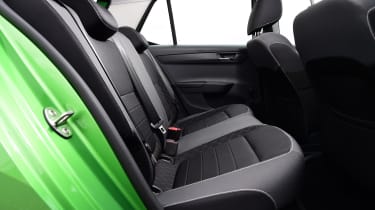
The spacious Fabia offers impressive space up front, with a height adjustable driver’s seat and both height and reach-adjust steering wheel combining with lots of seat fore-and-aft adjustment to allow a good driving position to be found. Leg room is ample and there’s lots of headroom – again, the height-adjust driver’s seat lets even taller occupants strike the right balance.
It’s even better in the rear. This is sometimes an area where smaller superminis can struggle but the Fabia proves its family-friendly credentials here. Two six-footers can sit reasonably comfortably behind tall adults, and it will even take three adults without too much of a squeeze. Skoda’s reputation for making cars with bigger interiors than the norm is once again evident. The tall body design ensures ample headroom, too. Very few cars can do better in this class; indeed, only the SEAT Ibiza and VW Polo - both of which use the VW Group's latest MQB-A0 platform, are more spacious inside.
Boot
The Fabia can claim to have one of the biggest boots in the supermini sector. In standard guise, it offers 330 litres of space, which expands to 1,150 litres with the 60:40 split seats folded. Not only is this better than the 303 litres of the best-selling Ford Fiesta, it’s also a much better-planned space that’s easier to load. All versions have handy luggage hooks in the boot, practical touches that the Skoda brand is well known for.
The 110PS models are fitted with a full-size steel spare wheel as standard, which does have an impact on boot capacity: seats-up luggage space is reduced to 305 litres, and seats-down capacity drops to 1,125 litres - still competitive though with its Fiesta rival. If you want the reassurance of a full-size spare or space saver wheel, it costs an extra £110.
If boot capacity is a necessity in your small car, then the Skoda Fabia Estate is the car to go for. While it once had a few supermini estate rivals to take on, that's no longer the case. It has a 530-litre boot thanks to its extended rear end, and this increases to a maximum of 1,395 litres when they're folded.
A virtual must-have option is the Simply Clever pack. This comprises a useful net system and storage compartment in the boot, a holster for multimedia devices and even a tiny waste bin in the door panel. A variable boot floor is another handy option.
Did you know you can buy a used car with Auto Express? Choose from tens of thousands of cars with trusted dealers around the UK. Click here to buy used with Auto Express now...