Audi Q3 review
The latest Audi Q3 is evolutionary rather than revolutionary, but it’s an upmarket compact SUV that’s good to drive

Our opinion on the Audi Q3
It’s a case of evolution for the third-generation Audi Q3, whose Q5-inspired looks also feature plenty of tech shared with the larger machine. It isn’t a game-changer, but it has all the qualities buyers after a premium compact SUV would want, such as a feature-packed infotainment system, safe handling, and plenty of performance - especially from the quattro models. The plug-in hybrid is a very worthy choice for company car drivers, thanks to its long EV range. The only major downsides are its firm low-speed ride on standard suspension, and we wish the Q3 weren’t quite so expensive.
About the Audi Q3
The Audi Q3 has been a big seller for the German firm since it first arrived in 2012. It’s grown over time to help deliver more space and practicality, and just like with the previous model, there are five-door and sportier-looking Q3 Sportback bodystyles to choose from.
The range comprises Sport, S Line and Edition 1 variants, with the usual mix of petrol, diesel, and plug-in hybrid power available across most trim levels.
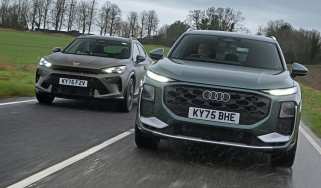
We’ve tested both regular and Sportback versions of the Q3, and put an e-hybrid Audi Q3 against a Cupra Formentor in a group test. We’ve also included an e-hybrid Q3 Sportback in our plug-in hybrid megatest.
Audi Q3 prices and latest deals
Prices for the Audi Q3 start at just under £38,500, which isn’t cheap, but is on a par with similar premium rivals. However, higher-specification powertrains and equipment grades can see prices edge higher, with some versions breaking the £50,000 barrier.
Used - available now


You can configure your dream Audi Q3 with our Buy a Car service. Alternatively, you can buy a new Audi Q3 from stock, or find out the very best Audi Q3 leasing deals.
Performance & driving experience
Pros |
|
Cons |
|
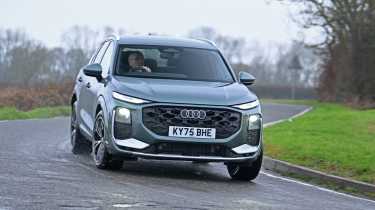
The VW Group has put some serious resources into upgrading the Audi Q3’s platform to give customers a wide choice of competent powertrains and chassis options.
All of the combustion-engined models have decent torque from low revs, so you don’t have to push them too hard to make progress, and they have good mid-range performance for everyday use.
Most engines come with front-wheel drive, but the more powerful engine choices have quattro four-wheel drive. All petrol and diesel models use a seven-speed dual-clutch automatic, while the plug-in hybrid e-hybrid features a six-speed auto.
Performance, 0-60mph acceleration and top speed
The 1.5 TFSI is a familiar Volkswagen Group unit. It’s exceptionally refined, but it can struggle to power larger models such as the Q3. It has enough low-down torque to not feel too tardy at low speeds, but its 9.1-second 0-62mph time is nothing special, and it can feel underpowered when pushed at higher speeds – the entry-level BMW X1 is better in terms of overall performance.
If your heart is set on petrol, the 201bhp 2.0-litre is a much better bet, with a 0-62mph time of 7.1 seconds. There’s also a more potent 262bhp variant that offers a huge uplift in performance, cracking the same acceleration sprint in 5.7 seconds. The latter also has quattro four-wheel drive, which makes full use of the extra power, especially in slippery conditions. In our experience, the latter also seems to drive with more fluidity than the 148bhp 1.5-litre variant, which can sometimes slur gearshifts.
While the e-hybrid is the most powerful Q3, its kerbweight is 150kg greater than the 2.0 TFSI 265’s, so it’s more than a second slower from 0-62mph at 6.8 seconds. It still feels quick enough, but it’s not as smooth as the pure-petrol model, because the transmission shunts as it switches between the electric motor and combustion engine – it’s a lot smoother than past versions, though. The petrol engine does tend to sound thrashy when pushed, so you soon get into the habit of accelerating just enough to use the electric motor’s power without the engine firing up.
There are also 148bhp and 190bhp versions of the 2.0 TDI diesel offered. While the former has the same power output as the entry-level petrol, its extra torque (360Nm) makes for more effortless driving in real-world conditions – even if its 9.2-second 0-62mph time is marginally slower. The more potent version comes with quattro four-wheel drive and gets from 0-62mph in 7.5 seconds.
| Model | Power | 0-62mph | Top speed |
| Q3 1.5 TFSI 150 | 148bhp | 9.1 seconds | 140mph |
| Q3 2.0 TFSI 265 quattro | 262bhp | 5.7 seconds | 149mph |
| Q3 1.5 e-hybrid | 268bhp | 6.8 seconds | 134mph |
Town driving, visibility and parking
A high driving position gives a good view out, while light yet accurate steering boosts manoeuvrability at lower speeds. All models come with parking sensors and a reversing camera, too.
There’s a bit of a fidget to the ride at lower speeds, but it’s not intolerable, and the trade-off is decent agility. We found the brake pedal easy to modulate.
When it’s full, the e-hybrid system prioritises electric running, and the system delivers smooth and responsive performance. It’s not quite as refined when the engine is employed, with more noise from under the bonnet, but the power delivery remains smooth when using smaller throttle inputs.
Country road driving and handling
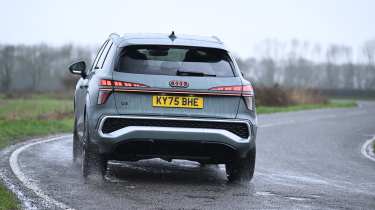
A trait of Audi models is that their ride improves as you increase your pace, and on country roads, the standard Q3 soaks up bumps well. The optional adaptive suspension system (part of the £4,500 Sound and Vision Pack Pro on S-Line trim and above) helps widen the Q3’s bandwidth between a comfortable ride and a sporty-feeling driving experience, depending upon which drive mode you’ve selected. In comfort mode, the adaptive suspension has excellent bump absorption when – even on the top-spec 20-inch wheels
Whichever set-up or drive mode you’re in, body roll is kept reasonably well in check, and there’s plenty of grip for you to confidently carry some speed in the corners on a twisty country road.
The e-hybrid is a little bit more compromised than other variants due to the extra weight of the car’s plug-in system. This version is around 150kg heavier than the 2.0 TFSI quattro model, so there’s a bit more body roll in corners. It’s also better when the system has some charge in the battery, because when the battery is flat, there’s more shunt from the transmission as the electric motor and engine work in tandem to make progress.
Motorway driving and long-distance comfort
The Q3 is an accomplished long-distance cruiser, especially in e-hybrid guise, where the extra weight of the battery helps to settle the car’s ride. With enough charge in the battery of e-hybrid models, you can stay in electric mode, even at motorway speeds, but when the engine is on, it has to be worked hard if you need extra power to overtake.
Our test cars had the £1,200 Driver Assist pack, which included noise-reducing laminated front windows, which did a good job of quelling wind noise.
MPG & running costs
Pros |
|
Cons |
|
The entry-level 1.5 TFSI 148bhp Q3 is officially rated at 44.1mpg in top-spec Edition 1 trim, and over the course of our test route, on a combination of country roads, motorway and a little bit of town and urban driving, we saw 42.1mpg.
Move up to the 2.0-litre four-cylinder petrol and the on-paper figures are a little startling, with the Edition 1 versions of the TFSI 201bhp rated at 34.4mpg and the TFSI 262bhp quattro only 32.1mpg. We drove the latter quattro model on the same roads as the 1.5 TFSI and matched the claimed figures with 32.1mpg.
Diesel Q3s are rated at 45.6mpg for the quattro version, and 53.3mpg for the entry-level two-wheel drive model.
| Model | MPG | CO2 | Insurance group |
| Q3 1.5 TFSI 150 Sport | 46.2mpg | 139g/km | 22 |
| Q3 2.0 TFSI 204 S-Line quattro | 36.2mpg | 177g/km | 29 |
| Q3 2.0 TFSI 265 S-Line quattro | 32.8mpg | 195g/km | 32 |
| Q3 1.5 e-hybrid Sport | 156.9mpg | 40g/km | 30 |
Electric range, battery life and charge time
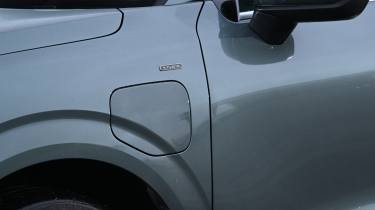
The e-hybrid is where things get more complicated, but the overarching message is that it’s very good for the class. On paper, the most efficient model offers 72 miles of pure electric range, and when we tested the Q3 e-hybrid in wintry conditions, the range predictor estimated 61 miles. Back in the UK, over a mix of urban, countryside, and motorway driving in mild weather, we managed to drive 54 miles on electric power alone.
MPG figures range from 134-166mpg depending on specification, but this is inclusive of a full battery. In real-world testing, we saw an average of around 73mpg from a full battery and fuel tank. With the battery depleted, we saw a figure of 43.2mpg on a mixed loop, which isn’t that far off its claimed depleted fuel economy of 46.3mpg.
There is an important caveat to the Audi’s efficiency figures: they are based on a new weighted MPG calculation. This explains why the Q3 PHEV’s fuel economy rating is around half that of a rival BMW X1 PHEV. These figures will equalise when the BMW undergoes a new model update.
Audi offers DC charging of up to 40kW, which is capable of topping up the battery from 10-80 per cent in 26 minutes at a public high-speed charger. AC charging is rated at 11kW, so a three-phase source can fully refresh the battery in two and a half hours, a standard 7kW home wallbox charger does the same job in three hours, or it’s 12 hours via a three-pin plug socket.
| Model | Battery size | Range | Insurance group |
| Q3 1.5 e-hybrid | 26kWh | 72 miles | 30 |
Insurance groups
While not the lowest, insurance groups for the Q3 are no higher than they are for its BMW and Mercedes rivals. The line-up starts in Group 22 for the entry-level 1.5 TFSI and 2.0 TDI engines in Sport trim, rising to group 32 for the most powerful 2.0 TFSI quattro.
Tax
Only the entry-level 1.5 TFSI Sport and 2.0 TDI Sport (once the first year’s VED and registration fee are discounted) come under the £40,000 luxury car tax barrier and avoid an additional surcharge on top of the standard rate of annual VED between years two and six. The rest of the Q3 range will be subject to this fee.
Business users will automatically turn to the e-hybrid for the lowest company car costs. A percentage rate of seven per cent is nearly double that of an EV, but far lower than for the petrol and diesel variants, which start from 33 per cent, rising to the maximum 37 per cent at the top of the range. The diesel models are in the 34-37 per cent range. If you can make an EV work in your life, then the Audi Q4 e-tron might be a more affordable option.
Depreciation
Audi has always been an aspirational brand, and the Q3 has relatively strong residual values. The regular Q3 is expected to retain after three years or 36,000 miles between 47 and 55 per cent of its original value, while the Q3 Sportback is a little lower in the 40 to 53 per cent range.
That’s on par with rivals like the BMW X1 (47 to 53 per cent) and the Mercedes GLA (46 to 55 per cent). The Volvo XC40 performs a little better, though, maintaining between 50 and 55 per cent of its original value over the same period.
Interior, design & technology
Pros |
|
Cons |
|
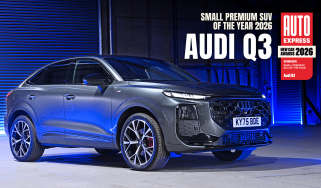
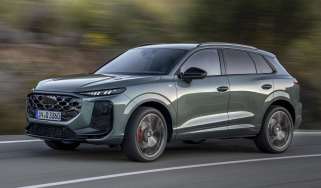
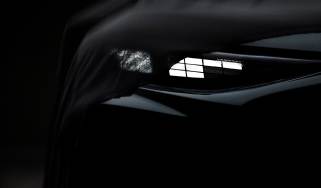
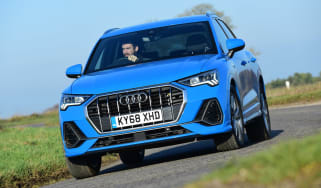
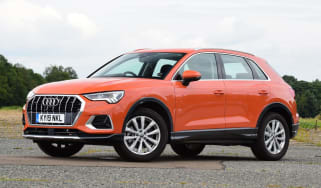
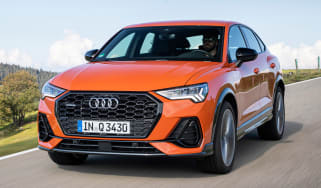
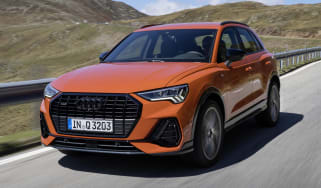
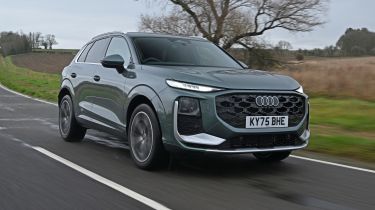
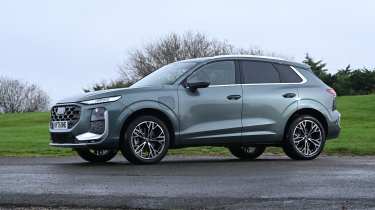
The Q3’s chunky and complex design gives it the appearance of looking bigger than it actually is, which we expect many customers will enjoy. The two-piece headlight units are fairly typical of 2025’s design themes, but they do feature big-car tech such as Digital LED beams that can augment the light to highlight your lane or hazards at night.
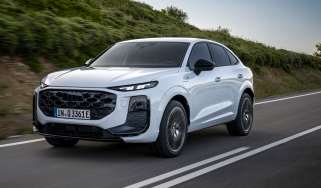
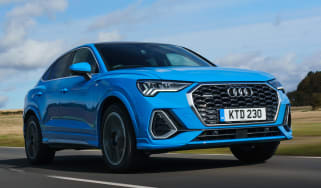
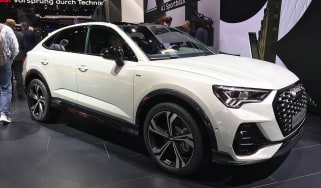
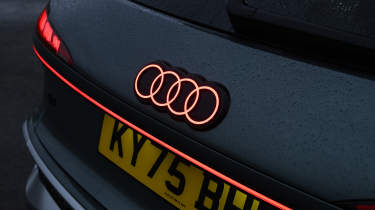
Of the two bodystyles, the sleeker Q3 Sportback is the more distinctive to look at, thanks to its sloping roofline. The rear ends of both Sportback and SUV models feature yet more class-first lighting technology.
As with the latest A6, the Q3’s rear lights are split into multiple elements: the main upper lighting units are joined by a thin light bar, with much larger and brighter brake light elements sitting below. It’s not a simple design, but it’s not unattractive. There’s a limited paint range, but with bright red, deep blue, sage green and a couple of greys, customers are well catered for.
Interior and dashboard design
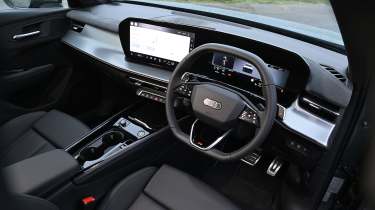
The cabin shares many of its design cues, like its curved dual screen layout, with the latest Q5 and A6. The displays situated within them are smaller, and there’s no option for a passenger screen. Big-car tech, such as a sophisticated head-up display, can be added as an option.
One new feature of the Q3 is its ‘double deck’ stalks. Rather than sprouting from the steering column, the indicator stalk and wiper selector are mounted on the left end of a bar that stretches behind the steering wheel, and they are more like rocker switches than traditional stalks.
They take a bit of getting used to, especially the rotary controller for the wiper speed, which might be a bit fiddly to operate for some while driving, but we found that they work well with aclimatisation, and the single-wipe or one-touch indicator was intuitive to use. The other end of the column features the drive selector, which has a similar action and helps to free up space on the centre console for storage.
Materials and build quality
Overall, the materials feel sturdy and contemporary. There’s a real-metal insert on the dash and plenty of soft-touch microfibre across the top of the dashboard and door cards. However, in the various models we’ve driven there are a few odd material choices that don’t always seem to mesh together that well.
In place of traditional leather, Audi has wrapped the steering wheel of some models in an odd, rubbery, textured vinyl that’s not particularly nice. The seats also feature some strange woven fabrics on their outer trim elements, and all other materials are either black or grey.
We were also left unimpressed by the gloss-black sliding cover over the central storage bin. It doesn’t slide very smoothly when opening or closing, which is disappointing for something that you’re likely to be touching on a frequent basis.
Infotainment, sat-nav and stereo
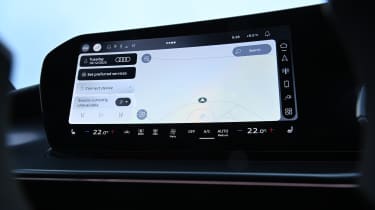
Key stats include a 12.8-inch touchscreen display and an 11.9-inch driver’s display mounted within a single curved housing. We like the layout, but the massive bezels make it look a little old-fashioned. The good bit, though, is the new digital interface that’s been designed for Audi’s smaller models, which is Android-based, and has a completely different user experience to the over-complex system found in the Audi A5 and Audi A6 models.
The main screen features a full-size map with floating tiles that handle other functions such as phone, general information and media. Although the screen isn’t huge, the layout is clean and allows for quick access to functions. Air-conditioning controls are integrated into the main screen in a static bar at the base – these work fine, but dedicated physical controls would be preferable. The only one of those is for the volume knob, while a row of touch-sensitive switches provides quick and easy access to the driver aids and drive modes.
The biggest improvement is the driver’s display that – unlike in a Q5 or A6 – can show a map view in front of the driver, keeping the central screen free. By default, the driver’s display screen narrows to show only a bar of information, with a rev-counter at its centre. We’d still prefer a more traditional dual-dial layout, but it’s a slicker and far more readable layout than in other Audis.
Boot space & practicality
Pros |
|
Cons |
|
A dark headlining and black plastics can make the interior of the Audi Q3 feel a little claustrophobic, but the reality is that there’s a generous amount of space on board.
Dimensions and size
The Audi Q3 is bigger than its predecessors and its two key rivals. At 4,539mm long, it’s more than 100mm longer than a Mercedes GLA and has a few centimetres extra length over a BMW X1. It’s similarly wide, though, and it actually sits lower than both its premium rivals.
Compared with a Volkswagen Tiguan, the length is within a few millimetres, but the Audi is lower.
| Dimensions comparison | |||
| Model | Audi Q3 | BMW X1 | Volkswagen Tiguan |
| Length | 4,531mm | 4,500mm | 4,539mm |
| Width | 2,087mm (inc mirrors) | 1,845mm (2,104mm inc mirrors) | 1,842mm |
| Height | 1,588mm | 1,642mm | 1,658mm |
| Wheelbase | 2,681mm | 2,692mm | 2,677mm |
| Boot space | 488-1,386 litres | 500-1,545 litres | 652-1,650 litres |
Seats & passenger space
The Q3’s centre console isn’t so tall that it divides the cabin, as is the case in some rivals. There’s good storage, with a centre console cubby containing a wireless phone charging pad and USB sockets, plus deep cup holders behind it and a slightly narrow central storage bin beneath the central armrest. There’s a deep glovebox and a second cubby by the driver’s right knee. The door bins are awkwardly shaped, though.
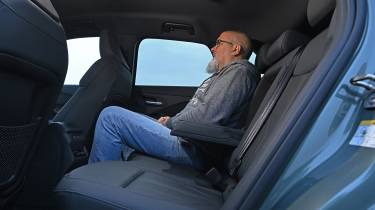
There’s a good amount of space in the back of the Q3, and passengers have plenty of legroom, although the seat base is a bit narrow due to a couple of trays taking up space at either end of the back seats, and a sizable central tunnel limits foot space for the middle occupant. Twin USB sockets and separate temperature controls are included.
Boot space
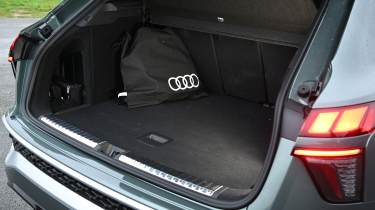
All non-plug-in and quattro versions of the Q3 have a 488-litre boot with the seats up, which extends to 575 litres thanks to the standard-fit Rear Seat Bench Plus feature, which allows you to slide the seats forward and reposition the backrest into an upright position. With the seats down, capacity increases to 1,386 litres.
The coupe-esque Sportback model has the same seats up boot capacity as the regular Q3, but the sloping roofline means the seats down volume is reduced to 1,289 litres in non-e-hybrid models, and 1,196 litres in e-hybrid versions.
The Q3’s boot is a decent size, but a BMW X1 is more generous at 540 litres. If pure practicality is what you’re after, the bigger (yet slightly cheaper) Volkswagen Tiguan is rated at 652 litres
The Q3’s second row is split three ways for greater flexibility and will fold nearly flat with the boot floor. There are a couple of small unlidded bins on either side of the load area, plus space under the floor, though this compartment is smaller in the e-hybrid because that’s where the battery pack is located. If there’s one criticism, it’s that there are no remote levers to drop the rear seats from the boot.
Towing
The Audi Q3 is capable of towing up to 2,200kg with a braked trailer, reducing to 1,800kg for the 1.5 TSI model. A mechanical trailer hitch is £925 and adds a trailer stabilisation mode for the stability control system.
"I really like the sliding rear seats, underfloor storage, and flexible 40:20:40 split-folding rear seats, because these features will be invaluable for family life." - Jordan Katsianis, news editor.
Reliability & safety
Pros |
|
Cons |
|
Audi offers a full suite of active and passive safety features across all Q3 models. These are controlled through a quick-to-access menu via a physical button, and certain individual elements can be added to a shortcut menu for quick disengagement. We’d still prefer a Renault-style Personal mode accessed through a dedicated button, but it’s definitely not a deal-breaker.
Euro NCAP awarded the Audi Q3 its maximum five stars out of five rating when it tested the car in 2025. The Tesla Model Y was also tested that year and scored five stars, although it scored higher in every category when compared to the Q3.
In terms of reliability, the Q3’s well-proven range of engines has generally been rated well, but there is always an associated level of complexity when elements such as dual-clutch transmissions and turbocharging are involved. The brand finished 19th out of a list of 31 manufacturers in the 2025 Driver Power customer satisfaction survey. That was better than parent brand Volkswagen (27th), but behind other premium brands such as Volvo (13th), BMW (8th), and Lexus (3rd).
| Euro NCAP safety ratings | |
| Euro NCAP safety rating | Five stars (2025) |
| Adult occupant protection | 86 per cent |
| Child occupant protection | 81 per cent |
| Vulnerable road user protection | 76 per cent |
| Safety assist | 74 per cent |
Buying and owning
Best buy: Audi Q3 1.5 e-hybrid S line
If you’re able to charge it up, the plug-in model offers low everyday running costs, while S line trim offers a good mix of kit and style. Beyond that, the diesel is recommended for high-mileage drivers, while the expected bestseller, the 2.0 TFSI 204 petrol, is also a decent all-rounder.
Audi Q3 alternatives
The Mercedes GLA is smaller, older and less practical, although an all-new model – with an all-electric powertrain – is due in 2026. Unless you get a great deal, we’d avoid it.
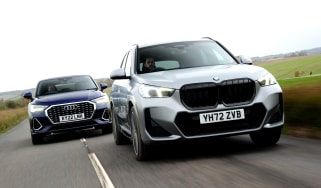
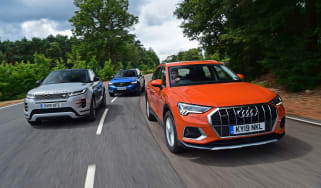
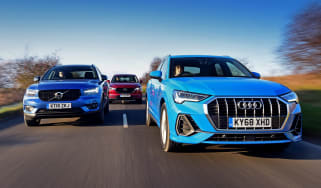
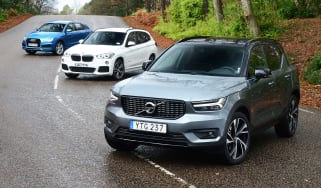
The BMW X1 has had a couple of years to mature in the marketplace, and while it’s nearly as spacious and efficient as the Audi, it’s now pipped in terms of tech, interior quality and versatility. The Volvo XC40 remains a popular choice, but it’s now showing its age and feels clunky to drive.
It’s more difficult to make a case against the Audi Q3’s in-house rivals, because the Cupra Terramar and Formentor, plus the Volkswagen Tiguan offer similar packages for less money. High-end tech, such as the Digital LED headlights, dual-valve dampers and OLED rear lights are specific to the Audi, but requires a big financial jump to access them.
Audi Q3 pictures
Key updates of the Audi Q3 review
13 May 2026: General update with the latest valuation data
Frequently Asked Questions
The 3-year or 60,000-mile manufacturer warranty is unimpressive these days when both BMW and Mercedes offer 3-year/unlimited mileage warranties and have done so for years.
Deals on the Q3 and alternatives