Used Nissan X-Trail (Mk3, 2013 - 2022) review
A full used buyer’s guide Nissan X-Trail covering the X-Trail Mk3 (2013-2022)

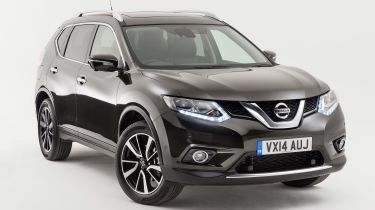
The X-Trail sits in a crowded market, especially if five seats are enough for your needs. But even if you need space for seven, there are many accomplished choices and it doesn’t really stand out. Still, the Nissan isn’t a poor buy; it looks smart, is well equipped and has a roomy cabin, but there are alternatives that offer these things and feel more special to drive and more solidly built, and are just as affordable. So while we wouldn’t steer you away from an X-Trail at the right price, we’d urge you to look at a few rivals before taking the plunge.
Nissan has a long history of making rugged SUVs; its Patrol was introduced way back in 1951. Over the years the company has produced a raft of other 4x4s, including the original X-Trail, which arrived in the UK in 2000.
The first two generations of X-Trail were surprisingly capable off road, and offered reliable family transport at keen prices, even though the exterior design was uninspiring.
But with the Mk3, unveiled in 2013, Nissan brought the design right up to date. This sleeker and much more stylish SUV packed lots of hi-tech features. It also offered the option of seven seats, which is why there was no second-generation Qashqai +2. So how does the X-Trail Mk3 stack up?
Models covered
- Nissan X-Trail Mk3 (2013-2022) – Third generation SUV is smart and well equipped, and offers option of seven seats.
History
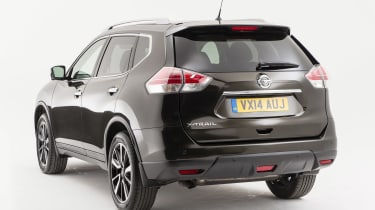
The third-generation X-Trail arrived in July 2014, codenamed T32; its predecessors were the T30 and T31. Only a 130bhp 1.6 dCi diesel engine was offered, with front or part-time four-wheel drive; the former was available with a six-speed manual or a CVT auto.
Used - available now

2024 Nissan
X-Trail
23,102 milesAutomaticPetrol1.5L
Cash £21,801
2024 Nissan
X-Trail
20,001 milesAutomaticPetrol1.5L
Cash £22,514
2017 Nissan
X-Trail
48,390 milesManualDiesel1.6L
Cash £11,125
2024 Nissan
X-Trail
38,246 milesAutomaticPetrol1.5L
Cash £22,070A 1.6 DIG-T turbocharged petrol engine appeared in January 2016, in 2WD manual form only, then in January 2017 a 175bhp 2.0-litre diesel was introduced, rated at 175bhp and offered with a manual gearbox (4WD only) or CVT (2WD or 4WD).
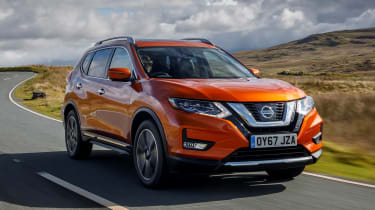
July 2017’s facelift brought a revised nose, better refinement and a higher-quality interior, plus LED rear lights, new wheel designs and DAB as standard across the range. There was also new standard and optional safety tech. The Mk3 X-Trail was replaced by the Mk4 car in 2022.
Nissan X-Trail Mk3 reviews
- Nissan X-Trail 1.6 dCi n-tec review
- Nissan X-Trail 1.6 dCi Tekna review
- Nissan X-Trail 2.0 dCi Tekna review
- Nissan X-Trail 1.6 DIG-T Tekna review
Which one should I buy?
The 1.6 DIG-T feels sluggish while the 1.6 dCi is noisy and short on torque, leaving the 2.0 dCi as the best option, especially if towing, but prices are high.
Entry-level Visia spec gets 17-inch alloys, cruise control, air-con, hill start assist and all-round electric windows. It also has a spare wheel, plus electrically heated and adjustable door mirrors.
Acenta trim adds privacy glass, power-folding door mirrors, dual-zone climate control, automatic lights and wipers, parking sensors front and rear plus an electrically operated sunroof.
n-tec has 19-inch alloys, a powered tailgate, DAB radio, a bird’s-eye parking camera, AEB and a suite of other safety aids. The top-spec Tekna features LED headlights, heated leather seats, blind spot warning and automatic parking.
Alternatives to the Nissan X-Trail Mk3
Two of the most talented seven-seat SUVs that compete with the X-Trail are the Hyundai Santa Fe and its Kia Sorento cousin. Both are bigger, come with long warranties, lots of kit and keen prices; they tend to be reliable, too. Another alternative is the Mitsubishi Outlander, which (unusually) is available in plug-in hybrid form or as a regular diesel.
Noticeably more upmarket – and pricey – is the Volkswagen Tiguan. Older models come with five seats only, like the (more costly) Audi Q5 and BMW X3.
What to look for
Refinement
Vibrations can occur at motorway speeds, even if the wheels are perfectly balanced.
Stop/start
If the stop/start doesn’t work properly the car is probably overdue a service or needs a new battery.
Sunroof
When car is driven on rough surfaces, sunroof mechanism can squeak and rattle. Dealers can fix this.
Locks
Central locking solenoids can fail, leaving doors unable to lock or unlock, so check that all the door locks work.
Interior
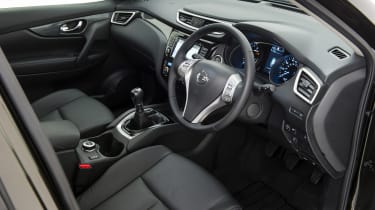
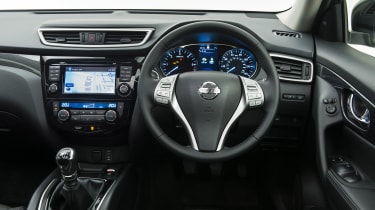
Inside, the X-Trail is less utilitarian than previous models, and feels more upmarket, with a modern design and plenty of passenger space – even if the optional third row is only for children. It’s still worth having, but boot space rises from 445 to 550 litres if you go for the five-seater. Find a car with a glass roof if you can; it really brightens up the cabin.
Running costs
X-Trails have to be serviced every 12 months; diesels have an 18,000-mile cap and petrols a 12,000-mile limit. Petrol cars are a little cheaper to maintain, though.
All engines are chain-driven so there are no cambelts to change, but fresh brake fluid is needed biennially, at £50. If you can find a car with the balance of a service plan, some maintenance will already have been paid for.
Recalls
The X-Trail was recalled in July 2016 over possible oxygen sensor failure, leading to the car running badly. Models built between April 2015 and June 2016 were affected. X-Trails made up to the end of 2015 were recalled in August 2016 for possible corrosion in the tailgate’s gas struts. These could then fail so the tailgate wasn’t supported.
Driver Power owner satisfaction
In this year’s Driver Power satisfaction survey, the X-Trail came 60th out of 75 cars. It didn’t score particularly highly in any category, with the engine and gearbox rated towards the bottom of the table, along with build quality and reliability. Owners rated the car’s infotainment and safety highest, along with its practicality.
Nissan X-Trail (2013-2022) review: What we said
Extracts from our 2021 in-depth review of the Nissan X-Trail
The X-Trail has a lot to offer drivers exploring options at the larger end of the SUV category. It’s by no means the biggest in the seven-seat SUV class though, which some may see as an advantage, and while that applies equally to the rear seats they’re fine for the limited use that most families will demand of them.
Overall, the X-Trail is a roomy car with plenty of space for passengers and their luggage. The similarity of the X-Trail to the Qashqai inside the cabin is a positive thing too, because it looks good, feels well-built and is stacked high with goodies on more expensive models in the range.
About the Nissan X-Trail
The Nissan X-Trail SUV is basically a larger version of the Nissan Qashqai, with extra length in the body which allows you to spec it with an optional extra pair of rear seats. The Qashqai has been recently replaced though, with an all-new model featuring hybrid tech. While Nissan has already revealed how the next X-Trail will look - it was on display at the 2021 Shanghai motor show - Nissan dealers in the UK will be plugging away with the existing X-Trail until the new one arrives here in 2022.
The X-Trail is Nissan’s largest SUV, at least in the UK market, where it’s given up on the bigger nameplates such as the Patrol and Pathfinder. It’s not for lack of available product, as Nissan still sells sizable SUVs in the US and elsewhere. However, with most larger SUV buyers preferring premium badges in the UK, Nissan knows the strength of its brand lies in the more mainstream sectors.
Those seven seats are the X-Trail's key selling point, especially because this generation abandoned the rugged character of the older X-Trail models in favour of a more rounded look that it shares with the (now replaced previous-generation) Nissan Qashqai. The relationship is more than skin-deep, as the two SUVs share a platform, engines and interior tech.
As it’s basically a stretched Qashqai, the X-Trail isn’t as big as some of its rivals, instead sitting somewhere in-between the compact and large SUV categories. That means it’s not the roomiest seven-seater in its class.
Rivals with more space include the Skoda Kodiaq, SEAT Tarraco, Peugeot 5008, VW Tiguan Allspace, Kia Sorento and Hyundai Santa Fe, all of which offer more space for passengers to enjoy. Five-seat SUVs such as the Mazda CX-5, Honda CR-V and Toyota RAV4 are also worth a look if you’re not in the market for seven seats, but need a larger boot.
Standard entry-level equipment includes 17-inch alloy wheels, air con, a DAB radio and Bluetooth, while top-of-the-range Tekna cars receive bigger wheels, a Bose audio system, heated leather-trimmed seats and increased safety kit.
There's just one diesel option available - a 150PS 1.7 dCi with either front- or all-wheel drive, and the choice of manual or CVT auto transmission. Petrol power is also limited to a single 160PS 1.3-litre unit, with front-wheel drive and a DCT auto gearbox.
A mid-life facelift in 2017 saw the X-Trail's looks tightened up, although not much changed under the skin compared to the 2013 original. That also means that the X-Trail is still only a seven-seater if you add the extra row as a cost option.
If you're thinking of buying a Nissan X-Trail, why not visit our Find a Car service for the latest deals or try our free car valuation tool to see the price of a specific car
Engines, performance and drive
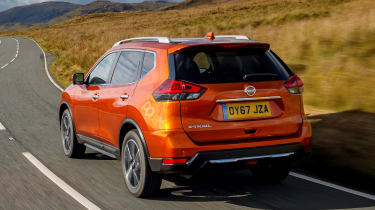
The X-Trail is no entertainer, but it’s easy to drive for such a bulky machine, thanks to light steering, an easy six-speed manual gearbox and a raft of safety tech.
The versatile SUV includes Nissan's ‘Intelligent Trace Control’ which constantly monitors your speed and steering input, adjusting your line through a corner if the car senses you’re going to run wide, rather than cutting in with juddering traction control once the car has lost grip.
Intelligent Ride Control appears, too, using subtle engine braking to reduce oscillations over particularly bumpy roads, or over urban speed humps. However, it’s not enough to disguise a slightly fidgety ride on the larger 19-inch alloys fitted to Tekna models. Models on smaller wheels are fine, but a Mazda CX-5 is more cosseting and the Skoda Kodiaq is sharper, yet just as smooth-riding.
You can now specify your X-Trail with Nissan's ProPILOT semi-autonomous driving technology, which allows the car to steer, accelerate and brake autonomously in a single lane on highways and motorways, both in heavy traffic and at cruising speed on the open road.
The X-Trail doesn't excite or inspire on the road, but offers a reasonable blend of refinement, comfort and agility for such a large machine. Wind and road noise are well isolated, but the diesel engines can make a bit of a din under load.
Tackle a few corners, and you'll soon be aware that the X-Trail has plenty of body roll, while the steering is soft rather than sharp. On the move it’s a comfortable cruiser with a well judged ride, although it’s fidgety at low speeds – finding bumps and lumps in the road around town. All-wheel-drive cars are capable when confronted with a bit of soft-roading, too, and features such as the hill-start assist system are tailored with muddy stuff in mind.
Overall, the X-Trail isn’t as composed as a Peugeot 5008. It’s upset more by bumps and cambers, while the damping means the car reacts more violently to potholes and bumps in the surface – especially at the rear. It’s also neither as responsive nor as rewarding to drive as a Skoda Kodiaq. The Nissan’s steering is nicely weighted, however, and although it leans quite a bit when you push it faster through corners, it doesn’t ever feel unsafe; just a little uncontrolled next to its more composed rivals.
Engines, 0-60 acceleration and top speed
Nissan no longer offers either the 1.6- or 2.0-litre diesel, and the 1.6 DiG-T petrol unit is also off the price list. In pursuit of improved emissions and lower CO2 figures, the range now includes a single 1.7-litre diesel with 148bhp and 340Nm of torque, along with a 1.3-litre petrol delivering 158bhp and 270Nm. Both of these engines are tried and tested elsewhere in the Renault-Nissan Alliance - in the Nissan Qashqai and Renault Kadjar.
Diesel models are available with front-wheel drive and a six-speed manual gearbox as standard, although there is the option of a CVT auto transmission and all-wheel drive. However, keep in mind that choosing the latter will have quite an impact on economy and emissions figures.
The 1.3-litre four-cylinder petrol is only available with a dual-clutch transmission and front-wheel drive. Swift acceleration requires the engine to be worked hard, although with a 0-62mph time of 11.5 seconds, buyers shouldn't be expecting too much in the way of performance.
MPG, CO2 and running costs
Downsizing from the old model’s 2.0-litre to the 1.7 dCi diesel pays dividends at the pumps for the X-Trail, which can return a claimed best of 47.7mpg in its most efficient two-wheel-drive manual form. That only drops a little to 45.1mpg for the all-wheel drive model. These figures are on the WLTP test cycle, so should better represent real-world economy.
CO2 emissions start at 155g/km for the entry-level diesel, but soon climb to a high of 205g/km if you opt for the all-wheel drive auto version.
The 1.3 DiG-T petrol engine is not quite as frugal, delivering a maximum fuel economy of 38.5mpg, on the combined cycle. CO2 emissions start from 166g/km, depending on trim level, which is reasonable, but not exceptional, particularly when compared to rivals using hybrid technology.
Interior, design and technology
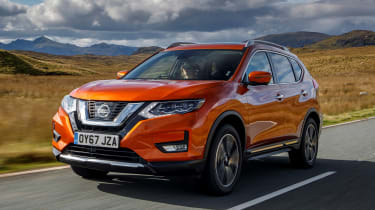
Take a passing glance at the Nissan X-Trail and you might initially mistake it for its little brother, the Qashqai. However, while the corporate nose is largely the same as the Qashqai’s, the X-Trail’s rounded rear is significantly different.
The 2017 revisions are recognisable by a new, wider front grille, changes to the bumpers front and rear, chrome side mouldings and an LED daytime running light signature that throws a different pattern to that of the Qashqai - it's easier to spot the difference between the two if the lights are on. There's also a couple of new colours and alloy wheel designs. It's not a dramatic restyle, and if you were a fan of the pre-facelift model chances are you won't be offended by the update, if you even notice the changes.
Trim levels include entry-level Visia, then Acenta, Acenta Premium, N-Connecta and top-of-the-range Tekna. Base standard kit is pretty generous with 17-inch alloy wheels, Bluetooth, a DAB radio, air con, cruise control and a multi-function steering wheel.
The flagship Tekna spec adds 19-inch wheels, self-parking and powered leather seats to the X-Trail’s lavish kitbag – but by then you’re talking about spending the best part of £33,000.
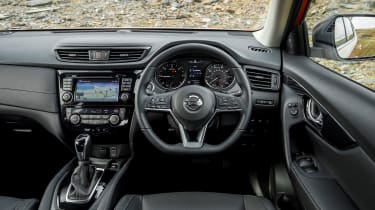
Owners of the old X-Trail won’t recognise the latest one from the inside, but Qashqai owners will feel right at home. The layout is identical to the Qashqai’s, exhibiting soft-touch materials and good fit-and-finish. However, the Skoda Kodiaq, Mazda CX-5 and a number of other newer rivals offer more modern designs and a greater feeling of quality inside.
Sat-nav, stereo and infotainment
As with the facelifted Qashqai, we can’t help feeling that Nissan could have done more with the infotainment and connectivity tech in the updated X-Trail, because rivals have moved the game on.
While the core features offered as part of Nissan’s Connect Evo system are okay (sat-nav, around-view monitor and some other selected app functions, such as Facebook and TripAdvisor), the seven-inch screen isn’t in an ideal position and, most importantly in this class today, the lack of smartphone features compared with its rivals highlights the X-Trail’s relatively limited tech.
Although Apple CarPlay and Android Auto aren’t supported, Bluetooth for calls and audio streaming, as well as DAB, is included with NissanConnect Evo. However, the menu system is clunky and the graphics lack clarity and definition compared with the larger, crisper screens fitted in rivals such as the Peugeot 5008 and Skoda Kodiaq.
At least you get a three-year subscription to Nissan’s live services, which include traffic information.
Practicality, comfort and boot space
On first impressions, the X-Trail makes a great case for itself as a family car. It has decent cabin space and Nissan has effectively consolidated its crossover line-up by offering the X-Trail as a substitute for the old seven-seat Qashqai+2.
However, if you do want that third row of seats, the X-Trail only offers them as a £1,000 option, even on the most expensive model. We’d prefer it if the extra chairs were included as standard at the top of the range, and we'd recommend seriously thinking about whether you'll actually use the seats enough to justify the extra outlay.
Still, the standard five-seat X-Trail offers lots of appealing practical touches, with unusually wide-opening doors, plenty of storage space, including a compartment with a lid between the seats and a useful glovebox. Then, there’s that generous rear load area.
Size
The X-Trail is one of the larger cars in the medium-sized SUV class. Its 4,690mm length is the same as the Hyundai Santa Fe, while the Ford Kuga is shorter at 4,626mm. It’s slightly narrower than both at 1,820mm versus 1,882mm (Kuga) and 1,880mm (Santa Fe). The X-Trail is tallest of the three at 1,710mm, but there’s not a lot to split them.
However, thanks to its updated platform co-developed with Renault which features a 76mm wheelbase stretch versus the last version, the X-Trail offers decent space in the cabin.
Leg room, head room & passenger space
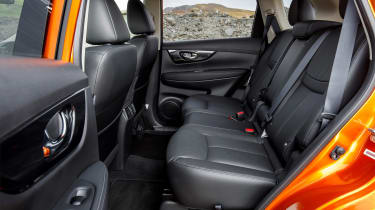
The X-Trail has good cabin space, including decent legroom. The rows of seating are arranged in a tiered theatre-style system, where every row sits a little higher than the one in front, so the rearmost seats don't feel as claustrophobic as they could. This doesn’t come at the expense of headroom, though, as there’s plenty of space in the back seats.
The rear doors open outward to almost 80 degrees, aiding access for passengers and for fixing child seats. The optional third row comprises a pair of flat-folding seats, but they are only big enough for children – despite the fact that the middle row slides fore and aft to make more space for the extra passengers or for luggage. There are a trio of seatbelts in the second row, and the outer seats have ISOFIX child seat mounts.
Boot
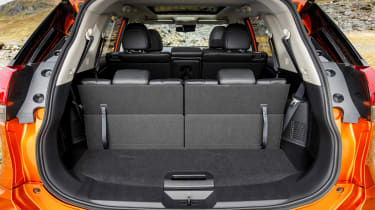
With all seven seats in place the Nissan offers 445 litres of space, while in five-seat form there's 565 litres. Fold both the middle and third rows and you benefit from a huge 1,996-litres. But, while the load space is good, it’s still slightly smaller than the Peugeot 5008 and Skoda Kodiaq can offer.
The X-Trail has some very neat practical touches, like a boot floor that moves up and down to create horizontally-separated loading areas – in fact, Nissan claims the versatile X-Trail has 18 different configurations for the load area.
Towing
The Nissan X-Trail has different towing capacities depending on which engine and transmission combo you choose, starting at 1,500kg and rising all the way to 2,000kg. Drivers looking for the maximum pulling potential will have to settle for a manual diesel.