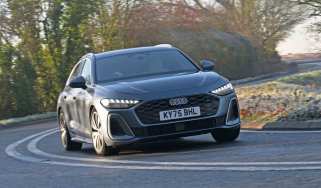
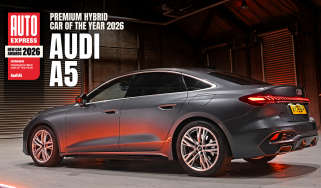
Audi A5 review
The Audi A5 is a bigger, smarter, plusher (and pricier) replacement for the A4 that’s competent to drive
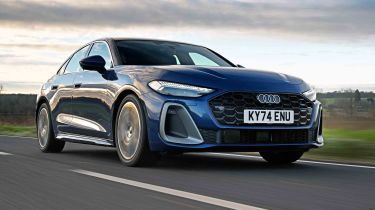

Our opinion on the Audi A5
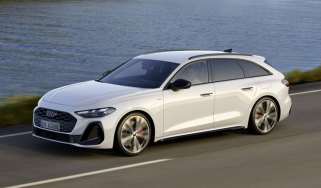
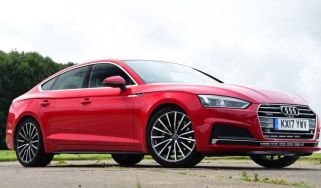
The latest Audi A5 replaces the old A4 saloon and Avant, and is bigger and better finished inside than any of its predecessors, but prices have risen to match its grander stature. We don't think the experience behind the wheel won’t tempt keen drivers, but the A5 doubles down on being a high-quality, solid and sensible car with smart looks and better legroom (although not headroom) for rear passengers. It’s also more practical than the old A4, thanks to having a hatchback tailgate rather than the restrictive letterbox-style opening of a traditional saloon car.
It’s a shame efficiency doesn’t make a big leap in the petrol versions, but the plug-in hybrids offer a fine mix of performance and efficiency if you can afford one. To a large extent, the A5 is a case of ‘meet the new boss, same as the old boss’.
About the Audi A5
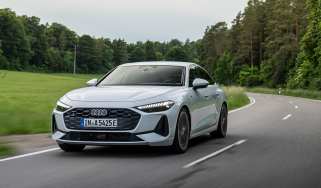
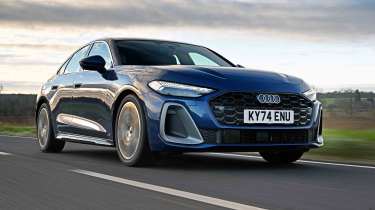
You’re going to have to bear with us for a second, because the car you see here is the replacement for the Audi A4 saloon. The change from A4 to A5 was necessary to differentiate between Audi’s EVs and internal combustion-engined cars – although the Audi brand has since backtracked on this model naming strategy. It was intended that all ICE (internal combustion engine) models would use odd numbers, so the A4 needed to become A5.
Used - available now


Going forward, all-electric Audis will continue to use the e-tron moniker, just as TDI denotes a diesel engine and TFSI indicates a petrol engine. For company car drivers, e-hybrid will distinguish plug-in hybrid models from the rest of the range.
The repurposing of the A5 name means a few of the old A5 models, such as the Sportback, Coupé and convertible are gone forever. The A5 is now only available as a ‘saloon’ or an Avant estate.
To make things more complicated, the A5 Saloon is actually a hatchback, and is very similar to the old A5 Sportback. So if you’re in the market for something like the old A4 saloon, the A5 is your only option. It remains to be seen whether the A4 name, which has been around since it replaced the Audi 80 in 1994, will return when the brand reveals an electric compact executive saloon in a few years’ time.
We've driven the Audi A5 on the international launch and in the UK as part of a road test. We've driven petrol, diesel, and plug-in hybrid examples through the French mountains, on German roads around Munich, and here in the UK on a mix of different road conditions, revealing that the car continues to tread the centre ground between its two premium German rivals. The BMW 3 Series offers a more responsive and dynamic feel, while the Mercedes C-Class has a slight edge in terms of comfort.
Performance & driving experience
Pros |
|
Cons |
|
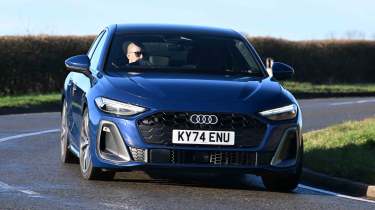
The brand claims to have worked on the Audi A5 to give it a more engaging driving experience compared with its sensible and borderline forgettable A4 forebear, but we’re not convinced much has changed.
The latest car comes with fewer engine options than before, with the 148- and 201bhp petrols coming standard with front-wheel drive, while the diesel is available in both front- and quattro four-wheel drive. The e-hybrid is four-wheel drive only.
All A5s get a seven-speed S tronic automatic gearbox, while the diesel was the first TDI to get hybrid tech. The MHEV+ system can run the car in electric-only mode for very short distances, and Audi says this improves official emissions by up to 10g/km.
Performance, 0-60mph acceleration and top speed
The fastest-accelerating engine option in the standard A5 range is the plug-in hybrid. With 295bhp and all-wheel drive, it can cover the 0-62mph blast in 5.9s and hit a 155mph top speed. The all-wheel-drive diesel can do 0-62mph in 6.9 seconds, taking 0.8 seconds less to cover the sprint than the front-drive version.
The 201bhp petrol engine gets the A5 from 0 to 62mph in 7.8 seconds, then on to a 154mph top speed. That’s a tenth shy of the front-wheel drive 201bhp diesel, and the figure increases to 9.8 seconds for the 148bhp petrol, which can reach 134mph.
The 365bhp Audi S5 manages the 0-62mph sprint in 4.5 seconds, and it’ll bump into Audi’s 155mph limiter with ease. The performance figures for the Audi S5 Avant estate models are largely the same as for the saloon. If that isn't enough, the 630bhp Audi RS 5 dispatches the same acceleration sprint in a mere 3.6 seconds.
On the road, the A5’s 201bhp petrol or diesel options both feel adequate without being too punchy. Much like the rest of the A5, they are refined and do the job with minimal fuss, but don’t stand out for responsiveness or clout.
The plug-in hybrid is an impressive piece of kit, with the well-integrated petrol and electric power sources working together seamlessly, and its standard four-wheel drive system makes the most of that power. Clever tech reads the driving conditions and the planned route to optimise the system’s performance, and the result is that it feels powerful when you need it to, and relaxed when you don’t.
| Model | Power | 0-60mph | Top speed |
| TFSI 150PS | 148bhp | 9.8s | 134mph |
| TFSi 204PS | 201bhp | 7.8s | 154mph |
| TDI 204PS quattro | 201bhp | 6.9s | 150mph |
| e-hybrid quattro | 295bhp | 5.9s | 155mph |
Town driving, visibility and parking
The A5 isn’t perfect at ironing out bumps and ripples in the road, but if anything, it’s the smaller imperfections that transmit most annoyingly into the cabin. Bigger speed bumps are dispatched with minimal fuss, but the car doesn’t always absorb the smaller stuff around town. That is on the larger wheels and sports suspension of the models that we tested, however. We suspect that the regular Sport on 18-inch alloys will provide a more comfortable ride, although that car hasn’t yet been made available for testing.
The seven-speed automatic gearbox is smooth and does its work without drawing attention to itself. The light steering is also at its best in lower-speed manoeuvres.
Rear visibility isn’t great, with the sloping hatchback window not being particularly large, and not having a rear wiper will be a handicap when the weather gets colder and wetter. The Avant estate version is better in this respect, but regardless, all A5s are equipped with a 360-degree camera and rear camera, as well as Audi’s parking-assist tech.
The A5 e-Hybrid is the most refined A5 because you can drive in EV mode for extended periods, though we did find it's possible to kick the engine into life with a firm shove of the accelerator pedal. When driving on electric power, you'll find that the steering wheel paddles are employed to control the strength of the regenerative braking rather than the gears when the engine is running. None of the brake regen settings is particularly strong, but it’s a nice touch that makes the e-hybrid feel more like an EV.
B-road driving and handling
Despite Audi’s attempts to make the A5 more engaging, the pecking order still places the car below the BMW 3 Series in terms of driver engagement and enjoyment.
There’s nothing particularly wrong with how the Audi drives; it’s just a very safe and solid companion that doesn't feel like it has any sort of edge to it. Where the BMW would at least make it feel like it’s enjoying a twisting section of road with its lively responses and chassis poise, the Audi deals with things in a slightly disengaged way. Much of that is due to the feel and weight of the steering, which is lovely around town, but out onto faster roads, that lightness shifts from a positive to a negative. A bit more weight and overall feeling of connection wouldn’t go amiss.
If you’re not after thrills from your compact executive car, then the Audi is a great all-rounder that feels solid and sure-footed with plenty of traction, even if you don’t go for a version with quattro four-wheel drive.
One thing to note is that, due to its hybrid system, the diesel has a less pleasant feel to the brake pedal. Petrol cars have progressive action, but the diesel feels like you’re almost instantly up against resistance in the brake pedal travel, making it harder to modulate and gradually feed in the stopping power. The plug-in hybrids don’t suffer from this, though, despite also having regen brakes.
Motorway driving and long-distance comfort
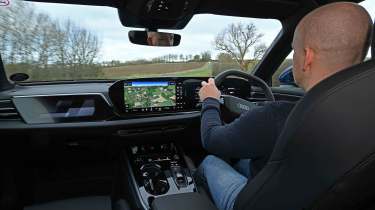
Motorway driving is the Audi A5’s most natural environment, and the car does a good job of keeping out road and wind noise. The high-quality interior can be appreciated as you settle into a longer cruise, and the screens are nicely angled toward the driver, creating a cockpit-like ambience.
The higher-powered petrol and sole diesel - both with 201bhp - are better options than the 148bhp petrol for anyone regularly on longer runs. The diesel is much pricier to buy, though, so you’ll need to be doing big miles to make the extra efficiency pay back.
The e-hybrid plug-in models are more expensive again but acquit themselves well on longer journeys. Refinement is very good when cruising, and if you put your foot down, you’ll either get a muted snarl from the petrol engine or a slight whine from the electric motor, depending on the selected driving mode.
“The neatest part of the A5’s PHEV set-up is the efficiency-boosting intelligent hybrid system. In Hybrid mode, the car assesses driving conditions and the navigation route data to optimise the mix of petrol and electric power.” – Steve Walker, head of digital content.
MPG, emissions & running costs

Pros |
|
Cons |
|
The two petrol cars have claimed economy figures of up to 42.8mpg, depending on spec, which is broadly in line with its petrol BMW 3 Series and Mercedes C-Class rivals. The diesel Audi A5 returns up to 58.9mpg in front-wheel drive form, or 55.3mpg if you want the quattro four-wheel drive car. The A5 diesel uses new mild-hybrid technology that can run the car for short distances on electric power and otherwise boosts efficiency, although it still isn't as good as the most efficient C-Class, because the C 220 d with 197bhp has a consumption figure of 62.8mpg.
If you want a more comprehensive hybrid experience, you’ll want the e-hybrid plug-in A5. It delivers a WLTP combined efficiency of 142mpg, or 43.5mpg when the battery is flat. That's 3.5mpg better than the equivalent BMW 330e plug-in hybrid.
The Audi A5 Avant estate carries a slight fuel economy penalty across the range, which you can read about in our dedicated review.
| Model | MPG | CO2 | Insurance group |
| TFSI 150PS S Line | 42.8mpg | 154g/km | 24E |
| TFSi 204PS S line | 42.8mpg | 155g/km | 31E |
| TDI 204PS S Line | 58.9mpg | 127g/km | 33E |
| e-hybrid quattro 299PS S Line | 141.9mpg | 45g/km | 39E |
Electric range, battery life and charge time
The A5 e-hybrid models have a 20.7kWh (usable) battery that powers an electric motor integrated into the S tronic automatic gearbox. This gives an impressive electric range of 67 miles, which is better than the BMW 330e but worse than the 71-mile Mercedes C 300 e. You might think that a few miles here or there could be made up by careful driving, but these official figures determine the company car tax band of the car, and by getting over 70 miles, the Mercedes accesses a cheaper tax bracket.
Charging is AC only, with no option to rapid charge, which is odd considering the less expensive Volkswagen Passat has the ability to be rapid charged. If you charge your plug-in hybrid A5 from a 7.4kW home wallbox, a full charge will take just under four hours
| Model | Battery size | Range | Insurance group |
| e-hybrid quattro Saloon S Line | 20.7kWh | 67 miles | 39E |
| e-hybrid quattro Avant S Line | 20.7kWh | 65 miles | 40E |
Tax
Predictably, no versions of the A5 duck under the £40,000 threshold for luxury car tax, so all suffer from higher annual Vehicle Excise Duty from the second time the vehicle is taxed until it is six years old. Given that there isn’t an electric A5, there isn’t a version eligible for the discounted low-emission zones that benefit electric cars.
The e-Hybrid plug-in hybrids are going to be the best choice for company car drivers, unless very high mileage or lack of access to charging forces them into a diesel. The 67-mile electric range puts the cars into a 10 per cent Benefit-in-Kind tax bracket for the 2026/27 tax year, but the Mercedes C 300 e can do more than 70 miles, so it is taxed on seven per cent of its value.
Insurance groups
The A5 is likely to be one of the more affordable mid-size company cars around to insure, with the least powerful petrol starting in group 24, which is four places lower than the equivalent 3 Series and nine places below the C-Class.
For the time being, it should also be less costly to insure than electric alternatives, such as the BMW i4 starting in group 35, and the Tesla Model 3 beginning in group 36.
The plug-in hybrids are more costly to insure due to having a more complicated drivetrain of both an engine and an electric motor, plus a battery pack. These e-hybrid cars range from group 38 to 40, depending on spec.
Depreciation
The A5, according to our resale valuation provided by CDL, maintains between 39 and 47 per cent of its original value over three years or 36,000 miles. The BMW 3 Series is slightly ahead at between 43 and 49 per cent, while the Mercedes C-Class manages between 42 and 45 per cent.
As an alternative, the Mercedes CLA Electric will retain between 50 and 56 per cent of its original value over the same period.
To get an accurate valuation for a specific model, check out our free car valuation tool...
Interior, design and technology
Pros |
|
Cons |
|
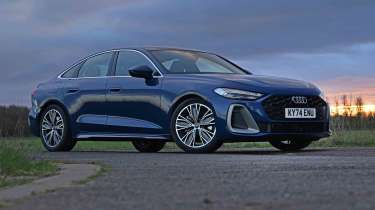
While the Audi A5 looks quite sensible and grown up in terms of its exterior and interior design, there’s nothing revolutionary about its styling (apart from it now being called A5 rather than Audi A4). However, that does mean you still get all the bits the A4 always excelled in.
So cabin quality is excellent, and everything is laid out logically, including the much-appreciated physical volume knob for the audio system. As in most cars, too much is now controlled through the touchscreen, but the more buttons that remain, the better.
Interior and dashboard design
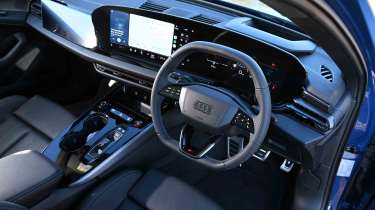
The dashboard is dominated by a long curving arc that’s actually formed by two separate displays, and there’s plenty of squishy surfaces, gloss plastic trim and nice lighting to show it’s a high-class place to be.
Too many controls work through the touchscreen, but that at least cleans up the front area that would previously have housed the more user-friendly but less aesthetically pleasing rotary controls and other buttons. Standard spec is a round steering wheel that feels noticeably larger than the BMW 3 Series’ more compact device, but above the entry-level Sport trim, you get a much nicer wheel that’s flattened off top and bottom.
Materials and build quality
Everything feels high in quality, from the squishy dashboard top and fabric across the full width of the car to the rubber-lined front door bins that stop anything from making a noise rolling around. The silver air vents on either side of the cabin and beneath the big screen increase the appearance of premium effort.
Sat-nav, stereo and infotainment
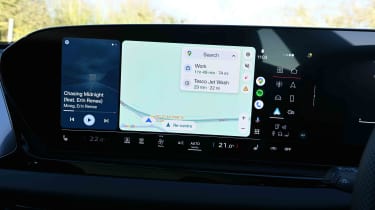
The two large screens dominating the cabin are a 14.5-inch curved touchscreen central display angled toward the driver, and an 11.9-inch digital instrument cluster controlled by touch-sensitive buttons on the steering wheel. We found the buttons on earlier cars to be overly sensitive, and on several occasions during our test drive, we accidentally activated the audio system while cornering. This issue should be fixed on cars ordered from December 2025 onward because there are more physical controls (including those for volume control) on the steering wheel. You'll also be able to display a map in the driver's cluster, which wasn't possible on early versions of this generation of A5.
It’s a shame so many other buttons have been removed from the cabin - it’s not a quick press to switch driving modes when you spot a series of bends coming up, for example. The menu system is logically laid out, but like all touchscreens, it isn’t easy enough to use when you’re on the move. The menu structure is being simplified for cars ordered from December 2025 onwards, and you'll be able to customise the screens' background colour, because some found the black background hard to read.
The standard audio system offers crisp enough sound for most, but if you’re an aural connoisseur, the range-topping Vorsprung brings an 810-watt, 16-speaker Bang & Olufsen sound system. However, for the full 3D sound experience, you'll need to spend a further £425 to add speakers embedded in the car’s front headrests, which we think is a bit rich considering how much a Vorsprung trim model costs over our preferred S Line trim.
Not to be overlooked, and only fitted to the top-spec Vorsprung models, is a third screen. Mounted ahead of the front passenger, the 10.9-inch touchscreen is a bit of a novelty for a while, but having an extra nav or trip computer display isn’t massively useful, although Audi says its tech can stream content away from the driver's prying eyes. We’re unsure which screen wins when the driver and passenger disagree about the radio station or navigation destination. As part of the December 2025 updates, you can see Apple CarPlay and Android Auto smartphone mirroring on the third screen and in the driver's instrument cluster.
Boot space, comfort & practicality
Pros |
|
Cons |
|
As mentioned previously, in calling the Audi A5 a Saloon, Audi is being slightly disingenuous, due to the hatchback design of the car. The hatch is actually more practical than a saloon’s letter-box style opening when it comes to fitting big loads in. It is a shame that no rear windscreen wiper is fitted to the A5 (you’ll have to go for the A5 Avant for that), because you’ll either have to break out the bucket and sponge more often in winter in order to see what’s behind you, or rely on the standard front and rear parking sensors and reversing camera - which actually do a very good job.
All A5 Saloons are five-seaters, while there is also the Avant estate model. Audi no longer sells an A5 Sportback, Coupe or Cabriolet.
Dimensions and size
The A5 is notably larger than the A4 saloon it replaces, and the over 70mm of extra length is mainly between the wheels, making for a more spacious cabin area.
The increase in size also puts the A5’s footprint well clear of the BMW 3 Series or BMW 4 Series Gran Coupe, and the Mercedes C-Class, and the Audi is also taller than any of its rivals, although you feel like you’re sitting quite low down when you drop into the driving seat.
The A5 has grown and is larger than the BMW 4 Series Gran Coupé, the car’s most logical rival. Prices have also increased to match its new stature, and while you get a bigger car – around 70mm longer, 24mm taller and 13mm wider – a step up on what was already a nice cabin, and a lift in standard kit, it’s still quite a price hike
| Dimensions comparison | |||
| Model | Audi A5 | BMW 3 Series | Mercedes C-Class |
| Length | 4,835mm | 4,713mm | 4,751mm |
| Width | 1,860mm (2,099mm inc mirrors) | 1,827mm (2,068mm inc mirrors) | 1,820mm (2,033mm inc mirrors) |
| Height | 1,461mm | 1,440mm | 1,438mm |
| Wheelbase | 2,902mm | 2,851mm | 2,865mm |
| Boot space | 445-1,299 litres | 480 litres | 455 litres |
Seats & passenger space
Though the front of the car feels wide and spacious for passengers, there’s not a great amount of storage. Under the movable armrest there’s a fairly shallow space, and you get a pair of cup-holders and a wireless charging pad in the centre, as well as two USB-C chargers. But that’s about it. The door bins are lined and have a reasonable depth, but it’s not a car where you’re going to forget where you’ve stashed your sweets.
It is comfortable, though. The front seats are big and welcoming, if lacking a tiny bit in lateral support, but it’s not a problem to spend hours in them on a long run.
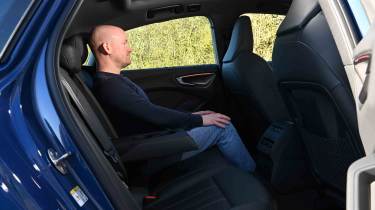
Back-seat passengers used to sacrificing some comfort sitting in the rear of compact executive models of old will be delighted to learn that it’s they who most benefit from the A5’s increased size over its predecessor. Legroom is significantly better compared with the old A4 – or any of the other premium German competitors – and rear passengers get their own ventilation control, as well as a pair of USB-C chargers and a fold-down armrest.
But the news isn’t all good if you carry taller passengers, because the sloping roofline has a predictable impact on rear headroom. And although the width has increased over the A4, three passengers in the rear will have to be good friends. Choose the Avant estate if you’ve got taller people to fit in the rear because it has a little more headroom.
The rear door pockets aren’t lined as they are in the front, which smacks of cost-cutting to us. Two Isofix points are provided on the outer positions of the rear seat, and are accessed by removing a couple of conveniently located plastic tabs.
Boot space
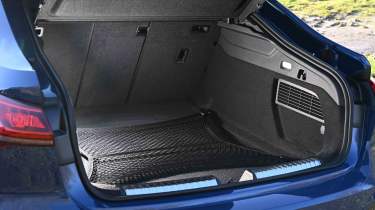
Unlike the rear-seat space and despite the A5’s growing dimensions, its boot capacity hasn’t grown over previous Audi compact execs; in fact, it’s smaller, at 445 litres, dropping to 417 in the A5s with quattro all-wheel drive. The A4 saloon was 15 litres better than the front-drive A5, while the BMW 3 Series can offer 500 litres in total, and the Mercedes C Class has up to 480 litres of luggage capacity.
The A5 Avant estate is no larger than the saloon, but it does gain a little boot space, going up to 476 litres depending on the specification.
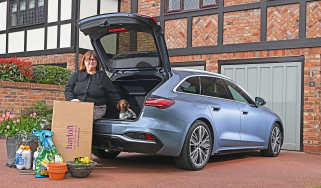
The hatchback design is more practical than the traditional saloon boot still favoured by rivals, though. The small decrease in overall volume is countered by a wider opening, which offers better access than a saloon, especially for bulkier or heavier loads. There is a small lip to lift things over, and the boot is quite long and wide, but shallow rather than being particularly deep.
There’s also nothing particularly clever about the load area. It features a couple of plastic hooks, a 12V socket, and a luggage net, but lacks underfloor stowage or any neat compartments for hiding smaller items.
All versions of the A5 come with a handy 40:20:40 split folding rear seat. In the regular A5, dropping the rear seats has to be done from the back door rather than the boot, whereas the Avant estate model features a more convenient lever at the rear of the car. The seats at least go pretty much completely flat, which helps when sliding in longer items. Folding the seats opens up 1,299 litres of space (which is exactly the same as the BMW 4 Series Gran Coupe) or 1,271 litres on quattro models. In the Avant, there’s up to 1,424 litres with the seats down, depending on the version.
Towing
The S6 performance model actually has the best towing capacity at 1,900kg, but the quattro TDI diesel cars are within a well-packed suitcase of that figure at 1,885kg and will be significantly more economical. The e-hybrids manage around 1,700kg, and the base front wheel drive petrol A5s are rated to tow 1,500kg.
“Audi’s decision to call the 5-door hatchback A5 a ‘Saloon’ is certainly confusing, but the large tailgate opening is undoubtedly better for practicality. You get far more options for cramming things in, but it also means you don’t gain as much by choosing the Avant estate.” - Steve Walker, head of digital content
Safety & reliability
Pros |
|
Cons |
|
Safety experts Euro NCAP have awarded the Audi A5 the maximum five-star rating. Direct comparisons between the 3-Series and C-Class can’t be made because these rivals were tested under earlier, less stringent testing criteria, but against electric alternatives, the Volkswagen ID.7 scored better in all categories, while the BYD Seal did better in the adult and child occupancy categories, and had a higher vulnerable road user protection result.
Standard safety kit on all cars includes adaptive cruise control, lane-departure warning and intersection, turn and swerve assist, as well as front and rear parking sensors and 360-degree and rear-view cameras. However, only the top Edition 1 models come with lane-change assist, a top-down camera display, and the proactive passenger-protection system that preempts an accident and primes the car’s safety systems.
The Audi brand seems to yo-yo in the Driver Power rankings. After significant improvement in 2025 compared with its 2024 result, the brand has once again slipped down the list, placing 23rd out of 30 in the latest 2026 best car manufacturers list. That puts it well behind other premium rivals, such as Volvo (14th), BMW (5th), and Mercedes (1st). Owners gave pretty average scores across the board, with the only above-average categories being both interior and exterior quality, the built-in sat-nav, and audio system. Respondents said they didn't like front-seat comfort, ride quality and smoothness, fuel economy, or the high servicing and running costs.
| Euro NCAP safety ratings | |
| Euro NCAP safety rating | Five stars (NCAP, 2024) |
| Adult occupant protection | 87% |
| Child occupant protection | 86% |
| Vulnerable road user protection | 78% |
| Safety assist | 77% |
Buying, prices and deals
Best buy: Audi A5 e-hybrid quattro Saloon S Line
As you might have already deduced, going up one number from A4 to A5 means that pricing across the board has seen a bit of an increase, because the A5 starts at a little under £43,000, jumping to around £45,500 for the mid-range S Line. The moodier Black Edition starts at just over £48,500, while if you push the boat out for the top-of-the-range Vorsprung, you’ll need to fork out nearly £57,500.
The e-hybrid plug-in hybrid models are offered in an entry-level Technik trim to keep costs down, and these models start from around £49,500. The Avant estate bodystyle starts at just over £44,500.
Audi still offers a diesel engine in the A5, and while that will be attractive to some buyers, we think the optimum engine choice is the e-hybrid plug-in version. Assuming you can afford the extra outlay of £3,750 over the oil-burner, it should deliver the goods in terms of low running costs and is a no-brainer for company car drivers. The petrol options are solid but forgettable.
The S Line models are very popular across Audi’s range because of the more dynamic looks. It’s a decent value package that adds a lot, but the larger wheels probably don’t help ride quality. The Audi A5 Avant estate doesn’t offer as much practical benefit as it did, since the regular A5 has a hatchback tailgate, so it may come down to whether you prefer the estate look.
Our network of trusted dealers is currently offering discounts on the recommended retail price of the Audi A5 via our Find a Car service. Alternatively, you can lease an A5 or buy a used A5, all on Auto Express.
Audi A5 alternatives
While the mid-size company car market has been gravitating away from the traditional saloon car body style, there are still the usual suspects in the BMW 3 Series and Mercedes C-Class to contend with. The C-Class has a wide choice of engines, from mild-hybrid petrol and diesel options, plus a plug-in hybrid with a long electric-only range. The 3 Series still has the edge over the A5 in terms of the driving experience, though.
It’s hard to argue with the latest range of electric cars – especially if you are a company car driver paying Benefit-in-Kind (BiK) tax. Of the choices available, the Tesla Model 3 gets our nod, but the Mercedes CLA Electric isn't far behind, with impressive range and efficiency, and it comes as either a graceful four-door coupe or a sleek estate. The BMW i4 is a great driver's car (if you can afford its hefty list price), while the Volkswagen ID.7 provides a big battery with a usefully long electric range.
Key updates of the Audi A5 review
28 September 2026: Update to include the 2026 Driver Power customer satisfaction survey results and the latest resale valuation data.
17 December 2025: Included information about the revisions to the infotainment system for cars ordered from December 2025 onwards.
Audi A5 pictures
Frequently Asked Questions
Audi hasn’t yet released details of the A5 service schedule, but its cars often offer flexible servicing. This could involve annual inspections or every 9,300 miles, up to 18,600 miles or two years, depending on how the car’s sensors assess oil degradation. Audi pledges to price-match on service, repair, maintenance or new tyres, on any quote that includes Audi genuine parts.
Deals on the Audi A5 and alternatives