Audi A5 Avant review
The Audi A5 Avant makes a lot of sense as a family car, if you can afford the premium price

Our opinion on the Audi A5 Avant
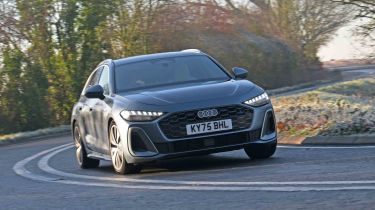
The latest Audi A5 Avant makes a lot of sense, especially in TDI diesel guise. It’s practical and spacious, comes with efficient mild-hybrid and plug-in hybrid power, and is arguably better looking than the saloon on which it shares the same platform. It’s also chock-full of excellent technology and feels well made. It’s certainly worth a look if you can afford the premium price.
About the Audi A5 Avant
Audi doesn't refer to their more practical load-luggers as estate cars – their cars are far too classy for that. Instead, the brand calls them Avant. Not referring to them as an estate also handily circumvents the fact that they aren't as practical as a traditional estate car, but just offer that little bit more versatility than the saloon counterpart. And it's a formula that continues with the latest A5 Avant, which excels at delivering a handsome exterior and a premium interior, just not quite as much boot space as its closest BMW and Mercedes rivals.
You've a choice of four different trim levels, two petrol engines, one plug-in hybrid, and one diesel engine. The latter can be had with front-wheel drive or quattro four-wheel drive, while the plug-in hybrid is quattro only. There's also a performance Audi S5 Avant for those who need to get to the recycling centre in a hurry.
Used - available now


We've driven the A5 Avant abroad on the international launch, as well as on UK roads. We've also run an A5 Avant S Line TDI quattro as part of our long term test fleet.
Performance & driving experience
| Pros |
|
| Cons |
|
Audi has worked hard over the last decade or so to improve the driving experience of its cars. Once safe but dull, today’s range is more engaging than it used to be without any real sacrifice in comfort or refinement. The A5 Avant continues this trend, though to pick out any significant advances over the already talented A4 Avant it replaces would require driving them back to back – it feels very similar to us.
With the A6 e-tron taking up the mantle as Audi’s electric offering for now, the A5 Avant sticks to more traditional means of propulsion with petrol and diesel engines, an automatic gearbox, and the option of quattro all-wheel drive depending on the variant, and power and torque figures competitive with others in the class.
There are currently four A5 Avant engine options in the standard range – two petrols of different outputs, a four-cylinder diesel, and a diesel with all-wheel drive – plus a sporty S5 Avant topping the range.
Performance, 0-60mph acceleration and top speed
The 2.0-litre petrol models are separated by output, with 148bhp for the entry-level car and 201bhp for the more powerful model, with 0-62mph acceleration of 9.8 seconds and 7.8 seconds, respectively, and top speeds of 132mph and 152mph.
Next up is the first of the diesels, a 2.0 TDI making 201bhp and promising a 7.7-second 0-62mph time and 149mph flat out. Add Quattro, to this engine (available from S line trim and above) the 0-62mph dash drops to 6.9 seconds, while top speed is 146mph. On the road, the front-wheel drive TDI feels refined and brisk, lively but never fast. Its engine produces enough torque in the mid-range (400Nm between 1,750 and 3,250rpm) to satisfy but rarely elate.
| Model | Power | 0-62mph | Top speed |
| Sport TFSI 150 S Tronic | 148bhp | 9.8 seconds | 134mph |
| Sport TFSI 204 S Tronic | 201bhp | 7.8 seconds | 152mph |
| Sport TDI 204 quattro S Tronic | 201bhp | 6.9 seconds | 147mph |
Town driving, visibility and parking
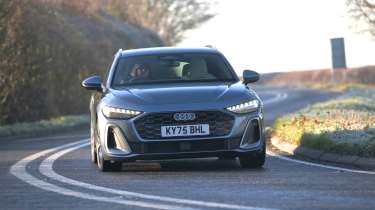
Refinement is this car’s priority and that comes across during in town driving. We’re yet to test any of the models on smaller wheels, which might take the edge off a ride quality that transmits smaller bumps more than bigger ones, but it's not as though the ride on 20-inch wheels is more than respectable enough. The cabin has thin enough windscreen and roof pillars for decent visibility, too.
B-road driving and handling
The TDI we’ve driven so far is not a car that enthusiasts will rush towards, but it does more than enough dynamically to provide plenty of enjoyment to whoever is behind the wheel. It’s impressively refined rather than outright fun to drive, with an emphasis on ride quality and not on-limit chassis precision, which is just the way it should be in a car of this type.
Motorway driving and long-distance comfort
The A5 Avant makes a predictably good motorway cruiser. Wind and road noise are kept to a minimum on the move, the most audible noises being a distant hum from the engine and a faint rumble from the low-profile tyres of the 20-inch alloys. The top model also gets standard massage seats, which may prove welcome over longer trips, though we’ve no complaints with the basic shape of the seats to begin with.
"I find that visibility in the A5 Avant is good, and although it’s a large car, I’ve never found it intimidating from behind the wheel." – Sarah Perks, director of content and publishing
MPG & running costs
| Pros |
|
| Cons |
|
Audi’s simple approach in offering petrol and diesel models means fuel economy is a case of ‘what you see is what you get’ – no calculating the impact of electric range or big concessions for certain journeys.
Audi claims up to 41.5mpg from the least powerful petrol model, 56.5mpg from the front-wheel drive 204PS TDI, and slightly less, 54.3mpg, from the TDI quattro with all-wheel drive. We have tried the latter as part of our long-term test fleet, and initially we averaged 43.7mpg, which improved to 49.5mpg in warmer weather. Thanks to its 60-litre fuel tank (petrol models have a 56-litre tank), over 550 miles to a tank is easily achievable.
| Model | MPG | CO2 | Insurance group |
| Sport TFSI 150 S Tronic | 41.5mpg | 155g/km | 24 |
| Sport TFSI 204 S Tronic | 40.9mpg | 157g/km | 30 |
| Sport TDI 204 S Tronic | 56.5mpg | 130g/km | 32 |
| Sport TDI 204 quattro S Tronic | 54.3mpg | 136g/km | 34 |
Electric range, battery life and charge time
The plug-in hybrid version uses a 25.9kWh battery (20.7kWh usable), with a range of 65 miles on electric alone (61 miles if you go for the Vorsprung trim with bigger wheels).
While the eHybrid can accept up to 11 kW, most are likely to utilise a 7kW wallbox charger at home, which will take around 4 hours to fully recharge the battery. It's a little odd that you can't rapid charge it like its less expensive Skoda Superb Estate and Volkswagen Passat siblings, but considering that's an expensive way of topping up the battery, that's unlikely to be a big problem for most people.
The battery comes with a separate 8-year or 100,000-mile warranty, which is standard for the class.
Insurance groups
Audi A5 Avant insurance starts in group 24, for a Sport or S Line spec car with the 150PS TFSI petrol. Stepping up to Edition 1 trim knocks this up to group 27, with a similar three-group jump for other engines. 204PS petrols in Sport trim begin at group 30, the 204PS TDI at group 32, and the TDI Quattro in group 34. The S5 Avant starts in group 42. These numbers are pretty similar to the BMW 3 Series Touring, which starts in group 25 for a 318d and tops out in group 36 for a plug-in 330e model.
Tax
There’s no escape from the luxury car tax surcharge with the Audi A5 Avant since the cheapest model starts at over £44,000, which means that after the first year, all models are subject to five years at £640 before dropping down to the standard £200 annual vehicle excise duty (VED) rate.
In the first year though tax is still CO2-based, which marginally benefits the two four-cylinder diesels over the four-cylinder petrols. The 2.0 TDI’s 129g/km gives it a £455 first-year bill, while adding Quattro and bumping up to 135g/km increases that to £560. Both petrol models are 155g/km, for a £1,410 first-year VED bill.
Non plug-in models will sting you hard as a company user paying Benefit-in-Kind (BiK) taxation. The 2.0 TDI is in the 31 per cent bracket, the TDI Quattro 33 per cent, and the petrols 37 per cent for the 2025/2026 tax year. By contrast, an all-electric Audi A6 Avant e-tron is just 4 per cent – a difference that'll save you thousands of pounds every year.
If you can't make a full EV work, then the eHybrid plug-in hybrid is in a much more reasonable BiK taxation bracket of 10 per cent in the '26/'27 tax year, 11 per cent for '27/'28, and 18 per cent in the '28/'29 tax year.
Depreciation
According to our expert valuation data, the Audi A5 Avant is predicted to maintain between 42 and 49 per cent of its original value after three years or 36,000 miles, with the 2.0 TDI Edition 1 losing the most and the least expensive 2.0 TFSI Sport performing the best. That’s a little better than the Mercedes C-Class Estate (40 to 44 per cent), but slightly behind the BMW 3 Series Touring (47 to 51 per cent).
To get an accurate valuation on a specific model check out our free car valuation tool...
Interior, design & technology
| Pros |
|
| Cons |
|
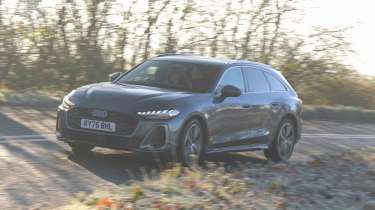
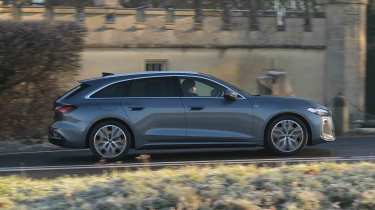
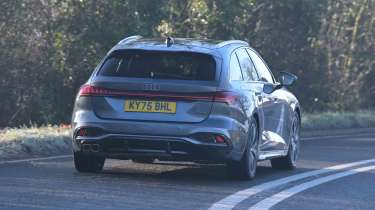
This is the first time you’ve been able to buy an Audi A5 Avant, but don’t let that fool you - effectively, the car takes over from the A4 Avant in Audi’s range, and it’s very much a visual as well as philosophical evolution of that car. Audi singleframe grille? Check. Slightly angry, squinting headlamps? Check. Silhouette that implies a slight sacrifice in utility in the name of a rakish profile? Also check.
Other than adopting other recent Audi cues such as a full-width light bar at the back (remember when these used to be considered slightly naff in the 80s and 90s?) and a hint at haunches over each wheel arch, mainly the preserve of RS models before, there’s nothing groundbreaking here but also nothing that should put off the seasoned Audi buyer, including the typically restrained paint finishes – Grenadine Red and Ascari Blue are the more vivid options if you’re feeling bold.
There are four trim levels for the regular Avant: Sport, S line, Black Edition, and Vorsprung. The plug-in hybrid can be had in all those trims, but it also has a slightly cheaper Technik trim that sits below Sport and is aimed at company car drivers.
Both Technik and Sport offer a similar amount of equipment, with the former just missing out on the latter's slightly fancier LED exterior head- and tail lights. Both trims come with an electric tailgate, heated front seats, rear parking sensors, heated front seats, three-zone climate control, and electric lumbar adjustment for the front seats.
The sportier-looking S Line trim adds sports suspension, privacy glass, alloy pedals, and 19-inch alloy wheels. Black Edition comes with plenty of black exterior trim, electrically adjustable front seats, heated rear seats, and a heated steering wheel. At the top of the tree is Vorsprung with adaptive LED headlights, a panoramic glass roof, a head-up display, a third 10.9-inch TFT screen in front of the passenger, a Bang & Olufsen premium sound system, 20-inch alloys, and a surround view camera system.
Naturally, there are a number of option packs with the A5 Avant. A panoramic glass roof with switchable transparency is a £2,210 option on Sport, S Line and Black Edition trims but comes as standard on range-topping Vorsprung. The Technology Pack is another pricey option at £2,495 for S Line and Black Edition, but it adds adaptive LED headlights, a premium Bang and Olufsen 3D sound system, a head-up display, and ambient interior lighting.
The Comfort Pack for S Line trim is a reasonable £995 and comes with electrically adjustable front seats with driver's seat memory, heated rear seats, and a heated steering wheel.
Cheekily, Audi still charges you £425 on the range-topping Vorsprung trim to get front headrest speakers to go with your standard Bang and Olufsen sound system.
Interior and dashboard design
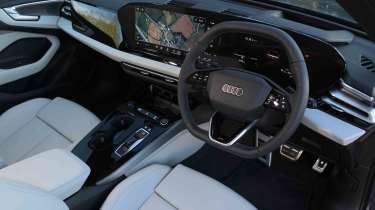
The interior takes a few steps further than the exterior, mainly as it’s more screen-heavy than its predecessor. Driver and infotainment displays are now in one pseudo-freestanding unit, and Vorsprung models get a passenger display too, much like we've seen in some other recent Audi and Porsche models.
Equally, there’s been a similar reduction in physical controls, for less visual clutter than the outgoing A4 Avant but not necessarily a more attractive (or, given almost every other manufacturer has their own take on the curved display screen interface now, Audi-like) user environment.
Most of the controls (such as those on the steering wheel, or the controls for the hazard lights and Drive Select on the centre console) are capacitive, though you still get a physical volume knob on the centre console, and can angle the tiny air vents by hand too.
Materials and build quality
For all its screens, Audi has kept its suppliers of piano black plastic happy, because there’s a ton of it in here, from the centre console to the steering wheel controls, all positively begging to pick up fingerprints and small scratches within the first few weeks of use. There’s a smattering of silvery trim trying vainly to lift the uniform black colour scheme (S Line models do also allow for a lighter shade of seat material), but piano black aside, everything has the usual Audi tactility, with squishy plastics and artificial leather (or microfibre in the Edition 1) with a high-quality feel.
Infotainment, sat-nav and stereo
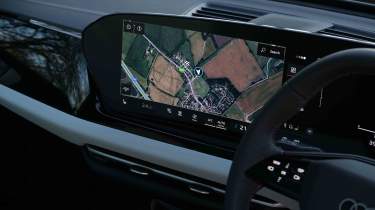
All models come with a wraparound 14.5-inch OLED touchscreen as standard, with AI-powered navigation and infotainment that learns your habits and subtly adjusts the car’s set-up to suit whatever it believes is your style, be that for lighting or even navigation preferences.
You can still tap away at it, and it’s quick to respond when you do, while Apple CarPlay and Android Auto get a suitable chunk of real estate when you access them (and are as easy to use as in any other car, via wireless or USB-C wired connection). With no more physical heater controls you need to fiddle with settings displayed on the screen itself, which functions adequately, while capacitive steering wheel controls let you change certain driver display screens, music settings, and activate the heated steering wheel – some of which it’ll do even if you don’t want them to, if you happen to brush a button when cornering.
Boot space & practicality

| Pros |
|
| Cons |
|
While the latest A5 Avant has the same five-door silhouette and rakish wagon profile of the old A4 Avant, the newer car is slightly larger, the primary benefits of which will be felt by the passengers, who all get a little more space to stretch out than they did before.
There’s a caveat to this, which is that Audi’s been more generous to passengers than it has to luggage. While the Avant gets 31 litres more space than the regular A5, it’s actually 19 litres smaller than the A4 Avant’s boot was, or more in quattro models, which lose another 28 litres. Probably not enough to notice unless your milk float is out of commission and you need stand-in wheels, but the deficit compared with the 500-litre 3 Series Touring, despite the BMW being a smaller car, is notable.
Dimensions and size
The A5 Avant is bigger than the old A4 Avant in more than just model number. Where the old car measured in at 4,762mm long, the A5 grows to 4,829mm. Width has also expanded, from the old A4’s 1,847mm to the latest A5’s 1,860mm, and it’s wider too (including the mirrors), at 2,099mm compared to the previous model’s 2,022mm. And of course, it’s literally gone up in the world – 1,460mm rather than 1,435mm. So while the proportions have remained the same, the entire car takes up just a little more road than it used to.
It’s also bigger than a BMW 3 Series Touring in every dimension, which stretches 4,709mm long (shorter even than the old A4 Avant), 1,827mm wide (2,068mm with mirrors), and 1,440mm tall.
| Dimensions comparison | |||
| Model | Audi A5 Avant | BMW 3 Series Touring | Mercedes C-Class Estate |
| Length | 4,835mm | 4,713mm | 4,751mm |
| Width | 2,099mm (inc mirrors) | 1,827mm (2,068mm inc mirrors) | 1,820mm (2,033mm inc mirrors) |
| Height | 1,476mm (inc roof rails) | 1,440mm | 1,455mm (inc roof rails) |
| Wheelbase | 2,902mm | 2,851mm | 2,865mm |
| Boot space | 476-1,424 litres (448-1,396 litres quattro) | 500-1,510 litres | 490-1,510 litres |
Seats & passenger space
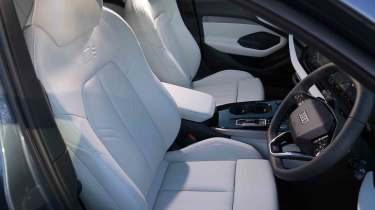
Front seat occupants shouldn’t have a problem getting comfortable. The seats are well shaped and have plenty of adjustment. For the driver, the steering wheel can be tilted and extended into the right place, however short or gangly your arms might be. The centre console isn’t so high you’ll feel hemmed in either, though Audi’s been a bit mean with storage space – the door pockets aren’t huge and other than a pair of cupholders, a fairly small phone charging tray, and a token glovebox, that’s your lot for oddment stowage.
One benefit of the A5 Avant’s physical growth over the old A4 is a little more space for rear passengers. Put a couple of particularly tall people in the front seats, and it’d begin to intrude on legroom, and it’s still not a car in which three adults would like to travel side-by-side, but otherwise, space is pretty generous, and the slightly longer roofline means more space for heads than in the regular A5 saloon. A pair of Isofix child seat mounting points with top tether attachment are fitted to the outer positions of the rear seats, with a further i-size point for the front passenger seat. Do make sure that the front passenger airbag is switched off if you do decide to put a child seat in the front, though.
Boot space
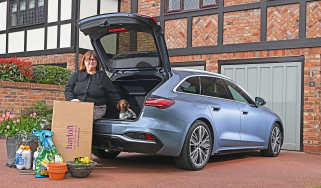
The load area is well designed and is nice and square in shape. It has a competitive capacity of 476 litres with the rear seats up, rising to 1,424 litres with them folded (or 448-1,396 litres in quattro four-wheel models). Much like its main rivals, the plug-in hybrid loses some capacity (361-1,306 litres eHybrid) due to the hybrid's battery pack taking up space. The eHybrid version offers a similar amount of space as the equivalent plug-in hybrid C-Class Estate, but the hybrid BMW 3 Series Touring has a bigger 410-1,420 litre boot.
The rear seats fold in a more flexible 40/20/40 split like its 3 Series Touring and Mercedes C-Class Estate rivals to make the most of the available space, and potentially allow you to carry both people and random IKEA flatpack furniture at the same time.
The tailgate is electric in all versions, while the loading height is a relatively low 640mm, making it a bit easier for a dog to jump aboard when compared with a typical SUV. There’s no lip as such to heave luggage over – a key plus in an estate car like this.
"The best version of A5 Avant for towing is actually the high-performance S5, which can handle up to 1,900kg. However, its thirsty 3.0-litre engine will necessitate frequent fuel stops, so the 2.0 TDI quattro is likely to be a better bet, and its 1,800kg limit is nearly as good. It'll cost you £1,160 to get a tow bar fitted to all versions of the A5 Avant." – Max Adams, online reviews editor
Reliability & safety
| Pros |
|
| Cons |
|
A full five-star rating from Euro NCAP in 2024 suggests there are worse places to be than an A5 Avant in the event of a crash. And that result now includes the plug-in hybrid and high-performance S5 versions, whereas the initial test results didn't feature them. However, the A5 only narrowly beat the likes of the Skoda Superb Estate and Volkswagen Passat in the child occupant category, but in all other areas (adult occupant, vulnerable road user, and safety assistance technology), both the Superb and the Passat had the edge over the A5.
Still, the A5 has a long list of safety features to match its competition. Audi helpfully makes it relatively easy to turn off lane-keep functions with a little button on the end of the indicator stalk.
The car’s too new to make any solid predictions on reliability yet, though Audi’s use of familiar petrol and diesel engines means the brand should have the hang of bolting those together by now.
The Audi brand doesn’t have a great reputation in our Driver Power customer satisfaction survey, placing a rather disappointing 23rd out of 30 manufacturers. That's well below Mercedes, which topped our best manufacturers list, and fifth-place BMW. Audi owners rated the ride and handling of their cars as being average, and they weren't impressed with the high cost of servicing or insurance. They did appreciate the cabin materials and overall finish, as well as their car's infotainment system.
| Euro NCAP safety ratings | |
| Euro NCAP safety rating | (Euro NCAP, 2024) |
| Adult occupant protection | 87% |
| Child occupant protection | 86% |
| Vulnerable road user protection | 78% |
| Safety assist | 77% |
Buying, prices and deals
Best buy: Audi A5 Avant Sport TDI 204 S Tronic
The starting price of just over £44,500 (provided you opt for the free white colour) is competitive compared with its mainstream rivals. The diesel comes in at around £49,000, while the plug-in hybrid is around £51,500. If you want all the bells and whistles, the Vorsprung trim starts at just over £59,000.
Given buyers opting for the A5 Avant are likely to have deliberately chosen it rather than the larger electric A6 e-tron, the diesel is the version to go for on account of its enormous range between fills and lower first-year tax burden than the petrol models. This engine is the only one (outside of the S5) to offer all-wheel drive, but you'd need to go for the more expensive S line trim in order to get that.
Entry-level Sport provides plenty of toys for your money, and its smaller wheels will no doubt give a better ride than the occasionally too firm S line model, and we don't recommend forking out over £60,000 for a Vorsprung model in order to get the £700 adaptive S sport suspension option that enables you to tailor the ride to the road conditions.
The A5 Avant is a pricier estate than our class favourite - the Skoda Superb Estate - but you can save up to £5,000 by building your perfect Audi A5 Avant through the Auto Express Buy a Car service. Alternatively, you can look for a used A5 Avant or browse our wide range of A5 Avant leasing deals to choose from, and we can even help you to sell your car.
Audi A5 Avant alternatives
Once again, the change of name hasn’t altered the A5 Avant’s position in the market: the car goes head-to-head with its old foes, the BMW 3 Series Touring and the Mercedes-Benz C-Class Estate. The Audi lags behind the others on boot space (476 litres in petrol models, compared to 490 litres for the Merc and 500 litres for the BMW), but since premium estates like this are bought more as more practical alternatives to their saloon counterparts rather than for their outright load-lugging capacity, a few litres here and there likely won’t make much difference.
There’s the usual split in terms of how each drives, with BMW’s offering being more fun and the Mercedes being the ride quality champ, while on pricing, the Audi’s £44,500 starting point is on par with the BMW, but lower than the £48,000 premium you'll need for the Mercedes.
At the time of writing, Alfa Romeo, Jaguar, and Lexus no longer offer equivalent estate models.
Long-term test: Audi A5 Avant TDI quattro S Line
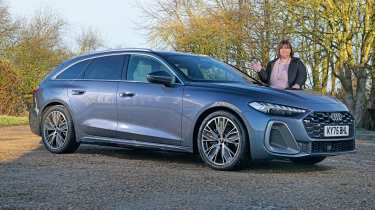
Sarah Perks, our director of content & publishing, ran our long-term Audi A5 Avant. She previously ran a petrol A3 Sportback, but chose a diesel this time due to her long commutes.
Sarah found that the A5 to be a much more grown-up car compared with her previous Python Yellow A3, and wasn't so sure that the lashings of piano-black trim were a good idea for a family car given how easily it showed fingerprints. You can read the full long-term test here…
Key updates of the Audi A5 Avant review
24 June 2026: General update with the latest resale valuation and company car tax figures
25 March 2026: General update to reflect the revised trim structure and include our long term impressions of the Audi A5 Avant
Audi A5 Avant pictures
Frequently Asked Questions
A three-year/60,000-mile warranty isn’t especially impressive though – BMW and Mercedes both offer unlimited mileage policies, Lexus up to 10 years/100,000 miles with routine main dealer servicing, and even Alfa Romeo gives you five years/75,000 miles these days.