Honda Jazz review
The Honda Jazz is a practical, efficient and generously equipped hybrid supermini, though it’s pricier than rivals

Our opinion on the Honda Jazz
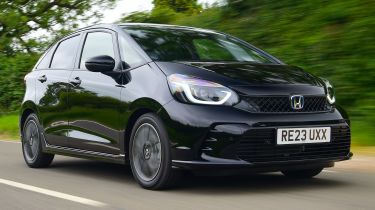
The fourth-generation Honda Jazz may not be the most inspiring shape, but its boxy bodystyle gives it a huge advantage in terms of practicality, while its highly efficient hybrid powertrain means it has low running costs and extremely good fuel economy. It's not the last word in fun when it comes to the driving experience, but it is very smooth and easy to drive around town and surprisingly capable on long motorway trips. All in all, if you prioritise practicality, ease of use and efficiency above all else, the Jazz could be the right choice.
About the Honda Jazz
The Honda Jazz has been around in the UK since 2002, and over the intervening years, its mix of practicality, reliability and low running costs has won a loyal band of repeat customers. But the Jazz’s unassuming nature has made it hard to reach customers outside that loyal band of buyers who have homed in on the little Honda’s common-sense qualities.
The latest fourth-generation model introduced in 2020 is powered solely by a 1.5-litre hybrid system badged e:HEV. That's a similar approach to its arch-rival, the Toyota Yaris, and is part of a growing number of superminis offering customers the choice of hybrid power. Like the Yaris, the Jazz allows for brief periods of electric-only driving (up to a mile, in fact). While that sounds insignificant, it really helps to save fuel in stop/start city driving, which is the sort of driving you're most likely to do in a small car like the Jazz.
Used - available now


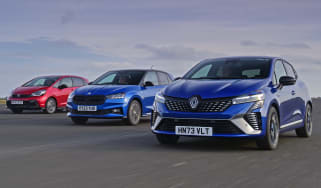
We’ve pitted the Jazz against the Skoda Fabia and Renault Clio as part of a group test, and we've also conducted a twin-test with the Honda Jazz up against a Toyota Yaris Cross.
Honda Jazz prices and latest deals
The Jazz starts at around £28,500 in base Elegance trim, and this rises to nearly £30,000 for the fancier Advance spec. The sportier-looking Advance Sport and chunky Crosstar Advance both cost around £31,000.
Don’t forget, you can save thousands by building your ideal Honda Jazz through the Auto Express Buy a Car service. We also have a number of affordable used Jazz models to choose from, as well as some great Jazz leasing deals. You can also sell your car with us.
Performance & driving experience
Pros |
|
Cons |
|
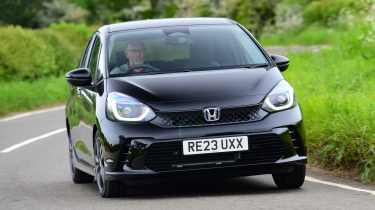
The latest Honda Jazz has bypassed the recent trend for small-capacity turbocharged engines and gone straight to hybrid power. Called e:HEV, the system includes a 1.5-litre Atkinson-cycle petrol engine and two electric motors. A mid-life update bumped the total system power output from 106bhp to 120bhp.
There are three driving modes to make the most of the complex hybrid set-up. The EV mode runs the car solely on electric power, and this mode would normally be used when moving off from a standstill or when travelling at low speed. In Hybrid Drive, the petrol engine and electric motor work together to achieve optimum power and fuel economy, while the car will opt for Engine Drive mode at motorway cruising speeds, relying exclusively on the petrol engine.
| Model | Power | 0-62 mph | Top speed |
| Jazz Elegance | 122bhp | 9.4 seconds | 109mph |
| Jazz Advance | 122bhp | 9.6 seconds | 109mph |
| Jazz Crosstar Advance | 122bhp | 9.7 seconds | 109mph |
Performance, 0-60mph acceleration and top speed
The hybrid system in the Jazz produces 120bhp, allowing the Jazz to go from 0-62mph in 9.4 seconds in Essential spec, which is roughly the same time as a Renault Clio E-Tech (9.3 seconds). The Advance-spec cars take a little longer at 9.6 seconds, while the SUV-inspired Crosstar Advance model requires 9.7 seconds to complete the same benchmark sprint. The top speed for all models is 109mph.
The Jazz’s hybrid system combines the efforts of a 1.5-litre petrol engine and two electric motors. One motor is designed to help with direct propulsion, while the other converts energy from the petrol engine into electricity, which can be used immediately to drive the Jazz or be stored in the car’s small 0.7kWh lithium-ion battery pack.
Town driving, visibility and parking
The Jazz is really at its best at lower speeds, with its light steering making it well-suited to urban life, and we like that the Jazz tends to favour quiet electric drive in town from a refinement standpoint. We did notice that the Jazz can operate in EV mode at higher speeds, but you’ll need to be very gentle with the accelerator pedal in order to keep it in this mode.
Unlike some sportier superminis, the Jazz has a rather high seating position, and this contributes towards a generally good level of all-round visibility. Standard-fit front and rear parking sensors and a rear-view camera only improve things further.
Country road driving and handling
It’s on a B-road where the Jazz starts to lose ground to its rivals. When the road gets twisty, a Renault Clio feels fleet-footed, whereas the Jazz feels more ungainly in comparison. While nicely weighted, the steering in the Jazz isn’t as quick as the Clio’s, and feels lazier to respond to your inputs. And while the hybrid system in the Jazz has benefits at lower speeds, if you apply any more than two-thirds throttle at higher speeds, the CVT transmission sends the engine’s revs soaring, producing plenty of noise in the process.
Motorway driving and long-distance comfort
The Jazz relies quite heavily on its petrol engine to get up to motorway speeds, but it will try to use electric power when it can while coasting and cruising. Things started to get a bit noisy when we pushed on for more speed due to the aforementioned CVT transmission.
Occasional noise aside, the Jazz handles well enough. It’s one of the more comfortable superminis for longer distance travel, and it feels perfectly up to the task of keeping up the pace and overtaking when needed.
“When the four-cylinder unit does spark into life, it’s incredibly smooth. There’s no shunt from the powertrain, only a continuation of the same, easily modulated response. It feels like an EV.” - Alex Ingram, special contributor.
MPG & running costs
Pros |
|
Cons |
|
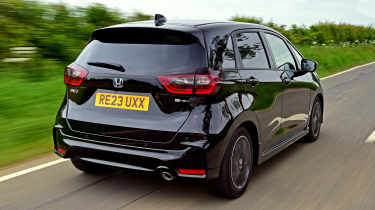
The most efficient Honda Jazz is the standard car, which gets up to 62.8mpg on the WLTP combined cycle. The added weight of the SUV-style Crosstar reduces this to 58.9mpg.
When we tested the Jazz against the Skoda Fabia and Renault Clio, it managed a highly impressive average of 59.5mpg after a wide range of roads and speeds. In other words, Honda’s official claim is a realistic one. The Clio E-Tech managed 55.2mpg after the exact same round of testing, but this car’s WLTP number is 65.6mpg, so it wasn’t as impressive as the Honda.
The jacked-up Jazz Crosstar also proved to be very efficient when we tested it, returning 55.4mpg when we pitted it against the Dacia Sandero Stepway. That rival managed 44.3mpg in the same conditions.
Honda’s hybrid tech also ensures low emissions, with official CO2 levels of 102g/km across the board 108g/km. However, the Toyota Yaris emits even less, just 91g/km. Technically speaking, the Jazz can drive on electric power alone, but the tiny 0.7kWh battery is only capable of up to one mile of range. Instead, it’s primarily used to assist the petrol engine and reduce overall fuel consumption and lower emissions.
| Model | MPG | CO2 | Insurance group |
| Jazz Elegance | 62.8mpg | 102g/km | 21 |
| Jazz Advance | 61.4mpg | 102g/km | 22 |
| Jazz Crosstar Advance | 58.9mpg | 102g/km | 22 |
Insurance groups
Insurance premiums will potentially be higher than those of several supermini rivals. The Jazz range starts in group 21 (out of 50), with the Advance spec cars in group 22. The Renault Clio E-Tech will be a much cheaper car to insure, residing in group 15, while the Toyota Yaris also undercuts the Honda here, sitting in groups 13 to 16.
Check any car's MoT history in a few easy clicks with our MoT checker tool...
Tax
It’s not the cheapest supermini to buy, but every Honda Jazz still avoids the luxury car tax surcharge, so you’ll only be faced with the standard rate of VED road tax. Company car buyers won’t have much relief here, though, as fully electric cars like the Citroen e-C3 or Renault 5 now offer far superior tax benefits when compared with hybrids.
Depreciation
Our market data indicates that the standard Honda Jazz should retain between 50 and 55 per cent of its initial value after a period of 36,000 miles or three years. These numbers make the Jazz one of the better superminis in terms of depreciation, because the Toyota Yaris will only hold 41 to 51 per cent after the same length of time, while the Renault Clio manages 47 to 52 per cent.
To get an accurate valuation on a specific model check out our free car valuation tool...
Interior, design & technology
Pros |
|
Cons |
|
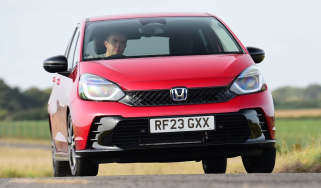
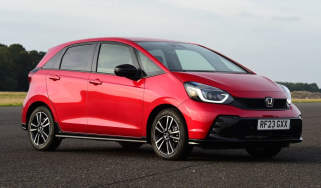
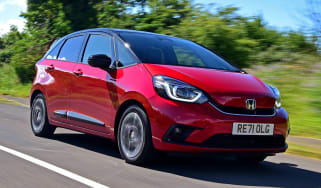
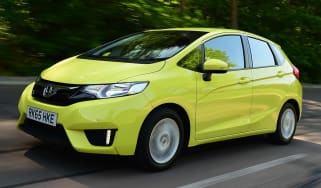
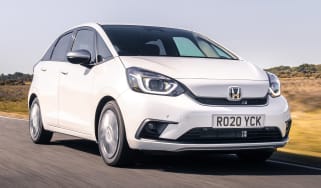
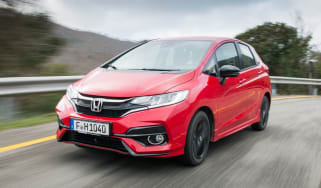
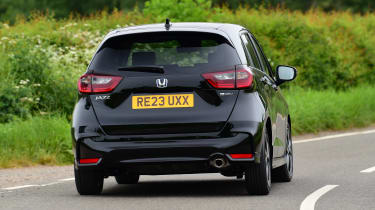
With the roofline reduced by 10mm, the Honda Jazz has a sleeker silhouette than before, although the overall profile is still more like that of a small MPV, rather than a supermini. Slimmer A-pillars also help with forward visibility and add to the already good-sized glasshouse.
Honda has opted to do away with the vibrant paint choices offered for the previous Jazz model. Instead, there’s a rather dull choice of pearlescent and metallic colours to choose from. There are optional packs that allow for further personalisation of the exterior, including different coloured trim pieces for the front grille and rear bumper, side body mouldings, and door mirror caps.
The latest Jazz comes to the fight with strong equipment levels across four model grades. Entry-level Elegance comes with 15-inch alloy wheels, LED headlights, a nine-inch infotainment screen with sat-nav and Apple CarPlay and Android auto smartphone connectivity, front and rear parking sensors, a reversing camera, and adaptive cruise control.
While that is well-specified, we'd recommend mid-range Advance because it has premium features such as:
- Heated front seats
- Heated steering wheel
- Blind spot monitoring with rear cross traffic alert
- Keyless entry and start
- Privacy glass
- 16-inch alloy wheels
Next up is Advance Sport, which has sportier-looking gloss black exterior trim details, some aluminium pedals, individual drive modes, and adjustable regen paddles on the steering wheel.
Honda introduced the Crosstar Advance model to sit alongside the regular five-door supermini. It has a raised ride height, body cladding, and roof rails for a pseudo-4x4 look, but don’t expect any off-road ability because it lacks four-wheel drive. Compared to the Advance-spec Jazz, it’s slightly less efficient and, in our opinion, out of step with the overall ethos of the Jazz.
Interior and dashboard design
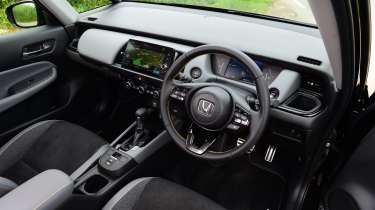
Inside, the four-generation Jazz has a definite whiff of the discontinued Honda e in its cabin, which is no bad thing. It’s a much smarter look compared to the previous Jazz, with a minimalist two-spoke steering wheel, a seven-inch digital driver display, and a nine-inch central touchscreen. The dash is clearly laid out, with large physical switches and dials for the ventilation functions positioned underneath the touchscreen.
Materials and build quality
Honda’s typical durability can be found within the Jazz, but it’s focused far more on functionality rather than luxury. It’s still a pleasant place to sit, but the Peugeot 208 claims the crown for overall plushness.
Infotainment, sat-nav and stereo
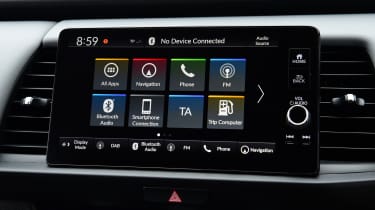
Every Jazz is equipped with a nine-inch touchscreen and Honda Connect infotainment system. While the screen uses big widgets that link to the prime functions, performing tasks such as changing radio stations or entering an address requires more steps than you might expect, so it’s not the easiest system to navigate.
Most functions are operated via the touchscreen, but the main menu and back buttons are physical controls next to the screen above a volume knob. The buttons take a bit of getting used to, but once you’re in the habit, it makes life easier to get back to the main menu.
Wireless Apple CarPlay is included, but Android Auto requires a cable connection. There’s no charging pad, so iPhone users will also have to plug their devices in to keep them charged.
One slightly irritating quirk that we found during our own test was that, due to the shallow cowl design, the driver’s digital instrument display was sometimes affected by sunlight. The main screen was easier to see, but the information on either side was harder to make out.
Boot space & practicality
Pros |
|
Cons |
|
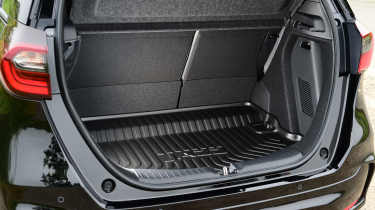
Practicality and ease of use are where the Honda Jazz still really shines. Visibility for the driver is excellent, thanks to the slimmer A-pillars and high windscreen. This, along with an elevated driving position, a good view out of the rear window, standard parking sensors, and a reversing camera, means there shouldn’t be any problems with parking manoeuvres or navigating out of tight junctions. In fact, when we pitched the Jazz up against the Renault Clio and Skoda Fabia in a three-way supermini test, it easily stood out as the most versatile car.
The famous Magic Seats in the second row are a brilliant bit of design. Not only do they split in 60/40 fashion, but you can also fold up the bases like a cinema seat to help you slide awkward larger items across the rear floor.
There are also many useful cubby holes and storage bins for assorted items, while all versions include a front centre armrest, cupholders and seat back pockets for extra convenience.
Dimensions and size
The Jazz is similar in length to a Skoda Fabia, but the SUV-inspired Jazz Crosstar is slightly longer, wider and taller than the standard model.
| Dimensions comparison | |||
| Model | Honda Jazz | Toyota Yaris | Renault Clio E-Tech |
| Length | 4,089mm | 3,940mm | 4,053mm |
| Width | 1,694mm | 1,745mm | 1,798mm |
| Height | 1,526mm | 1,500mm | 1,440mm |
| Wheelbase | 2,517mm | 2,560mm | 2,583mm |
| Boot space | 304 litres | 286 litres | 301 litres |
Seats & passenger space
The Jazz includes plenty of space for the driver, although Honda hasn’t forgotten about the needs of passengers – the cabin can easily accommodate a six-foot passenger behind a similar-sized driver without any worries about knee or legroom. Despite a 10mm lower roofline than its predecessor, head room is still very good, with the only downsides we found being the gentle upward slope of the rear passenger footwell limits footroom beneath the front seats, and the middle position is a bit narrow, but the latter is a criticism you can make of many supermini-sized cars.
We measured the rear seat area in the Honda Jazz when we pitted it against the Renault Clio and Skoda Fabia. We found that the Jazz has the advantage when it comes to knee room, but while the Jazz offers more head and shoulder room than the Clio, it isn't quite as accommodating as the Fabia – although the Skoda is both taller and longer.
The Jazz has two handy USB-C ports for children in the back to charge their phones or tablets, and all versions of the Jazz come with Isofix child seat mounting points on the outer positions of the rear bench.

Boot space
The Jazz’s boot size is a decent 304 litres, which is more than a Renault Clio offers (254 litres), but can’t match the huge 380 litres of load space a Fabia provides. However, with the rear seats folded, the Honda supermini trumps its competitors, offering 1,205 litres of capacity, compared with 1,190 litres with the Fabia and 1,006 litres in the Clio.
We measured the loading lip of the Jazz, and found it has a very low opening at 615mm, compared with 667mm for the Fabia and 744mm for the Clio, which means it's much easier to load up the Jazz compared with its rivals.
Reliability & safety

Pros |
|
Cons |
|
Customers have consistently rated the Honda Jazz as a solid performer in the Driver Power owner satisfaction survey. Based on the latest Driver Power survey results, the latest model continues to outperform its predecessors, finishing 14th out of 50 models in the best cars to own rankings. It scored highly for reliability in particular, which should reassure potential owners.
The Honda brand has had a shakier time in the best manufacturer league tables in recent years, but its latest 10th-place finish out of 31 brands is a reasonable outcome. In fact, this outshone Toyota, which only finished 14th.
Like its predecessor, the fourth-generation Jazz received a full five-star Euro NCAP crash safety rating when it was tested in 2020. The scores for adult and child protection are impressive, at 87 and 83 per cent, respectively.
There’s a comprehensive level of safety kit for all Jazz variants. Aside from a myriad of airbags, each trim level includes automatic emergency braking, a forward collision warning system, lane keep assist, a lane departure warning and a traffic sign recognition system, among a host of other safety tech. The Advance trim and above add blind-spot monitoring and rear cross-traffic monitoring – the latter helps to detect vehicles that are about to cross your path when backing out of a parking space or driveway.
| Euro NCAP safety ratings | |
| Euro NCAP safety rating | Five stars (2020) |
| Adult occupant protection | 87% |
| Child occupant protection | 83% |
| Vulnerable road user protection | 80% |
| Safety assist | 76% |
Buying and owning
Best buy: Honda Jazz Advance
While the Crosstar adds an element of funkiness to the otherwise humble Jazz, it also bumps up the cost and reduces efficiency, so we don’t think it’s worth it. Instead, we'd recommend opting for the more affordable Advance trim, because you get many premium features and the best running costs.
There are still plenty of additional packs offered with the Advance trim, but we don’t think they’re worth the price because they're mostly styling tweaks, and don't offer any useful additional equipment.
Honda Jazz alternatives
There’s another small, hybrid-powered Japanese supermini that acts as a thorn in the Jazz’s side, and that is the Toyota Yaris. This car follows a very similar formula of prioritising low running costs and emissions, and it’s a bit cheaper to buy than the Jazz. It doesn’t come close to the Honda in terms of practicality, though.
Elsewhere, there’s the stylish Renault Clio, spacious Skoda Fabia and cost-effective Vauxhall Corsa to consider. If you’re considering going electric, the Renault 5 and the BYD Dolphin are two zero-emission superminis worth considering.
Honda Jazz pictures
Key updates of the Honda Jazz review
1 June 2026: General update with latest valuation data and the Honda brand's extended warranty package.
Frequently Asked Questions
Honda offers a three-year/90,000-mile vehicle warranty, which is a generous mileage limit compared to some rivals. Beyond that, you can extend this warranty by 12 months at a time with annual franchised dealer servicing until the car is eight years old or covered a maximum of 100,000 miles, whichever comes first.
Deals on the Jazz and alternatives