Mercedes C-Class Electric review
What the new Mercedes C-Class Electric lacks from behind the wheel, it more than makes up for with superb refinement and tech

Our opinion on the Mercedes C-Class Electric
Mercedes hasn’t taken the easy option in electrifying its venerable C-Class. Instead of simply fitting a big battery and electric motor to its combustion-engined favourite, the maker has laid down the gauntlet with a bespoke platform and unique body. The result is mostly very good; the C-Class Electric is calm, comfortable and competent, with excellent in-car tech, great efficiency and usable real-world range. It’s unlikely to be the sharpest car to drive in its class, although our definitive verdict will come when we get it alongside the hotly anticipated BMW i3 in the coming months.
About the Mercedes C-Class Electric
With fuel prices currently spiralling out of control, electric cars have been given a boost that we might not have expected this time last year. It comes at a great time for many makers – few more so than Mercedes, which having launched the lauded CLA, GLB and GLC already, is now turning its attention to the strong-selling C-Class.
Early Merc EVs didn’t hit the spot, but with industry disruptors such as Tesla and BYD making hay, there’s no more room for excuses or caveats. There’s no space for half-baked or buggy new models, only fundamentally brilliant high-end electric cars that are considered worth the price tag.
The importance of the C-Class Electric is reflected in the fact that it isn’t just an existing model with a battery shoved under the floor, but the foundation of the brand’s entire future line-up. It represents a whole new ethos of how Mercedes builds luxury cars for the 21st century.
Priced from a touch under £58,000, it’s quite expensive, but it is worth remembering that this C 400 4Matic powertrain represents the very top of the tree for non-AMG models; cheaper, single-motor variants will join the range later, alongside performance flagships with more than 600bhp. For your money, you get plenty of high-end kit as standard, and it’s not a big cost jump to pick up the hi-tech Hyperscreen or the optional air suspension and rear-wheel-steering combination.
Of more importance, however, is the fact that this new C-Class proves that with a bit of time and a lot of investment, legacy marques such as Mercedes can still compete when it comes to cutting-edge hardware and software. In the C-Class Electric’s case, it feels like Merc’s new-era products are finally benefiting from the marque’s 140 years of car-building experience.
Performance & driving experience
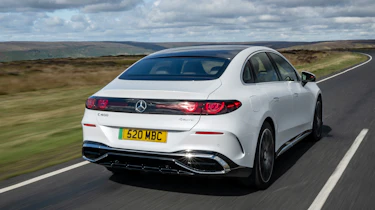
Pros |
|
Cons |
|
Mercedes has gone to the effort of developing a brand-new architecture for the new C-Class and the benefits are obvious from the moment you set off. Beyond just offering fresh chassis hardware, electric motors and battery technology, everything on the new MB.EA platform has been designed alongside the flexible, cutting-edge software that’s at its core.
Not only has this allowed Mercedes to catch up with the manufacturing efficiencies of new-age rivals, these innovations have also allowed it to develop even higher levels of luxury, genuinely useful features and more range than anything from an American start-up or Chinese industrial giant.
| Model | Power | 0-62mph | Top speed |
| Mercedes C 400 4Matic | 482bhp | 4.0 secs | 130mph |
Performance, 0-60mph acceleration and top speed
In terms of its straight-line performance, this is the most potent non-AMG C-Class ever. It produces 482bhp of combined power from its two e-motors, but the relentless pull of the BEV powertrain is best summed up by the colossal 800Nm of torque.
It easily feels good for its four-second 0-62mph time and should comfortably rocket up to its limited 130mph speed limit on the autobahn. This is helped, in part, by the two-speed transmission on the rear axle. It’s largely imperceptible unless you really concentrate, and varies its shift-point depending on the selected drive mode and your driving behaviour.
If we were being really picky, the brakes aren’t perfect. That’s not to say the C-Class doesn’t represent a huge leap in progress versus early Mercedes EVs – the inconsistent pedal feel and unpredictable recuperation made models like the EQA and EQC a challenge to drive at times. But there’s still work to be done.
It can be tricky to bring the car to a complete stop without your head nodding forwards, for example. You can put the car into a near one-pedal mode in its highest recuperation setting, but it doesn’t bring the C-Class to a stop quickly enough without needing to press the brake pedal. In contrast, BMW’s system in the new iX3 – and, by association, the new i3 saloon – feels far more sophisticated, and takes no mental capacity to execute.
Yet, frankly, there’s never been a more luxurious car in the compact executive segment, and even without much of the high-end hardware, such as air springs and rear-wheel steering, there’s a distinct and finely tuned sense of quality across the board.
However, the best compact executives have to excel in all areas, and while the current ICE-powered C-Class saloon has never been closer to the equivalent BMW 3 Series in terms of its dynamics and general driving engagement, we have a sense that this C-Class Electric will have a fight on its hands when the new BMW i3 arrives in the coming weeks.
Town driving, visibility and parking
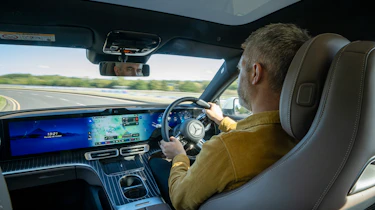
On the move, Mercedes has made some massive steps forward in the set-up and consistency of its main controls. The throttle is smooth, predictable and consistent underfoot, and the ride is extremely plush. The brand is the only one to offer air suspension in a compact executive saloon, and it’s obvious from the moment you start moving, because the experience is truly luxurious. Better still, unlike most other Mercedes models, the ride quality doesn’t diminish if you fit larger wheel sizes, so it’s always buttery smooth.
Visibility is good all-round, and while the rear windscreen is quite shallow, the superb 360-degree cameras make manoeuvring slowly or parking in tight spaces easy. The automatic parking function is also brilliant – if you’ve used systems like this in the past and been left unimpressed, try this one and you’ll see how far Mercedes has advanced the technology.
Country road driving and handling
Despite repeated insistence from Merc’s engineers that this car has a duality to its driving experience which delivers a sporty character, this is no sports saloon in the fashion of a BMW.
Sport mode is easily accessed via a button on the centre console, and adds some extra weight to the steering plus more lateral stability through bends. There’s no disguising this car’s weight, however, which can make it feel a little cumbersome at times. The suspension definitely prioritises comfort over dynamics, and can get a little upset over bumps or by changes of direction.
The second element of Mercedes’ unique dynamic package is a rear-wheel-steering system that usefully tightens the turning circle, but it can undermine your sense of confidence in the steering at high speeds. More astute tuning in future AMG models might clean up some of these dynamic foibles, but for now it’s best not to mistake this high-powered C 400 4Matic variant as a potential rival to a half-fat M-Performance BMW or Audi S5.
Motorway driving and long-distance comfort
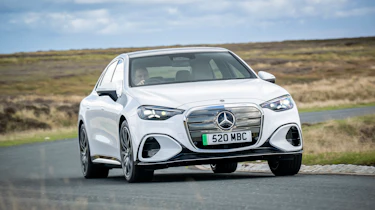
Instead it’s preferable to keep this car on the motorway, where its talents really come into focus. This is a superb cruiser, which is exactly as it should be considering a majority of C-Class Electrics will sit at sustained high speeds for much of their life.
The fundamentals are there – this car rides beautifully, and the steering has a good heft to it. The controls, on the whole, are well weighted, even if we’d like a bit more feel through the brake pedal. All of this is important if you’re the one actually driving, but Mercedes’ work with its self-driving system is at a point where it’s more than capable of taking the strain.
Just like the systems in the latest BMW models, Merc’s semi-autonomous driving functions are capable of achieving Level 2++ status, which means you can take your hands off the wheel. You have to keep your eyes forward, and initiate overtakes with the indicator stalk, but the simple change of not needing to touch the steering wheel makes these systems far more relaxing, even for control freaks.
The only chink in its armour when cruising on the motorway concerns its refinement, which undoes a little of Merc’s hard work. There’s a touch more road and tyre noise than we were expecting, and even though it’s incredibly well optimised aerodynamically, there’s still some wind noise around the mirrors. Yet when considered against rivals, the Merc is more than acceptable.
This is no longer a junior executive saloon, but a fully-fledged luxury car. In this class, plenty would gladly trade engagement for disengagement, and the new C-Class does that brilliantly… - Jordan Katsianis, News Editor
MPG & running costs
Pros |
|
Cons |
|
How much battery is too much battery? This is a question that every car manufacturer has to wrestle with. In the case of the Mercedes C-Class Electric, it might well have just enough. As it stands, the biggest battery option available in the new C-Class is 94kWh as fitted here, which gives it a maximum range of around 462 miles. By any account this is very impressive, until you take into account that BMW’s new i3 will be capable of up to 564 miles.
However, BMW has achieved this thanks to a battery pack that’s almost 20 per cent bigger, meaning that much of the extra capacity goes into lugging around the additional weight. As a result, if you actually look at the efficiency, rather than just the range, the actual running costs of the Mercedes should be lower. However, the C-Class is a more technically complex car than the BMW, and most of its other rivals, so this could see running costs skyrocket later in the car’s life.
Merc’s environmentally-sound processes and battery procurement policies are among the best in the world, so if the eco aspects of your EV matter, you’ll find a more transparent papertrail than with brands like BYD or Tesla.
Electric range, battery life and charge time
Mercedes has done a fine job of making the C-Class one of the most impressively efficient BEVs on the market. The first time we drove the car in Finland, we averaged around 4.4miles/kWh over our test route. The weather was pleasingly warm and the speed limits generally low on test, but we did have the air-con blasting the entire time, and did little to purposely hypermile or conserve energy.
This dropped considerably during our first drive on UK roads in cooler, autumn weather, but an average figure of 3.4mi/kWh should still mean a real-world range of almost 320 miles. Our route was fairly typical of what the average motorist might encounter on a day-to-day basis, with a mix of urban, rural and motorway miles.
The charging capability is strong; Mercedes says a peak charge speed of 330kW will top the battery up from 10 to 80 per cent in around 22 minutes. The elephant in the room is the new BMW i3, which will top 400kW in the right conditions.
| Model | Battery size | Range | Insurance group |
| Mercedes C 400 4Matic | 94kWh | 452-428 miles | NA |
Insurance groups
Insurance groups for the new C-Class Electric are still to be announced, and given this is Merc’s first BEV in the segment they are tricky to confidently predict. However, given the high-end features and general expense, we expect them to be quite punchy. One thing that might counteract this, however, is the extent of the car’s excellent active safety features, which will help it to avoid having an accident in the first place.
Tax
All C 400 models will cross the £50,000 luxury car surplus threshold – at least until the single-motor models arrive in due course – lifting yearly VED road tax to £640 from years two to six of ownership. After that, it will return to the non-surcharge rate – whatever that is at the time.
In terms of company-car tax, this sits in the usual BEV bracket of four per cent for the 2026/2027 tax year, rising to five per cent the following year.
Depreciation
Experts predict the Mercedes C-Class Electric will retain between 46 and 49 per cent of its value after three years or 36,000 miles – a reasonable figure for this kind of car. Figures for the BMW i3 haven’t been revealed, but the outgoing i4 couldn’t come close to the Merc’s numbers – at least not in the later stages of its life.
Interior, design & technology
Pros |
|
Cons |
|
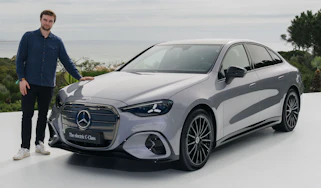
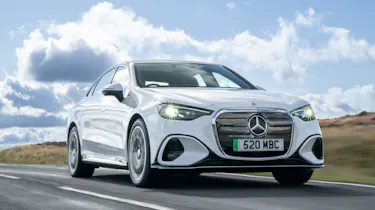
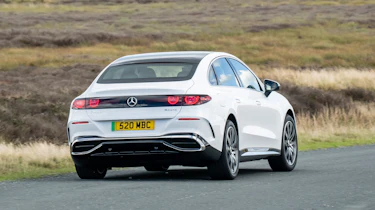
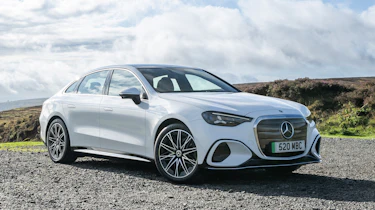
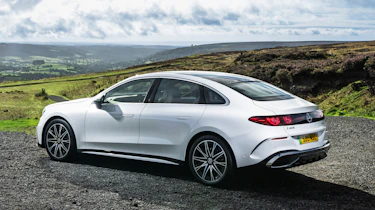
Mercedes has decided to build the new C-Class Electric on a completely new architecture. Rather than the usual long bonnet and long nose, this new model deviates from the usual three-box silhouette to incorporate a sloping roofline and short bootlid. The differences to a combustion-powered C-Class are clear; it’s 132mm longer, for starters, and is the first Mercedes saloon this side of a Maybach with a rear-quarter window in more than 60 years.
Styling is subjective, but the new C-Class EV’s looks won’t be to all tastes. Like the electric GLC, which is starting to appear on UK roads in reasonable numbers, it’s the kind of car that looks better in the metal than it does in pictures. But while it’s miles from the awkward-looking, bubble-shaped EQE and EQS, Mercedes has clearly still put great focus on the car’s aerodynamics.
Interior and dashboard design
Mercedes has fundamentally revamped its interior design, as the cabin features a pillar-to-pillar screen that dominates the experience from the moment you open the door. This layout does have some unique features, which we’ll come to shortly, but it means the cabin’s appeal might be limited for customers not particularly keen on this sizable digital interface.
Between the seats is a large and wide floating centre console with a wireless charging pad and two cup-holders, plus a set of physical controls – albeit touch-capacitive ones. To make up for the lack of visual design elements, Mercedes has put a lot of detail into those that do remain, such as the glowing – some might say garish – air vents and sliver-clad door trim.
Look closely and you’ll notice those air vents aren’t just there for cabin comfort; the central blower also features a small camera for the interior-monitoring and driver-attention systems. You wouldn’t spot it unless you were searching, but once you know it’s there, it does give an almost Orwellian feeling to the driving experience. Should you want to, you can also use it to take selfies, or host online video calls – while stationary, of course.
Materials and build quality
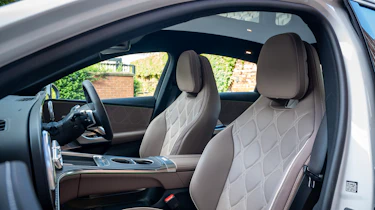
Generally speaking the fit and finish seem very good, and the material quality has also taken a noticeable step up compared with the petrol-powered C-Class. Some previous-generation Mercedes would produce a sort of creak whenever you pressed down on a hard surface, but this appears to have been largely put to one side.
The centre console is also available in a wide range of finishes, ranging from the usual glossy wood right through to a range of new technical metal ones. But these are locked into specific model variants, which could be annoying.
Most models feature man-made leather upholstery and this feels robust, if not particularly luxurious, but a £2,000 upgrade to Nappa leather does up the ambience. If you do go hunting for cheap plastics, though, you’ll find them on the lower dash and down the side of the centre console.
We did notice that the door-shut sound felt a little cheap – probably due to the frameless windows and retractable door handles. Not great in a near-£60,000 executive saloon car.
Infotainment, sat-nav and stereo
After only a few moments of acclimatisation, the new C-Class’s Hyperscreen (featured on AMG Line Premium trim and above) works brilliantly. It’s extremely configurable, and whether you’re using it to display multiple layers of information – about the navigation, stereo and massaging seats for example – or prefer a simpler look, it all falls to hand easily, giving quick access to the car’s intricate capabilities. It’s also worth noting that while the climate controls are integrated into the screen, they are always accessible and easy to expand upon.
The sheer level of content available is incredible, and it doesn’t just feel a step up on previous Mercedes models, but a clear jump ahead of its new-age rivals, too. There’s no Chinese-based car that has such an impressive digital interface, and thanks to the big leap in software-defined tech, Mercedes will be able to apply software updates for years to come. There’s also a special mention for the 4D Burmester hifi, which brings S-Class stereo quality to a more accessible level – it is extraordinary for this class of car.
Frequently used functions such as switching off the driver aids or dipping in and out of the car’s phone mirroring applications is also easy, and for those still not convinced there’s a volume roller and some extra physical keys on the centre console.
As mentioned, the Hyperscreen is standard on AMG Line Premium models and above, but lesser versions still come with a pillar-to-pillar display comprising three individual monitors for the driver, passenger and central touchscreen. We’ve not had a chance to try the set-up on Sport and AMG Line cars, but expect much of the functionality to remain – it just won’t look as pretty.
I went in fully expecting to hate such a big screen, but its screen quality is so high and usability so impressive, it’s almost won me over. - Jordan Katsianis – News Editor.
Boot space & practicality
Pros |
|
Cons |
|
As is often the case in low-roofed cars with a skateboard-style BEV chassis, the driving position doesn’t quite sink you as low into the cabin as you’d expect. But there’s still plenty of room inside the C-Class Electric – despite a living-room sized screen mounted to the dashboard. Storage inside is very impressive, too; the centre console features a double wireless phone charger, plus space for two reasonably sized bottles. There’s also a lower shelf for larger items and Mercedes’ familiar double-lid centre storage bin.
Dimensions and size
Dimensions comparison | |||
| Model | Mercedes C-Class Electric | BMW i3 | Tesla Model 3 |
| Length | 4,883mm | 4,760mm | 4,720mm |
| Width | 2,066mm | 2,075mm | 2,089mm |
| Height | 1,503mm | 1,480mm | 1,441mm |
| Wheelbase | 2,962mm | 2,897mm | 2,875mm |
| Boot space | 470 + 101 litres | 420 + 31 litres | 425 + 88 litres |
The new C-Class is larger than its main rivals, being over 120mm longer than the upcoming BMW i3. This unlocks lots of space inside, with plenty of room in the back row and its two boot areas. However it also pushes the new C-Class very close to the existing E-Class saloon in terms of dimensions, and might count against it for people based in urban areas, or those who prefer the petrol C-Class’s traditional compact footprint.
Seats & passenger space
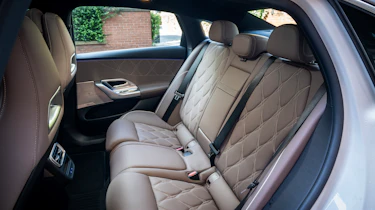
The front seats are wonderfully comfortable, and depending on your specification include heating, cooling and massage functions. There’s lots of lumbar support, too – almost too much; we found the seat jabbing into our lower back at the start of our test drive, and had to delve into the on-screen menus to lessen the pressure.
The second row also benefits from the C-Class’s new platform, with a wide bench and generous rear legroom across all three rear seats. The floor is a bit high – a typical EV issue – meaning it can feel as if you’re sitting with your knees around your ears at times.
A panoramic roof is standard, and beyond making the cabin lighter, it also offers rear passengers more headroom, despite the sloping roofline. There’s one quirk worth mentioning, though: in order to keep the rear-door glass as one piece, the rear windows only drop a few inches. This might annoy dogs and kids more than adults, but it’s a compromise prospective buyers should be aware of.
Some might also struggle with the door openings, which could make getting bulky child seats in and out tricky. The lack of an estate variant will be another blow, but for families, the GLC is arguably a better bet anyway.
Boot space
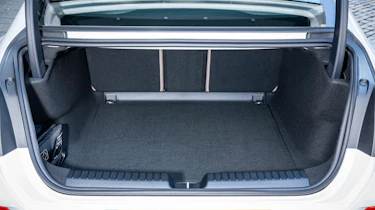
Boot space is generous, at 470 litres, and while the opening is a little more compromised than the more traditional C-Class’s, the room inside is unaffected. The 101-litre ‘frunk’ under the bonnet is a real boon, giving you a place to store away the charging cables or small items that you’d prefer not to have rolling around in the main cargo area. It’s also easily accessed by pressing the three-pointed star on the bonnet.
For those who need it, there’s the option of a towbar, and all models feature three-piece split-folding seats that allow for the storage of long, narrow items without needing to move the main outer rear seats. Unfortunately, there’s no news of an estate variant, but Mercedes says this will be the role of the GLC SUV, which is perfectly reasonable.
Towing
With so much grunt in the powertrain, towing the maximum 1,800kg with a braked trailer via an electrically folding hitch will be easy. Mercedes also has an embedded trailer stabilisation system from within the ESP system, and a reverse parking assistant when hitched up – this is only generally seen on large American SUVs and pick-up trucks.
“It’s always tricky making a low-roof car on a skateboard chassis, but Mercedes has carved out the maximum interior space possible, with the packaging engineers obviously having won the battle against the design team” - Jordan Katsianis – News Editor.
Reliability & safety
Pros |
|
Cons |
|
It’s not just the screen that benefits from the C-Class’s cutting-edge new digital features, because the active-safety tech is some of the best we’ve experienced. It’s all very well offering features such as cross-traffic alert or autonomous emergency braking, but it’s clear that the comprehensive technological leap inside this Mercedes has also made big inroads when it comes to the calibration and intelligence of these systems.
While it’s not yet legal in the UK or Europe, it’ll also support Level 2++ autonomous driving, which is the point where this type of technology really comes into its own, because you won’t have to constantly hold the steering wheel or be bugged by the potentially annoying in-car reminders.
Buying, prices and deals
- Best buy: Mercedes C-Class Electric C 400 AMG Line Premium
The C-Class has one of the most complicated range structures in the business, and this will be the case for the electric variant too. For now, Mercedes will start with just the upper-specification C 400 4Matic. This will be available in five trim levels, ranging from £57,995 to £70,995, and each offers a different combination of features that essentially removes the chance to specify individual options.
Our pick would probably be the £65,995 AMG Line Premium on the basis that this is the cheapest model that comes with Merc’s glorious Hyperscreen. If you’re going to give up so much style for the sake of a large screen, it may as well be the nice one. Lesser trims see this replaced with three individual units, with each grade coming with less and less capacity on the passenger side.
Other key features such as adaptive headlights, wireless phone charging and heated seats are also fitted, but it doesn’t extend to range-sapping 20-inch wheels. Stepping up to the Premium Plus does unlock the incredible Burmester 4D sound system, though, so if you’re a bit of an audiophile, this might also be tempting.
If all this cutting-edge technology doesn’t bother you, we’d suggest hanging back for a lesser single-motor variant that will also save you some cash and increase the range.
Mercedes C-Class Electric alternatives
BMW has been just as transformational with its new all-electric 3 Series as Mercedes has been with its C-Class Electric. The BMW actually outperforms the Mercedes in terms of range, with up to 563 miles possible on the dual-motor 50 xDrive variant, but it’s worth remembering the BMW’s battery is also quite a lot bigger. When it arrives, we’re betting that it’ll be a sharper drive, but unable to match the Mercedes in terms of luxury or equipment.
Tesla’s preoccupation with driverless cars and robotics has caught up with the Model 3, because this once world-beating BEV is now at the mercy of cars like this new C-Class. It offers neither the equipment, range nor dynamic polish of its German rivals, and while it is more affordable to buy than ever, its poor resale values will close that gap. A Tesla Model 3 only now appeals when the price is absolutely right.
The Seal has long been considered the best BYD on sale in Europe, but just looking at its specs on paper puts things into perspective. Costing more than £45,000 for the base RWD model, the Seal is only capable of 350 miles of range and offers little in the way of new-age features or tech. Yes, it costs quite a lot less than the Merc, but cheaper versions of the C-Class will soon arrive to close that price gap.
Other alternatives come in the form of the recently updated Hyundai Ioniq 6 and the soon-departing Polestar 2. Both were competitive when they launched, but can’t hold a candle to the Merc (or, most likely, the BMW) when it comes to luxury kit or comfort.
Mercedes C-Class Electric pictures
Frequently Asked Questions
Yes, the C-Class Electric is a luxurious and technologically advanced saloon car with excellent efficiency. We’ll have to wait until the full range is revealed to see if lesser models are better value, though.