BMW 5 Series review
The BMW 5 Series goes large on technology and electrification, but the keen dynamics of the previous model remain

Our opinion on the BMW 5 Series
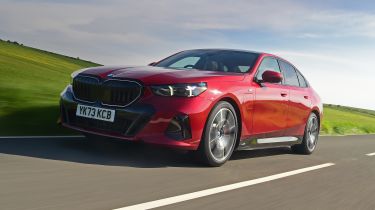
Once again, the latest BMW 5 Series is a staggeringly capable all-rounder. Comfortable, great to drive, and wonderfully luxurious inside, there are very few flaws to find anywhere.
The only real sticking point is that the highly impressive all-electric BMW i5 is only slightly more expensive and is likely a better bet for company car drivers than the plug-in hybrid models. We’re not sure if private buyers would be willing to pay the significant price increase between the 520i petrol and the 530e plug-in hybrid.
About the BMW 5 Series
It’s a sign of the times that the latest BMW 5 Series has ditched diesel in the UK in favour of an electrified range mostly made up of mild- and plug-in hybrid power, or has ditched the combustion engine altogether in the form of the all-electric BMW i5.
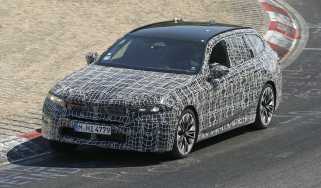
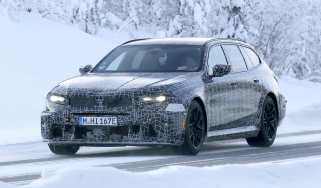
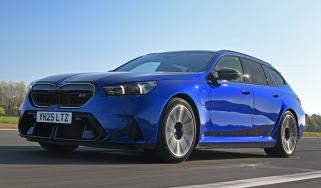
While its powertrains have changed dramatically in recent years, the latest 5 Series still treads the crucial fine line between luxury and performance. There’s a healthy dose of power available from even the entry-level 520i, while the biggest speed demons are catered for by the BMW M5, for which we have a dedicated review. There’s also the 5 Series Touring for those in need of a fully-fledged load lugger.
We’ve tested the latest 5 Series against the Mercedes E-class in a twin test, and we've also run a BMW 530e M Sport Touring as part of our long-term test fleet.
Performance & driving experience
Pros |
|
Cons |
|
The driving experience is generally where the BMW 5 Series excels, and the latest eighth-generation model sets a new standard in the class with superb refinement and comfort coming on leaps and bounds, too.
Used - available now

2023 BMW
5 Series
50,922 milesAutomaticDiesel2.0L
Cash £20,420
2019 BMW
5 Series
86,595 milesAutomaticDiesel2.0L
Cash £14,697
2023 BMW
5 Series
58,379 milesAutomaticDiesel2.0L
Cash £22,497
2013 BMW
5 Series
68,500 milesAutomaticDiesel2.0L
Cash £7,494The 5 Series handles tidily, even though the plug-in hybrids weigh over two tonnes. Its quick steering and well-controlled body movements help disguise this heft well, even on twisty B roads, with its suspension (coil springs at the front and air suspension over a multilink arrangement at the rear of plug-in hybrid models) rarely feeling flustered.
The brakes feel more than up to hauling the mass of the 5 Series to a stop from high speeds, and the transition from the PHEV’s regenerative braking system (which helps to recoup energy for the battery pack under braking) to the mechanical brakes feels almost seamless.
The only downside of this excellent body control is that you don’t have the soft, wafty ride of a Mercedes E-Class, but you only really feel the negative effects at low speeds around town where there’s a little patter. Once you’ve picked up some speed, this disappears, and the 5 Series becomes a marvellous long-distance cruiser with very little wind or road noise to disturb you.
Performance, 0-60mph acceleration and top speed
Kicking things off is the 520i petrol, which uses a 208bhp 2.0-litre turbocharged petrol to deliver a 0-62mph time of 7.5 seconds, followed by the 299bhp 530e plug-in hybrid that’ll complete the same sprint in 6.3 seconds. The top performer in the standard 5 Series line-up is the 489bhp 550e plug-in hybrid, with its 155mph top speed and a 0-62mph time of only 4.3 seconds.
If this still isn’t enough pace for you, the full-fat BMW M5 dispatches the same 0-62mph dash in an eye-watering 3.5 seconds, and it’ll then charge on to a limited top speed of 155mph (or an unlimited 190mph if you go for the £19,500 Ultimate Pack).
| Model | Power | 0-62mph | Top speed |
| 520i M Sport | 208bhp | 7.5 seconds | 143mph |
| 530e M Sport | 299bhp | 6.3 seconds | 143mph |
| 550e xDrive M Sport | 489bhp | 4.3 seconds | 155mph |
Town driving, visibility and parking
The BMW’s PHEV system has a slightly sluggish step off the line in its e-mode, so it doesn't feel as effortless as the fully electric BMW i5. However, once rolling, these models are staggeringly refined because of their ability to shuffle around in near-silence at town speeds.
When the engine does engage, there is a slight jolt from the eight-speed auto ‘box - nothing too harsh, but enough to let you know that the system’s full 295bhp and 400Nm of torque is at your disposal.
The pure-petrol 520i feels a bit less eager from a standstill than the more powerful PHEVs, even though it is around 200kg lighter and uses mild-hybrid tech. Every 5 Series variant has light steering at least, which helps to make short work of those pesky three-point turns.
Country road driving and handling
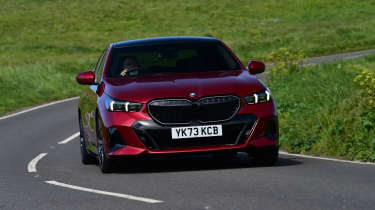
The combined efforts of its petrol engine and electric motor (whether plug-in or mild-hybrid) help the hefty 5 Series gather speed deceptively quickly, with only a distant growl of its engine to let you know it's working hard. In everyday driving, it has more than enough power, so you won’t be left wanting for more speed.
Aim this sizable saloon at a corner, and it provides plenty of grip courtesy of its carefully engineered chassis. The aforementioned light steering is quick, so you can chuck the 5 Series around far more easily than its size suggests.
Motorway driving and long-distance comfort
A flagship executive saloon would be destined to fail if it couldn’t take on motorway runs in its stride. Naturally, the latest 5 Series builds on its decades-long lineage to deliver a comfortable, refined cruising experience. The Mercedes E-Class is ever so slightly softer, but the BMW’s firmness is more than tolerable, plus it’s a worthy price to pay for its tighter control over body movements at speed.
“We’d like a little more feedback from the steering, but it does a great job of hiding the car’s mass without allowing you to get too confident.” - Alex Ingram, special contributor.
MPG & running costs
Pros |
|
Cons |
|
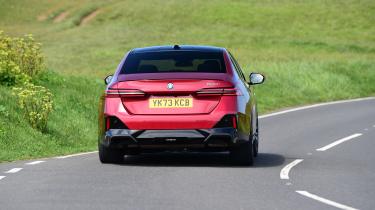
Fuel economy for the BMW 5 Series is competitive with its rivals. The entry-level 520i petrol engine outdoes its Mercedes E-Class equivalent by offering up to 48.7mpg and emissions of 131g/km. Based on our experience testing plug-in hybrid cars, you’re unlikely to match the 128.4mpg quoted for the 530e or the 100.9mpg for the 550e, even with regular charging. That being said, we saw a diesel-like average of 50.6mpg when we tested the 530e against a Mercedes E 300 e. The latter, meanwhile, only returned 40.5mpg after facing the exact same driving conditions.
Over a longer period of time, we managed to achieve 77.8mpg overall with regular charging during the 7,000 miles we covered in our long-term BMW 530e Touring.
The 5 Series is no longer offered in the UK with a diesel engine, so those who want to stick with the black pump will need to defect to the Mercedes E-Class, which still features a four-cylinder E220 d model in its line-up, claiming over 58mpg. Even the more powerful six-cylinder 450 d in the E-Class saloon can average around 47mpg.
| Model | MPG | CO2 | Insurance group |
| 520i M Sport | 48.7mpg | 131g/km | 35 |
| 530e M Sport | 128.4mpg | 49g/km | 39 |
| 550e xDrive M Sport | 100.9mpg | 64g/km | 44 |
Electric range, battery life and charge time
Both the 530e and 550e plug-in hybrid versions of the BMW 5 Series use a 22.1kWh battery pack (19kWh usable), which provides around 64 miles of range in the 530e, and 57 miles of range in the 550e. Using a standard 7.4kW home wallbox charger, it should take around 3.5 hours to charge a flat battery.
| Model | Battery size | Range | Insurance group |
| 530e M Sport | 22.1kWh (19kWh usable) | 64 miles | 39 |
| 550e xDrive M Sport | 22.1kWh (19kWh usable) | 57 miles | 44 |
Insurance groups
It’ll probably come as no surprise that this beefy BMW saloon won’t be the cheapest car to insure. The entry-level 520i M Sport starts off proceedings in insurance group 35 (out of 50), while the poshest 550e M Sport Pro with the Tech+ and Comfort+ packs sits in group 44. The Mercedes E-Class, meanwhile, ranges between groups 41 and 50.
Tax
Due to every version of the BMW 5 Series costing well over £50,000 when new, the luxury car tax surcharge applies to all models from the second year the vehicle is taxed, up until it is six years old.
Company car drivers will benefit from lower Benefit-in-Kind (BiK) taxation with the plug-in hybrid 530e and 550e compared with the petrol 520i. But for the biggest savings, business buyers will want to look towards the electric BMW i5, because this offers the very lowest company car tax rates.
Both the PHEV and all-electric i5 will incur the eVED pay-per-mile tax that's planned to be implemented from April 2028, and will ramp up in cost from April 2029.
Depreciation
In saloon and Touring estate forms, the BMW 5 Series will retain between 41 and 47 per cent of its original value after a period of three years or 36,000 miles, according to our market data. That matches the saloon version of the Mercedes E-Class (the estate maintains between 43 and 50 per cent), while the Audi A6 saloon is predicted to be worth between 39 and 45 per cent of its original value (the Avant retains between 42 and 47 per cent) over the same length of time.
The electric i5 is expected to lose more than its petrol and plug-in hybrid siblings, with our experts predicting it will be worth between 35 and 39 per cent of its initial value after three years or 36,000 miles.
Interior, design & technology
Pros |
|
Cons |
|
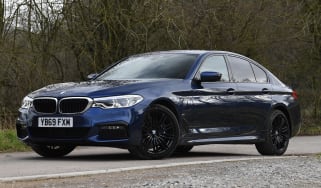
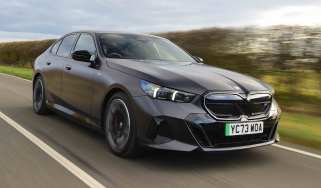
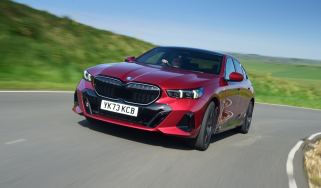
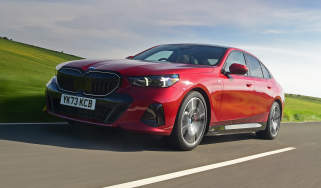
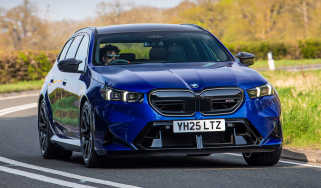
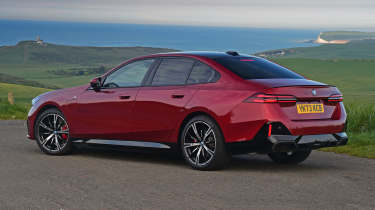
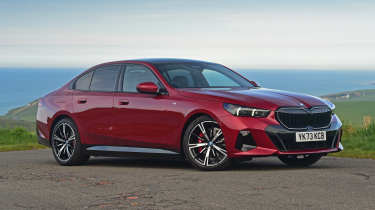
In contrast to some of the brand’s more controversial designs, the BMW 5 Series is fairly constrained, but it’s definitely more bloated-looking than the previous model. Anyone not keen on the size of its grille will need to opt for the M Sport Pro specification to get a darker, high-gloss black grille surround that helps to make it less obvious.
Interior and dashboard design
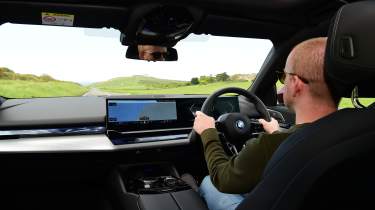
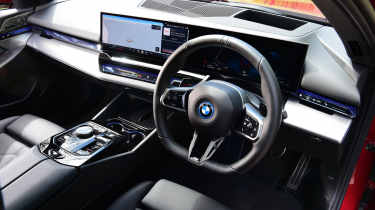
Just like its predecessors, the latest 5 Series’ cabin manages to strike a careful balance between prestige and sportiness. There’s plenty of technology to be found here, but we were pleased to find that ergonomics have been paid attention to in the overall interior design. That being said, the touch-sensitive controls did cause some frustration during testing.
Materials and build quality
Inside is where the latest 5 Series really delivers on its premium feel. The finish is excellent and gives the impression it’s been lifted straight out of the far pricier BMW 7 Series. The interior isn’t flawless, because the touch-sensitive controls on what BMW calls the interactive bar below the main screen need a hefty prod to switch on or off.
Not that you can really tell, but the standard Veganza leather is actually a manufactured alternative to traditional leather, but it looks great, and you can take things even further by adding genuine BMW Individual Merino leather. There’s a choice of inlays and the option of Crafted Clarity controls that replace the gear selector, iDrive wheel, volume wheel and start/stop button with crystal to really push the boat out.
Infotainment, sat-nav and stereo
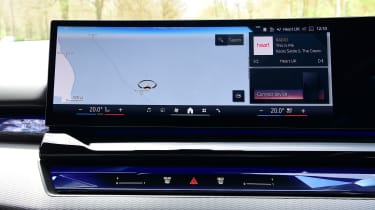
The 12.3-inch digital driver’s instrument cluster is supplemented by the widescreen 14.9-inch curved infotainment system, which runs the brand’s latest software. Like most of its rivals, it can be controlled by touch, but the intuitive iDrive click wheel and some handy shortcuts are also there to help you navigate through its various menus much more easily while on the move than rivals that have resorted to touchscreen-only systems.
As standard, you get a 12-speaker, 205-watt Harman Kardon sound system, which is plenty powerful, but it can be upgraded to an 18-speaker, 655-watt Bowers and Wilkins audio system. All versions come with Apple CarPlay and Android Auto smartphone connectivity, plus two wireless charging pads ahead of the gear lever.
“Contemporary, hi-tech and beautifully finished, there’s little else for the money that feels as special. Yet all that would be meaningless if it wasn’t for the fact that it manages to remain functional and easy to use, too.” - Alex Ingram, special contributor.
Boot space & practicality
Pros |
|
Cons |
|
The BMW 5 Series is available as a sizable five-seat, four-door saloon car, and a more practical five-door estate called the 5 Series Touring, which’ll make short work of a family's demands.
With its generous exterior dimensions, the 5 Series is a big car inside, with plenty of space for five. The front seats are supremely comfortable and include electric lumbar adjustment as standard. Adding the pricey Comfort Plus pack gives you full electric adjustment to the front seats, a seat ventilation system, memory settings, and a heated steering wheel.
The rest of the interior is well thought out, with a deep cubby under the central armrest, which we found useful for hiding valuables. The 5 Series has a wireless charging pad just beneath the centre console, which is a more convenient way to keep your smartphone topped up, since the USB-C ports are awkwardly positioned just ahead of the cup holders. The door bins are wide and deep, so there’s space for a bulky water bottle to be safely stowed.
Unlike its predecessor, the G60’s platform, used by the latest 5 Series, can accommodate the plug-in hybrid model's battery pack without reducing passenger space, unlike rivals such as the Mercedes E-Class.
Dimensions and size
The latest BMW 5 Series is bigger in all directions than the Mercedes E-Class. Given how long it is, front and rear parking sensors are a highly welcome standard feature.
| Dimensions comparison | |||
| Model | BMW 5 Series | Mercedes E-Class | Audi A6 |
| Length | 5,060mm | 4,949mm | 4,999mm |
| Width | 1,900mm | 1,880mm | 1,875mm |
| Height | 1,515mm | 1,480mm | 1,470mm |
| Wheelbase | 3,000mm | 2,960mm | 2,930mm |
| Boot space | 520 litres | 370 to 540 litres | 354 to 492 litres |
Seats & passenger space
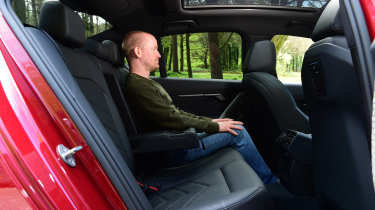
Rear seat space is so accommodating that you might wonder why people would bother with the larger BMW 7 Series, plus the bench is soft and forgiving, making it feel just as luxurious in the back as it does up front. The cabin is wide, and there’s enough headroom for those in the back to stretch out.
You’ll find that two Isofix child seat mounting points on the rear bench's outer positions, which are easy to access behind some folding plastic clips.
Boot space
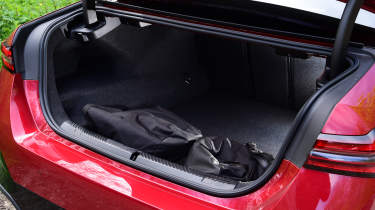
The vast 520-litre load area in the BMW 5 Series is the same whether you go for the regular petrol or plug-in hybrid versions, although you will have to find space for the charging cables because the 5 Series doesn’t have a handy storage area for them. If you need to carry longer items, then the rear-seat backs can drop down in a flexible 40/20/40 split to expand that volume into the cabin, although the saloon bodystyle makes it tricky to load really bulky items. That particular problem can be easily solved by opting for the Touring version.
You will find an extra 20 litres of luggage capacity in the petrol and diesel versions of the Mercedes E-Class. However, if you opt for the plug-in hybrid version of the E-Class, its boot shrinks dramatically to 370 litres, which is smaller than what you’ll find in the Skoda Fabia supermini.
“The back seats feel as sumptuous as those up front, with even the central seat feeling like a relaxing place to sit – not always a given, even in a car this large.” - Alex Ingram, special contributor.
Reliability & safety
Pros |
|
Cons |
|
The latest 5 Series has been awarded a maximum five-star rating by safety experts Euro NCAP in 2023. It was criticised for not having a rear seat child presence detection system, or a way of monitoring the driver’s attention. We’d like to think parents would notice when their children are in the back of the car, and, in our experience, driver attention alert systems can be highly irritating in the real world, so these shouldn’t be things to put you off buying a 5 Series.
According to the 2026 Driver Power best cars to own rankings, the BMW 5 Series has jumped from 26th place out of 50 cars to 17th place out of 50. Owners are reportedly happy with certain aspects of the driving experience, with high scores in the powertrain and acceleration categories. There were also good scores in the front seat comfort, visibility, sat-nav, and connectivity categories. However, it scored below average for ride and handling, value for money, running costs, quality, and reliability.
The BMW brand has also improved in the rankings, climbing from eighth in 2025 to fifth out of 30 brands in the best manufacturer rankings. It was just pipped by Lexus (4th), Tesla (3rd), and Mercedes (1st). As with the 5 Series, owners praised the powertrains, acceleration, sat-nav and technology of their cars, but had grumbles regarding the high running costs.
| Euro NCAP safety ratings | |
| Euro NCAP safety rating | Five stars (2023) |
| Adult occupant protection | 89% |
| Child occupant protection | 85% |
| Vulnerable road user protection | 86% |
| Safety assist | 78% |
Buying and owning
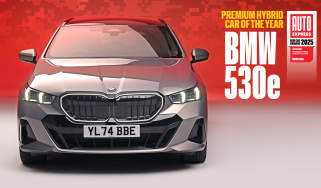
Best buy: BMW 530e M Sport
The 5 Series range kicks off with the mild-hybrid 520i, which offers more than adequate performance for most needs. Starting from just over £53,000, it significantly undercuts the least expensive PHEV 530e, at just over £59,500. At the top of the standard 5 Series range sits the 550e xDrive, which comes in at just under £77,000.
The BMW 5 Series continues to impress with its handling finesse and on-board technology, while the plug-in hybrid models no longer have a practicality deficit compared with the petrol models. Because of this, along with the potentially huge savings on running costs, we recommend opting for 530e. Moving up to a higher spec or the 550e might be tempting, but it’ll make a much bigger dent in your bank balance.
For petrol and PHEV models, the choice is between M Sport and M Sport Pro. The latter gets bigger wheels, a boot spoiler, M Sport seat-belt colours and an illuminated grille surround, which we think are mainly cosmetic changes that don't add much to the overall experience of the car. Save yourself £3,000 and plump for M Sport.
If you do want to add to your 5 Series, you may want to invest in the Bowers & Wilkins sound system, which is among the best fitted to any car, so it’s worth the £1,250 upgrade. The panoramic-glass roof may bathe the cabin with light, but it is pricey at £1,600
Build your perfect 5 Series via the Auto Express Buy a Car service, though, and you can save thousands on your new car. We also have a wide range of 5 Series leasing deals to choose from, and we can even help you to sell your car.
BMW 5 Series alternatives
Audi, BMW and Mercedes have been battling for executive car supremacy for decades, and the fight continues with the latest BMW 5 Series facing the Mercedes E-Class and Audi A6. There’s a left-field rival from Korea to consider, too, and that is the Genesis G80.
If you’re thinking about the BMW i5 instead, this faces the EV versions of its aforementioned rivals in the shape of the Audi A6 e-tron, Mercedes EQE and Genesis Electrified G80.
Key updates of the BMW 5 Series review
29 July 2026: Updated with 2026 Driver Power customer satisfaction survey data
18 March 2026: General update including the latest valuation data and some impressions from our long-term 530e Touring test.
BMW 5 Series pictures
Frequently Asked Questions
The standard BMW manufacturer’s warranty is three years with unlimited mileage, which is the same as Mercedes and superior to Audi, which has a mileage limit of 60,000 miles.
Deals on the 5 Series and alternatives