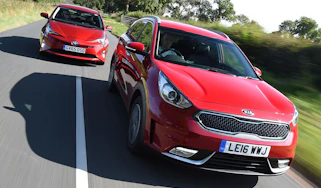
Kia Niro review
Efficient, practical and boasting excellent on-board technology, the Kia Niro is a family SUV that offers great value for money
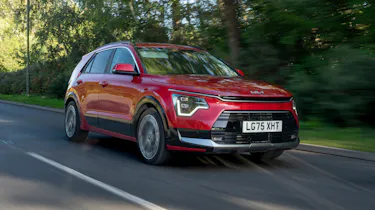

Our opinion on the Kia Niro
The Kia Niro once again delivers on the practicality front, and any notion that it would be compromised due to the mix of internal combustion and pure-electric powertrains can be dismissed. The conventional hybrid model is a tough competitor in a congested market, while the plug-in hybrid offers the flexibility of its electric power that is impressive as well as efficient. The range-topping Niro EV doesn’t offer a world-beating range, but its versatility, comfort and excellent onboard technology will appeal to family and business users alike.
Cabin space across the Niro range is superb, its infotainment system is top-notch, and the low running costs are particularly appealing, but just like the old car, the Niro doesn’t feel all that special to drive, and some of its interior quality is lacking. That aside, the Niro (in whichever form you choose) is a strong contender across a variety of segments, and one of the best small SUVs on the market right now.
About the Kia Niro
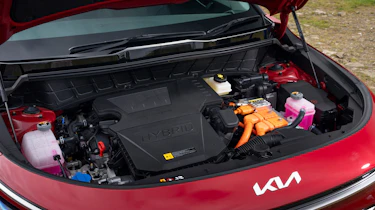
Like the old model, the Niro hybrid utilises a 1.6-litre GDi (Gasoline Direct Injection) petrol engine combined with an electric motor fed by a small battery, all used to drive the front wheels (like all Niros). The same petrol engine features in the plug-in hybrid, but it’s mated to a more powerful electric motor and larger battery for a pure-electric driving range of up to 40 miles. Both hybrids get a six-speed dual-clutch automatic transmission.
Used - available now


This review focuses on the hybrid and plug-in hybrid Kia Niro models, but we also have a dedicated in-depth review of the fully electric Kia Niro EV if that’s the car that’s caught your eye.
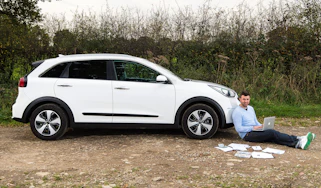
Our senior photographer, Pete Gibson, lived with a Kia Niro Hybrid for six months as part of our long-term test fleet. Unfortunately, our car suffered from some major software issues during his time with it, but aside from this drawback, the Niro proved to be an efficient, practical and sturdily-built daily car.
Performance & driving experience
Pros |
|
Cons |
|
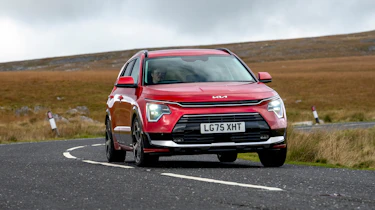
The dynamics of the Kia Niro have been improved thanks mainly to the introduction of its K3 underpinnings. The platform is shared with Hyundai, and Kia’s parent company has claimed the architecture allows for better body control due to a lower centre of gravity. Whichever Niro you pick, it’ll feel much more stable and compliant in the bends than plenty of rivals.
Two driving modes are available for the hybrids: ‘Eco’ and ‘Sport’. Credit to Kia, there’s a noticeable difference between the two on the move. In Eco mode, throttle response is slowed and gear changes happen earlier to provide more efficiency. In Sport, the throttle response is sharpened, and the Niro is keener to hold onto gears. Both have plenty of flexibility, however, so you don’t end up chopping between the two that often.
We wouldn’t go as far as to call the Niro fun. It’s still a small SUV designed for comfort and practicality over driving thrills, but it’s easy to develop confidence from behind the wheel. The Niro does well in tricking you into thinking it's a smaller car, and it’s easy to develop confidence from behind the wheel.
| Model | Power | 0-62mph | Top speed |
| Kia Niro 1.6 GDi 136 Hybrid Aspire | 134bhp | 11.4 seconds | 105mph |
| Kia Niro 1.6 GDi 168 PHEV 2 | 166bhp | 9.6 seconds | 104mph |
| Kia Niro 1.6 GDi 168 PHEV 4 | 166bhp | 9.6 seconds | 104mph |
Performance, 0-60mph acceleration and top speed
The Niro Hybrid comes with a 1.6-litre four-cylinder petrol engine mated to a 1.32kWh battery and one electric motor. When combined, they are good for 134bhp and 265Nm of torque. With power being sent to the front wheels only (as with all Niros), the Hybrid model manages the 0-62mph sprint in 11.4 seconds and goes on to a top speed of 105mph.
The Niro PHEV features the same petrol engine, except it comes with an 11.1kWh battery. The plug-in hybrid produces 166bhp and 265Nm of torque, which gives it a 0-62mph time of 9.6 seconds and a top speed of 104mph.
Town driving, visibility and parking
Threading the Niro through tight urban streets isn’t much of an issue. The light steering makes for quick manoeuvres, and it’s easy enough to know where the extremities of the car are, partly thanks to the flat rear end. Every model comes with a reversing camera as standard, so parking is straightforward, too.
The Niro’s brakes don’t offer that much feel, and you have to press them quite hard to garner some stopping power at higher speeds. However, they do work better at slower speeds around town and are easy to modulate for a smooth stop.
Country road driving and handling
In the corners, it’s fairly easy to reach the Niro’s limit, after which point you’ll find plenty of safe and manageable understeer. The steering is not particularly communicative, but it is accurate and has a reassuring weight, which inspires confidence through corners.
On top of this, the seats are surprisingly supportive, with plenty of side bolstering to keep you in place.
Motorway driving and long-distance comfort
A fair amount of wind noise limits the Niro’s refinement at motorway cruising speeds. On top of this, the six-speed dual-clutch automatic transmission in the hybrids can be a bit slow to change gear at times, and kicks down sharply if you floor the accelerator before sending the revs skyward. However, it does do a good job of providing seamless shifts the rest of the time.
The manual override paddles in the PHEV are best left alone because they can be painfully slow to intervene. If you put your foot down in either hybrid, the engine noise can sound a bit gruff at first, but this dies down once up to cruising speed.
“The Niro feels entirely at home at motorway speeds – it’s a good example of how an electrified boost can really help what is a modest petrol engine. ” - Pete Gibson, senior photographer.
MPG & running costs
Pros |
|
Cons |
|
Kia says the base hybrid can return up to 64.2mpg on a combined cycle – about five miles-per-gallon better than the old model – but we averaged 50.5mpg after covering more than 11,000 in our Niro Hybrid long-term test car. That’s still decent for a car that you don’t plug in, and we spent a lot of our time travelling on motorways where the engine is on most of the time. For comparison, the 11th-gen Honda Civic we lived with only managed to achieve 45.1mpg after close to 6,000 miles of motoring.
The Niro PHEV is more expensive to buy, but it’s also greener as it emits 18g/km of CO2, according to Kia. This car’s headline 353.1mpg WLTP combined test cycle figure sounds highly appealing, too, but a word of caution, it’ll be difficult to recreate this outside of a laboratory.
| Model | MPG | CO2 | Insurance group |
| Kia Niro 1.6 GDi 136 Hybrid Aspire | 58.9mpg | 111g/km | 21 |
| Kia Niro 1.6 GDi 168 PHEV 2 | 353.1mpg | 18g/km | 23 |
| Kia Niro 1.6 GDi 168 PHEV 4 | 353.1mpg | 22g/km | 24 |
Electric range, battery life and charge time
The plug-in hybrid Niro uses an 11.1kWh battery and offers a pure-electric driving range of up to 40 miles. We’ve established that a number closer to 30 miles is more achievable day-to-day, so long as you charge the car regularly. Using a typical home wallbox charger, it’ll take around three hours to fully charge.
| Model | Battery size | Range | Insurance group |
| Kia Niro 1.6 GDi 168 PHEV 2 | 11.1kWh | 40 miles | 23 |
| Kia Niro 1.6 GDi 168 PHEV 4 | 11.1kWh | 37 miles | 24 |
Insurance groups
The Kia Niro sits between insurance groups 21 and 25 out of 50. This means that it’s a bit pricier to cover than its cousin, the Hyundai Kona, as that dips as low as group 14. The Volkswagen T-Roc also starts from group 14.
Tax
The Kia Niro PHEV offers the lowest emissions of the combustion-powered models, but company car drivers will still benefit from far bigger tax savings if they opt for a fully electric car instead. Cars like the Kia Niro EV, Kia EV3 and Hyundai Kona Electric are the closest alternatives, but there are plenty of other small electric SUVs to choose from if these don’t take your fancy.
Regardless of your chosen Niro, you’ll need to pay VED road tax annually. You’ll also need to tread carefully on the configurator, though, as some of the posher variants cross the £40,000 luxury car tax threshold.
Depreciation
Our market data shows that the Kia Niro will retain 47 to 50 per cent of its initial value after a period of three years or 36,000 miles, with the full-hybrids being the strongest performers.
This is a very similar outcome to the combustion-powered Hyundai Konas, which are set to hold between 47 and 53 per cent after the same period.
To get an accurate valuation for a specific model, check out our free car valuation tool...
Interior, design & technology
Pros |
|
Cons |
|
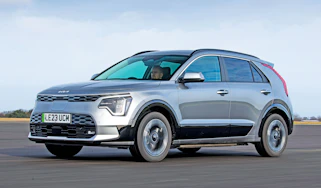
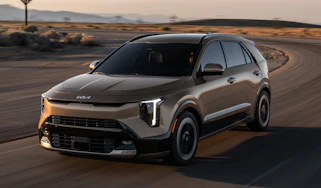
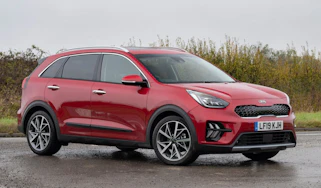
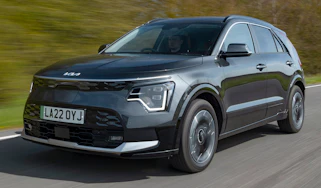
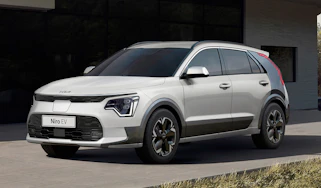
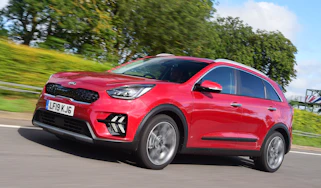
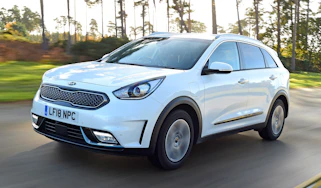
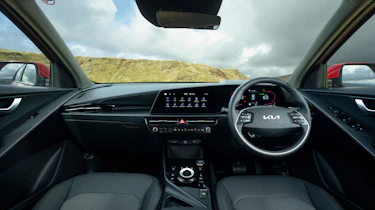
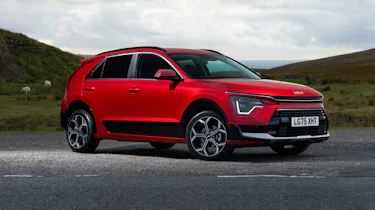
Kia’s bold design language has transformed the Niro from a rather bland, innocuous SUV into one of the better looking family cars you can buy right now.
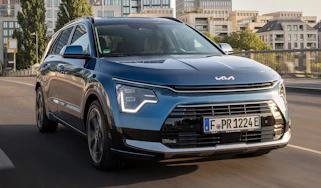
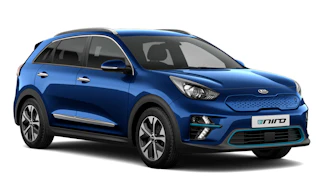
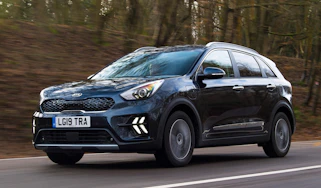
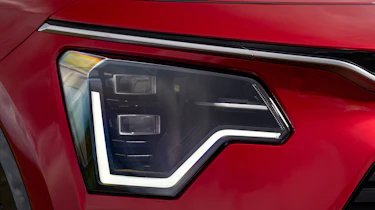
The second-generation Niro has a cleaner look to the front end with a set of distinctive angular LED daytime running lights paired with a thin chrome strip above the slim grille. Meanwhile, the Niro’s rear end is more squared-off and features boomerang-style vertical headlights.
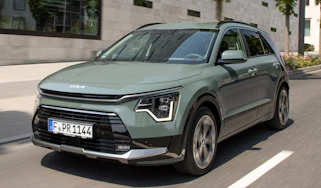
The C-pillars actually sit away from the bodywork, funnelling air along the side to improve aerodynamic efficiency, according to Kia. Contrasting C-pillars are available on certain models, too, along with more vibrant paint colours, should you wish to make your Niro stand out a bit more.
Interior and dashboard design
Inside, we see a step up from the old model in terms of design and technology, but not so much in terms of build quality. The overall layout gives the cabin a bright and airy feel though it’s not quite as stunning as the cabin of the Mazda CX-30.
Materials and build quality
The Niro’s materials and buttons do feel robust on the whole, if not premium to the touch. The centre console is finished in piano black which is just waiting to be scratched, we fear.
Upgrade to the top-spec models and some of the interior surfaces become a little softer and generally look more expensive, but we still wouldn’t call the cabin’s quality segment-leading. Top-of-the-range cars also come with an openable sunroof.
Infotainment, sat-nav and stereo
Following some revisions during the car’s lifetime, every Niro now gets a 10.25-inch screen with built-in sat-nav. Top spec ‘4’ models also get a head-up display and a 10.25-inch digital dash. Every model also has Apple CarPlay and Android Auto compatibility.
The digital dash itself is clear and easy to read, but instead of using a dial format for the rev counter or speedo it only offers a numbered readout. The 10.25-inch central screen is also crisp in its resolution, and the infotainment system is a doddle to navigate. Only when you quickly jump between menus can it start to lag slightly.
Beneath the screen, you’ll find a band of touchscreen buttons which can either control the cabin’s climate, or at the flick of a button, provide a shortcut menu to the infotainment screen. While we’d prefer physical knobs on the move, the touchpads are responsive and large enough to easily use while driving.
As standard on the Niro, you’ll find two front USB charge ports (one Type-A, one Type-C) and two Type-C charging ports on the side of the front seats.
Boot space & practicality
Pros |
|
Cons |
|
Given Kia’s K3 platform was originally designed to accommodate hybrid, plug-in hybrid and fully electric powertrains, the packaging employed to create space in the Niro’s cabin is impressive.
There are some clever storage solutions dotted about the interior as well. For instance, the front cubby can be used as either general storage space or, at the touch of a couple of buttons, a pair of cup-holders reveal themselves. There’s more storage under the central armrest, and the glovebox is a decent size, but we found the door bins are very slim, which limits how much stuff you can store in them and means they’re off-limits for larger items.
Dimensions and size
The Kia Niro is taller, wider and longer than its predecessor, but it’s still classed as a compact SUV and is roughly the same size as the Toyota C-HR and the Skoda Karoq.
| Dimensions comparison | |||
| Model | Kia Niro | Hyundai Kona | Mazda CX-30 |
| Length | 4,420mm | 4,350mm (4,385mm N-Line & N-Line S) | 4,395mm |
| Width | 1,825mm | 1,825mm (2,100mm inc mirrors) | 1,795mm |
| Height | 1,560mm | 1,585mm | 1,540mm |
| Wheelbase | 2,720mm | 2,660mm | 2,660mm |
| Boot space |
451 litres (hybrid) 348 litres (PHEV) | 466 litres | 430 litres |
Seats & passenger space
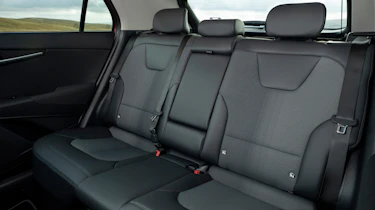
Cabin space was a real plus point of the old Niro, and it’s even better here thanks to the extra length, longer wheelbase and a slimmer front seat design that liberated more space for back-seat occupants, among other changes. Even sitting behind a driver over six-feet tall, rear passengers should have plenty of legroom. Headroom is also excellent due to the square proportions of the Niro.
Up front, the low centre console, low window line and decent headroom combine to make the Niro feel spacious and airy inside. Meanwhile, rear passengers will appreciate the USB-C sockets built into the sides of the front seats so they won’t have to fight over who gets to charge their devices.
Boot space
Boot space varies for each powertrain. The most spacious is the Kia Niro EV, which has an impressive 475 litres – that’s 53 litres more than the Vauxhall Astra – and does not even include the 20-litre storage space under the bonnet. Fold the rear seats down, and the luggage capacity expands to 1,392 litres.
The Hybrid comes next with a respectable 451 litres while, unfortunately, due to the battery being located at the rear, the Niro PHEV’s boot space falls to 348 litres. Folding the Niro’s 60:40 split rear bench gives you 1,445 and 1,342 litres to play with in the hybrid and plug-in hybrid, respectively.
The Niro does have quite a high load lip, which isn’t great when you’re loading heavier items, but the boot opening is nice and wide. We also like the lightweight load cover, which can be twisted and collapsed into a compact disc that you can stow pretty much anywhere.
Towing
The maximum braked trailer towing weight for the Niro hybrid and PHEV models is 1,300kg, which is the same amount as the Hyundai Kona hybrid. However, for maximum small SUV lugging capability, you’ll want a 2.0-litre diesel-powered Skoda Karoq as this can take on up to 2,100kg.
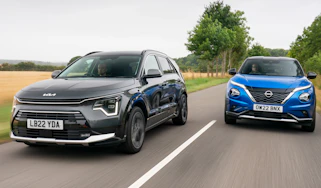
“While the load lip in the Kia is quite high, the Korean car still offers better access to the load area than the Nissan Juke.” - Dean Gibson, senior road test editor.
Reliability & safety
Pros |
|
Cons |
|
The second-generation Niro was crash tested by industry experts Euro NCAP in 2022 and received a four-star (out of five) rating for cars without the safety pack, and five stars (which includes all Niros sold in the UK) for models that come with the more advanced autonomous braking system that recognises pedestrians and cyclists. The Niro’s 91 and 84 per cent scores for adult and child occupant protection are about average for this class, as is the 79 per cent score for safety assistance technology you get in all models sold here.
Speaking of which, the Niro comes as standard with a decent array of safety kit onboard, including a reversing camera, rear parking sensors, smart cruise control with stop/go functionality, hill-start assistance, lane-keeping assist and forward collision avoidance assist. Pricier models add front parking sensors, highway driving assist, blind spot collision avoidance assist and even a remote parking assist system.
The Kia Niro was rated as the 28th best car to own in the most recent Driver Power owner satisfaction survey. While this is a fairly middling result, owners have been impressed by their cars’ running costs, as it was the top performer in this category. Other areas like driving dynamics and styling held it back. The fact that the Kia brand only managed 25th out of 30 in the best manufacturer results means there’s a lot of work to be done, though.
| Euro NCAP safety ratings | |
| Euro NCAP safety rating | 4/stars 5 stars (with/without Safety Pack, 2022) |
| Adult occupant protection | 91%/91% |
| Child occupant protection | 84%/84% |
| Vulnerable road user protection | 75%/76% |
| Safety assist | 60%/79% |
Buying and owning
Best buy: Kia Niro 1.6 GDi 136 Hybrid Aspire
In entry-level Aspire trim, the Kia Niro Hybrid starts from around £30,000, and considering that this powertrain has proven its worth when it comes to real-world efficiency, we’d stick with it. It’s also cheaper as the PHEV starts from around £35,000.
You can save on every variant’s list price with the Auto Express Buy A Car service. We also have a range of Niro leasing deals to choose from, along with used Niro models in stock right now.
Kia Niro alternatives
Given the Niro is offered with two distinct powertrains, it has a long list of rivals. The Niro Hybrid and PHEV come up against the likes of the Honda HR-V, Renault Captur, Nissan Juke and Toyota C-HR plus this Kia’s sister car, the Hyundai Kona.
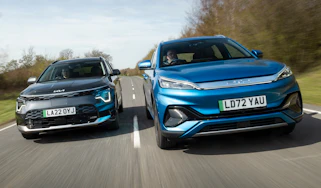
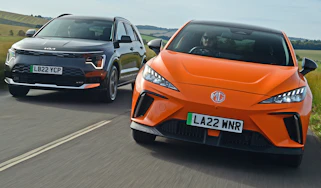
Of course, there’s also the purely electric Kia Niro EV to consider, and this has its own set of alternatives. There’s the brand’s own Kia EV3, along with several other competitors like the BYD Atto 2, Hyundai Kona Electric, Jeep Avenger, Peugeot E-2008 and Smart #1
Kia Niro pictures
Key updates of the Kia Niro review
15 October 2026: Latest depreciation and pricing data.
Frequently Asked Questions
As with all Kias, the Niro gets a seven-year/100,000-mile warranty. The warranty is also passed on to each owner, within the time or mileage limit. Although the two companies are closely related, this is an ever better offering than Hyundai’s, which only lasts for five years.
Deals on the Niro and alternatives