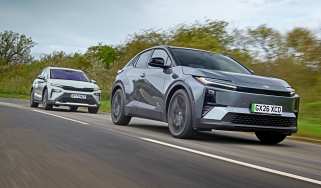
Toyota C-HR review
The Toyota C-HR combines bold looks, high efficiency, and lots of safety kit and equipment, but it is expensive

Our opinion on the Toyota C-HR
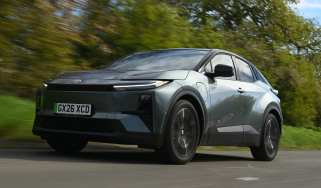
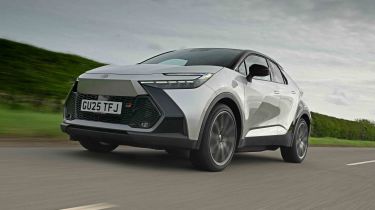
The Toyota C-HR offers excellent real-world efficiency, a plush cabin and an interior filled with tech that’s fairly easy to use. It comes standard with many safety features, and its hybrid engines offer low emissions. Credit should be given to the designers for keeping the same bold styling that made the Mk1 such a hit, because this Mk2 version looks just as dramatic.
The CH-R Plug-in Hybrid is an expensive addition to the line-up and is best suited to company car drivers to help keep their tax bills under control. Overall, we think the well-equipped Design trim is the best value for money, and the less powerful 1.8 Hybrid model is perfectly usable in everyday driving.
About the Toyota C-HR
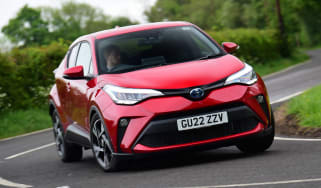
The second-generation Toyota C-HR (the initials stand for Coupe-High Rider) follows a template that was set by the popular Mk1 model, which was sold between 2016 and 2023. While the Mk2 arrived exclusively with hybrid 1.8 and 2.0-litre powertrains (the Mk1 did have a petrol option for a brief period), Toyota has tweaked the line-up for 2026, so now the only hybrid powertrain on offer is the 1.8 version.
You can still buy the larger 2.0-litre engine, but it’s only available in the C-HR Plug-in Hybrid, so prices are a lot higher as a result. Whichever powertrain you choose, drive is sent to the front wheels via a CVT automatic transmission; there’s no four-wheel-drive option.
Used - available now


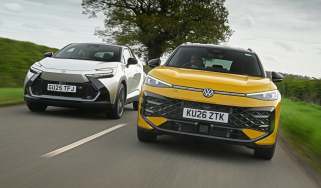
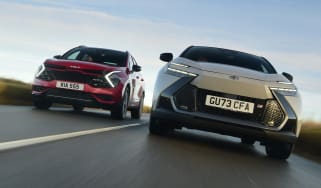
We’ve tested a GR Sport Toyota C-HR against the big-selling Kia Sportage, and we've also tested a 1.8 hybrid Toyota C-HR against the VW T-Roc. We have also run an Excel version of the Toyota C-HR as part of our long-term test fleet.
Performance & driving experience
Pros |
|
Cons |
|
Since the C-HR is based on the same TNGA platform as the Toyota Corolla, it means the small SUV has an excellent starting point when it comes to the driving experience.
If you went beyond the city limits in the old C-HR, it would struggle because the revs used to soar whenever you asked for more than moderate acceleration, and trying to maintain speed up a hill would often become quite a noisy affair. This version of the C-HR benefits from a refined and enhanced powertrain that seems much more comfortable with life. The engine still drones if you ask for maximum acceleration, but it gets up to speed quicker, so you can get back to cruising sooner.
Performance, 0-60mph acceleration and top speed
The Toyota C-HR’s hybrid engines offer smooth and quiet power. The 138bhp 1.8-litre powertrain can run on electric power at low speeds, making it feel relaxed and responsive around town. It takes 10.2 seconds to sprint from 0-62mph, which isn’t the fastest acceleration around, but is still quicker than many rivals.
For those wanting extra punch, the 2.0-litre Plug-In Hybrid delivers 220bhp and does 0–62mph in just 7.4 seconds, making it the fastest C-HR available.
| Model | Power | 0-62mph | Top speed |
| C-HR 1.8 HEV | 138bhp | 10.2 seconds | 106mph |
| C-HR 2.0 PHEV | 220bhp | 7.4 seconds | 112mph |
Town driving, visibility and parking
The C-HR shines in the city. It rides smoothly over speed bumps and potholes, especially with smaller 17 or 18-inch wheels. The steering is light and responsive, making it easy to manoeuvre through traffic.
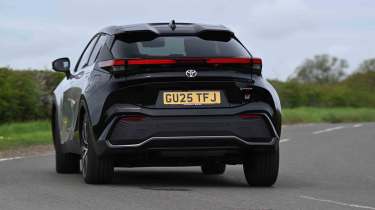
Parking is helped by a standard reversing camera, although the thick rear pillars and sloped back window (which doesn’t have a wiper) limit visibility a bit. Some safety systems can feel overactive, but overall, the C-HR is easy to handle in tight spots.
Country road driving and handling
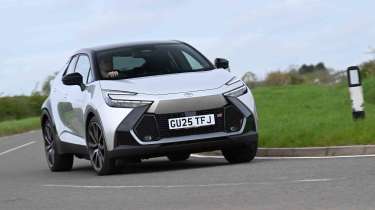
While not as sporty as some rivals such as the Ford Puma, the C-HR stays stable and composed through corners. The newer models handle hills and higher speeds more comfortably than older versions.
Those choosing the C-HR Plug-In Hybrid model will notice its extra 200kg of weight, particularly when travelling along faster roads. Suspension tuning has helped maintain the crisp body control of the standard hybrid C-HR, though, while the ride still does a good job of smothering the majority of road imperfections.
On the whole, the C-HR is a decent hybrid SUV to drive. We’d never go as far as to suggest there’s much fun or genuine driver involvement to be had, because there’s just too much going on between you and the engine itself for that. You’d need a more traditionally powered petrol small SUV, like the Ford Puma, using a manual gearbox, in order to feel involved in the driving experience.
However, it is possible to lean on the body control afforded by the TNGA underpinnings, use intelligent accelerator inputs to make the transmission behave more like a conventional auto, and you can maintain genuinely swift progress on a twisting road.
The Plug-In Hybrid adds some extra weight, but thanks to well-tuned suspension, it still handles confidently while smoothing out most road bumps.
Motorway driving and long-distance comfort
All C-HR models feel calm at cruising speeds. The more powerful PHEV reaches motorway pace more quickly, but even the base hybrid keeps up comfortably. Road and wind noise are well controlled, especially in trims with smaller wheels. Expect a bit more road noise if you choose the larger 20-inch wheels.
“My car’s perfectly fine around town and at a cruise, but it huffs and puffs a little when you put your foot down to overtake. Things aren’t helped by the CVT automatic gearbox, which creates the infamous drone from the engine under hard acceleration.” - Paul Adam, special contributor.
MPG & running costs
Pros |
|
Cons |
|
Every Toyota C-HR comes with hybrid technology, so even the least efficient model is still more frugal than most petrol-only rivals. The 1.8-litre Hybrid has a combined WLTP figure of 60.1mpg and 115g/km. During our time with a 1.8-litre C-HR Excel on our long-term test fleet, we saw a combined average of 54.6mpg after a wide range of driving conditions. While that was a bit short of the official number, it still meant petrol station visits were something of a rarity.
Unlike regular petrol cars, hybrids are more efficient in town. It’s common for the C-HR to run on electric power for over 70 per cent of short trips, without needing to switch to Eco mode. And because the hybrid is self-charging, there’s no need to plug it in — ideal if you don’t have a charger at home.
The 2.0-litre Plug-in Hybrid has a much higher combined figure of 353.1mpg, but based on our experience of PHEVs, you're unlikely to achieve that in everyday driving. During our PHEV mega test, we achieved 51.8mpg as a worst-case scenario figure without electrical assistance from its hybrid battery on a test loop involving some urban, B road, and motorway driving.
| Model | MPG | CO2 | Insurance group |
| C-HR 1.8 HEV | 60.1mpg | 115g/km | 20 |
| C-HR 2.0 PHEV | 353.1mpg | 19g/km | 25 |
Electric range, battery life and charge time
The C-HR PHEV needs to be plugged in to get the best results. The plug-in hybrid model uses a 13.6kWh battery and is claimed to offer up to 41 miles of electric-only driving, although we only managed 34 miles of electric driving during our hybrid megatest. Unlike some PHEVs, the C-HR doesn't support DC rapid charging, but replenishing a flat battery is expected to take around 2.5 hours when using a 7.4kW wallbox charger at home.
Each time you start the car, it defaults to EV mode, using battery power alone until it runs out. On longer trips, switching to EV/HV (hybrid) mode helps the car manage energy more efficiently by combining engine and electric power based on driving style, route, and terrain. If you’re commuting into a low-emission zone, HV mode helps preserve battery charge for use in city centres. There’s also a charge mode that uses the engine and regenerative braking to top up the battery while you drive.
The hybrid battery in regular and plug-in hybrid models is covered by a separate warranty of up to five years/60,000 miles, but this can be extended by 12 months or 10,000 miles at a time after every service at a Toyota franchised dealer, up until the car is 10 years old or has covered 100,000 miles. After this point, you’ll need an annual hybrid battery service that’ll give you a further 12 months of hybrid battery warranty coverage until the car is 15 years old.
| Model | Battery size | Range | Insurance group |
| C-HR 2.0 PHEV | 13.6kWh | 41 miles | 25 |
Insurance groups
The C-HR starts in insurance group 20 for the entry-level 1.8 Hybrid Icon, rising to group 22 for the 1.8 Hybrid Excel. The PHEV slots into groups 25 and 26. Compared with other hybrid small SUVs, the C-HR will likely cost more to insure than the Hyundai Kona, which is in group 16 for the 1.6 Hybrid Advance model. However, if you need something in an even lower insurance group, take a look at the entry-level Volkswagen T-Roc, which starts in group 14 in 1.5-litre Life form.
Check if your car needs an MoT and view its complete history with our MoT History Checker…
Tax
You will have to be careful which trim level and powertrain combination you go for with the C-HR, because pricier models (basically the top-spec GR Sport Hybrid with options fitted, or the PHEV in all trims bar the entry-level Design with no options) sneak above the £40,000 luxury car tax surcharge threshold. This is applied from years two to six after the car is registered.
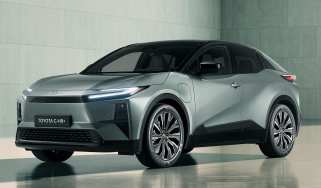
Company car drivers stand to save a bit more on Benefit-in-Kind (BiK) tax if they opt for the PHEV, due to its lower emissions. However, for the most appealing rates, the all-electric Toyota C-HR+ is the best option for reduced company car tax.
Depreciation
Our market data shows that residual values for the C-HR are good rather than outstanding. After three years and 36,000 miles, this small SUV will maintain between 41 and 49 per cent of its resale value. The equally funky Nissan Juke, meanwhile, manages 42 to 45 per cent, while the Hyundai Kona is in the 47 to 55 per cent range.
To get an accurate valuation on a specific model, check out our free car valuation tool…
Interior, design & technology
Pros |
|
Cons |
|
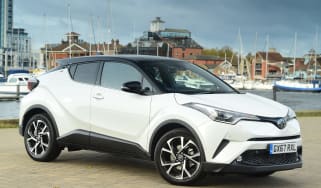
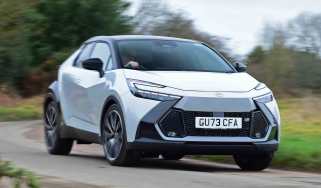
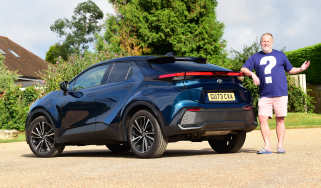
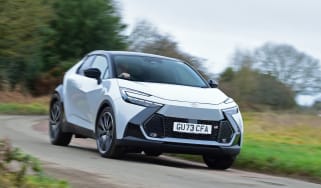
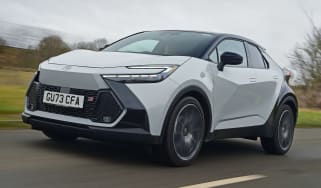
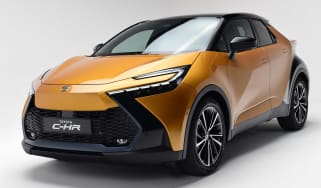
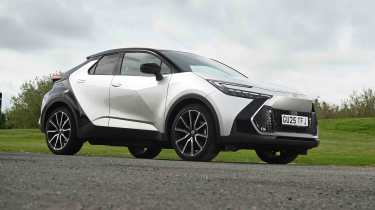
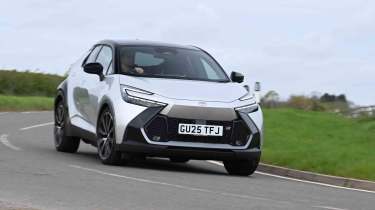
Credit should be given to the designers at Toyota for not playing it safe and watering down the striking looks of the original C-HR. Instead, the latest C-HR looks even more arresting than before, with the GR Sport model coming standard in two-tone paint to really showcase its looks in the best light.
Other trim levels can be had with a contrasting roof colour for an additional cost. There’s one free Pure White colour, and four metallics that can be specced with a ‘Bi-Tone’ contrast roof, plus two premium colours – although the latter cost around £1,000.
The standard Icon trim features 17-inch alloys, an 8-inch touchscreen with Apple CarPlay connectivity and sat-nav, a 7-inch digital driver's instrument cluster, keyless entry and start, blind spot monitoring, and LED headlights.
We recommend Design trim because of its more generous equipment list, which includes:
- 18-inch alloys
- A 12.3-inch infotainment screen with wireless smartphone connectivity
- An electric tailgate
- Front and rear parking sensors
- Heated front seats
- Dual-zone climate control
The more expensive Excel adds 19-inch alloys, a panoramic glass roof, a 360deg camera system, a driver monitoring system, lane change assistance, and adaptive headlights. The sportier-looking GR Sport doesn't feature the latter, but it does come with 20-inch alloys, a head-up display, and a JBL sound system.
You can add a £1,600 Tech Pack to the Excel trim, and you'll get an uprated JBL sound system, a head-up display, and a digital rear-view mirror display. GR Sport can be ordered with the rather expensive £3,000 Premium and Safety pack, but it does get you a lot of features including adaptive headlights, a panoramic glass roof, a digital rear view mirror display, and an extensive list of additional safety technology, such as front cross traffic alert, emergency steering assistance, lane change assistance, and high beam assistance.
Interior and dashboard design
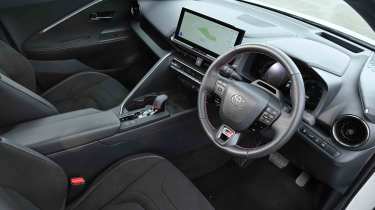
Inside, Toyota hasn’t deviated much from the stylised formula that made the first C-HR a success. There’s a fully digital instrument panel, a whopping 12.3-inch infotainment system touchscreen in higher-spec models (lesser C-HRs make do with an eight-inch display), and wireless smartphone integration.
We prefer physical controls because they’re easier to use on the move compared with the purely touchscreen-based systems used in the DS 3 and Peugeot 2008, which can be very distracting because you have to look away from the road to find the right area of the screen to press.
Materials and build quality
High-grade plastics and thick padding are featured in all key areas of the interior, while sensibly positioned toggle controls in the centre of the dash control the ventilation system and heated seats.
Toyota has a pretty robust reputation for quality, and the C-HR feels as well screwed together as we’d expect. We ran an Excel trim C-HR for spent six months on our long-term test fleet, and we didn’t encounter any interior foibles during this time.
Infotainment, sat-nav and stereo
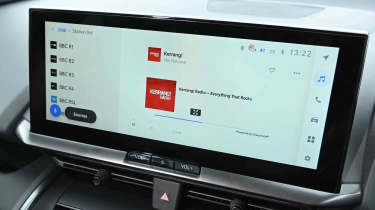
The entry-level Icon model has an 8.0-inch touchscreen, while everything from Design trim and above gets a larger 12.3-inch display.
The previous C-HR had an outdated-looking infotainment set-up. The latest screen is much improved, not just in layout but also in terms of the speed of its responses. However, it still can’t quite match the high-resolution infotainment system featured in the Volkswagen T-Roc, which has sharper graphics and easier shortcuts to navigate.
A wireless charging pad comes as standard on mid-range Design trim cars, as well as sat-nav. All versions come with Android Auto or Apple CarPlay if you want to bypass the built-in apps and infotainment system in favour of your phone.
All cars have a six-speaker sound system, which can be upgraded to a nine-speaker JBL system on Excel trim. The top-of-the-range GR Sport gets this stereo upgrade as standard.
The 12.3-inch digital driver’s display fitted to Design trim and above has different configurations, but it’s a little tricky to set up via the control pad on the steering wheel.
“The C-HR is one of those cars you can just jump in and drive – especially in Excel trim. Little touches such as the wireless phone charging pad and a memory function for the driver’s seat position make for a quick getaway with the minimum of fuss, while the premium sports seats offer decent support and are comfortable.” - Paul Adam, special contributor.
Boot space & practicality
Pros |
|
Cons |
|
The sleek roofline of the Toyota C-HR can fool you into thinking it’s a much smaller car than it actually is. In terms of length, it’s a little bit longer than a Hyundai Kona, and just shy of the latest Volkswagen T-Roc. The C-HR is also taller than a Kia Niro, but doesn’t quite reach the ‘lofty’ heights of the Renault Symbioz.
Get inside, and you’d think that you were driving something more akin to an MPV. The windscreen’s base seems to be in a different postcode from the driver, stretching beyond a very deep dashboard. The bonnet ahead of the windscreen slopes away, making gauging the car’s extremities difficult. That’s why we think opting for a mid-range Design will be worthwhile, because it includes front and rear parking sensors to assist you. There are large side door mirrors to assist when changing lanes on the motorway, and blind spot monitoring is standard to alert you to anything hidden alongside you.
Dimensions and size
The Toyota C-HR is roughly the same size as a Hyundai Kona or Volkswagen T-Roc, so is more of a high-riding hatchback than a full family SUV like a Nissan Qashqai.
| Dimensions comparison | |||
| Model | Toyota C-HR | Hyundai Kona Hybrid | Volkswagen T-Roc |
| Length | 4,362mm | 4,350mm | 4,372mm |
| Width | 1,832mm | 1,825mm | 1,828mm |
| Height | 1,558mm | 1,585mm | 1,573mm |
| Wheelbase | 2,640mm | 2,660mm | 2,629mm |
| Boot space | 447 litres | 466 litres | 475 litres |
Seats & passenger space
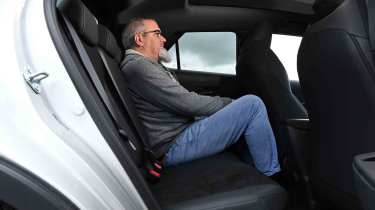
C-HR drivers get the slightly raised position that many SUV buyers seem to crave, and both front seat occupants have a decent amount of room to stretch out. The C-HR’s svelte design will impede headroom for the tallest passengers, but the majority of people will be able to get comfortable enough in the front of this small SUV.
Space in the back is decent enough and compares well with what you’ll find in some small SUVs like the Jeep Avenger, Peugeot 2008 and Vauxhall Mokka. Two Isofix points are provided on the outer rear seating positions, although parents may rue having to put children in the back because the angle of the rear roof pillar means you’ll need to duck down in order to lean in.
The door openings aren’t the largest, so it’s difficult to install a child seat. If you need more practicality, consider the more conservatively styled Nissan Qashqai, with its nearly 90-degree rear door openings, or step up to something like brand’s larger Toyota RAV4 SUV.
Boot space
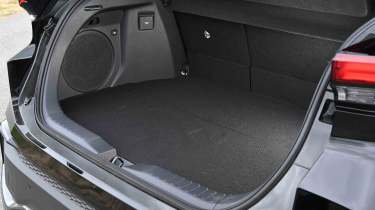
The 1.8-litre C-HR’s 388-litre boot is much more generous than the 319-litre Honda HR-V, but trails the 466-litre Kona and 479-litre Qashqai. It doesn’t come with the latter’s clever dividing panels to prevent items from sliding deeper into the boot, and the load lip is very high, making it harder to load heavy items into the boot.
One word of caution: the plug-in hybrid loses nearly 80 litres of boot space courtesy of the location of the drive battery under the floor, reducing overall capacity to 310 litres. That’s much less than you’ll find in similar PHEV versions of the Cupra Formentor and Kia Niro. Indeed, it’s even smaller than one of our favourite superminis, the Renault Clio.
Towing
Something else worth considering if you’re interested in towing is that no version of C-HR can pull more than a 750kg braked trailer. If you need something more capable, a Kona Hybrid can lug up to 1,300kg, or you could go back to traditional petrol or diesel power and get something like the Skoda Karoq, which can pull up to 2,100kg.
Reliability & safety
Pros |
|
Cons |
|
The Toyota C-HR carries the maximum five-star safety rating from Euro NCAP, putting it ahead of the four-star Hyundai Kona.
Every C-HR gets autonomous emergency braking to help prevent or mitigate low-speed collisions with pedestrians and cyclists around town. At higher speeds, there’s adaptive cruise control to maintain a safe distance from the car ahead, and lane departure warning and lane-keeping assist to help keep you within your lane. Blind spot monitoring will warn you of other vehicles alongside you on the motorway.
Road sign recognition is also standard, and helps to warn you of speed limit changes to save you from getting a speeding fine. There’s also an emergency eCall system to alert the emergency services of your location should you get involved in a serious collision.
Further up the range, Design comes with a rear-cross traffic alert system to let you know if vehicles are crossing your path when reversing onto a road. Excel comes with a front-cross traffic alert, which does the same at the front. The latter is particularly helpful in the countryside when overgrown hedgerows obstruct your view at junctions.
Be aware, though, that due to the C-HR having to comply with the latest 2024 safety regulations requiring additional assistance technology, such as speed limit warnings and lane keeping assistance, you’ll notice many more warning ‘bongs’ during your drive. You may become quite bored with all these alerts and want to turn them off. It is possible to do this using a menu in the digital instrument cluster, but it takes many button presses and must be done every time you restart the car.
As a brand, Toyota came in 19th out of 30 manufacturers in our 2026 Driver Power owner survey. While that is just ahead of Skoda (20th) and Ford (21st), it’s behind Honda (17th) and Nissan (12th).
The C-HR ranked 21st out of the 50 best cars to own, scoring highly for quality and reliability, low fuel consumption, the responsiveness infotainment system, and its balance of physical and touchsensitive controls. The weren't so positive about the sat-nav system, which is perhaps just as well that our preferred Design trim gets full smartphone connectivity so you can use your favourite navigation app instead of the car's in-built version. Owners also weren't keen on C-HR's poor visibility which isn't helped by thick rear pillars and the lack of a rear windscreen wiper, and they felt the C-HR could be better value for money.
| Euro NCAP safety ratings | |
| Euro NCAP safety rating | Five stars (2024) |
| Adult occupant protection | 85% |
| Child occupant protection | 86% |
| Vulnerable road user protection | 86% |
| Safety assist | 79% |
Buying, prices and deals
Best buy: Toyota C-HR 1.8 Hybrid Design
In its most basic spec (Icon trim with the 1.8-litre hybrid powertrain), the C-HR line-up kicks off at just under £32,000. At the very top end of the scale sits the GR Sport with plug-in hybrid tech, and this costs a little more than £44,000.
There are a number of trim levels and powertrains to choose from with the C-HR, but the majority of drivers will be best served by the mid-range Design model. Official fuel economy of over 60mpg is not to be sniffed at, while we’d only recommend the PHEV if you’re able to charge it regularly.
If you'd like to buy a C-HR of your own and save money in the process, you can configure your ideal C-HR now to get great offers from nearby dealerships, take a look at our top leasing deals or find top used models with our Buy A Car service. You can even sell your existing car for a great price with Auto Express Sell My Car.
Toyota C-HR alternatives
There’s no shortage of small SUVs on today’s market, so there are many rivals to the Toyota C-HR to choose from. For those who want a funky and distinctive SUV, the closest competitor is the striking Nissan Juke, although it’s smaller overall than the Toyota. Elsewhere, there are also more conservatively styled models, including the Skoda Karoq, Volkswagen T-Roc and Renault Symbioz. If you’re after a blend of practicality and driving fun, the Ford Puma is one of the very best cars to drive in this class.
Latest deals on the C-HR and rivals
Toyota C-HR pictures
Key updates of the Toyota C-HR review
21 July 2026: Updated with the 2026 Driver Power customer satisfaction survey results.
4 June 2026: Update to include the latest impressions from the Toyota C-HR versus VW T-Roc twin test
Frequently Asked Questions
Toyota’s standard warranty of three years or 60,000 miles can be extended up to 10 years or 100,000 miles, provided you have the car routinely maintained at an approved workshop.
New & used Toyota C-HR deals