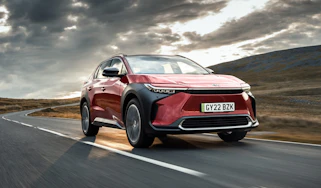
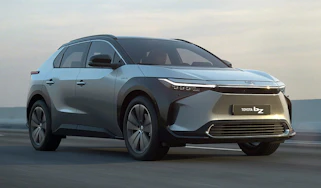
Toyota bZ4X review
The Toyota bZ4X is a capable family car, but there are more impressive and efficient electric cars out there
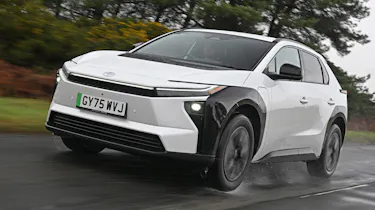

Our opinion on the Toyota bZ4X
There’s plenty to like about the Toyota bZ4X. For example, it has an ideal amount of space on board and is surprisingly entertaining to drive for an electric SUV. However, when looking at the very high standard of opposition this car faces, it does feel rather disappointing in some areas.
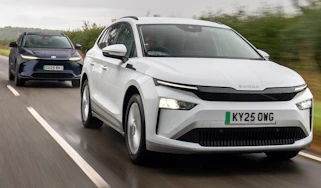
It’s not that the bZ4X is a bad car, it’s just that we feel that the Skoda Enyaq is a better one in most areas. The Toyota isn’t as efficient, nor as well equipped unless you spend a lot more cash, while the driving position could be an issue, too. The Toyota bZ4X is still worth considering if you’re after an electric family car, but you’ll want to shop around for a top-notch finance or leasing deal.
About the Toyota bZ4X
Toyota’s first Beyond Zero (or bZ) model got a mixed reaction when it arrived in 2022. Some even argue it was a bit of a disappointment, given the brand’s extensive battery-tech experience with its hybrid vehicles.
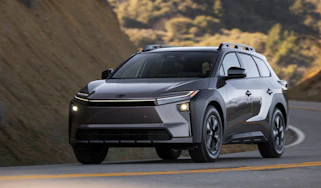
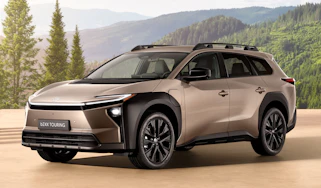
However, it has since been facelifted and made much more competitive in the quickly evolving EV marketplace. There's also a more practical Toyota bZ4X Touring based on the Subaru e-Outback, which you can read about in our dedicated in-depth review.
Used - available now


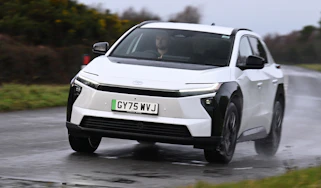
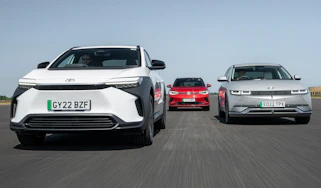
We’ve tested both the front- and four-wheel-drive versions of the bZ4X extensively on UK roads. Our most recent test pitched the front-wheel-drive, pre-facelift model through its paces in our Skoda Enyaq versus Toyota bZ4X twin test.
Performance & driving experience
Pros |
|
Cons |
|
There are two powertrain and battery options available in the bZ4X. The smallest 57.7kWh is reserved for the entry-level Icon trim and comes in front-wheel drive form with the least powerful electric motor. The larger capacity 73.1kWh battery is also available in front-wheel drive form with a slightly more potent electric motor, or with two electric motors, making the bZ4X four-wheel drive. The latter is presently the quickest bZ4X you can buy and is only available in its most expensive Excel trim.
Performance, 0-60mph acceleration and top speed
The entry-level, front-wheel drive version produces 165bhp and gets from 0-62mph in a respectable 8.6 seconds. That’s certainly slower than the least powerful Tesla Model Y (6.9 seconds), but only 0.5 seconds behind the cheapest Skoda Enyaq.
We found the 221bhp motor in the mid-range Design model felt fast enough for most needs thanks to its 7.4-second 0-62mph. It’s quite refreshing that Toyota hasn’t bothered to include a sport mode for more spirited driving, which highlights that this is very much not a sports car. Acceleration is best when left in the car’s normal mode, while Eco pairs things back a touch to conserve power and your driving range.
We’re yet to try the 338bhp four-wheel drive version (also using a 73kWh battery), but its 5.1-second 0-62mph sprint is unlikely to trouble the blisteringly quick 3.3-second dash of the Model Y Performance – or even the standard Dual-Motor Model Y, for that matter.
| Model | Power | 0-62mph | Top speed |
| Icon 57.7kWh FWD | 165 bhp | 8.6 seconds | 87 mph |
| Design 73.1kWh FWD | 221 bhp | 7.4 seconds | 99 mph |
| Excel 73.1kWh AWD | 338 bhp | 5.1 seconds | 99 mph |
Town driving, visibility and parking
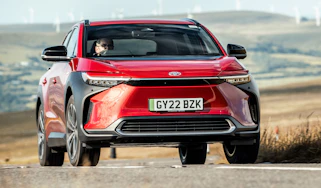
We always found that the pre-facelift version of Toyota’s EV provided quite a comfortable ride on urban streets, with a pliancy that eclipsed the Enyaq’s for low-speed comfort. Thanks in part to the smaller 18-inch wheels fitted to Icon and Design versions of the bZ4X and further suspension tuning, the latest version continues to impress, remaining unchallenged by big potholes and rough sections of road.
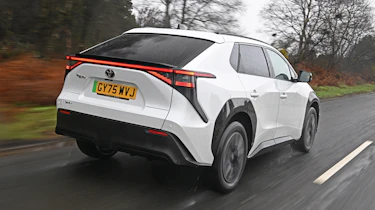
There’s a decent view of your surroundings, too, although rear visibility is impaired a little by the narrow back window, thick pillars, and the lack of a rear windscreen wiper in rainy weather. All versions come with a reversing camera, while mid-range Design and above add a panoramic view, plus front and rear parking sensors to help when manoeuvring.
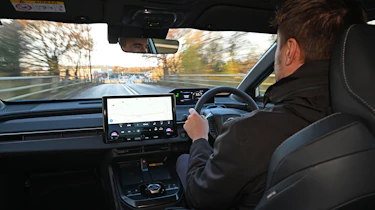
The electric powertrain is relatively quiet, with only a small amount of electric motor whine to be heard, while the cabin is well insulated from the outside world. Throttle response is brisk, so there’s no problem with keeping pace with traffic, while stronger brake regeneration is available via a button on the centre console.
Country road driving and handling
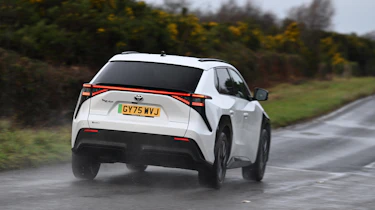
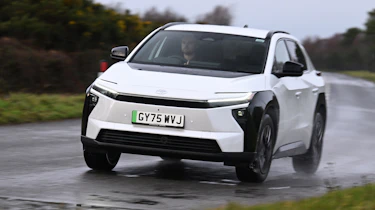
At higher speeds, the bZ4X has the kind of agile handling that has become a familiar feature of Toyota’s line-up, although it doesn’t come at the expense of comfort.
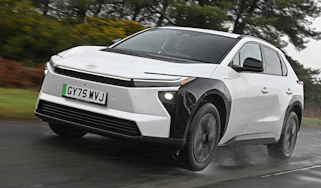
A kerbweight of just over 1,900kg for the front-wheel drive model is pretty good for an electric vehicle (the AWD version is 90kg heavier), and the car absorbs shocks and bumps well while remaining stable in corners. The steering is well weighted, if not buzzing with feedback that’s typical of electric-assisted steering. The latter came in handy during our test drive in a particularly heavy downpour because we didn’t experience any unpleasant tugging at the wheel while driving through standing water.
Motorway driving and long-distance comfort
A slippery shape helps the bZ4X to deliver hushed refinement at higher speeds. We didn’t find much in the way of wind or road noise in the pre-facelift bZ4X, while the suspension continues to deliver a pliant ride even at the national limit. The latest version includes additional noise-dampening measures, such as acoustic glazing on the front windows, more foam insulation, and integrated noise-silencing material in the floor to help keep unwanted sounds at bay.
"The Toyota is better resolved than the Skoda Enyaq, although the front-wheel-drive configuration and spiky electric power delivery mean torque steer is present, whereas the rear-drive Skoda sprints away without fuss." - Dean Gibson, senior test editor.
Range, charging & running costs
Pros |
|
Cons |
|
Early criticism of the bZ4X was centred around its high list prices. But today there’s relative price parity between the Toyota and its main rivals.
Electric range, battery life and charge time
The pre-facelift bZ4X only had one battery capacity, whereas the revised model has two: 57.7kWh or 73.1kWh. This means that those who don’t need to go quite so far can get a less expensive version, while anyone looking to go further will benefit from the slightly increased battery capacity and more efficient EV drivetrain provided in the facelifted bZ4X.
Those improvements have increased the range from 318 miles in the pre-facelift bZ4X to 352 miles for the latest front-wheel drive Design model. The larger 20-inch wheels and heavier four-wheel drive system of the AWD Excel version reduce this figure to 292 miles, though that’s still better than the 284 miles of the equivalent pre-facelift model. If you’re only plotting to use your bZ4X around town, then the 275-mile 57.7kWh Icon version should fit the bill.
We’ve only tried the most efficient front-wheel drive 73.1kWh Design version so far, and in unflatteringly cold single-digit weather in the rain. This hampered efficiency to 3.5 miles per kWh or a predicted range of 255 miles, so we’ll have to reserve judgment on its efficiency until we’ve tried it in warmer weather.
A useful feature of the revised bZ4X is its battery preconditioning system, which you can turn on manually or let it do its thing automatically when you set a route in the sat-nav. If the car deems you’ll need a recharge partway through your journey, it’ll automatically make sure the battery is at the correct temperature to accept its maximum charging speed when you plug in, helping you wait less time before continuing your journey.
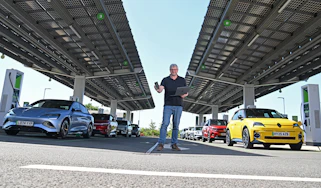
The maximum charging speed of 150kW remains the same as before, and both the 57.7kWh and 73.1kWh versions can go from 10-80 per cent state of charge in around half an hour, which is similar to many electric SUV rivals. A typical 7.4kWh home wallbox charger is likely to fully recharge the 73.1kWh bZ4X in around 10 hours, while the smaller capacity 57.7kWh version takes just over 8.5 hours.
| Model | Battery size | Range | Insurance group |
| Icon 57.7kWh FWD | 57.7kWh (54kWh usable) | 275 miles | 32 |
| Design 73.1kWh FWD | 73.1kWh (69kWh usable) | 352 miles | 36 |
| Excel 73.1kWh AWD | 73.1kWh (69kWh usable) | 290 miles | 41 |
Insurance groups
The inclusion of a cheaper and less powerful version has reduced the insurance group rating of the cheapest bZ4X to group 32. However, while the mid-range model (now the 73.1kWh Design) remains in group 36, the top-of-the-range AWD model has climbed to group 41. That’s a shame because rivals such as the Skoda Enyaq, Ford Explorer and Nissan Ariya all sit in lower groups.
Tax
Provided you avoid the top-of-the-range AWD Excel or the expensive £2,500 panoramic glass roof and JBL premium sound pack in the front-wheel drive Excel trim bZ4X, the rest of the range comes comfortably under the revised £50,000 luxury car tax threshold for EVs. You’ll still have to pay the standard rate of vehicle excise duty (VED) road tax, though.
Due to its zero tailpipe emissions, the bZ4X will have a lower company car Benefit-in-Kind (BiK) tax compared with traditionally powered SUV rivals, and presently attracts a four per cent BiK rate for the ‘26 to ’27 tax year, five per cent from ‘27 to ‘28, and seven per cent from '28 to '29.
One thing worth paying attention to is that EVs will be subject to an eVED pay-per-mile fee from April 2028 onwards.
Check if your car needs an MoT and view its complete history with our MoT History Checker…
Depreciation
While the bZ4X started out with relatively strong residuals when it was launched, values have tailed off significantly.
According to data provider CDL, the bZ4X is likely to retain 42 per cent of its original value over a typical ownership period of three years or 36,000 miles. In comparison, the Enyaq will retain 43 to 47 per cent, while the Renault Scenic maintains 53 per cent over the same period.
To get an accurate valuation on a specific Toyota bZ4X, check out our free car valuation tool...
Interior, design & technology
Pros |
|
Cons |
|
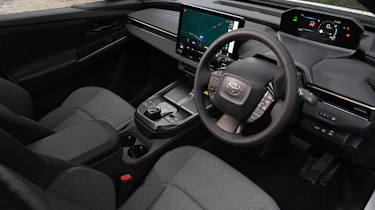
Toyota has helped ease the transition to electrification by making the bZ4X’s cabin feel familiar to anyone who has driven one of the manufacturer’s recent hybrid models.
Interior and dashboard design
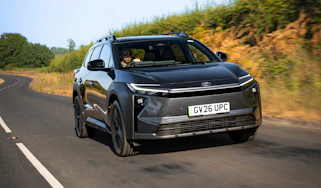
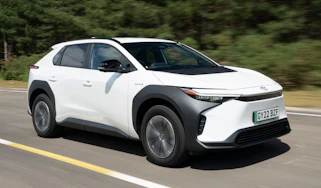
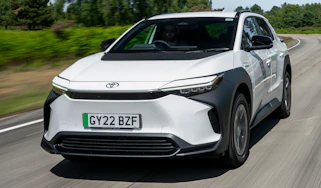
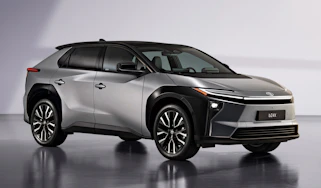
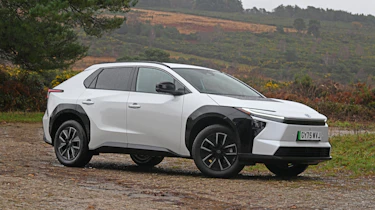
The hatchback’s slippery shape means that the bZ4X is almost like a coupe-SUV in appearance. And while the lack of grille looked distinctive when the car first launched, it’s a design feature that has since been applied to the Toyota C-HR and Toyota Prius hybrids.
The EV’s cabin is fairly conventional, apart from the high-set centre console and driver’s display that sits above the rim of the steering wheel, similar to Peugeot’s i-Cockpit layout.
Entry-level Icon trim comes with 18-inch alloy wheels, a 14-inch touchscreen infotainment with Apple CarPlay and Android Auto smartphone connectivity, heated front seats and steering wheel, a reversing camera, and blind spot monitoring.
We’d recommend that you spend a bit more on the mid-range Design trim in order to have the larger-capacity battery and:
- Front and rear parking sensors
- A 360-degree camera system
- Wireless phone charging
The range-topping Excel trim adds 20-inch alloy wheels, ventilated front seats, electric front seat adjustment with driver’s side memory settings, and a parking assistant.
Materials and build quality
Despite the facelift, there are still lots of dark grey plastic and grey fabric inserts on the dashboard and doors. We’re pleased that the mass of gloss-black plastic on the centre console has been replaced with a more muted matt-black alternative, least of all because it’ll be less likely to pick up scratches.
The interior continues to feel robust and well-built in typical Toyota fashion. We’ve said before how impressed we are by the lack of squeaks or rattles in the examples of bZ4X we’ve tested, because with EVs offering near-silent running, such noises are far easier to pick out than they would be in a petrol car.
Infotainment, sat-nav and stereo
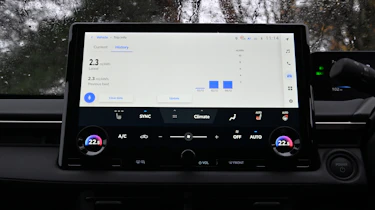
All versions of the facelifted bZ4X use a larger 14-inch central touchscreen with a layout similar to the RZ, including nifty rotary dials for easy adjustment of the climate control temperature.
The old 12.3-inch display wasn’t the most intuitive or particularly sharp, but the latest screen is much improved, with better clarity and easier navigation. You can even customise a menu for quick access to frequently used functions, such as the driver assistance screen, in order to turn off the speed limit warning and lane keep assistance. There’s also a physical audio volume dial, which is far easier to use than the sliders used in Volkswagen Group models.
You can connect your smartphone to the screen using Android Auto or wireless Apple CarPlay to use a navigation app, but you may wish to use the in-built sat-nav system, which now includes automatic route planning for charging stops and battery preconditioning ahead of any stops the system thinks you’ll need to make.
“I find that the bZ4X’s high dials and low steering wheel layout is completely at odds with my preferred seating position. I like to sit low, but in the Toyota this limits my view of the dials unless I drop the steering wheel into my lap, which feels completely unnatural to me.” – Dean Gibson, senior test editor.
Boot space & practicality
Pros |
|
Cons |
|
Dimensions and size
The bZ4X is 4,690mm long and 1,860mm wide, which makes it 90mm longer than its Toyota RAV4 SUV sibling, but 5mm narrower. The all-electric crossover sits lower to the ground, too, measuring 1,600mm tall against the RAV4’s 1,685mm.
| Dimensions comparison | |||
| Model | Toyota bZ4X | Renault Scenic | Skoda Enyaq |
| Length | 4,690mm | 4,470mm | 4,658mm |
| Width | 1,860mm | 1,864mm (2,085mm inc mirrors) | 1,879mm |
| Height | 1,600mm | 1,572mm | 1,622mm |
| Wheelbase | 2,850mm | 2,785mm | 2,766mm |
| Boot space | 452 litres | 545-1,670 litres | 585-1,710 litres |
Seats & passenger space
While the front feels a little hemmed in by the high-set centre console, there’s lots of space and a range of adjustment on offer to optimise your seating. However, you might need to compromise your position because of the dashboard layout. As with Peugeot’s i-Cockpit, the bZ4X has a smaller steering wheel than usual (not as small as a Peugeot’s), and you need to position it low in your lap so that you can see all of the information on the screen.
Storage is hit and miss, too. There’s no glovebox, while the centre console armrest bin is only average in size, and the door pockets are heavily sculpted, so it will be difficult to fit longer items in them. That's a shame, because interior storage is another area where Toyota scored poorly in our 2026 Driver Power customer satisfaction survey, while Skoda scored much better in this regard.
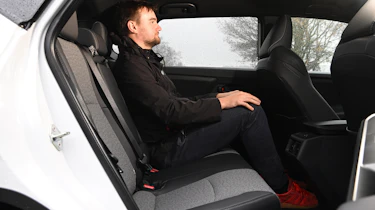
Legroom in the back of the Japanese crossover is excellent, courtesy of the car’s long wheelbase. However, the low roof means there’s less headroom here than the Enyaq, although only the very tallest occupants will have cause for complaint.
A flat floor offers decent foot space, but the high position means that the seat cushions don’t offer much thigh support, which could become uncomfortable on longer trips. Goodies in the back are scarce, but include two USB-C charging ports and twin air vents, but no temperature control, while the door bins aren’t much bigger than cup-holders.
Boot space
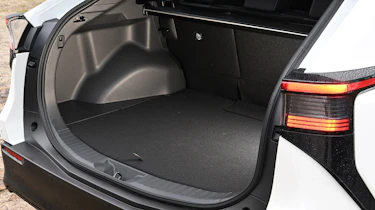
A low load lip boosts access to the boot, while Motion models and above have a powered tailgate as standard. The bZ4X is hatchback-shaped at the rear, so the total capacity isn’t outstanding – at 452 litres it’s 133 litres down on the Enyaq, while the load area is awkwardly shaped thanks to plenty of wheel arch intrusion and the high floor.
If you want a more practical electric Toyota, then you'll need to look toward the Toyota bZ4X Touring, which sports a much more generous 669-litre load area with the seats up, rising to 1,718 litres with the seats down – both of which beat the Enyaq. And the Touring has a handy remote release from the boot, which saves you from having to walk around in order to be able to load your latest flat-pack purchase from IKEA.
It's a shame there's no remote release for the back seats from the boot area in the regular bZ4X; you can only lower the rear seats using the shoulder release on the backrest. The floor is relatively flat when they’re down, which helps when loading longer items. There’s no storage under the bonnet – it’s all taken up by the car’s powertrain – so the only place to stow cables is a shallow tray under the boot floor.
Towing
The four-wheel drive version of the facelifted bZ4X now gets a more respectable 1,500kg braked towing capacity, but the rest of the range still has a disappointingly low 750kg braked towing capacity.
In the meantime, top-spec versions of the Hyundai Ioniq 5 and Nissan Ariya are rated to pull up to 1,600kg and 1,500kg, respectively.
“I drove the bZ4X in rainy conditions, and this highlighted the issues with the rear screen and its lack of a wiper. Toyota expects aerodynamic efficiency to keep the glass clear while driving, but that doesn’t help if the car has been parked in the rain.” – Dean Gibson, senior test editor.
Reliability & safety
Pros |
|
Cons |
|
In our latest 2026 Driver Power owner satisfaction survey, the Toyota brand placed 19th out of 30 manufacturers, which is behind the likes of Suzuki (15th) and Nissan (12th). Owners told us they were happy with the ride and handling of their cars, the quality and reliability, and the running costs. However, they felt practicality and boot space could be better, and they grumbled about the interior, especially the car's built-in sat-nav system.
Euro NCAP gave the bZ4X a five-star rating when it was introduced in 2022. The electric Toyota was then retested in 2025 and subjected to much tougher criteria, but it managed to retain its maximum five-star rating.
All cars come with Toyota’s Safety Sense suite of driver aids. This features lane assist, adaptive cruise, blind spot monitoring, and road-sign assist. We’ve also found that the driver-attention alert wasn’t as intrusive as some rival systems.
| Euro NCAP safety ratings | |
| Euro NCAP safety rating | Five stars (2025) |
| Adult occupant protection | 88% |
| Child occupant protection | 85% |
| Vulnerable road user protection | 80% |
| Safety assist | 79% |
Buying, prices and deals
Best buy: Toyota bZ4X 73.1kWh FWD Design
The pre-facelift Toyota bZ4X used to qualify for the UK Government’s £1,500 Electric Car Grant, like the brand's Toyota Proace City Verso EV and Toyota C-HR+, but the post-facelift bZ4X no longer qualifies. Toyota is offering a discount for a limited time, but without it, prices for the entry-level Icon start at just under £40,000, while the predicted best-seller – the 73.1kWh Design – starts at around £46,000. Four-wheel drive is reserved for the top-of-the-range Excel trim, which comes in at around £51,500.
We’d stick with the front-wheel drive version because it has the best electric driving range of all the bZ4X models available, but we would upgrade to the mid-range Design trim in order to gain a few more luxuries, such as front and rear parking sensors, plus a surround view camera system.
Our Buy A Car service lets you spec your ideal Toyota bZ4X and choose the best offer from top dealers around the UK. Alternatively, you can lease a bZ4X or buy a used bZ4X. We can help you sell your old car, too.
Toyota bZ4X alternatives
The bZ4X enters the all-electric family SUV market at a busy time, with a host of high-quality alternatives for buyers to choose from. The Hyundai Ioniq 5 and Kia EV6 are fantastic options, with the former offering a more relaxed, practical character and the latter a focused, sportier drive and sleeker looks. The Nissan Ariya has good all-round ability, a big battery capacity and high specification for a reasonable price, while the Skoda Enyaq does almost everything you could ask for in a family EV. Other alternatives include the Volkswagen ID.4, Tesla Model Y and Ford Mustang Mach-E.
Key updates of the Toyota bZ4X review
23 September 2026: Update to include the 2026 Driver Power results and mentions of the Toyota bZ4X Touring.
29 January 2026: Included impressions of the updated Toyota bZ4X range and driving impressions
Toyota bZ4X pictures
Deals on the Toyota bZ4X and alternatives
Frequently Asked Questions
The bZ4X comes with Toyota’s standard three-year manufacturer warranty, but it can be extended to 10 years or 100,000 miles (whichever comes first) with annual servicing at an approved Toyota centre.