Electric car charging stations in the UK: public EV charging prices, networks and top tips
Our guide to saving hundreds of pounds on public EV charging covers all the bases


Electric cars have slowly begun to hit price parity with their petrol and diesel counterparts, yet they still only account for one in five new cars sold in the UK. One of the biggest issues stifling further growth is the high cost of public charging.
Plugging-in and charging at home can be incredibly inexpensive, with a full charge of a typical 60kWh EV costing less than £5 at the average off-peak domestic electricity rate of eight pence per kilowatt-hour. On the other hand, public charging can cost 10 times this, or more.
According to EV charging website ZapMap, the average EV driver splits their top-ups between home and public EV chargers on an 84:16 basis. Bearing this (and the current average price for rapid charging) in mind, over the typical 36,000-mile ownership period of a model such as the Renault 5, public charging would make up almost 65 per cent of the cost of charging, despite covering only 16 per cent of the mileage.

Many drivers, however, have to rely solely on public charging because they don’t have the luxury of a driveway and a home wallbox. So for the benefit of everyone, we’ve put together the ultimate guide on EV charging, focusing particularly on ways you can avoid paying too much when you top up.
Like next-day delivery or priority boarding on an airline, in the world of electric car charging you can pay more for the convenience of a faster service. Electric car chargepoints don’t all provide the same maximum output, but it is usually written on the side or displayed on a screen – and these are usually broken down into three categories: slow (less than 50kW), rapid (50-150kW) and ultra-rapid (over 150kW).
As of February 2026, ZapMap says the weighted average prices for slow and rapid/ultra-rapid charging (taking into account subscription discounts and each chargepoint operator’s popularity) are 54 and 76 pence per kilowatt-hour respectively.
To put this in perspective, a full charge of the R5 and its 52kWh battery at the average slow public charging rate would set you back £28.08 – but £39.52 using rapid infrastructure. This is the equivalent of 11 or 16 pence per mile, which over an entire ownership period can add up to a lot – especially, again, if you don’t have access to a domestic chargepoint. In comparison, solely charging at home on an off-peak electricity rate can cost just two pence per mile, meaning those with a driveway have a massive cost advantage.
Bear in mind, however, that different EVs have different maximum charging rates and that you might be wasting money by plugging into a more powerful charger. Some of the most powerful devices capable of speeds in excess of 350kW can be more expensive to use than those outputting, say, 100kW. The Renault, for example, has a maximum charging speed of 100kW anyway, so shelling out extra to top up at a charger more powerful than this is pointless because you won’t benefit from the additional power.
Which charging network is best?
This largely depends on whether you’re placing greater emphasis on reliability, user experience or simply how much charging costs. As of the beginning of March 2026, the UK's biggest rapid-charging network is operated by Motor Fuel Group (MFG), with almost 2,800 chargers over 550 locations. The largest network overall, however, is Shell Recharge Ubitricity, which operates roughly 14,500 chargepoints of varying speeds.
In terms of customer satisfaction, the Tesla Supercharger network gets the highest rating on ZapMap’s 2025 annual survey, as it also did in our own 2024 Driver Power customer satisfaction survey, which rated users’ satisfaction with chargepoints.
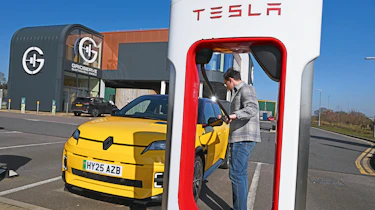
That’s not to say other networks don’t offer strong benefits; Ionity, for one, is currently rolling out a fleet of ultra-fast 400kW chargers. Meanwhile, Gridserve operates four EV charging forecourts (with more to come), all complete with seating and work areas, corner shops and even a Costa Coffee.
Tesla Superchargers also come out on top when it comes to pricing, though; out of all the biggest EV charging networks, its fleet of chargepoints consistently offer the cheapest rates. However, Superchargers aren’t as numerous as some other brands of chargepoint, nor are they open to everyone.
Can I use the Tesla Supercharger network?
The Supercharger network was once for the exclusive use of Tesla drivers; in fact, many of the first Tesla owners were granted the perk of free Supercharging for the life of their vehicle.
Times have changed, however, and since 2022 some Superchargers in the UK support charging for all EVs with a Type 2 connector. More than 50 per cent of Superchargers in the UK are no longer exclusive to Tesla owners, so more EV drivers can capitalise on their lower pricing; checking Tesla's app will enable you to see which ones you can use. Depending on their location, Superchargers cost around 56p per kWh for non-Tesla drivers, or 30p off-peak – generally late evening to early morning. That compares with around 40p and 21p on and off-peak for Tesla drivers.
One thing worth pointing out, though, is that sites owned by third-party companies, often listed as ‘EV On the Move’ on the Tesla app, can be from 15-40 per cent more expensive than their regular counterparts.
It’s not just Tesla that employs variable pricing depending on your location; several chargepoint operators will charge different amounts depending on where you’re stopping to plug-in.
As a result, it can be worth adjusting your route to save cash. For example, if you’re heading south from London and need a top-up, it may be worth exiting the M23 to plug-in at Gatwick, rather than seven miles down the road at Pease Pottage.
Both locations boast Gridserve chargers, but (at the time of writing) the former is priced four pence per kilowatt-hour lower. That means a full charge of our Renault 5 would be just over £2 less – or roughly £82.50 over the course of 10,000 miles. The long-term saving generally stays the same for most EVs, although those with larger batteries and poorer efficiency will benefit most of all.
How do I know what I’m paying?
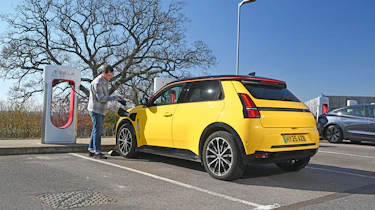
Knowing what you’re going to pay when charging an electric car isn’t always as easy as when filling up a petrol or diesel vehicle with fuel.
Traditional fuel stations have large signs with the prices displayed by the roadside, as well as meters on the pumps to show you how much you’ve spent. However, this isn’t always the case with electric car chargers. Regulations introduced in late 2023 stipulate that new EV chargers must incorporate a screen on which current pricing can be displayed, plus a contactless payment reader. Older units are accompanied by QR codes that can be scanned for up-to-date cost information, although contactless payment pads were mandated from 2024.
Yet this doesn’t solve the problem of not knowing how much charging costs until you get out of the car and check the device itself. Although some chargepoint operators, notably those from EG Group, utilise petrol station-styling pricing totems giving you the cost per kilowatt-hour from the roadside, most haven’t quite caught up yet.
To avoid getting somewhere only to discover that you’ll need to remortgage your house in order to charge up, many car infotainment systems offer live pricing through the built-in sat nav, as do the likes of Google Maps and the ZapMap app.
EV charging provider price bands
| MFG EV Power | 69-79p per kWh |
| Osprey | 87p per kWh |
| BP Pulse | 89p per kWh |
| InstaVolt | 89p per kWh* |
| Tesla Supercharger | 54-71p per kWh* |
| Gridserve | 82-89p per kWh* |
| Shell Recharge | 74-89p per kWh* |
| Ionity | 81p per kWh* |
(* Subject to off-peak/subscription rates)
Off-peak charging benefits
Many EV drivers with a home wallbox use lower off-peak electricity rates to charge their car for much less. Some public infrastructure also offers off-peak pricing, although plugging in at, say, 2am to get a discount might not be practical for many.
Nevertheless, there are savings to be had. Tesla, for example, almost halves the price of charging from 10pm to 8am; at Tesla Centre Dartford, Kent, for example, you could spend just £11 for a 10-80 per cent top-up of an R5 – £9 less than the peak rate.
Similarly, InstaVolt also lowers its pricing between those times to just 60 pence per kilowatt-hour, down from 89 pence. The same charge of the Renault would cost £34.40, whereas at the off-peak rate it’d set you back just £21.84, or more than £10 less. You do have to use the InstaVolt app to benefit from this, though.
Are EV charging subscriptions and apps worth having?

As frustrating as it is to stuff your phone’s home screen full of icons for charging apps, you might be missing out on some significant savings if you don’t at least keep some of them on there.
InstaVolt, for example, only offers its off-peak rates to those using the app or a specific RFID card. BP Pulse also claims that you can save roughly 20 per cent over the cost of contactless charging when using its app, while the price per kilowatt-hour drops from 89 pence to 82 pence when logged into the Osprey app. Unless you’re driving a Tesla, many Superchargers require you to download the Tesla app onto your phone if they don’t have screens or contactless payment pads built-in.
Many of these apps advertise charging subscriptions that offer even more enticing discounts, but these are typically only financially worthwhile if you use public infrastructure a lot. The Gridserve Plus subscription, for example, costs £7.99 per month and provides 25 per cent off the price of charging at the firm’s 200-plus locations nationwide. Based on the rate of 89 pence per kilowatt-hour, you’d need to charge around 36kWh in order to break even, meaning that signing up is very much worth your while – even if you cancel your subscription and then sign up again whenever you need to plug-in once more.
Tesla, on the other hand, charges £9.99 a month for its membership; it's £90 a year if you pay in one lump sum, and included for Tesla owners. Membership knocks around 10-15 pence per kilowatt-hour off the price of Supercharging, or the equivalent of 20-25 per cent. In the best-case scenario, you’d need to charge around 65kWh to break even. Unless you drive an EV with a big battery or use Superchargers frequently, this is probably a subscription you can do without.
Charging provider subscriptions
| Operator | Price | Discount over lowest price | KWh per month to break even |
| BP Pulse | £7.85 per month | 22.4 per cent* | 50kWh |
| Tesla Supercharger | £9.99 per month (or £90 per year) | 20-25 per cent | 65-100kWh |
| Gridserve | £7.99 per month | 25 per cent | 36kWh |
| Shell Recharge | £9.99 per month | 30 per cent* | 40kWh |
| Ionity Motion | £5.49 per month | 25 per cent | 25kWh |
| Ionity Power | £10.50 per month | 40 per cent | 34kWh |
(* App pricing. Details correct as of 11 March 2026)
More ways to get free or discounted public EV charging
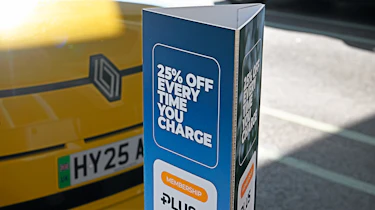
There are several ways beyond downloading an app that you can save money on EV charging. Chargepoint operators (CPOs) often do promotions offering discounted charging, while some car makers offer discounts when you buy a new model; if you’re lucky enough to purchase a new electric BMW, for example, you’ll get one year’s subscription to the brand’s ‘Active’ tariff. This includes 25 per cent discounts with the likes of BP Pulse, as well as an Ionity subscription.
Beware of parking fines when charging
Leaving your car in a car park for a period beyond that outlined by the operator can lead you to receiving a fine, and the same is true of charging stations. Many charging firms enforce what is generally known as an ‘idle’ or ‘congestion’ fee, which penalises you for leaving your car plugged-in once it’s hit the charging level you’re aiming for, or for charging beyond what is deemed reasonable at busy times.
BP Pulse charges a £10 idle fee for every hour you stay at a location over 90 minutes, while at busy times Tesla gives five minutes' grace, then charges 50 pence for every minute you’re left plugged-in at over 80 per cent capacity.
Also, don’t forget to be aware of parking restrictions too. Public car parks now generally require drivers to pay for parking on top of the charging cost, while destination chargers such as hotels may need you to pop into reception to register the car’s number plate if you’re using a point in the car park.
Would a cut in VAT help make EV charging cheaper?
Unlike charging from a home wallbox, which incurs the standard domestic electricity VAT rate of five per cent, public charging currently demands the same 20 per cent as applied to the majority of consumer goods. This being the case, industry commentators have long called for a cut in the price of VAT on public charging in order to help bridge the wide price disparity between public and domestic infrastructure – but will it really help all that much?
For a full charge of the Renault we’ve been using as an example, at the average rapid charging price of 76 pence per kilowatt-hour, a cut in VAT from 20 to five per cent would save just shy of £6 per charge. This, as you might have already realised, means it’s still significantly more expensive than charging domestically, with operators having to incorporate profit margins, as well as installation and maintenance costs, into their pricing structure.
Nevertheless, such a change would indeed bring prices down significantly: using our initial usage pattern of 84 per cent home charging and 16 per cent public charging, the average electric car user could save around £45 per year when covering a total distance of 12,000 miles, or even more if relying heavily on public infrastructure.
Buy a car with Auto Express. Our nationwide dealer network has some fantastic cars on offer right now with new, used and leasing deals to choose from...