Mercedes CLA review
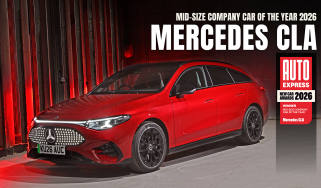
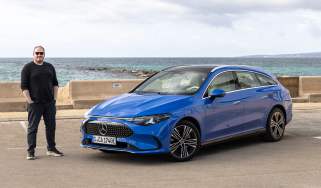
The electric Mercedes CLA represents a huge step forward for the brand’s EVs, and the hybrid version is very competitive too

Our opinion on the Mercedes CLA
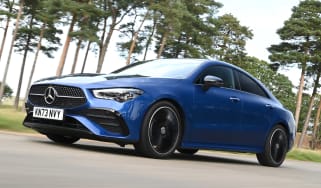
The Mercedes CLA emphatically put the brand back on the right track after some underwhelming model launches. Whether you go for the EV or the hybrid, its chassis feels superbly engineered in a way that previous EQ electric models didn’t, and efficiency is class-leading. There’s a sophisticated interior, an abundance of tech and exceptional cruising ability, too.
Although it’s expensive and we’re still waiting for true performance thrills to come from the AMG variant, the CLA is easily one of Mercedes’ most convincing new offerings in recent years.
About the Mercedes CLA
The CLA is a vital car for Mercedes, the first of four fresh models on the MMA architecture. It’s also the first to feature a next-generation electronic brain that’ll underpin all forthcoming models, a ‘software defined vehicle’ no less.
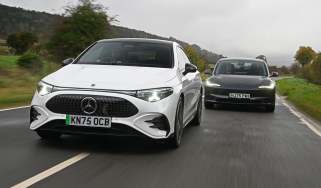
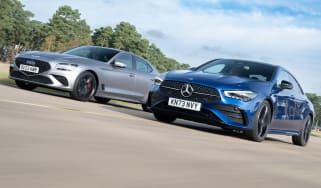
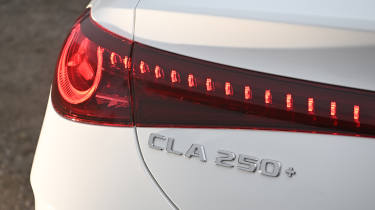
The CLA electric offers close to 500 miles from a single charge, with ultra-fast charging capability. The larger battery CLA 250+ version beat electric car rivals including the Tesla Model Y and Audi A6 Avant e-tron on our 2026 winter EV range test. It also conquered the Tesla Model 3 in a compact executive saloon head-to-head. The hybrid-powered model, meanwhile, returned tremendous efficiency on our test route.
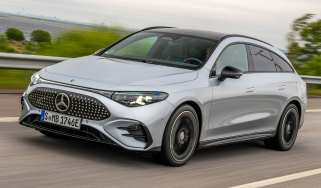
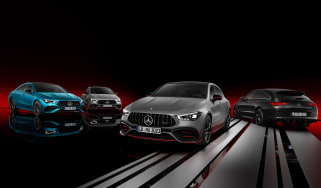
There’s a Shooting Brake estate version to complement the compact saloon and familiar Mercedes trim levels including Sport and AMG Line.
Mercedes CLA prices and latest deals
The electric Mercedes CLA saloon starts at under £40,000 in 200 guise with the smaller battery. The big battery 250+ models open at £43,000. The hybrid powertrain comes in under £39,000 in entry-level CLA 180 form and the CLA Shooting Brake estate is around £1,000 more than the saloon.
Used - available now


You can configure your perfect Mercedes CLA through our Buy A Car service now. Alternatively, check out the best deals out there on a new Mercedes CLA from stock or top prices on used Mercedes CLA models...
Performance & driving experience
Pros |
|
Cons |
|
It’s fair to say that Mercedes had some work to do on the driving experience of its cars. Many of its early electric models were off the pace. We’re happy to report that in just about every quantifiable measure the electric CLA is a significant improvement over Mercedes’ older EVs and the CLA hybrid isn't bad either. The company has taken the decision – rightly, we feel – to focus not on the sharpest dynamics or Tesla-like immediacy, but on a more measured and consistent feel right across the board.
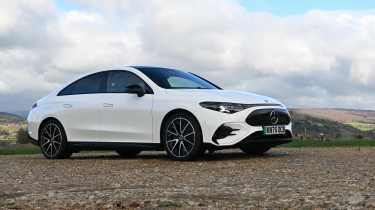
The CLA lives up to the promise of the three-pointed star on the nose, with a level of refinement and comfort you’d expect. Compared with the previous Mercedes CLA and A-Class, it’s in a different league, and comfortably ahead of a Tesla Model 3 or Polestar 2.
| Model | Power | 0-62mph | Top speed |
| Mercedes CLA Hybrid 180 Sport | 164bhp | 8.8 seconds | 135mph |
| Mercedes CLA 350+ Shooting Brake | 349bhp | 5 seconds | 130mph |
| Mercedes CLA Hybrid 200 Sport | 193bhp | 8 seconds | 144mph |
Performance, 0-60mph acceleration and top speed
Mercedes’ new MMA platform, which is used in the CLA, caters for both pure-electric and hybrid powertrains.
The electric CLA arrived first and the 250+ has a single motor driving the rear axle with 268bhp and 335Nm of torque – figures that put it a little behind the entry-level BMW i4 eDrive35.
On the road, we found that performance is more than enough to keep up with fast-moving traffic. It’s comparable to single-motor versions of the Tesla Model 3 and Polestar 2, never alarmingly fast but powerful and athletic in feel given that it pairs the lowest-powered e-motor with the biggest and therefore heaviest (85.5kWh) battery. Speaking of which, Mercedes quotes a total weight figure of 2,055kg, which is impressive considering the size of that battery pack.
Then there’s the dual-motor CLA 350. There’s an extra motor up front, which reduces storage space under the bonnet but ups the power output to 349bhp, cutting the 0-62mph time from 6.7 seconds to just 4.9 seconds. The extra performance is certainly felt, and thanks to the instant punch of the e-motors, it probably wouldn’t have too much trouble keeping up with previous-generation Mercedes-AMG models.
The hybrid versions of the CLA feature a brand-new 1.5-litre four-cylinder petrol engine that was designed to be as compact as possible. The hybrid powertrain is available in three states of tune – 134bhp, 161bhp or 187bhp – but in every case it’s paired with a 30bhp electric motor that’s integrated directly into the eight-speed dual-clutch transmission and powered by a 1.3kWh battery under the front seats.
Town driving, visibility and parking
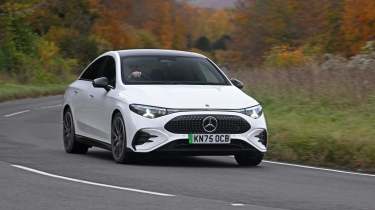
In town, the CLA electric glides over smaller imperfections in the road as if they weren’t there, making it much more comfortable than not only a Tesla Model 3, but also other more fidgety alternatives such as the Polestar 2 and Hyundai Ioniq 6. Only short, sharp jolts over drain covers cause any sort of kerfuffle, but even then the knocks and noises from the suspension are well isolated from the cabin.
A tight turning circle of 11.2 metres and light steering help the CLA to wiggle around tight spots, and while the latest CLA is a modest 35mm longer than its predecessor, it still feels fairly compact on the road.
Country road driving and handling
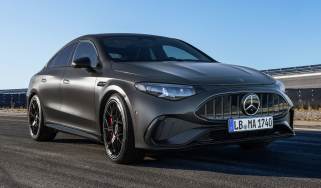
The CLA is not particularly fun or engaging to drive, but that’s not really the point with a hyper-efficient EV or hybrid – a more aggressive and powerful AMG version will answer that call when it arrives later on.
The rear-driven chassis of the electric CLA strikes a sweet balance through a series of turns, with enough power to push the car from the back axle without being dramatic or too lively to handle. Grip is strong, and the steering is very well suited to the response of that chassis.
The CLA doesn’t dart towards an apex like a Tesla Model 3, but it feels far more natural and reassuring. It’s easy to build up a smooth flow along a more challenging road. The quality of the suspension helps here; it absorbs bumps very well and doesn’t get fazed by mid-corner undulations.
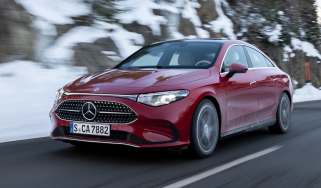
When we tested the hybrid CLA in all-wheel drive 4Matic form, the handling was similarly neutral and tidy; there’s a slight amount of body lean when cornering, while the steering has the perfect balance of weight and speed of response. The all-wheel drive system provided excellent traction out of corners on the wet, snowy roads in Austria where we took our first drive.
The CLA electric’s clever braking setup seamlessly blends the friction and regenerative braking systems into one, you don’t really notice the regenerative system working at all. We’d still like to see some paddles behind the steering wheel to adjust the level of regen on the fly, however.
The only bug with the CLA hybrid’s brakes was when coming to a complete stop. The pedal seems to lose bite, letting the car run away from you slightly just as you want it to halt. It’s something owners will adapt to, but it is a little annoying.
Motorway driving and long-distance comfort
The CLA’s ride is superbly judged and you feel this most on the motorway: it’s controlled and composed while still offering a plush and cosseting quality. The 18-inch wheels fitted to most models in the UK are perfectly sized to steamroll over a majority of road imperfections, backed up by springs and dampers that perfectly complement the overall driving experience.
General refinement is excellent. The EV’s powertrain is completely silent (aside from a little bit of computerised warble in certain modes) while the hybrids are also very hushed, running on the electric motor when less than 30bhp is needed. If you work it hard, the four-cylinder petrol engine can emit a gruff tone, but it doesn't have the same droning or coarse quality as other small-capacity engines.
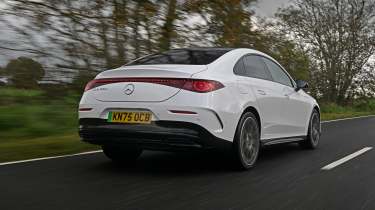
The car’s impressive aero efficiency also keeps wind noise to a minimum and was partly achieved by very small wing mirrors. Visibility down the car’s sides is still good despite this, although the rearward view is little restricted by the shallow rear windscreen.
“The CLA hybrid’s gearbox is a little stubborn. The shifts are certainly smooth, but they’re also slow and the eight-speed auto has a tendency to hold onto gears for longer than we’d have liked, so you have to listen to the engine revving high.” - Ellis Hyde, news reporter.
Range, charging & running costs
Pros |
|
Cons |
|
The headline figures for the CLA’s efficiency certainly come from the EV, but the hybrid is impressive too.
In the all-wheel-drive 220 4Matic hybrid, we managed to average more than 70mpg on a route including city streets, twisty country roads and motorways; this is much higher than the 52.4mpg suggested by Mercedes. The CLA hybrid’s ability to recuperate up to 25kW of energy when slowing down, in any gear, to recharge the battery will have helped.
Front-wheel-drive CLA hybrids are more fuel-efficient still and choosing the Shooting Brake estate bodystyle only loses you about 1mpg model for model.
| Model | MPG | CO2 | Insurance group |
| Mercedes CLA 180 Sport | 56.5mpg | 114g/km | N/A |
| Mercedes CLA 220 4Matic | 50.5mpg | 127g/km | N/A |
| Mercedes CLA 200 Sport | 56.5mpg | 114g/km | N/A |
Electric range, battery life and charge time
In our conversations with the CLA’s chief engineers it was clear that their central ambition in creating the car was to eke out as much range as possible. On that metric, the CLA is a huge success. Mercedes quotes a peak range figure of 483 miles on a CLA 250+ electric fitted with the aero-focused 18-inch wheels - helping achieve a low drag coefficient of 0.21. Range drops a little on the AMG Line models, but never below 461 miles, even with the larger 19-inch wheels.
The actual efficiency and range figures you’ll see in the real world are a different matter, but we’re happy to report that while the CLA will get closer than you might expect to the official test results. When we tested the car across a range of motorways, A-roads and city driving, we managed an impressive 4.8m/kWh, which would translate to a range of 408 miles. At around 80 per cent of the WLTP figure, this is a very strong result.
In a twin test of the CLA against the Model 3, we saw this drop to 351 miles and in our long-range EV test under tougher conditions, the Mercedes dropped to 303 real-world miles. However, this was still better than its four competitors.
To put the Mercedes’ amazing claimed figures into context, a Tesla Model 3 Long Range will top out at 436 miles on the WLTP cycle, with Polestar’s long-range 2 only just breaking the 400-mile mark at 408 miles. Don’t expect either to crack 400 miles in everyday use, though. The only rival in the CLA’s pricing orbit that currently gets close is the DS No8, which has a 483-mile range on paper, thanks to a bigger 100kWh battery.
The CLA’s MMA platform doesn’t sacrifice ease of use to reach those range numbers, because the 800V architecture allows 320kW charging. That will see the car add around 200 miles in just 10 minutes. Mercedes actually launched the CLA without the ability to charge at 400V DC fast-charging stations, which make up the vast majority of public chargers in the UK but there’s now a no-cost option allowing this on all new cars.
During our 2025 EV range test, the Mercedes CLA charged faster than any rival, reaching a speed of 326kW - almost twice as fast as the competition from MG, Audi and Tesla.
| Model | Battery size | Range | Insurance group |
| Mercedes CLA with EQ Technology+ | 85kWh | 461-483 miles | N/A |
Tax
The electric CLA currently makes a huge amount of sense for company-car drivers. Sitting in the three per cent Benefit-in-Kind (BiK) bracket means that it’ll cost a few hundred pounds in annual deductions – thousands less than a similarly priced petrol or diesel car.
The CLA hybrid is in the 28 per cent Benefit-in-Kind (BiK) bracket. For the first year’s road tax, all CLA hybrids will cost the same - £455 with £200 in the years following. The EVs pay £10 in year one then the same £200.
Depreciation
It’s still early days for the CLA Electric, but current estimates suggest that the 250+ will hold onto between 49 and 56 per cent of its original value after three years or 36,000 miles, with the dual-motor models faring the worst. Overall, it’s pretty much identical to single-motor versions of the Tesla Model 3, though.
The hybrids vary between 48 and 50 per cent retained value with the base C180 models doing best. Shooting Brake estates out-perform the saloons by a percentage point or two.
Interior, design & technology
Pros |
|
Cons |
|
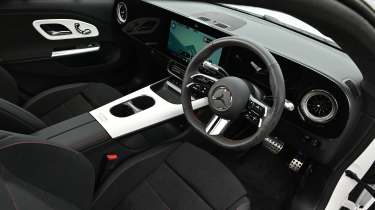
The CLA debuted a new digital interface and operating system that is spreading across the Mercedes range. The main dashboard is one piece of gloss-black plastic integrating a 14-inch touchscreen and 10.25-inch driver’s display. Some models have a second 14-inch touchscreen on the passenger side, but most will do with just the one and the passenger side featuring a black panel with glowing stars.
Interior and dashboard design
The CLA’s screens are so vast that there hasn’t been much space left for anything else, leading to a vibe that’s more Curry’s PC World than boutique hotel. Below the black panel sits a centre console with two cup-holders, behind which is a small cubby. There are some design flourishes, such as the intricate door cards and glass roof, but digital real-estate aside, there’s not much else going on.
In some ways, the CLA’s ergonomics are an improvement over Mercedes cars that came immediately before. The door-mounted electric seat controls, which were irritating touch-sensitive buttons on other models, have returned to being physical switches. This small change alone feels like progress.
On the same panel, however, Mercedes has introduced the kind of annoying dual-function electric window switches that we’ve complained about in various electric Volkswagens over the past few years. It surely could not have been hard to incorporate individual rear window controls rather than a pair of switchable buttons that control both front and rear.
Materials and build quality
Lots of parts that are frequently touched inside the CLA – the window switches, the steering wheel, the air vents – all feel suitably expensive. However, areas lower down, including the glovebox and its handle, feel like they’re made from a rather cheap, hard plastic. The huge slab of piano-black trim is something that looks flashy in a brand-new car, but we’re not convinced it’ll look so smart after a few years’ use.

Infotainment, sat-nav and stereo
On the face of it, the CLA’s infotainment system looks and reacts much like the units found on pretty much all other Mercs, but a new electronic architecture underpins all of its operations. This is one of Europe’s first so-called ‘software-defined vehicles’, with all the tech working off the one base system with a deep-rooted but flexible connection to ‘the cloud’. This brings benefits such as over-the-air updates, enhanced online services and an AI-assisted voice command system.
It works very well, with super-fast responses and enough digital real estate to house all the main controls without any issues. The homescreen always displays a navigation map that can be mirrored onto the driver’s display, with little tiles giving quick access to your phone, media and more. It’s not unlike the dock bar on an iMac. The real boon here, though, is that the responses and clarity of menus are just as good as on modern smartphone or tablet.
The air-con and ventilation controls are digital, but can be accessed on the main screen. The tiles are a touch small, and there’s nowhere to rest your hand to help guide your finger while driving, but it’s a reasonably elegant system that’s intuitive and easy to use in a way other recent Mercedes systems are not.
There are then more controls, such as a volume slider and drive modes, on a black panel at the base of the screen alongside a phone charging pad. We found that these are a little difficult to reach, but certainly aren’t the worst of their type out there. Would we prefer physical controls? Yes. But with so much screen space in this car, it’s not the buzzkill that it has been in the past.
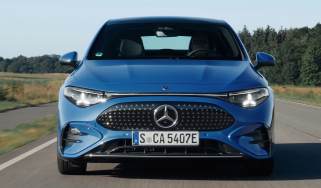
"Mercedes has gone overboard with the three-pointed stars - which you’ll find slathered over the grille, within the headlights and on the passenger-side dash. It’s a bit garish." - Alastair Crooks, senior news reporter.
Boot space & practicality
Pros |
|
Cons |
|
It’s important to remember the Mercedes CLA is more compact than a Tesla Model 3-sized saloon, evidenced by the relatively cramped cabin and limited boot space. That’s not to say the car is tiny – in actual fact the longer wheelbase, glass roof and flat floor make the second row a much nicer place to spend time than in the previous model – but it’s not generous and won’t, for example, be particularly suitable as a fleet vehicle that needs to take passengers in the rear seat.
Dimensions and size
As with the previous model, this latest CLA is more of an Audi A3 saloon rival than a competitor for cars such as the Tesla Model 3 and Polestar 2, despite costing the same or more than that pair. The CLA is relatively tall and narrow for a car of this capability, which is good news for drivability in towns and cities, but leads to an awkward exterior design.
Dimensions comparison | |||
| Model | Mercedes CLA | Tesla Model 3 | BMW i4 |
| Length | 4,723 mm | 4,720 mm | 4,783 mm |
| Width | 1,855 mm | 1,850 mm | 1,852 mm |
| Height | 1,468 mm | 1,440 mm | 1,448 mm |
| Wheelbase | 2,790 mm | 2,875 mm | 2,860 mm |
| Boot space | 405 - 1,290 litres | 425 litres | 470 litres |
Seats & passenger space
While the dash appears a little monolithic, it’s not as absurdly high as the dashboards in previous Mercedes EVs such as the EQE and EQS. As a result, the view out of the front is reasonable, and there’s plenty of room for adjustment in the driver’s seat and the steering wheel. The rear window is reasonably sized, but its lower edge is quite high, so rear visibility isn’t great.
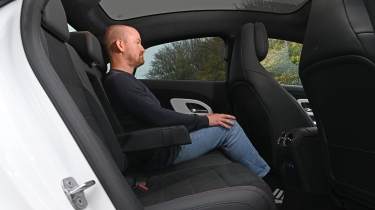
Hop into the back and the good news for previous generation Mercedes CLA owners is that there’s a little more space in almost every direction. However, those coming from other similarly priced EVs – in particular, the Volkswagen ID.7 – will find accommodation a little at a premium.
Knee room is fine if not outstanding – roughly the same as in a Volkswagen Golf – and headroom is a little tight due to the structure that surrounds the huge panoramic glass sunroof. The floor is flat but just a touch high, which means that longer-legged occupants will find under-thigh support a little short.
Fitting child seats is fairly straightforward in all models, thanks to Isofix mounting points that are easy to reach behind folding covers.
Boot space
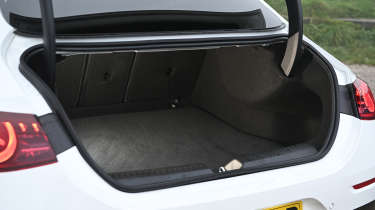
The 405-litre boot is a fine size for a car in this class, and the Merc’s saloon opening is a little larger than that of the Tesla Model 3. There’s a modest amount of underfloor space to house charging cables, while single-motor electric models get a generous 101-litre frunk, which is an ideal place to hold the charging cables. The rear seats drop down too, allowing for a long – if slim – storage area.
The Shooting Brake’s sloping roofline means luggage space only rises to 455 litres or 1,290 litres with the second row folded flat. This is a 30-litre reduction over the previous-generation CLA Shooting Brake, or 60 litres with the seats down. That said, it can be supplemented on electric models with that extra storage space under the bonnet.
Towing
All CLAs offer an 1,800kg towing capacity, apart from the all-wheel-drive hybrid, which can haul up to 2,000kg.
“If you carry taller back-seat passengers, bear in mind that the Shooting Brake has a little more headroom in the rear than the saloon.” - Phil McNamara, editor-at-large.
Reliability & safety
Pros |
|
Cons |
|
A superb second-place finish out of 31 manufacturers in our 2025 Driver Power satisfaction survey – kept off the top spot by only Subaru – shows that Mercedes owners are delighted with their cars and how easy they are to live with.
The CLA is a brand-new generation of car, so there’s no real data about its reliability just yet, but an added bonus of the simplified electronic architecture is that it should help keep the bugs at bay.
All Mercedes models come with a three-year warranty – not a great length by today’s standards – but it is backed up by an unlimited-mileage offer. There’s also the unmatched breakdown cover, which runs to a whopping 30 years. The CLA EV’s battery is covered by a separate eight-year or 100,000-mile warranty that guarantees a minimum battery capacity of 70 per cent of its original.
Mercedes offers a service plan for the CLA, but compared with most other EVs, service costs are quite high. A three-year plan will set you back £1,152.
| Euro NCAP safety ratings | |
| Euro NCAP safety rating | Five stars (out of five) |
| Adult occupant protection | 94% |
| Child occupant protection | 89% |
| Vulnerable road user protection | 93% |
| Safety assist | 85% |
Buying and owning
Best buy: Mercedes CLA Sport Edition
There’s no reason to spend more on the more unattractive, less efficient and very un-sporty AMG Line trim. The key elements of the CLA are all there in the Sport Edition: a panoramic roof, the same charging speeds and the 14-inch infotainment system. The real question is whether to go for the pure-EV or hybrid model, with the electric car’s maximum range making this a harder decision than in many other rival models that offer both powertrains.
Mercedes CLA alternatives
This is where things get tricky, because the CLA is an exceptional car in isolation. However, its inflated price and superb range mean it’s outgrown its former small saloon class and now butts into the compact executive car sector above, without having the dimensions to support it.
A Tesla Model 3 Long Range is around 50 miles down in range, on paper, has a more basic-looking and feeling cabin and doesn’t feel half as well tuned for European roads, but it’s cheaper, has more space inside and comes with the added bonus of the firm’s Supercharger network. In engineering terms, we’d suggest the Mercedes is the superior car, but Tesla’s overall package is still a tough one to bet against. The Polestar 2 offers less of everything important, apart from space and practicality, for much the same price.
Deals on the Mercedes CLA and alternatives
Frequently Asked Questions
Yes
More reviews
Car group tests
In-depth reviews
Road tests
Which Is Best