“National embarrassment” as government does not know how pothole money is spent
A scathing report by the Commons’ Public Accounts Committee accuses the Government of “not taking its responsibilities seriously”

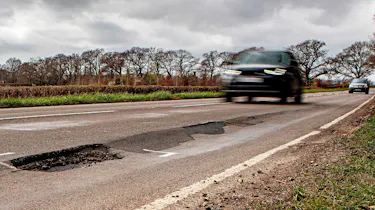
The UK’s local road network has been blasted as a “national embarrassment” as a new report finds that the Government does not know, nor has control over where and how improvement funds are spent.
Concluding its investigation into the condition and maintenance of local roads, the House of Commons’ Public Accounts Committee – the cross-party group responsible for overseeing government expenditure – wrote in its report that the Department for Transport “[isn’t] taking its responsibilities and use of public money on local roads sufficiently seriously.”
According to the PAC, the DfT perceives the UK’s roads to be in a “stable” condition, despite repair estimates by industry experts having doubled to over £16 billion in the last five years. Such a lofty sum may not seem surprising when you learn that, according to the PAC’s finds, “the DfT neither knows exactly how local authorities spend its funding as it is not ring-fenced, nor what it wants to achieve with it.”
Adding insult to injury, the committee criticised the DfT for not taking into account factors such as traffic volume and flood susceptibility whenever delegating when and where to direct funding, stating that despite the government pledging over £1 billion annually for repairs, “[it] has not evaluated the totality of funding it has made available and what it has achieved from this.” The PAC also highlighted the DfT’s short-sighted “focus on reactive repair work, rather than preventing problems occurring in the first place.”
Chairman of the PAC and Conservative MP, Sir Geoffrey Clifton-Brown, described the situation as “a national embarrassment” – despite his own party having overseen maintenance of the UK’s roads for almost the past two decades.
Clifton-Brown continued, saying: “Alarmingly, however, not only is the state of our local roads on the downslope, our inquiry shows government[s] are having to find out about these issues from industry bodies and road users themselves due to their own patchy data.”
“This Committee has long raised concerns around a failure across government departments to effectively fund and plan for the future, a theme that is certainly on show here, along with an overly tangled web of accountability.”
In its recommendations, the committee suggested the Government “should simplify its funding to local authorities and provide more long-term certainty around the amount and duration of funding.” Such a suggestion aligns with Asphalt Industry Alliance chairman, David Giles’, request for a “multi-year, ring-fenced investment commitment” which he recently told Auto Express would “ensure that highway engineers are able to take a holistic approach to maintaining the network, allowing them to use the right intervention at the right time.”
The PAC also recommended the Government allocate spending that “reflects the expected wear and tear of local roads due to the level of usage and local environmental conditions,” as well as to potentially “explore the scope for local authorities to use surplus Community Infrastructure Levy funding on local road maintenance.”
Finally, the PAC requested that the Government update its guidance on how local authorities are expected to monitor, repair and maintain local roads – something that has not been done since 2011. This is to not only mitigate safety concerns, but also prepare for what the PAC describes as “future challenges”, such as the likelihood for heavier electric heavy goods vehicles (HGVs) and even autonomous vehicles.
The AA’s president, Edmund King, reacted by saying the report “reinforces many things The AA has been calling for.” However, he criticised it for “overlook[ing] the important role of private contractors who sit in a position of almost total control over nearly 60% of the local roads. Road users pay billions in motoring taxes and deserve far better road infrastructure.”
Auto Express has approached the Department for Transport for comment, but we are yet to receive a response.
What's the best type of car to cope with the UK's pothole-covered roads? Check out our list of Best off-road cars and 4x4s...