AI has begun its car industry revolution with humanoid robots taking human jobs
Mike Rutherford thinks humanoid robots are set to play a key part in the car industry AI revolution

The music was great, but Britain in the 1970s was generally iffy. Strikes and power cuts were common. Personal, portable state-of-the-art treats included naff digital watches and giant Casio calculators. Only reasonably well-off folk could afford to own or rent colour TVs and VHS recorders for their maisonette homes. AM Binatone radios, cassette tape players or eight-track sound systems were for the car.
But by the end of the decade, Fiat bravely stepped up and revolutionised the car and television worlds with its bold, ahead-of-the-game attitude and accompanying two-minute TV commercial telling unsuspecting punters its cutting-edge cars (mainly Strada hatchbacks) were being “Handbuilt by Robots.”
Ten years after that, Toyota shipped me out to Japan for a ride in one of its robotic/self-driving cars. Then, another decade later, it was Honda’s turn to demonstrate its robo car prowess. After being shaken and stirred by the scarily high-speed driverless experience, tea was suggested and a cuppa was duly handed to me by a robotic four-foot Honda ‘employee’ wearing unfathomably squeaky trainers and introducing him/her/itself as Asimo.
All this proves that robotics and/or unpaid humanoid robots are nothing new. They’ve been in the automotive industry for decades. Unpaid and with no need for working hours restrictions, sick pay, annual leave and other work-related benefits, Asimo’s fast-breeding clan are doing many of the jobs that paid human workers used to do.
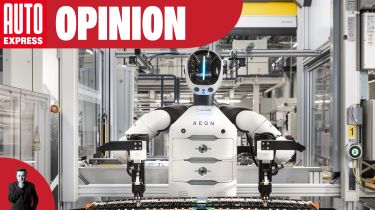
With AI now greatly aiding firms exploring more work for humanoid robots, less for humans, Hyundai is already travelling down that road in South Korea and the US. In recent days it has talked of such versatile humanoids being blessed with “56 degrees of freedom, most with fully rotational joints and human-scale hands with tactile sensing”.
Closer to home, BMW Group’s Leipzig factory in Germany is to “deploy” its own humanoid robots that have been successfully put to highly productive unpaid graft at the group’s Spartanburg, USA facility. The aim is to integrate them further into car production, where they’ll do everything from positioning components with millimetre precision to handling the removal and positioning of sheet metal parts for the welding process – a “particularly demanding and exhausting task”, according to the German firm.
There’s no getting away from it: humanoids purchased outright are, over the years, far more cost-effective to ‘employ’ than humans. AI-supported humanoid robots and driverless vehicles will inevitably lead to huge job losses for car or component factory workers and full or part-time drivers. What are they all supposed to do – apply for university places, take out heinously high-interest student loans and hope they might one day qualify, before landing jobs as artificial intelligence engineers?
Get the latest and best car news and reviews, first! Follow Auto Express on Google today