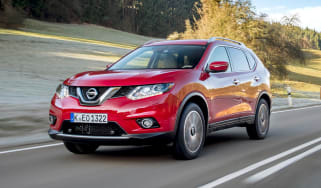
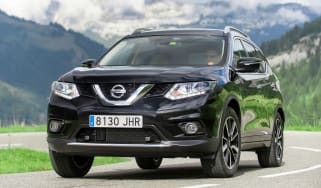
Nissan X-Trail review
The Nissan X-Trail is bigger and better than before, but its innovative electrified powertrain isn’t as efficient as some rivals
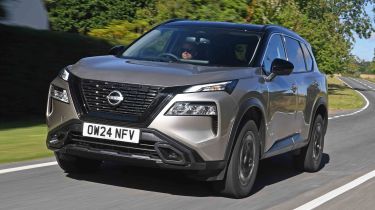

Our opinion on the Nissan X-Trail
Family car buyers will be pleased to know there have been some big improvements to the Nissan X-Trail SUV, delivering more passenger space, better cabin quality and a more extensive list of standard safety features. It’s still as practical as ever, comfortable, and just as easy to use for long trips as it is for everyday commutes.
It is a bigger car than before, which may deter some, and higher prices at the top end of the range spoil the X-Trail’s ability to challenge its close rivals. However, the real sticking point for both private buyers and business users is that the efficiency of Nissan’s e-Power setup is not as good as it should be. When you examine the numbers, it doesn’t stack up well enough against more conventional competition.
About the Nissan X-Trail
It’s taken four generations and over twenty years for the Nissan X-Trail to evolve from a rather boxy, workaday SUV into a more polished offering that competes in a very crowded large family SUV market.
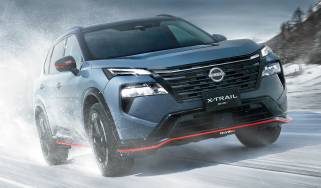
With electrification increasingly becoming the norm, Nissan has chosen not to go with a typical full-hybrid or even a plug-in hybrid set-up for the X-Trail, instead opting for a type of range-extending hybrid that it calls e-Power.
Used - available now

2024 Nissan
X-Trail
23,102 milesAutomaticPetrol1.5L
Cash £21,801
2024 Nissan
X-Trail
20,001 milesAutomaticPetrol1.5L
Cash £22,514
2017 Nissan
X-Trail
48,390 milesManualDiesel1.6L
Cash £11,125
2024 Nissan
X-Trail
38,246 milesAutomaticPetrol1.5L
Cash £22,070The Nissan X-Trail is due to receive a facelift in 2026, which includes revamped styling and updates to the brand’s e-Power hybrid tech. For now, though, buyers have the choice between mild-hybrid or full-hybrid power.
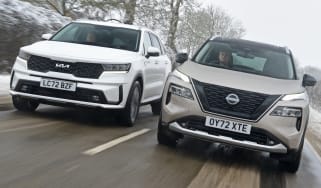
It’s only natural that big families want the best large SUV for their loved ones, so we put the X-Trail through its paces alongside a Kia Sorento in a twin test. Due to its far stronger value for money, the Nissan beat back its Korean competitor, and we found its hybrid powertrain to be smoother in operation.
Nissan X-Trail prices and latest deals
The Nissan X-Trail starts from around £36,500 for a five-seater in entry-level Acenta Premium trim. Next in line is the N-Connecta, which costs at least £39,000, while at the top of the line-up sits the Tekna from £42,300, and the Tekna+ from £44,500. You’ll need to add £1,000 to the price if you want seven seats.
If you're interested in buying a Nissan X-Trail of your own, we're here to help. Configure your ideal Nissan X-Trail now to get great deals from our network of dealerships, check out the best X-Trail leasing deals or take a look at our top used X-Trail models through our Buy a Car service. You can get a great price for your current car with Auto Express Sell my Car.
Performance & driving experience
Pros |
|
Cons |
|
All fourth-generation Nissan X-Trail models use a 1.5-litre, three-cylinder engine, with mild-hybrid versions available alongside the more powerful e-Power models. The latter system utilises the car’s engine as a generator to charge an onboard lithium-ion battery, which in turn powers the electric motor that's used to drive the wheels.
It’s an unusual set-up, but we found it to be a smooth operator with no jerky transition between electric and combustion-engined power sources, as you might find with some rival full-hybrid or plug-in hybrid powertrains.
The e-4ORCE all-wheel drive model has a dual electric motor setup that is able to respond 10,000 times faster than a mechanical four-wheel drive system – according to Nissan. This should be useful to those who need the traction benefits of four-wheel drive to get about in the winter, or have to tow a trailer or caravan out of a field.
| Model | Power | 0-62mph | Top speed |
| X-Trail 1.5 E-Power N-Connecta | 201bhp | 8 seconds | 105mph |
| X-Trail 1.5 E-Power e-4ORCE N-Connecta | 210bhp | 7 seconds | 111mph |
| X-Trail 1.5 E-Power e-4ORCE N-Connecta 7 Seat | 210bhp | 7.2 seconds | 111mph |
Performance, 0-60mph acceleration and top speed
The Nissan X-Trail is not a car bought for its handling prowess on twisty B-roads or its straight-line performance. Nevertheless, the Japanese SUV is capable of a decent turn of speed, with the quickest 210bhp e-4ORCE, all-wheel drive (five-seat) model able to cover 0-62mph in 7.0 seconds flat. Opting for seven seats means you’ll need a further two-tenths of a second to reach the sprint benchmark.
If you’re not fussed about having 4WD capability or seven seats, then the X-Trail 201bhp e-Power version is the one to go for. The mid-range car manages 0-62mph in 8.0 seconds, while the 161bhp mild-hybrid variant is the slowest option, taking 9.6 seconds to reach 62mph.
Town driving, visibility and parking
The X-Trail is perfectly comfortable out on the road, with the suspension only really troubled by the worst of the UK’s pockmarked routes. When the engine is idling to charge the battery, we did find it can sound droney, but the rest of the time, it isn’t that intrusive. The same goes for the high-pitched whine produced by the X-Trail's electric motors, which we found to be far more audible at low speeds than in the Kia Sorento we recently pitted against the Nissan, but quietens down at higher speeds.
Buyers will find the ‘e-Pedal Step’ mode particularly useful in urban traffic, because it allows for one-pedal driving, enabling you to control the vehicle for the majority of the time from just the accelerator pedal. It’s also helpful to improve efficiency at low speeds and maximise regeneration of the hybrid battery.
Country road driving and handling
If you’re happy not hustling along in too much of a hurry, then you'll find the X-Trail a good companion. We found the steering to be devoid of any feedback, and there was quite a bit of body roll through twisty roads, but for most people’s needs, it fulfils its brief competently.
Motorway driving and long-distance comfort
This large SUV is a decent cruiser at motorway speeds, with little wind or engine noise entering the cabin and spoiling the sense of refinement. However, the e-Power’s electric motors do create quite a persistent noise.
“The X-Trail’s basic controls are well calibrated. The brakes are easy to modulate, and it can turn tighter than the Kia Sportage, so it feels surprisingly wieldy for a seven-seater.” - Alex Ingram, former chief reviewer.
MPG & running costs
Pros |
|
Cons |
|
The 201bhp e-Power, front-wheel drive model offers the best fuel economy in the X-Trail range; up to 49.6mpg on the WLTP combined cycle, with CO2 emissions from 129g/km. Upgrade to the e-4ORCE four-wheel drive model and Nissan claims you should see fuel economy of around 45mpg with CO2 levels from 141g/km.
When we tested the 4WD version of the X-Trail against a Kia Sorento Hybrid, the Nissan managed to return 42.5mpg compared to the Kia's average of 39.5mpg. The X-Trail’s eagerness to work in EV mode meant that it was the more efficient around town of the two, and overall, it’s impressively frugal at low speeds.
If you spend less time driving in town, fuel economy from this set-up drops, as we only managed to achieve an average of around 36mpg when we first drove the X-Trail in the UK. Buyers who regularly undertake longer journeys may wish to look towards the Skoda Kodiaq, because it is still being offered with diesel power, which provides greater fuel economy on long motorway trips.
The entry-level 161bhp mild-hybrid version is cheaper to buy, but the five-seater only manages to average 40.9mpg, while specifying an extra two seats causes the fuel economy figure to fall to 39.8mpg. CO2 emissions start from 157g/km.
| Model | MPG | CO2 | Insurance group |
| X-Trail 1.5 E-Power N-Connecta | 49.6mpg | 128g/km | 25 |
| X-Trail 1.5 E-Power e-4ORCE N-Connecta | 45.6mpg | 140g/km | 29 |
| X-Trail 1.5 E-Power e-4ORCE N-Connecta 7 Seat | 44.8mpg | 142g/km | 30 |
Insurance groups
Insurance groups range between groups 25 and 30 (out of 50) for the Nissan X-Trail, which is in keeping with at least some rivals. The Kia Sorento resides in groups 25 to 34, but the Skoda Kodiaq will be a bit cheaper to cover in groups 18 to 26.
Tax
Nissan’s e-Power technology doesn’t deliver the same overall efficiency as a plug-in hybrid set-up, which means you probably won’t see many business users opting for an X-Trail as their next company car. The e-Power version offers better Benefit-in-Kind (BiK) company car tax rates than the mild-hybrid petrol, but they won’t be anywhere near as low as those of an electric SUV, such as the Kia EV9.
Private buyers will also need to be choosy about which version of X-Trail they go for, because some higher trim versions breach the £40,000 barrier, meaning you’ll need to pay the supplemental luxury car tax on top of the standard rate of VED road tax from the second time the vehicle is taxed until it is six years old.
Depreciation
The X-Trail is a pretty average performer when it comes to holding its initial value. Our market data shows that it’ll retain between 43 and 47 per cent after three years or 36,000 miles, while the Kia Sorento manages a more admirable 52 to 56 per cent. The Skoda Kodiaq is also a bit stronger than the Nissan, at 51 to 56 per cent.
To get an accurate valuation on a specific model check out our free car valuation tool...
Interior, design & technology
Pros |
|
Cons |
|
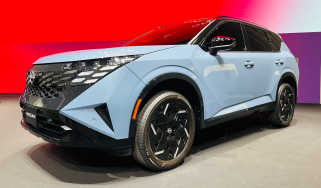
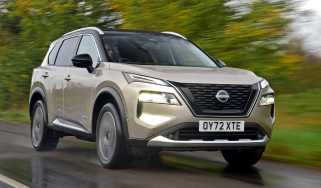
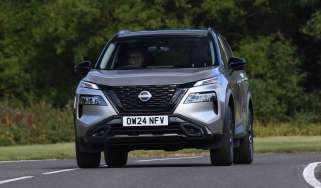
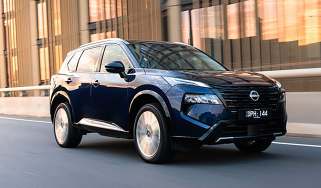
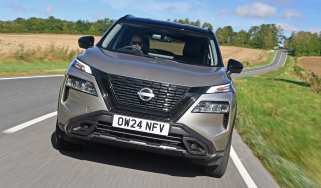
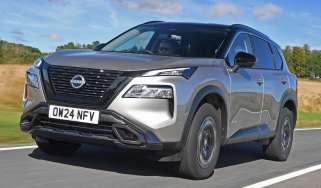
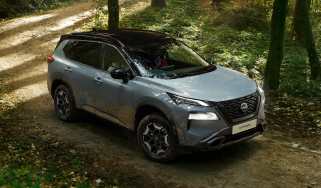
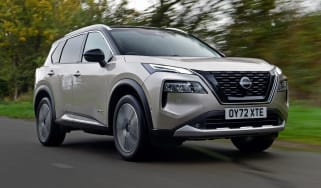
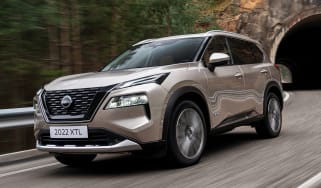
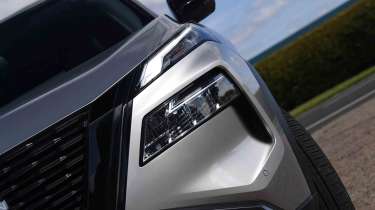
With an increase in overall width and height, the fourth-generation Nissan X-Trail has a more imposing look than before. It has a genuine SUV feel compared with its smaller Nissan Qashqai sibling, and its sharper lines project a more aggressive stance.
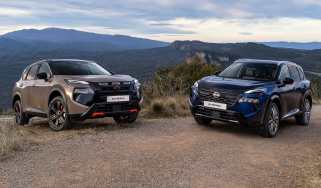
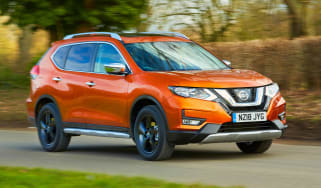
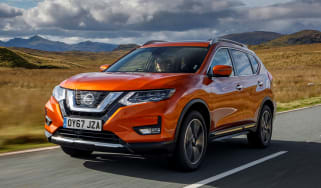
There is a choice of ten body colours to choose from and, while the X-Trail suits a grey or silver hue, the Sunset Orange paintwork works well – particularly if you specify an optional two-tone black roof. If you don’t need seven seats, then a five-seat X-Trail costs £1,000 less than the equivalent seven-seater model.
If you want your X-Trail to have more of a premium air, then you’ll have to pay extra for either the Tekna, Tekna+, or N-Trek versions. Moving up to these top trim levels brings a power-operated tailgate with a hands-free function, quilted leather upholstery, a head-up display and a Bose audio system with ten speakers. The X-Trail’s standard 18-inch diamond-cut alloys are fine, but the bigger, 20-inch versions that come with Tekna+ cars give the SUV a little more presence.
Interior and dashboard design
Inside, the X-Trail has more in common with the Qashqai than Nissan’s more futuristic-looking Nissan Ariya EV, which means it does feel a little dated in the cabin.
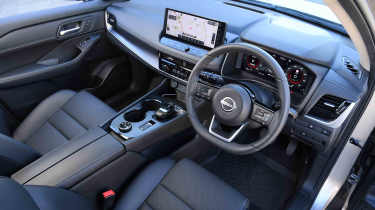
Simple ergonomics take priority over flamboyant style in the X-Trail's cabin. We found the rather stubby gear selector easy to use, and we like that it doesn’t take up much space on the centre console, while the climate controls are all chunky physical buttons and dials, not touch-sensitive sliders or plastic panels.
Materials and build quality
Quality is mostly good, and everything feels fairly well screwed together, however, so it's definitely a step up over the previous model, with plenty of squidgy plastics and well-damped buttons.
Infotainment, sat-nav and stereo
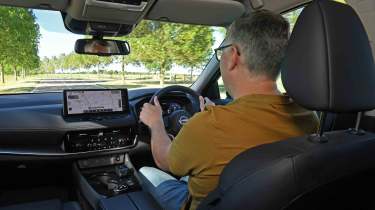
With the demise of the Visia trim available with earlier versions, every X-Trail comes with some form of touchscreen infotainment system. In Acenta Premium specification, there’s an eight-inch touchscreen, plus wireless Apple CarPlay, wired Android Auto, and a six-speaker audio system. If you go for N-Connecta trim and above, you're rewarded with a 12.3-inch infotainment touchscreen (like the one fitted to the car pictured), while top-of-the-range models add a 10.8-inch head-up display.
Nissan has made some big steps with its infotainment systems in recent years, and while it’s not class-leading in any one area, the X-Trail's infotainment set-up is fairly solid across the board, although we found it a bit sluggish at times during testing. The menus are cleanly laid out, with a home display that shows three main widgets, and the navigation system is the largest of the trio.
There are a couple of physical shortcuts along the bottom of the screen, which make skipping tracks or radio stations easy on the move. The optional Bose sound system may be worth the extra cash if you enjoy listening to music.
As part of its incoming 2026 update, the X-Trail will receive a Google-based infotainment system. If this is anything like the Google tech that we’ve seen in recent Renaults, it’ll be a welcome addition.
“The 12.3-inch screen looks fine, but the lack of responsiveness when entering a navigation address, for example, means you have to check each letter has been received in turn, which is painstaking, as is having to go through the steering wheel controls to work the dashboard display.” - Paul Barker, editor.
Boot space & practicality

Pros |
|
Cons |
|
Buyers will be impressed by the Nissan X-Trail’s refinement on the road. It’s a comfortable and relaxing place in which to travel, while Nissan hasn’t forgotten the practical touches that make family life a little easier. Items such as a centre armrest with two cup holders, luggage hooks and lighting in the boot, 60/40 split-folding rear seats and two rear Isofix points all add to the X-Trail’s ease of use.
Moving up through the various trim levels brings more luxury kit, such as a heating function for the front and rear seats, steering wheel and windscreen, plus wireless smartphone charging, tri-zone air-conditioning, and quilted leather upholstery. It's also worth noting that the X-Trail is offered in both five- and seven-seater configurations.
Dimensions and size
At 4,760mm long, the X-Trail is slightly longer than a Skoda Kodiaq and a Peugeot 5008. The fourth-generation model is 20mm wider and 15mm taller than its predecessor, which gives it an even more substantial look on the road.
| Dimensions comparison | |||
| Model | Nissan X-Trail | Kia Sorento | Skoda Kodiaq |
| Length | 4,680mm | 4,815mm | 4,758mm |
| Width | 1,840mm | 1,900mm | 1,864mm |
| Height | 1,725mm | 1,695mm | 1,659mm |
| Wheelbase | 2,705mm | 2,815mm | 2,791mm |
| Boot space | 585-1,396 litres | 179-1,996 litres | 340-2,035 litres |
Seats & passenger space
Room up front is good and what you’d expect from a large SUV, and the X-Trail certainly feels more spacious than its smaller sibling, the Nissan Qashqai
During our testing, we also found that the driving position in the X-Trail isn’t quite as commanding as the Kia Sorento’s. The C-pillars are relatively thick, and the rear side windows are small, so visibility is a little compromised, and you’ll be utilising the standard reversing camera to compensate for this.
We found that the smartphone charging shelf is big enough for even the largest of smartphones. The glovebox isn’t particularly roomy, but the door bins are a decent size. The latter isn’t carpeted to stop items from rattling around while you're driving, though
Rear passengers benefit from lots of legroom and headroom. We also like how the centre seat in the X-Trail's middle bench folds down entirely to provide a huge armrest for rear passengers.
If you decide to order your X-Trail with seven seats, only shorter people will feel comfortable in the back row. The first issue is that while the rear doors open nice and wide (almost to 90 degrees, which is useful when fitting a bulky child seat), the middle-row seats don’t move very far out of the way, so you need to wriggle through a small gap to access the third row. That third row is a little too small for adults due to limited knee and headroom, plus the seats are quite firm. They’re fine for occasional use, but it isn’t a full-time seven-seater like the more spacious Kia Sorento, which comes standard with seven seats.
Boot space
The X-Trail’s boot isn’t the largest in its class. In the mild-hybrid model, you get 585 litres of luggage space (with rear seats in an upright position), which is 81 litres more than you’ll find in the Nissan Qashqai. The e-Power versions offer 575 litres of cargo space, while a seven-seat model reduces this to 485 litres overall. Folding the rear seats unlocks a more spacious load area of up to 1,396 litres, depending on whether you opt for the five- or seven-seat X-Trail.
Towing
If you’re prioritising towing ability, then you’ll want to avoid the front-wheel drive 201bhp e-Power version because it only has a 670kg maximum braked trailer weight. The 161bhp mild-hybrid model has a 2,000kg limit in five-seat guise, which is reduced to 1,800kg if you opt for a seven-seater variant. The top-of-the-range 210bhp e-Power e-4ORCE four-wheel drive is capable of pulling up to 1,800kg, although its overall capacity is reduced to 1,650kg when configured as a seven-seat model.
“Not that an adult will thank you if you do make them sit back there, but it’s a minor gymnastic challenge to clamber through and, depending on how big or generous your middle row passengers are in sliding their seats forward, there’s not much space in the back.” - Paul Barker, editor.
Reliability & safety
Pros |
|
Cons |
|
If you’re a buyer looking for a safe family car, then the Nissan X-Trail is worth considering. Industry safety body, Euro NCAP, awarded the large SUV its full five-star rating, with excellent scores of 91 per cent for adult occupants and 90 per cent for child passenger protection. The X-Trail’s high level of standard safety equipment was also recognised with a 95 per cent rating.
The X-Trail includes a raft of active safety systems that help to make journeys easier and less stressful. Using a camera mounted in the windscreen and a radar behind the Nissan badge in the front grille, the onboard technology includes autonomous emergency braking, a forward collision warning, a lane-keeping assist system, a blind spot warning and traffic sign recognition.
Intelligent cruise control is also available and is capable of controlling acceleration and deceleration to automatically maintain a suitable following distance to the vehicle in front. Tekna and Tekna+ cars also include Nissan’s ProPilot driver assistance set-up.
The X-Trail is yet to appear in the Driver Power best cars to own rankings. However, the Nissan brand received a fairly middling result on the best manufacturer league table, ranking 15th place out 31.
| Euro NCAP safety ratings | |
| Euro NCAP safety rating | Five stars (2021) |
| Adult occupant protection | 91% |
| Child occupant protection | 90% |
| Vulnerable road user protection | 70% |
| Safety assist | 95% |
Buying and owning
- Best buy: Nissan X-Trail e-Power e-4ORCE Tekna
While it’s not the most efficient hybrid SUV on the market, we still recommend opting for the e-4ORCE powertrain because it’ll keep running costs under control while providing a decent bit of power when you need it.
Tekna trim adds to the price, but this added investment does make the X-Trail feel like a more premium offering, thanks to touches such as 19-inch alloy wheels, a panoramic roof, a power tailgate, and Nissan’s ProPilot tech.
Nissan X-Trail alternatives
Seven-seater competition for the X-Trail comes in the form of the capable Peugeot 5008, Kia Sorento, Skoda Kodiaq and Hyundai Santa Fe. Those who regularly need to use the third row will be better off with any of those rivals since they all offer space for adults, whereas the X-Trail can be a bit of a squeeze. For those with smaller children in car seats, the Sorento and Santa Fe provide four Isofix points, compared with just two for the X-Trail.
Company car drivers or those who wish to cut out their emissions may instead be tempted by the Kia EV9. Electric seven-seaters are still something of a rarity, so this model does come with a sizable £65,000 starting price. There’s also the Volvo EX90, which is much more luxurious, but this comes with a much higher price.
Frequently Asked Questions
The Nissan X-Trail is a large, practical SUV that's available with seven seats, feels well built and is comfortable to drive, however it's not the most efficient hybrid car we've ever tested.
Latest deals on the X-Trail and rivals