Volkswagen Polo review
The Volkswagen Polo still holds its own as a highly capable supermini

Our opinion on the Volkswagen Polo
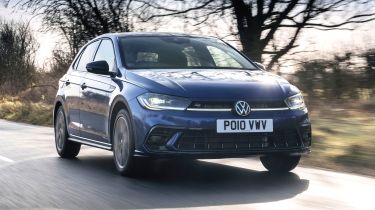
Building on its strong heritage, the sixth-generation Volkswagen Polo has followed a more premium path, evolving into a miniature Golf and setting a high standard in the supermini segment for quality and refinement.
With exceptional space and decent onboard technology that surpasses many of its rivals, the Polo effectively bridges the gap to more premium small cars like the MINI Cooper. However, its high-end positioning comes with a significant price tag, which might be a turn-off for potential buyers.
About the Volkswagen Polo
No matter which Volkswagen Polo you choose, you're getting one of the classiest superminis on sale in the UK today. The sixth-generation Polo arrived in 2018, bringing a step up in quality over the old car, as well as a range of efficient engines and some of the latest tech from the larger Volkswagen Golf. A facelift in 2021 brought the Polo a bit more up to date with fresh technology and a mildly revamped design.
The (five-door only) Polo is now nearly as long as a Mk3 Golf and almost as wide as the Mk5 version, which means it's one of the roomiest cars in the supermini class. It's a strong selling point in the face of a long list of rivals with their own talents.
Used - available now


On the subject of rivals, we lined the Polo up against its own sibling, the Skoda Fabia, in a twin test to see which VW Group supermini is the superior model.
Performance & driving experience
Pros |
|
Cons |
|
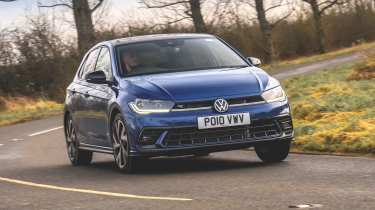
Although it’s a bit lacking in driving fun, the Volkswagen Polo takes the honour of providing the best refinement and comfort of almost any small car. It boasts a supple ride, edging out its competitors with Golf-like composure, and providing a more comfortable experience than the firmer SEAT Ibiza – a car that uses the same MQB A0 architecture that underpins this Polo, as well as the Skoda Fabia.
That’s not to say the Polo is a bad driving car; it’s just that some rivals are sharper and more enjoyable to pilot on twisty B roads. The steering is direct enough, but devoid of feel. It’s the same deal with the clutch pedal action and gearshift on manual models, revealing that the Polo is focused towards being easy and relaxing to drive, rather than providing an engaging experience. Models with larger alloy wheels suffer from compromised comfort levels, but that’s true of most cars with such options added.
Most Polo versions are equipped with a standard five-speed manual gearbox, while a seven-speed DSG automatic is available as an option on the 94bhp 1.0 TSI. The 113bhp 1.0-litre TSI comes only with the DSG gearbox.
Performance, 0-60mph acceleration and top speed
The non-turbocharged 1.0-litre 79bhp option might be okay for strictly urban driving, but it struggles to keep up with traffic on faster roads. It takes 15.6 seconds to hit 62mph from a standstill, and reaches a top speed of 106mph.
In almost every case, we’d recommend stumping up a bit more cash for the more powerful 94bhp 1.0-litre TSI. Its extra performance thanks to its turbocharger makes driving much more relaxing, because you won’t be left struggling to make a gap when merging into traffic. Its torque figure swells from a mere 93Nm for the lesser engine to a healthy 175Nm, all helping to drop the 0-62mph time to 10.8 seconds, while the top speed increases to 117mph.
The pricier 113bhp version provides a little more oomph, being a second faster across the sprint benchmark and providing a 125mph maximum and a decent 9.8-second 0-62mph time.
| Model | Power | 0-62mph | Top speed |
| Polo Life 1.0 80 PS manual | 79bhp | 15.6 seconds | 106mph |
| Polo Life 1.0 TSI 95 PS manual | 94bhp | 10.8 seconds | 117mph |
| Polo R-Line 1.0 TSI 115 PS DSG auto | 113bhp | 9.8 seconds | 125mph |
Town driving, visibility and parking
The Polo’s small size, light controls and decent all-round visibility make it very easy to manoeuvre around tighter urban streets. The suspension also makes reasonably short work of poorer road surfaces, allowing the ride quality to remain pleasingly refined, especially by supermini standards. Parking is also a stress-free affair, aided by standard reverse parking sensors. A reversing camera is available for a reasonable £380 or comes as standard on Match Plus or Edition 50 models.
Polos fitted with the DSG automatic transmission can be a bit jerky at times in stop/start traffic, but this is a fairly common pitfall with these particular gearboxes and is more of a mild annoyance rather than a major problem.
Country road driving and handling
Those who desire more performance will need to look elsewhere, because the Polo is far more focused on comfort and refinement. This certainly isn’t a bad car to drive, but its light controls and soft suspension mean everything is much better described as easy rather than engaging.
While the sight of a manual gearbox option will be a welcome sight in the eyes of many driving enthusiasts, it isn’t the slickest nor the most satisfying ‘box to use in a spirited fashion. It is, however, perfectly fine at getting on with the job at hand, much like the rest of the VW Polo.
Motorway driving and long-distance comfort
On A-roads and motorways, the Polo impresses with the refinement of a much larger car. The engines fade into the background hum, while low levels of wind and road noise mean you don’t need to crank up the stereo or shout to your passengers.
During our testing of the Polo in Black Edition and Edition 50 trims, we made several motorway trips, and VW’s supermini held up consistently well as a long-distance cruiser. The level of noise inside is no more than you’d expect to hear in a much larger car, and overall refinement is worlds apart from the Suzuki Swift.
“The Polo really will have you questioning whether a Golf is really worth the extra money. It may be a supermini, but this VW does a remarkable job as a motorway commuter car, too.” - Shane Wilkinson, senior content editor.
MPG & running costs
Pros |
|
Cons |
|
The 94bhp 1.0-litre TSI is our favourite engine from a performance perspective, and it also makes sense when it comes to fuel economy and emissions. Volkswagen claims a best of 55.3mpg (on the combined cycle) for this version under the latest WLTP test, with CO2 emissions from 116g/km. Add the seven-speed DSG gearbox to the Polo, and its stats drop slightly, with a maximum fuel economy of 52.9mpg and CO2 emissions of 122g/km. The non-turbo 79bhp 1.0-litre manages 53.9mpg and emissions of 119g/km.
Move to the 113bhp engine with its seven-speed DSG auto, and it delivers economy of 52.8mpg with CO2 emissions from 122g/km.
We tested the 95PS manual in our group test against the Hyundai i20 and SEAT Ibiza, with the Polo returning 41mpg. It was the lowest figure of the three in the test, though the Ibiza only achieved a little better at 41.6mpg. The i20 trumped them both by hitting 45.2mpg.
However, several hybrid options are available in the small car class that offer even greater efficiency, the most impressive of which is the Toyota Yaris, with an average economy figure of 68.9mpg. During our own testing, we achieved an average of 65mpg, maintained through extensive urban driving.
| Model | MPG | CO2 | Insurance group |
| Life 1.0 80 PS 5-Speed Manual | 53.9mpg | 119g/km | 3 |
| Life 1.0 TSI 95 PS 7-Speed DSG | 52.9mpg | 122g/km | 9 |
| R-Line 1.0 TSI 115 PS 7-Speed DSG | 52.8mpg | 122g/km | 15 |
Insurance groups
The entry 79bhp model will be very cheap to insure, sneaking into group 3 on the 1-50 scale – also making it a candidate for anyone looking for their first car. All cars fitted with our recommended 94bhp 1.0-litre TSI engine occupy groups 9-10, with 113bhp cars stepping things up to group 12. Those are all lower than hybrid competitors, with the entry-level Toyota Yaris in Icon trim sitting in group 13, while the Honda Jazz starts from group 19.
Check if your car needs an MoT and view its complete history with our MoT history checker...
Tax
Due to the Polo’s solely petrol-powered engine line-up, there are no road tax or Benefit-in-Kind (BiK) company car tax breaks to be found here.
While electric cars now have to pay VED, they are often still the better option for business users due to much lower BiK rates. Because of this, business buyers may wish to look towards zero-emission superminis like the BYD Dolphin, Renault 5, Peugeot E-208, and Vauxhall Corsa Electric instead.
Depreciation
Our market data shows that the Volkswagen Polo should retain between 47 and 51 per cent of its initial value after a period of three years or 36,000 miles. This is a slightly stronger outcome than that of the closely related Skoda Fabia, which only manages 43 to 47 per cent. Perhaps surprisingly, the most depreciation-resistant supermini is the Honda Jazz, as it retains 50 to 55 per cent of its value after the same period.
To get an accurate valuation on a specific model check out our free car valuation tool…
Interior, design & technology
Pros |
|
Cons |
|
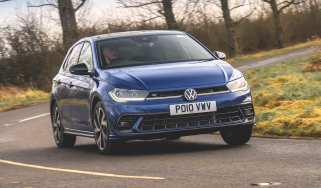
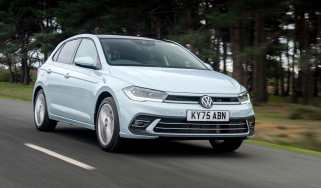
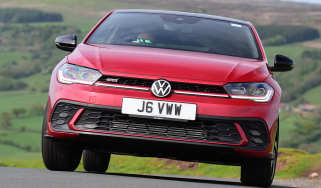
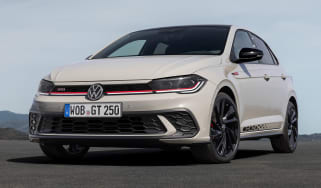
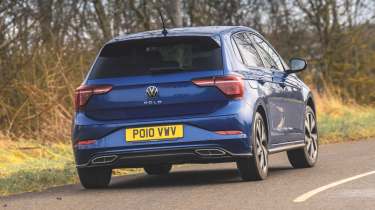
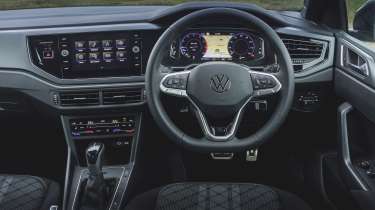
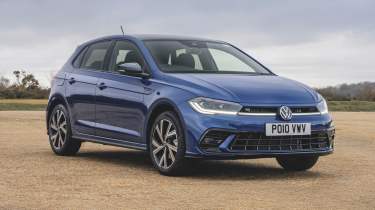
From a design standpoint, the sixth-generation Volkswagen Polo lacks any real flair, but it's still a neatly designed supermini – it looks more like a Volkswagen Golf than ever, especially because it has grown considerably in width.
A decent paint colour palette and choice of optional alloy wheels means that you’ll be able to make the Polo your own, although personalisation options are not as extensive as they once were.
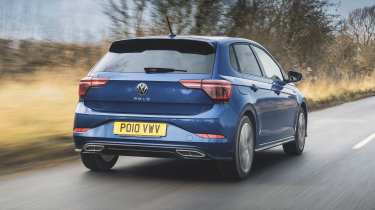
A facelift in 2021 brought in exterior styling tweaks, with new matrix-LED headlights as standard on the Black Edition model and above, along with a full-width LED running light at the front. The nose is sharper, while the redesigned rear lights look very similar to the cluster design on the Polo's bigger Golf sibling. It's in the cabin where the biggest changes have occurred.
Entry-level Life has all the basics and is our recommended version. As standard, it has:
- 15-inch alloys
- LED headlights
- Wireless Apple CarPlay and Android smartphone connectivity with wireless phone charging
- Rear parking sensors
Of the few options you might want to add, the £380 reversing camera is worthwhile to make parking that little bit easier, while the £135 front seat lumbar support option will aid comfort on long trips.
Match Plus trim adds rear privacy glass, 16-inch alloys, a reversing camera, keyless entry and start, adaptive cruise control, heated front seats and front parking sensors. Sportier-looking R-Line misses out on the heated front seats, front parking sensors and a reversing camera of the less expensive Match Plus trim, but it does have a 10.25-inch configurable digital instrument cluster, automatic high beam assistance, and dual-zone climate control.
Black Edition includes matrix LED headlights, 17-inch alloy wheels, some black exterior trim, and ambient interior lighting. Lastly, the most expensive Edition 50 trim has a panoramic glass sunroof, sports front seats, a park assist system, and standard Crystal Ice Blue metallic paint.
Interior and dashboard design
Every Polo version features a standard digital instrument display, measuring either eight or 10.25 inches. A multi-function steering wheel is also included, along with a redesigned panel for the heating and ventilation controls – which are now touch-sensitive. Although these haptic controls are backlit, you will often find yourself forced to look away from the road in front in order to change the fan speed.
We generally prefer to have physical dials for the air-con (as seen in the current Vauxhall Corsa), but at least the controls are located within easy reach on the dashboard, rather than being buried within the infotainment screen as they are on the Peugeot 208.
Materials and build quality
As one of the cheapest cars in VW’s current line-up, the Polo doesn’t escape its share of low-rent materials. However, everything does feel very well screwed together.
While the business-as-usual shape means that the Polo isn’t quite as eye-catching as some rivals, you can’t fault the level of the fit and finish. Tight shut lines are a sign of its quality, plus a classy design means it will appeal to a broad cross-section of customers.
Infotainment, sat-nav and stereo
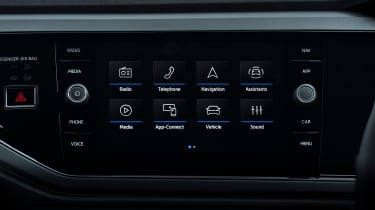
The Polo's infotainment system works well, with bright, clear graphics and rapid responses to prods of the screen. Bluetooth connectivity is standard, along with a DAB radio and Apple CarPlay and Android Auto smartphone connectivity. Volkswagen’s We Connect Plus system is also included for all versions, bringing real-time traffic info and live music streaming.
Compared to the likes of the Hyundai i20 or SEAT Ibiza, the eight-inch touchscreen in the Polo is pretty small. Still, it's neatly integrated into the Polo’s dash design, and although the system itself isn’t as modern as the set-ups used by its Spanish or Korean rivals in that test, it remains logical and straightforward to use.
The mapping is easy to use, thanks to a screen that responds quickly to pinching and swiping motions. However, we found the small display size means that the on-screen keyboard is a little fiddly and makes address entry tricky. At least there are shortcut keys surrounding Polo’s eight-inch screen, and there's a proximity sensor, which means menu keys appear as your hand draws close.
The Digital Cockpit Pro instrument cluster in our test car was simply excellent. It’s easy to switch between the various functions of the 10.25-inch display via the steering wheel buttons, and the dark background ensures it’s not a strain on the eyes, even at night.
Boot space & practicality
Pros |
|
Cons |
|
Though superminis are still popular cars in Europe, more buyers are opting for five-door accessibility over three-door sportiness, and the Mk6 Polo is now sold strictly with five doors.
It’s a totally conventional supermini set-up, unlike the taller Honda Jazz with its MPV-style raised driving position and deep dashboard. There’s plenty of head, leg and shoulder room for two full-size adults in the front of the Polo.
Dimensions and size
Using a modified version of the Golf’s platform called MQB A0, the Mk6 VW Polo has grown in size compared to the fifth-generation car. Compared to the top-selling Vauxhall Corsa, it’s longer and taller, but not quite as wide. Helpfully for passengers, the Polo has a much longer wheelbase (2,552mm vs 2,538mm), which explains why rear leg room in the Volkswagen is much more accommodating than its rival for those in the back.
| Dimensions comparison | |||
| Model | Volkswagen Polo | Skoda Fabia | SEAT Ibiza |
| Length | 4,074mm | 4,137mm | 4,059mm |
| Width | 1,751mm | 1,780mm | 1,780mm |
| Height | 1,451mm | 1,482mm | 1,447mm |
| Wheelbase | 2,550mm | 2,550mm | 2,564mm |
| Boot space | 351 litres | 380 litres | 335 litres |
Seats & passenger space
There are lots of adjustments in the steering wheel, seat, and seat belt height for drivers of all sizes to get comfortable. Manual front seat height adjustment is standard across the range, but you’ll need to pay a modest fee to get front seat lumbar adjustment or move up to R-Line trim and above. The modern, pared-back dashboard layout is logically laid out and built with classy materials. It’s also home to a decent number of storage bins and cubbies.
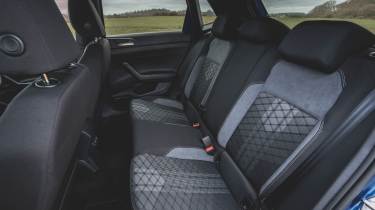
That longer wheelbase means the Polo is a roomy car for the class in terms of passenger space. Three adults across the back remains a tight fit, because a large central tunnel cuts noticeably into legroom for the middle passenger.
There are two Isofix child seat mounting points for the outer rear seat positions, along with (unusually for this class) an Isofix point for the front passenger seat. That could be a very helpful feature for any parents who are concerned about their little one while out and about, because they don’t have to waste time running to the back of the car should anything happen. However, you must check that the passenger airbag is deactivated if you decide to fit a child seat in the front.
Boot space
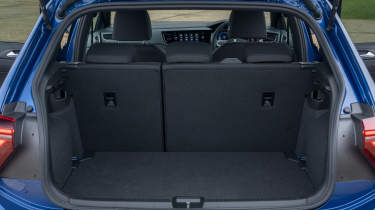
The Polo’s boot sizes up at 351 litres with the rear seats raised, meaning it's neck and neck with the SEAT Ibiza. It’s also a huge advance on the previous generation Polo’s 280-litre load space. It still trails the 380 litres of space provided by the Skoda Fabia, although the Polo has an adjustable height boot floor to give it a load area level with the boot opening. While this does take up space, it provides an area below in which to hide valuables.
The rear bench folds forward with a 60:40 split, although the seats don’t go completely flat. The cargo bay expands to an impressive 1,380litres with the seats lowered, firmly planting the Polo’s flag as a practical supermini.
“Just like the way it drives, the Polo feels like a reasonably larger car when it comes to space. Four adults can sit comfortably, and the boot takes a weekly shop with room to spare.” - Shane Wilkinson, senior content editor.
Reliability & safety
Pros |
|
Cons |
|
The Volkswagen Polo’s high level of perceived quality is matched with strong safety features, culminating in a five-star rating from Euro NCAP in 2022, surpassing the disappointing four-star result for the Hyundai i20, which was tested under similar criteria as the Polo.
Entry-level Life models feature a host of active safety kit, including a driver fatigue detection warning, a radar-controlled emergency braking system, a lane-keepng assist function, and hill start assist. Black Edition trim and above add VW's Matrix LED headlights, which adjust the main beam pattern to avoid dazzling oncoming vehicles. There’s also a Dynamic road sign display system that flags road sign and speed information on the digital instrument screen. Adaptive cruise control is fitted to Match Plus trims and above.
A driver's assistance pack is offered as an option and incorporates a lane change side assist system that monitors rear blind spots. If you want to specify a rear-view camera, you'll need to add this as an option or specify Match Plus or Edition 50 trims that have it as standard.
The Polo finished in 43rd position out of 50 cars in our 2026 Driver Power owner satisfaction survey. While that is one place above the Ford Fiesta, it's a long way behind the Renault Clio in 24th or even the Vauxhall Corsa in 16th. Polo owners like the mix of physical and touchscreen controls, the front-seat comfort, engine refinement, and exterior finish. They felt it could do with more interior storage, boot capacity and rear seat space. Value for money could also be improved, along with servicing costs and fuel economy.
In the best manufacturer rankings, Volkswagen climbs one place compared with last year, ranking 26th out of 30 in the 2026 results.
| Euro NCAP safety ratings | |
| Euro NCAP safety rating | Five stars (2022) |
| Adult occupant protection | 94% |
| Child occupant protection | 80% |
| Vulnerable road user protection | 70% |
| Safety assist | 70% |
Buying and owning
Best buy: Volkswagen Polo Life 1.0 TSI 95 PS
There are plenty of Polo trim levels to choose from: Life, Match Plus, R-Line, Black Edition and Edition 50. The entry-level Life model starts from just over £22,000, with the Match Plus coming in at just under £24,000. The sport-inspired R-Line climbs to around £25,500, while the Black Edition comes in at around £26,000. The fanciest Polo is the exclusive Edition 50, celebrating 50 years of the Polo, and it comes with a wealth of equipment to justify its near £27,000 asking price.
While there are a number of trims to choose from, the base Polo Life has enough kit for most daily needs. The 1.0 MPI engine is a bit underpowered, though, so we’d opt for the turbocharged TSI unit, especially if you’re driving out of town. The good news is that this extra power doesn’t come at the expense of increased running costs.
Fancy a VW Polo of your very own? You can save with our Buy a Car service by configuring your perfect Volkswagen Polo and getting top deals from our dealership network. You can also take a look at the best Polo leasing deals and browse loads of excellent used Polo models. Need to sell your car? Be sure to visit our Sell my Car page.
Volkswagen Polo alternatives
As well as its own siblings, the SEAT Ibiza and Skoda Fabia, the Polo also faces a healthy number of supermini rivals. The Vauxhall Corsa and Peugeot 208 offer both combustion and electric power, and an increasing number of pure-electric superminis are also arriving on the market. These include the Renault 5 and BYD Dolphin.
Volkswagen Polo pictures
Volkswagen Polo history
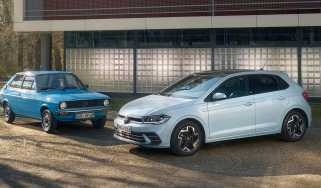
The history of the Volkswagen Polo dates back to 1975. Since then, it has grown from being a rebadged Audi into one of the best superminis you can buy. It’s not the cheapest supermini you can buy, but solid residuals mean you’ll lose less money when you sell it, while the latest versions feel like slightly smaller versions of the excellent Volkswagen Golf.
Volkswagen Polo Mk6: 2017-
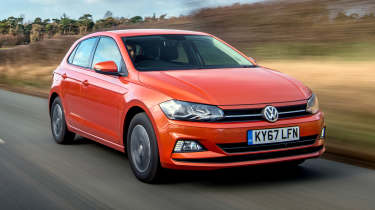
The current Polo is one of the classiest superminis you can buy. It’s like owning a smaller Golf, although this means you’ll pay a premium for the privilege compared with the Polo’s immediate rivals. Buying a used version of this will be your only way of getting the short-lived diesel version because this engine choice disappeared with the 2021 facelift, which also ushered in some styling tweaks, and made the digital instrument display a standard feature.
Volkswagen Polo Mk5: 2009-2017
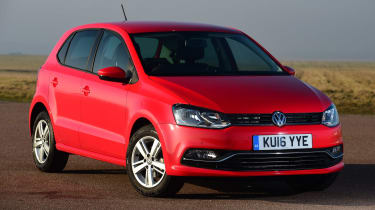
Launched in 2009, the Mk5 was the first Volkswagen Polo to be named European Car of the Year. It was also the 2010 World Car of the Year, completing a double of gongs for the impressive supermini. Only a lacklustre driving experience puts a blot in its copybook, although the Polo GTI offers grown-up thrills. Read our full Mk5 Volkswagen Polo buyer’s guide here…
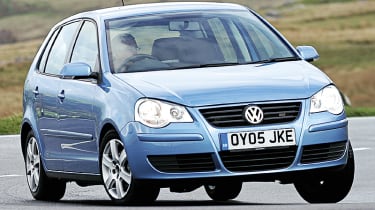
Volkswagen Polo Mk4: 2002-2009
Feeling every inch a ‘mini Golf’, the Mk4 Polo felt like a grown-up supermini. Excellent ride quality, superb build quality and economical engines are just some of the highlights, although a mediocre driving experience lets down the Polo. The 2005 facelift introduced Golf-style headlights and rear lights that wouldn’t look out of place on the Volkswagen Phaeton luxury car. Read our full Mk4 Volkswagen Polo buyer’s guide here...
Older Volkswagen Polo models
The Volkswagen Polo has come a long way since it arrived in 1975 as a rebadged version of the Audi 50. The Mk1 Polo lived on until 1981 when it was replaced by the Mk2, which included a now iconic ‘breadvan’ version. Things stepped up a gear in 1994 with the launch of the Polo Mk3, which was based on a new platform and came complete with new body and engines.
Key updates of the Volkswagen Polo review
16 July 2026: Update with the 2026 Driver Power customer satisfaction survey results
Frequently Asked Questions
The standard Volkswagen manufacturer’s warranty is three years or up to 60,000 miles, which is average for the class. Rival Toyota can provide up to 10 years or 100,000 miles of cover for a Yaris.
Deals on the Polo and alternatives