Fiat 500 review
It’s still full of retro charm, but the latest Fiat 500 is far more sophisticated than ever before

Our opinion on the Fiat 500
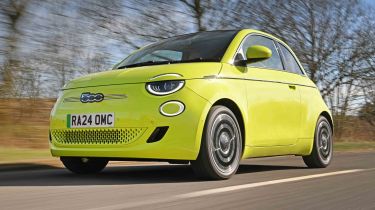
The stylish Fiat 500 (or 500e if you want to differentiate the electric model from the combustion-engined version) has proven to have real staying power. While rivals such as the Volkswagen up! and Honda e have disappeared from their respective brand’s price lists, the 500 remains. Initially only available as an electric vehicle, the 500 range has diversified over the years to include a petrol-only version to satisfy demand from those not quite ready for electric-only motoring. Whichever version you go for, its limitations are easy to see once you head out on the open road for longer trips, but as an urban runabout, there’s still plenty to like about this little retro-inspired city car.
About the Fiat 500
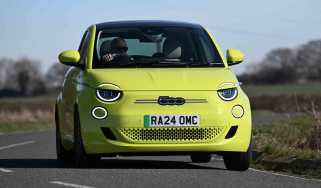
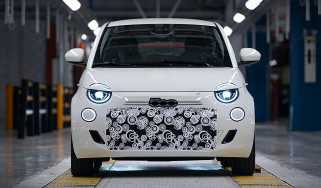
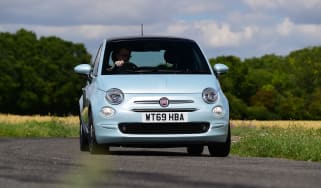
The modern Fiat 500 has come a long way since the iconic 1957 city car. While the latest incarnation retains the same recognisable profile as its forebears, this third-generation 500 is far more sophisticated, and not just because it is available in both petrol and all-electric forms.
Buyers get a choice of just one petrol engine, while there are two battery sizes and power outputs with the electric 500e. All versions drive the front wheels, though.
We previously ran a Fiat 500e for six months as part of our long-term test fleet, and we’ve also tried out the 500 Hybrid in its native environment of Turin as part of the international launch.
Performance & driving experience
Pros |
|
Cons |
|
The Fiat 500 is a car that’s very clearly been designed with the city in mind, and that’s without doubt where it does its best work.
Used - available now


It’s here where you’ll probably want to stay if you’re driving the hybrid, whereas the EV is a much more lively car, with a more responsive accelerator and adequate punch when pulling out of junctions or away from traffic lights.
Performance, 0-60mph acceleration and top speed
If you want a zippy city car, the mild-hybrid Fiat 500 is not it. This model sends an incredibly modest 64bhp and 92Nm of torque to its front wheels via a 1.0-litre three-cylinder engine and single electric motor. Floor it, and 0-62mph will eventually be dealt with in 16.2 seconds. Opt for the convertible, and it’ll take an even more excruciating 17.3 seconds.
Fiat 500e buyers get a choice of two motor and battery combinations, and while neither delivers the exaggerated performance specs we’re used to in modern EVs, they’re still much zestier than the Hybrid. The fully electric line-up kicks off with a 92bhp motor that will accelerate from 0-62mph in 9.5 seconds. The 116bhp option knocks half a second from that benchmark, and adds 9mph to the top speed – hitting 93mph flat out. Once again, the convertible versions are a bit slower due to the added weight.
| Model | Power | 0-62mph | Top speed |
| 500e 24kWh | 94bhp | 9.5 seconds | 84mph |
| 500e 42kWh | 116bhp | 9.0 seconds | 93mph |
| 500 Hybrid | 64bhp | 16.2 seconds | 96mph |
Town driving, visibility and parking
Being a city car, it’s at low speed where the Fiat 500 is designed to excel – and it does. Great visibility, tiny dimensions and a tight turning circle make everything from parking to darting in and out of traffic a doddle. Engaging your desired direction of travel in the 500e is as simple as prodding one of the large buttons on the dashboard. Opt for the mild-hybrid, though, and you’ll be using a traditional six-speed manual gearbox instead.
It’s clear from the outset that electric power is perfect for a small car such as this, because the 500e is so much more peaceful, easier and relaxing to drive than an equivalent petrol-powered city car. The mild-hybrid variant also remains pretty refined at these speeds, because you don’t have to work the engine very hard when trundling along at low speeds.
Country road driving and handling
The 500e’s relative lack of weight compared with most other small EVs makes it feel fairly agile along a twisty road. Beyond that, it’s more competent than fun. The grip from the fairly modest tyres is fine, and the car is set up to be predictable and nose-heavy, with a very cautious stability control system. The suspension struggles to keep up with higher-frequency bumps as the speed increases, so on a typical British B-road, things can start to get a little bouncy.
The 500 Hybrid feels out of its depth when getting up to B-road speeds and above. While it still handles as well as the 500e, the powertrain quickly runs out of puff. We found ourselves constantly having to change gears during testing in order to keep up with traffic.
Motorway driving and long-distance comfort
The little Fiat’s soft ride comes into its own once again on a motorway, where it remains fairly comfortable. But this is a very small car, and it’s clear that sound deadening isn’t a priority. Wind and road noise are a little high, even compared with similarly sized rivals such as the Renault 5. The light steering isn’t the most precise at higher speeds, which means the driver needs to make regular corrections to keep the car straight.
However, the additional power of the 500e over the Hybrid gives it yet another edge here, as the latter struggles to deliver sufficient power for overtaking. Fortunately, because the Hybrid has a six-speed gearbox, the engine remains pretty quiet when cruising at 70mph.
“In an age of punchy, downsized turbo engines and electric motors, the naturally aspirated 500 Hybrid feels borderline prehistoric.” - Richard Ingram, deputy editor.
Range, charging & running costs
Pros |
|
Cons |
|
Every Fiat 500 is generally cheap to run, but heavy rates of depreciation for the electric version will take their toll on your savings when it's time to sell on.
While the 500e will typically offer the lowest running costs, the 500 Hybrid won’t be too far behind. Fiat claims it can return up to 53.3mpg, and during our own testing, we saw an average of 42.1mpg after some rather spirited driving around the streets of Turin, before climbing to around 50mpg once we settled down into a longer cruise. This should mean that Fiat’s claims are indeed achievable.
| Model | MPG | CO2 | Insurance group |
| 500 1.0 Mild Hybrid Icon | 53.3mpg | 119g/km | N/A |
| 500 1.0 Mild Hybrid La Prima | 53.3mpg | 121g/km | N/A |
| 500 Cabrio 1.0 Mild Hybrid Icon | 52.3mpg | 122g/km | N/A |
Electric range, battery life and charge time
In temperatures around 17 degrees Celsius, we averaged 4.3mi/kWh from our test car fitted with the 42kWh battery, which equates to a real-world range of around 180 miles. This was achieved on a range of roads, including motorways. Sticking to suburban streets, this climbed as high as 5.2mi/kWh.
On a cold day with temperatures just above freezing, a motorway-only run achieved 3.1mi/kWh; given the temperature and speeds involved, this is more of a worst-case scenario. It’s unfortunate that a heat pump isn’t even offered as an option in the 500e, because this would help mitigate the problem as it provides a more energy-efficient way of heating the interior and helps to preserve the battery.
Fiat says the 500e’s charging maxes out at 85kW, and quotes a 0 to 80 per cent battery top-up in 35 minutes. That’s identical to the MINI Cooper E (85kW), but not as swift as the Renault 5 (100kW). The Fiat slows significantly beyond 80 per cent, with that final fifth of the battery taking closer to 50 minutes to top up. Utilise a typical 7.4kW home wallbox charger, and it’ll take only 3.5 hours to recharge the small-capacity 24kWh model, or 6 hours to fully recharge the 42kWh version.
| Model | Battery size | Range | Insurance group |
| 500e 70kW Icon | 24kWh | 118 miles | 13 |
| 500e 87kW Icon | 42kWh | 186 miles | 18 |
| 500e Cabrio 87kW Icon | 42kWh | 186 miles | 15 |
Insurance groups
Insurance for the Fiat 500 should be pretty reasonable across the board, although ratings for the mild-hybrid model are yet to be allocated. We expect them to be the same or slightly lower than their EV sibling, which starts as low as group 13 (out of 50).
Compared with other small EVs, the Dacia Spring city car will be much more costly to insure because it falls into groups 25 to 28. The Renault 5 supermini is slotted between groups 18 and 22.
Tax
If you’re in the market for a small company car, then the 500e will prove to be very cheap. The standard rate of VED road tax applies, but this car’s zero-emission status means you’ll only be faced with the very lowest Benefit-in-Kind (BiK) rates.
Naturally, VED road tax also applies to the mild-hybrid, but this attracts higher company car tax rates. However, no Fiat 500 comes anywhere close to the luxury car tax bracket.
Depreciation
The electric Fiat 500 doesn’t hold its value very well when it comes time to sell it on. According to our market data, this city car retains only 31-34 per cent of its original value after three years or 36,000 miles, whereas the Renault 5 fares much better, retaining between 46 and 49 per cent after the same amount of time.
We don’t yet have residual values for the latest hybrid version of the 500, but we’ll add them as soon as we have them.
To get an accurate valuation on a specific model check out our free car valuation tool...
Interior, design & technology
Pros |
|
Cons |
|
Despite having a clean sheet to explore new designs with the latest Fiat 500, the Italian manufacturer wisely went with an updated version of the trusted retro formula it used with the first modern 500 that arrived in 2007.
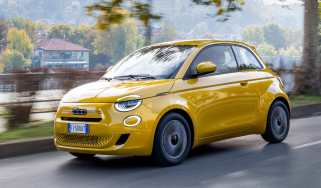
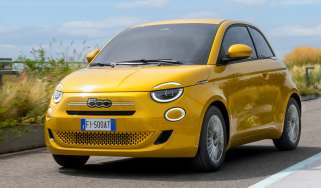
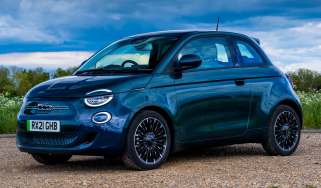
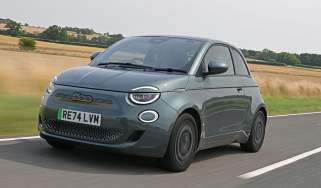
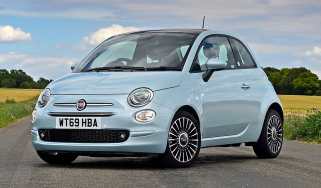
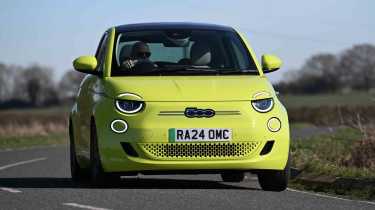
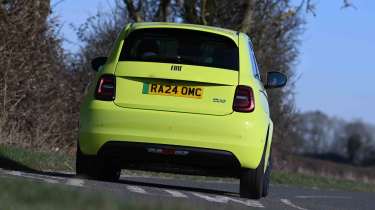
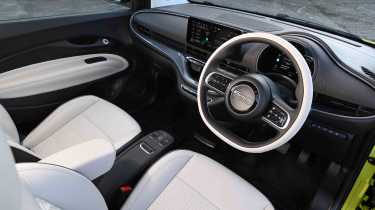
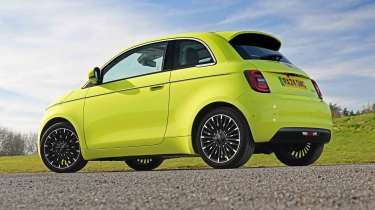
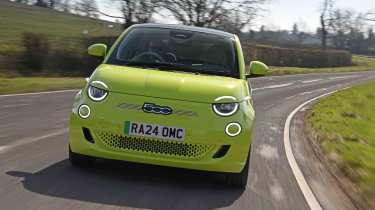
The current model is slightly bigger than the car it replaced, but it still retains the unmistakable family look. The split headlights at the front add a modern touch, and some of the alloy wheel designs really stand out. Inside, a body-coloured section across the dash pays homage to the original car. You’ll have to decide for yourself whether the buttons to open the doors add to the appeal or are a bit gimmicky, and the same goes for the sound effects that play when you switch the car on or off.
There are two main trim levels: Icon and La Prima. Entry-level Icon includes 16-inch alloys, LED headlights, climate control, a 10.25-inch infotainment screen, and rear parking sensors.
Our preferred La Prima trim includes:
- Heated front seats
- Sat-nav
- Wireless smartphone charging
- An uprated JBL sound system
- keyless entry
- Glass roof
- Rear privacy glass
- Reversing camera
Interior and dashboard design
Fiat’s design team played a bit of a blinder with the styling of the 500’s cabin, delivering a look that maintains some smart retro touches while taking advantage of the manufacturer’s latest touchscreen technology and electric layout.
The use of painted plastic or textured material (depending on spec) on the top of the dashboard doesn’t just create a throwback to the original 500, but also adds a splash of interest where most cabins ordinarily have dull, cheap black plastic.
Interesting upholstery designs and a quirky steering wheel also add character to a car, which disguises the fact that, like most very small cars, it’s been built to a cost.
Materials and build quality
There are lots of hard plastics around the 500’s cabin, but the previously mentioned use of colours and textures helps the 500 to look pretty smart inside. One or two frequently touched surfaces and buttons did feel a bit budget-oriented during testing, though, so they might not stand up too well to the test of time.
Infotainment, sat-nav and stereo
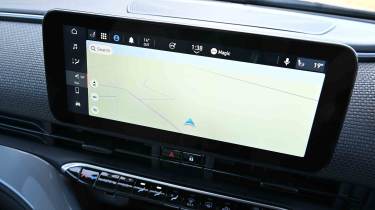
Fiat has tried to inject some prestige into its city car by loading it with plenty of smart technology. There’s a 10.25-inch touchscreen, a seven-inch digital driver’s display (neatly integrated into a round binnacle – another clever nod to the original 500), while top-spec trims get semi-autonomous driving tech that can accelerate, brake and steer the car within lanes without driver input.
Fiat’s bright, hi-res screen is fairly responsive, but loading times for the UConnect 5 system between menu selections – especially on the nav pages – can be sluggish. Disabling the lane-keep system is fairly easy, thanks to a button on the end of the left-hand stalk. That’s handy because turning it off via the touchscreen requires diving into some messy sub-menus.
Small switches on the back of the 500’s steering wheel spokes make it easy to adjust the volume and switch radio stations, or skip song tracks when on the move.
Boot space & practicality
Pros |
|
Cons |
|
No matter what you compare it against, the Fiat 500 is a tiny car by modern standards, and this inevitably takes its toll on interior and luggage space.
Dimensions and size
The Fiat 500 is less than four metres long, while a 1.7-metre width means you’ll barely need to slow down to judge your clearance for urban width restrictions.
Having said that, the old Fiat 500 is minuscule when compared with the current model. At three metres long, 1.3 metres wide and an identical height, the modern 500 simply dwarfs its ancestor.
| Dimensions comparison | |||
| Model | Fiat 500 | Dacia Spring | Renault 5 |
| Length | 3,632mm | 3,701mm | 3,922mm |
| Width | 1,683mm | 1,583mm | 1,774mm |
| Height | 1,527mm | 1,519mm | 1,498mm |
| Wheelbase | 2,320mm | 2,420mm | 2,540mm |
| Boot space | 185 litres | 308 litres | 277 litres |
Seats & passenger space
Visibility from the 500’s driver’s seat is excellent in almost every direction. There are large windows and no unnecessarily large pillars or a rising shoulder line to obstruct your vision. The view is further enhanced by the high driving position – the seat is height-adjustable in some models, but the position is fairly lofty even in its lowest setting. There’s plenty of adjustment in the steering wheel, but the pedal box is a little cramped, and there’s no left foot rest.
While the glovebox is large, the door bins are small. The console between the front seats has a space under the adjustable armrest, while a sliding cover hides an extra bin with a cup-holder. It’s set very deep, though, so extracting a hot drink demands caution.
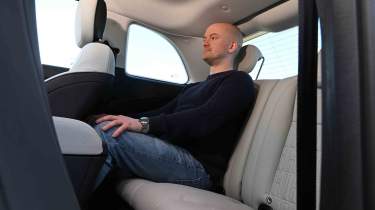
The 500 is strictly for four people only, with no centre rear seat or belt. That’s probably for the best, because the cabin would be too narrow for three. As it is, shoulder room is absolutely fine, but headroom is tight, and legroom is in short supply. If the driver is above average height, their seat will squash the knees of anyone sitting behind them. It’ll be suitable for adults on short trips, but for anything longer, you’ll be better off with one of this car’s rivals that has back doors and more rear passenger space, such as the Citroen e-C3 or BYD Dolphin Surf.
Boot space
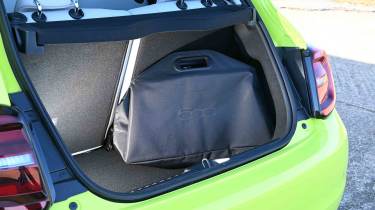
At 185 litres, the Fiat 500’s boot is fine for a supermarket trip, but its shape doesn’t lend itself to anything more bulky. The space is fairly deep – making it a little tricky to lift heavy items over the high load lip – but there is space for the charging cables beneath the false floor. The rear seats split down the middle, but they don’t fold flat, which in part explains why the 500’s seats-down volume is a still-compact 550 litres.
“Yes, the boot is tiny and the back seats are useless for adults. But the 500’s shape, its stance, and its adorable personality do just enough to distract from all of that.” - Richard Ingram, deputy editor.
Reliability & safety
Pros |
|
Cons |
|
The Fiat brand hasn’t always been the strongest performer in the Driver Power owner satisfaction survey, but they have placed four positions higher than last year, coming 18th out of 30 brands in the 2026 best manufacturers table. Owners were very happy with the running costs and styling of their cars, but were less enthused with the quality, practicality, and ride and handling.
The latest 500 scored four stars out of a maximum of five when it was tested by Euro NCAP in 2021. While overall occupant-protection scores were good, it was marked down for the lack of a central airbag, which would reduce the risk of injury between two front occupants colliding in the event of a side impact, and concerns about its autonomous emergency braking system’s reactions with other vehicles. All versions come with lane keep assistance and traffic sign recognition, but range-topping La Prima adds blind spot warning and adaptive cruise control.
| Euro NCAP safety ratings | |
| Euro NCAP safety rating | Four stars (2021) |
| Adult occupant protection | 76% |
| Child occupant protection | 80% |
| Vulnerable road user protection | 67% |
| Safety assist | 67% |
Buying and owning
Best buy: Fiat 500e 42kWh La Prima
Pricing for the 500 Hybrid starts at around £19,000 for the Icon version, rising to nearly £21,000 for the La Prima. The convertible commands a £3,000 premium, starting at around £22,000, while the range-topping La Prima costs about £24,000.
The Fiat 500e is still one of the more affordable electric cars on sale, and it has been made even more affordable by being awarded the maximum £3,750 Electric Car Grant (ECG). That means pricing for the 24kWh small battery in Icon trim starts at around £17,250, while the more useful 42kWh Icon costs around £20,250. Our preferred 42kWh La Prima comes in at around £23,250.
Due to the hybrid car’s woeful power output and slightly reduced refinement, we’d go for the fully electric Fiat 500e instead. The larger battery is our pick because its longer driving range brings added peace of mind and faster DC rapid charging. La Prima feels like an upmarket model, with lots of neat detailing and chrome trim that add some class to proceedings, so we think it’s worth the added investment.
You can build your new Fiat 500 through the Auto Express Buy a Car service, and we also have Fiat 500 leasing deals and used Fiat 500 models to choose from.
Fiat 500e alternatives
The combustion-powered city car sector is an increasingly small one, but the Kia Picanto offers plenty of value for money along with a very attractive seven-year warranty. Move up to larger superminis, and the level of choice increases with options such as the Citroen C3, Dacia Sandero, MG3, Renault Clio, and Vauxhall Corsa.
For those considering an electric car, there are a few more city car options like the BYD Dolphin Surf, Dacia Spring, and Leapmotor T03. There are also plenty of larger electric superminis, including the Citroen e-C3 and Renault 5.
Just like the generations before it, the Fiat 500 also has a slightly more practical sibling, the Fiat Grande Panda. This also comes with the option of mild-hybrid or electric power, and it’s every bit as distinctive to look at.
Key updates to the Fiat 500 review
17 July 2026: Update to include mention of the £3,750 electric car grant (ECG) discount on the electric 500e, and the results of the 2026 Driver Power customer satisfaction survey
29 April 2026: General update and addition of 500 Hybrid driving impressions
Frequently Asked Questions
The Fiat 500 comes with a three-year/unlimited mileage warranty – the latter not a massive factor in a model that’s likely to cover fewer miles than the average new car anyway. Fiat also includes an eight-year or 99,630-mile battery warranty on the 500e.
Deals on the 500 and alternatives