What do you do if a traffic light is stuck on red?
If a traffic light is clearly stuck on red, motorists have a dilemma on their hands. Driving through a red light is illegal but…

It’s one of the first rules of the road you learn, well before most of us even start driving: when a traffic light is red, you have to stop at it.
Amber means be prepared to stop, or prepared to go if the light has just been red, while green means proceed with caution.
Driving through a red light isn’t just illegal, it can be dangerous too – either for yourself or other road users.
But as the roads seem ever more clogged by temporary traffic lights, the prospect of a set of traffic lights breaking and leaving you waiting there indefinitely is becoming increasingly likely. The following does not constitute legal advice, but it should give you a little more idea of what to do, and where you stand legally, if you choose to drive past a clearly broken red light.
Don't miss the best of Auto Express on Google! Make us a preferred source. Click here...
The red light scenario
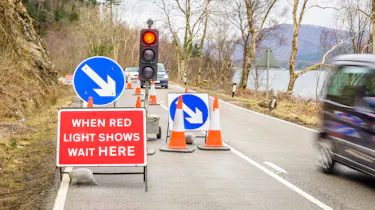
Picture the scene: You’re driving down the road and ahead is a set of temporary traffic lights – let’s just assume a utility company is digging up the road and will poorly resurface it afterwards, ready for it to become a pothole-strewn nightmare after one winter, ready for the cycle to repeat the following year.
The lights are on red, so you stop. A line of traffic comes through from the opposite direction, then the road becomes empty – yet your light doesn’t go green. A minute later more traffic comes through, then stops, and still no green light for you. By now, traffic is building up behind you, drivers are becoming impatient, the odd horn begins to sound…
Most of us, presented with this situation, would probably wait a few cycles and then, when opposing traffic cleared, tentatively drive on anyway. It’s an easier decision to make if the section of roadworks is short and you can clearly see that there’s no oncoming traffic, nor anything coming out of a junction also controlled by lights. It’s much riskier on a blind country road, but with the prospect of sitting there for a long time on a red light that clearly isn’t changing and no obvious detour you can take by turning around, you don’t have many options.

The legality of red lights
In the eyes of the law, this issue is fairly clear-cut: According to UK traffic laws, it is illegal to drive through a red light.
This applies even to one you suspect to be broken, and even with mitigating circumstances, such as when there’s an ambulance, fire engine or police car on an emergency call behind you, and you need to pull forward through a red light to let them through.
In other words, in any of these situations, you will fall foul of the law and could be prosecuted for passing a red traffic light. You’re guilty if you contravene a red light whether you intend to or not.
The only legal exception in this case is if the lights aren’t illuminated at all, i.e. they’re present but switched off completely, or are broken and not illuminated. In this instance, the Highway Code (rule 176) says you should treat the light as an unmarked junction, and proceed with caution.

What should you do at a broken red light?
Legally speaking, your hands are tied, though if you’re pulling out of the way of an ambulance on an emergency call, you would hope that the police would accept this as a reasonable explanation for doing so.
If you’ve been sitting for 15 minutes at a red light which clearly isn’t cycling, and you’ve had enough time to assess when it may be safe to proceed, you can at least explain that you’ve tried to take sufficient precautions.
This is obviously trickier if there’s an emotionless, unblinking camera set up to capture red light contraventions, and no doubt going through legal procedures in that case would be more of a pain.
You could also (hands-free of course) phone the company controlling that set of road works to see if they can rectify it, and potentially you could also call the police on the 101 non-emergency number to help direct traffic. Though in either situation you could be waiting quite a while before either party comes to help. There’s even a government website page where you can report broken traffic lights, but again, don’t bet on a quick fix.
Insurance risk
There’s also an insurance risk. Even if you think you’ve been cautious but still get into some kind of accident after passing a red light, your insurance company may have grounds for not paying out, because the law is very clear on how you should treat red lights.
In the end, how you proceed comes down to common sense. You are legally not allowed to contravene a red light, but presented with a situation where a light clearly isn’t cycling, you’ve been there for quite some time with no chance of the light turning green any time soon, and you’ve got sufficient vision to be sure nothing is coming the other way, most of us would probably pull away with caution – and hope that a camera or particularly officious member of His Majesty’s constabulary isn’t hiding behind a bush.
If you really can’t be sure, the safer option is to just turn around and find another route to your destination, one without malfunctioning traffic lights. Taking the risk is not worth it.
Get the latest car news in your inbox, for FREE! Sign up to the Auto Express email newsletter...