Graduated driving licences to boost young driver safety in Northern Ireland: will the rest of the UK follow?
Fresh regulations for novice drivers aim to reduce serious and fatal traffic collisions involving young people

Northern Ireland will be the first part of the UK to introduce graduated driving licences (GDL) as part of a major change to the rules for new drivers, in the hope of reducing serious and fatal road collisions involving young people.
The introduction of graduated driving licences, set to happen 1 October 2026, has been described as the “most significant reform to driver licensing and testing in almost 70 years” by Infrastructure Minister Liz Kimmins.

Graduated driving licence schemes are already in place in the Republic of Ireland, Australia, Canada, Sweden and part of the US. Northern Ireland’s version will include a mandatory six-month wait before a learner driver can take their practical test, plus restrictions on night-time driving and passenger numbers allowed in a newly qualified driver’s car at night.
For the first six months new drivers up to the age of 24 will only be permitted to have one passenger aged between 14 and 20 in their car from the hours of 11pm and 6am. Although there is an expectation for immediate family members, the rule does not apply if someone aged 21 or over, who has held a driver’s licence for at least three years, is sitting in the front seat.
All new drivers will also have to complete a GDL programme of training that “details the learning required to become a safe driver”, which must be completed and recorded in a logbook before a learner driver can undertake their practical driving test.
The new rules will allow learner drivers to drive on the motorway providing they’re accompanied by an approved instructor, and newly qualified drivers will be allowed to use motorways, too.
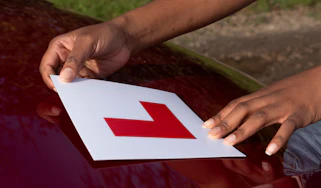
But once new drivers have removed their L-plates, they’ll now be required to have an ‘R’ plate on their vehicle for 24 months after passing their test, up from 12 months previously. There will be two colours, one of which will signify a driver has passed their test less than six months ago.
Drivers who do not follow the restrictions under the graduated driving licence scheme could receive three penalty points or a fine of up to £1,000.

NI’s Department of Infrastructure, which created the rules for graduated driving licences, says they’re “not about limiting independence, it is about saving lives. Restrictions are temporary and designed to reduce risk during the highest-risk period for new drivers”.
While announcing the scheme, Minister Kimmins said: “In 2024, there were 164 casualties (killed or seriously injured) from collisions where a car driver aged 17-23 was responsible. This age group of drivers account for 24 per cent of fatal or serious collisions despite holding just eight per cent of licences.
“Behind these figures are too many shattered lives as loved ones who set off on an everyday journey suffer life-changing injuries or are never coming home to their family and friends.
“The fundamental goal of learning to drive and the licensing process should be to create drivers and motorcyclists who are safe, and not just technically competent, by the time they are permitted to drive or ride unsupervised.
“The introduction of GDL plans to achieve this through a structured approach to learning to drive, including the completion of a Programme of Training and Logbook. This will better prepare drivers for both the driving test and initial post-test driving period by helping learners understand how human factors such as their attitude, personality, behaviour and feelings affect their driving style.”
Did you know you can sell your car through Auto Express? We’ll help you get a great price and find a great deal on a new car, too.