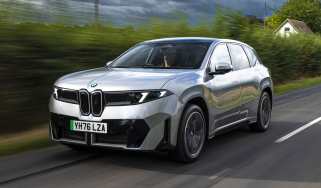
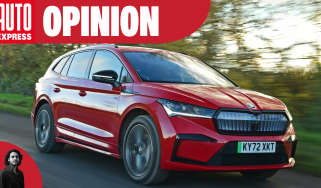
Long-term test: BYD Sealion 7
Final report: A disappointing driving experience mars this Chinese giant’s electric SUV


Verdict
Our experience with the BYD Sealion 7 has been broadly underwhelming, but that’s not to say it won’t fit the bill for lots of happy buyers. This car is spacious, well built and largely refined. But at this price point, it needs to be more rounded and capable on UK roads. We’d like to see more attention paid to the driving experience, user interfaces and efficiency.
- Mileage: 2,590 miles
- Efficiency: 3.02mi/kWh
The BYD Sealion 7 had a tough gig during its time with us. At Auto Express, we’re literally paid to be critical, and while we’ll always be impartial and look at things through the eyes of you, our readers, there’s no other way to say my next statement. I just didn’t really get on with the BYD Sealion 7.
When it first arrived, we asked whether Chinese brands such as BYD could build a car to the same standard as their European rivals. So far, for most Chinese models we’ve been offered in the UK, the answer is generally ‘no’, but they have usually been able to offer far more for your money. This BYD’s Achilles heel is that the latter notion does not apply, because its £47,000 list price is just too high.
Used - available now

2025 BYD
Sealion 7
1,074 milesAutomaticElectric
Cash £35,995
2025 BYD
Sealion 7
8,369 milesAutomaticElectric
Cash £35,495
2025 BYD
Sealion 7
6,482 milesAutomaticElectric
Cash £39,999However, although BYD still has plenty to learn from its European competitors, there are also lots of things this Sealion 7 does particularly well that the legacy brands need to take note of. I was constantly impressed by the impression of quality: the thunk of the doors, the complete lack of any squeaks and rattles, widespread use of soft-touch materials; these all add masses of showroom appeal.
The Chinese market’s desire for maximum rear legroom was appreciated by back-seat passengers, and the huge glass roof flooded the cabin with light. The big boot was flexible, and the fact I could store the cables up front kept it tidy. I liked its low-speed refinement, because the powertrain is always silent.
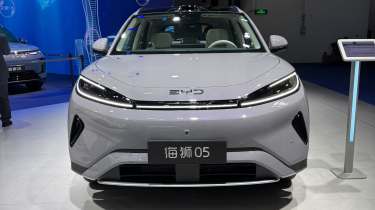
But the biggest issues are the way it drives, its efficiency and its range. For nearly £50,000, a motorway maximum (albeit in cold conditions) of no more than 200-220 miles isn’t enough. It may have been competitive four years ago when the car was launched in China, but rivals have caught up and overtaken it. I struggled to get more than 100kW at high-speed DC chargers, and even if it did hit its quoted 150kW peak rate, that’s no more than average in 2026.
Then there’s the driving experience. I admit that this will be more of a personal thing, and many people won’t find it as problematic as I did. But if the Sealion 7 wants to play the game as a leader – and price itself accordingly – it needs to deliver in this area, too. I found the BYD just a bit too exhausting to drive over long journeys, bouncy and unwieldy during short ones and it offered no sense of fun or joy at any point during my six months with it.
But after just returning from the Beijing Auto Show, BYD’s scale at a local level was impossible to ignore. The company and its many Chinese sub-brands, in effect, commandeered an entire show hall. The new BYD models weren’t spread thinly and there was one after another that could easily replace the Sealion 7. BYD’s incredible speed of development is clear to see, and with every new model the firm will get closer and closer to offering a more widely talented car.
However, the question remains whether BYD will see the need to optimise its future models for the much tougher European market. If it does, any and indeed all of those shiny new variants on the company’s stand in Beijing could well break the glass ceiling, and finally be a Chinese BEV that we think is worth buying over the legacy competition for more substantial reasons than just value for money. As it stands, though, the Sealion 7 can’t compete with its key competition.
BYD Sealion 7: second fleetwatch report
It’s possible to lock the Sealion 7 while everything is still turned on, but I accidentally left it like that for 10 hours.
A quirky feature has come to light during our time with the Sealion 7: turns out you’re able to fully lock and secure the car while it’s still switched on. This has been handy if I’m quickly popping out – to pick up my dry cleaning, for example – and want to keep my seat warm.
Unfortunately, this feature also makes it possible to accidentally leave the car locked but fully powered up. As a result, I've discovered that the lights, wipers, heater and heated seats consume about 20 per cent of the car’s battery capacity in around 10 hours. Luckily, there was plenty of charge left when I realised what I'd done.
BYD Sealion 7: second report
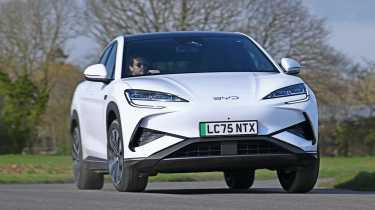
All is not rosy in the garden when it comes to driving our BYD
- Mileage: 1,604 miles
- Efficiency: 2.8mi/kWh
Progress among Chinese brands such as BYD has been nothing short of astonishing. In terms of tech, model reach across segments and profitability, there’s a lot for legacy brands to learn. But when it comes to the driving experience – something that’s hard to fully appreciate over a 10-minute test drive – our BYD Sealion 7 has some issues.
The general response I get from people is: “Oh, you have a BYD. Can I have a look?” And generally, their first reaction is: “It’s big, and nice inside.” Yep, indeed it is. Then we move on to: “And it’s electric, right? What’s it like to drive?” Ah, yes, well, about that…
First of all, I find the overly soft seats to be uncomfortable after only 15 minutes on the road. The general driving position doesn’t help, either, due to the almost bus-like angle to the steering wheel. I sometimes catch myself doing a bus-driver-like wheel shuffle when going around sharp bends.
Put the Sealion 7 into drive and it’ll creep forward, but press the throttle pedal and not much happens. Response from the electric motor is painfully slow, to the point where one has to take this into account when pulling out of junctions or overtaking. It’s not a ‘drive mode’ thing, because there’s no discernible difference between Sport, Comfort and Eco.
Yet in complete contrast, the brakes are incredibly sensitive. This makes driving at low speeds a frustrating exercise. It also makes you look like a total amateur when parking, because the brakes easily snap on, causing the whole car to rock back and forth. It’s no better on faster roads, because the spongy pedal makes the level of braking you apply hard to modulate and maintain.
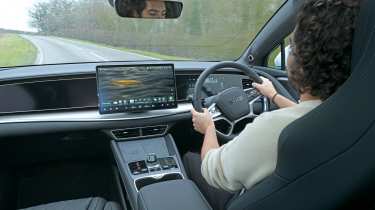
Then there’s the ride and handling. The suspension is soft, but it’s not a comfortable car. I’m no chassis engineer, but even I can feel that the spring rates – that’s the firmness of the springs – are far too low in relation to the dampers, which are too firm. The Sealion 7 rolls into corners, yet seems able to find, transmit and magnify every bump in the road. Along complex or uneven surfaces, the suspension gets so befuddled that it feels like the Sealion 7’s body is trying to emancipate itself from the suspension.
The harshest of potholes are generally absorbed by the relatively high-tyre profiles on our 19-inch wheels – dual-motor models swap these for 20s – but the lack of body control is an ever-present annoyance. The suspension hardware itself also makes quite a racket, constantly grumbling away in an otherwise quiet low-speed driving experience.
There are problems at motorway speeds, too. The steering, which is generally inert but not annoying around town, needs constant micro-corrections to keep the car straight when driving at more than 50mph. Without getting too technical, there needs to be a touch more ‘toe’ on the front wheels to keep the car from wandering inside its lane.
In combination with the sluggish throttle control and a surprisingly high level of wind noise, driving the Sealion 7 over long journeys isn’t as relaxing as it should be. Chinese motorway speed limits are quite a lot lower than those in Europe, and you can certainly tell from the way the car is set up. And on more challenging British B-roads; the Sealion 7 is simply not the tool for the job.
This would be more acceptable if the BYD was more affordable than its rivals, or if it had class-leading efficiency and range. But it doesn’t. We’re still seeing around 2.9mi/kWh in mixed city and country driving, but on motorways it’s more like 2.5mi/kWh.
This means it’ll struggle to top 200 miles from a charge on a long trip. And at my local street-lamp charging rate of 52p/kWh (off-peak), motorway driving costs around 20.8p a mile. At current average fuel prices, you’ll need to be driving a petrol car that does less than 33mpg for it to be more expensive. There are definitely some impressive elements to the Sealion 7, it’s just they just seem to evaporate once you select Drive.
BYD Sealion 7: first fleetwatch report
BYD’s aquatic EV has a clever and easily accessible camera system that makes parking a doddle
Our BYD has a couple of aces up its sleeve when it comes to managing its width in tight spaces, but the main one is a superb camera system. It offers a range of views, including clear and perfectly-aimed vision of the front wheels. This makes parallel parking or navigating width restrictions easy; there’s even a dedicated button for it on the steering wheel. If only there were more of these controls for other, even more useful, functions.
BYD Sealion 7: first report
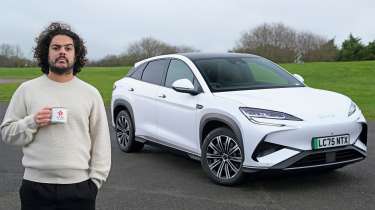
Will the large SUV buck the trend and demonstrate that Chinese cars come with a soul?
- Mileage: 588 miles
- Efficiency: 2.9mi/kWh
If 2025 proved one thing, it’s that Chinese car brands are deadly serious about becoming the biggest player in global sales. But despite having driven the vast majority of the new offerings on sale in the UK, no Chinese-branded model has really taken my fancy so far.
This isn’t about brand snobbery or politics, but the fact that Chinese cars often feel more like a product than a car, so often missing the soul that turns a car from a tool into something worth cherishing. So to challenge this notion, I’ve got my hands on China’s biggest manufacturer’s largest EV for the next few months to try to convince me otherwise.
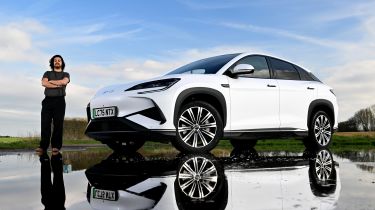
This is the BYD Sealion 7, a chunky electric SUV with a sloping roofline and a high-performance powertrain. It can be a little hard to grasp just how big it is from the pictures, but the 7 is around 250mm longer than a Volkswagen ID.5 or Skoda Enyaq Coupé – two cars that, despite this discrepancy, act as key rivals across most other metrics.
BYD says the Sealion 7 is all about breaking with clichéd notions of ‘cheap’, and it certainly does that when you read the price. Our car, in base Comfort trim, starts at £47,000. Its £1,100 of optional white paint results in a £48,100 on-the-road price.
Like lots of Chinese cars, it’s not short of equipment. Comfort trim comes with a 15.4-inch touchscreen, panoramic roof and heated and cooled front seats, with the rear bench and steering wheel also heated. A high-spec 12-speaker Dynaudio stereo, 360-degree camera system with sensors all-round and 19-inch wheels complete the kit highlights.
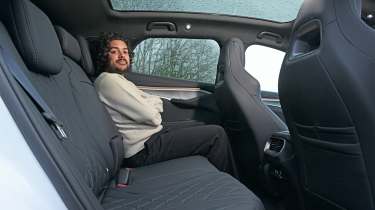
In fact, the only things this version lacks are the head-up display, real leather seats and larger 20-inch wheels found on higher specs. But there are a few elements missing across the range that could be expected at this price point. Matrix or adaptive headlights beyond just automatic full-beams are a notable miss, as is any form of massaging seats or autonomous parking assistance.
In contrast to the upper two dual-motor models, Comfort comes with a single, rear-mounted motor producing 308bhp. It derives its power from an 82.5kWh battery pack, and BYD quotes a 0-62mph time of 6.7 seconds. That ‘Blade’ battery is capable of up to 150kW charging speeds, which should get the battery from 10-80 per cent in around 32 minutes. Range is quoted at 300 miles.
But hold on a second. Aren’t high-end Chinese cars meant to be breaking the internet with their incredible charge speeds, performance and technology? A Volkswagen ID.5 isn’t just £10k cheaper, but it’ll also do an extra 45 miles on a charge and match the BYD for performance and top-up speeds. The flagship Ultimate model ups the range and charging to 329 miles and 230kW, but at £59,000 it’s hot on the heels of BMW’s new iX3 with its 500 miles and 400kW peak.
You sit high in the BYD’s driver’s seat, and the relatively low dashboard only accentuates this. The sloping roofline and tiny rear window don’t give it a particularly airy feeling – but the panoramic roof helps.
Connectivity has its highs and lows. The screen is relatively fast to react and has no problem maintaining a solid wireless connection for Apple CarPlay. But simple tasks are buried in multiple menus. You can also rotate the screen in a typical BYD way, but I find this utterly pointless.
We’ll go into more detail about how the Sealion drives and the sort of efficiency we’re getting over the course of the next few months, but at the moment it’s doing around 2.9 miles per kWh. This is less than what BYD quotes and is the result of largely urban driving so far, but that’s not such a bad number considering the recent cold weather.
The BYD will have to prove it’s worth the ambitious price tag by driving, cosseting and reassuring us to the levels we expect of its legacy-branded rivals that offer very similar, if not even better value. Only time will tell.
| Rating: | 3 stars |
| Model tested: | BYD Sealion 7 Comfort |
| On fleet since: | December 2025 |
| Price new: | £47,000 |
| Powertrain: | 82.5kWh battery/1x e-motor, |
| Power/torque: | 308bhp/380Nm |
| CO2/BiK: | 0g/km/3% |
| Options: | Premium paint (£1,100) |
| Insurance*: | Group; 46 Quote: £1,424 |
| Mileage: | 2,590 miles |
| Efficiency: | 3.02mi/kWh |
| Any problems? | None so far |
*Insurance quote from AA (0800 107 0680) for a 42-year-old in Banbury, Oxon, with three points.
Did you know you can sell your car through Auto Express? We’ll help you get a great price and find a great deal on a new car, too.