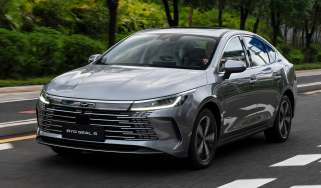
BYD Seal review
The BYD Seal makes a strong case for itself as a well-built, efficient EV that’s great to drive

Our opinion on the BYD Seal
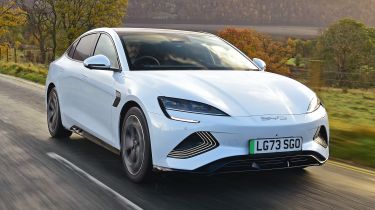
The BYD Seal is the Chinese brand’s most impressive UK offering to date, with excellent range, efficiency, and performance. It even has a well-finished interior with lots of standard equipment to give it the feel of a premium electric vehicle, so much so that it might make you think twice about a Tesla Model 3. However, it doesn’t undercut its closest rivals on price like BYD’s other offerings do, so the Seal doesn’t stack up as well as its more practical, faster charging, and more fun to drive competition.
About the BYD Seal
It may seem a little strange that a car maker would launch a saloon car when increasing numbers of buyers are defecting to SUVs, but the BYD Seal is not your normal compact executive saloon. It differs from rivals like the Audi A4, BMW 3 Series, and Mercedes C-Class in being an all-electric offering like the aforementioned Tesla Model 3. Going electric brings lower company car tax implications than hybrid or even plug-in hybrid alternatives, which is crucial in this market.
All versions of the Seal come with the same 82.5kWh (usable) battery size, and the entry-level rear-wheel drive model has an overall driving range of 354 miles. That’s a mighty impressive number.
Used - available now


The model range is very simple, consisting of just two trim levels: Design and Excellence. Our preferred Seal is actually the entry level rear-wheel drive Design trim, which actually has a specification that reads more like that of a luxury car than a fleet favourite.
One thing we should note is that BYD’s naming structure means this isn’t the only member of the Seal family of cars. There’s also the BYD Seal U and BYD Seal 6 to choose from, although these are very different cars from the fully electric Seal saloon that you see here.
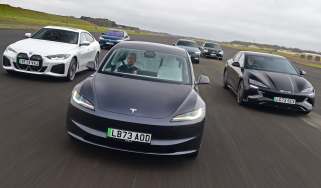
We’ve tested the BYD Seal by lining it up against its five key rivals in an electric company car megatest. Unfortunately for BYD, this car wound up in last place due to a few issues cropping up, but it’s still a respectable first foray into the UK market.
BYD Seal prices and latest deals
How much does the BYD Seal cost? Well, official ‘on the road’ prices range from £45,720 to £48,720 but you can currently save an average of £4,219 through the Auto Express Find A Car service, where prices start at £41,631. You can lease a BYD Seal from £342 per month or buy a used model at prices starting from £28,509.
Check out our latest new car deals, leasing deals and used car deals for the top offers available now on Auto Express. And don't forget we can help you sell your car, too.
Prices start from around £46,000 for the base BYD Seal Design, and moving up to the fancier Excellence trim adds exactly £2,000 to the price.
If you want to save on your new car, you can build your BYD Seal through the Auto Express Buy a Car service. We also have a range of BYD Seal leasing deals up for grabs, as well as brand-new Seal models in stock and ready to go. We can also help you to sell your car.
Performance & driving experience
Pros |
|
Cons |
|
The BYD Seal is quick enough in our preferred rear-wheel-drive Design trim that we don't think you'll miss the added get-up-and-go of the Excellence four-wheel-drive model. The Seal is generally refined enough, but it needs a little more fine-tuning to compete with the BMW i4. The accelerator could be a little more responsive, and we’d like a smoother transition between its regenerative and mechanical braking systems.
Underpinning the BYD Seal is the same e-Platform 3.0 used on the existing BYD Atto 3 SUV and BYD Dolphin supermini, upscaled for the saloon’s extra length. It’s the first of BYD’s Brit-bound models to switch from front to rear-wheel drive, though you can get a top-spec Excellence version with an additional motor on the front axle to make the Seal four-wheel drive.
| Model | Power | 0-62mph | Top speed |
| Seal Design | 308bhp | 5.9 seconds | 111mph |
| Seal Excellence AWD | 523bhp | 3.8 seconds | 111mph |
Electric motors, 0-60mph acceleration and top speed for EVs
The entry-level rear-wheel drive Seal gets from 0-62mph in just 5.9 seconds, which is faster than the equivalent BMW i4 eDrive30 and Tesla Model 3 RWD. That’s more than enough performance to make it our preferred version of the Seal.
The top-of-the-range Excellence AWD model officially takes 3.8 seconds to get from 0-62mph, but we recorded a 3.7-second sprint using its dedicated launch control mode on a closed track. It’s no faster flat-out than the rear-wheel drive model, with both versions hitting 111mph.
Town driving, visibility and parking
Thanks to its standard adaptive suspension, the four-wheel drive car feels like the most focused Seal to drive. At low speeds, there’s a slight chatter from the ride around town, but this settles at higher speeds, where the fancier suspension does a much better job of disguising the Seal's mass than the passive set-up of the rear-wheel drive Seal.
Around town, we prefer the regenerative braking set-up you’ll find in the Hyundai Ioniq 6, which uses paddles behind the steering wheel so you can select between varying strengths of regeneration, from a coasting mode for motorway driving up to a one-pedal drive mode for driving in stop/start city traffic. The system in the Seal is too subtle, making it difficult to bring the car to a halt just by lifting off the accelerator pedal.
Country road driving and handling
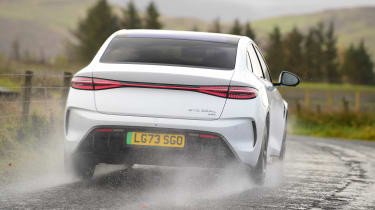
Despite being the performance-focused version, the four-wheel drive Seal Excellence is softer and less controlled than the BMW i4 over lumpy B roads, and isn’t as satisfying to drive as a result. Both versions of the Seal have fairly pronounced body lean in corners when pushing on, and an intrusive stability control system curtails any attempt to drive enthusiastically. Still, with weighty steering and a low driving position, the Seal is unquestionably the brand’s most driver-oriented car to date.
The BYD Seal is a quick car, though. The entry-level 308bhp rear-wheel-drive model provides all the performance you’d need, while the flagship four-wheel drive Excellence model ups the ante to 523bhp. However, both versions suffer from a less responsive accelerator than rivals, giving the impression of old-school turbo lag when trying to make a spirited getaway from the lights, and blunting the punchy acceleration we’ve come to expect from high-performance EVs
The main difference between the entry Seal Design and the flagship Excellence AWD is the additional electric motor powering the front wheels. Its four-wheel drive system utilises BYD’s Intelligent Torque Adaption Control (iTAC) system, which is, in effect, a torque-vectoring set-up that aims to reduce slip and increase traction in slippery conditions by directing power to the wheels with the most grip. We found that the four-wheel drive provided plenty of traction, even in some of the worst weather the north of England could throw at us. In the end, we’d still recommend the standard rear-wheel drive model because it’s perfectly capable of handling most situations.
Motorway driving and long-distance comfort
The BYD isn’t as quiet as the i4 at higher speeds, even though the side windows of the Seal are laminated to dampen wind noise at higher speeds.
We also think the Seal’s brakes could use a little more initial bite, especially given that the Seal is a heavy car with a lot of mass to slow down. The pedal travel is long, and there’s a distinct step between the regenerative braking system and the mechanical braking system.
“The Seal isn’t helped by a slow responding throttle, which gives it a character that’s reminiscent of an old-school turbocharged car, with a modest initial push followed by a great surge moments later. With so much performance potential, we would have liked to apply the power a little more progressively.” – Alex Ingram, former chief reviewer.
Range, charging & running costs
Pros |
|
Cons |
|
The rear-wheel drive model is our preferred version because its official range of 354 miles compares well with similarly priced rivals. The Excellence AWD has proven to be less efficient than its rivals, which is a little concerning for long trips when the charging speed lags behind the class best. Predicted resale values are likely to be on par with its competition, but insurance is likely to be expensive, considering the Seal sits in some of the highest insurance groups.
Electric range, battery life and charge time
The base rear-drive BYD Seal has a maximum claimed range of 354 miles, while the four-wheel drive version has a nearly nine per cent drop to 323 miles. That’s due to the inefficiencies of having an additional electric motor driving the front wheels and a weight penalty of around 130kg compared with its sibling. Both versions use an 82.5kWh capacity battery.
The four-wheel drive Seal proved to be the least efficient EV during our company car group test, at only 3.0mi/kWh. That’s a shame, because it has a larger battery than the equivalent dual-motor Tesla Model 3, yet the latter managed 3.8mi/kWh, allowing it to go significantly further on a charge.
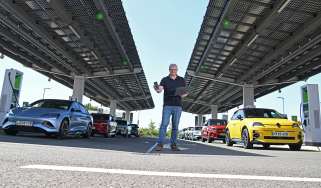
The Seal has a peak charge rate of 150kW, which is slightly down on all the main competitors, especially the Hyundai Ioniq 6, which can handle up to 233kW. During our electric car charging test, we only saw a peak of 123kW for just five minutes. It took 32 minutes to go from a 20 to 80 per cent state of charge, and it took a glacial 56 minutes in the 80 to 100 per cent section. We say 100, but we found that charging cut out at 99 per cent, just like it did with the Tesla Model Y also included in the test.
If you regularly tackle long trips in an EV, the Volkswagen ID.7 might be a better choice. It reached its advertised 200kW peak (admittedly for just three minutes) in our testing of the 86kWh version, and it took only 21 minutes to handle a 20 to 80 per cent charge. It can also go from 80 to 100 per cent much faster than the BYD, taking a mere 16 minutes.
Most owners will probably charge the Seal overnight at home via a 7kW wallbox. In the worst-case scenario of refilling a completely flat battery, which few owners will ever do, it will take a little over 13 hours.
The battery is guaranteed to retain 70 per cent capacity for eight years or 125,000 miles, which is longer than the warranties on BMW and Tesla battery packs.
| Model | Battery size | Range | Insurance group |
| Seal Design | 82.5kWh | 354 miles | 48 |
| Seal Excellence AWD | 82.5kWh | 323 miles | 50 |
Insurance groups
Unfortunately, insurance is likely to be costly. The entry-level Design model is in group 48, which is considerably higher than the Hyundai Ioniq 6 in group 36, and the BMW i4 and Volkswagen ID.7, which both start in group 38.
The top-of-the-range Excellence AWD is in the highest group 50 ranking, which is higher than the most potent M50 version of i4, and is also above that of the even faster Kia EV6 GT, which is in group 45.
Tax
The Seal will make sense to company car drivers because of the low three per cent Benefit-in-Kind (BiK) tax band electric cars sit in, at least until 2025. It'll rise to four per cent from 2026.
EVs no longer enjoy free VED road tax, so you'll need to pay the standard rate of tax (£195 per annum at the time of writing). No version of the Seal costs less than £40,000 when new, but the expensive car supplement (ECS) or luxury car tax threshold is increasing to £50,000 for electric cars from 1 April 2026, and anyone who bought a car from 1 April 2025 will retrospectively benefit from this threshold increase.
Depreciation
Residual values for the Seal are stronger than those of its key rivals, according to our expert data. It suggests that after three years and 36,000 miles, the Seal will maintain around 48 per cent of its resale value, putting it ahead of the Ioniq 6 (42 per cent), the BMW i4 (37 to 40 per cent). It’s even better than the Tesla Model 3, which is anticipated to be worth between 41 and 48 per cent of its original value over the same period.
To get an accurate valuation for a specific model, check out our free car valuation tool...
Interior, design & technology
Pros |
|
Cons |
|
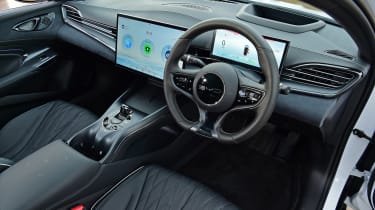
A handsome exterior design and a classy interior built with plush materials help to give the BYD Seal the premium feel its price demands. You get a lot of equipment for your money, and the standard ventilated front seats are a nice touch considering the full-length glass roof will make things quite hot in summer. We doubt you’ll need a rotating central touchscreen, but at least the screen responds swiftly to inputs. We approve of the separate digital driver instrument cluster, because it puts important information, such as speed, within the driver’s line of sight.
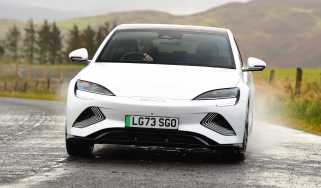
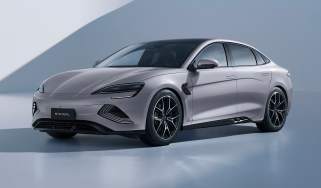
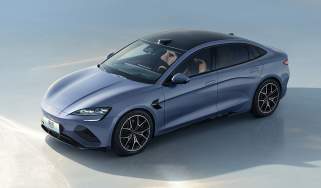
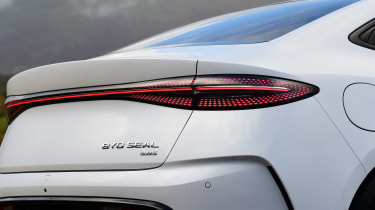
The exterior design of the BYD Seal is handsome, and looks sleek enough to cut through the air with maximum efficiency. You have a choice of four standard metallic colours, plus two premium paint colour offerings for just under £900 – which is quite reasonable given that such an option on the Tesla Model 3 is up to £2,000 if you want that car in its Quicksilver or Ultra Red choices.
Given that the Seal has been priced to compete with premium electric offerings in the class rather than trade on value like its cheaper sibling, the BYD Dolphin, you’d expect the interior to be of a certain standard. Fortunately, the Seal doesn’t disappoint.
Key features of Design trim:
- 19-inch alloy wheels
- LED headlights
- Electrically adjustable heated and ventilated front seats
- Surround-view camera system
- 12-speaker Dynaudio sound system
- Electric tailgate
The pricier Excellence trim only adds a few more luxuries, such as a head-up display and adaptive suspension, so you can switch between a more compliant ride for rough roads or a firmer one if you find yourself enjoying a twisty country B road blast and need to sharpen things up. However, the main draw is its more potent dual-motor set-up that brings with it four-wheel drive and significantly more performance.
Interior and dashboard design
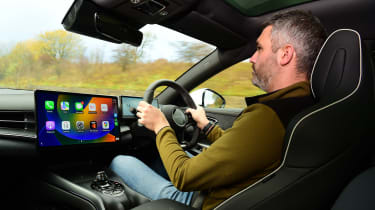
Inside, the wraparound dashboard design of the BYD Seal feels more sporty than some of rivals, and we appreciate the supplementary 10.25-inch screen in front of the driver, which puts important information such as speed and trip data right where you need it, rather than off to the side like in the Tesla Model 3, which relies on its central screen. The top-of-the-range Excellence trim goes further by providing a head-up display that projects your speed on to the windscreen within the driver’s line of sight.
The glass roof helps make the all-black interior less sombre, but if you want something a little more distinctive, you can also choose the Tahitian Blue alternative.
Materials and build quality
Quality is good throughout, and the soft-touch materials used across the top of the door cards are particularly classy. The seats feel suitably plush both front and rear, and those in the front will be treated to heated and ventilated seats as standard. The latter will be a welcome feature in the summer months given every Seal has a glass roof, which floods the cabin with light.
Infotainment, sat-nav and stereo
The infotainment system is lifted wholesale from the Atto 3. The 15.6-inch rotating display runs on the same super-fast processor that makes it responsive to your inputs. We don’t understand the point of its rotating screen, because after the initial interest in watching it rotate on its axis, we reckon most will prefer to keep it in landscape orientation to prevent the screen from obstructing their forward view as it does in portrait mode.
There is a handy shortcut to some basic climate control adjustments, such as the temperature controls, that can be made via a menu in the digital driver’s instrument cluster and the buttons on the steering wheel. This saves you from delving into the menus within the central touchscreen, but it’s still a shame that you have to exit whatever screen you’re on within the main display to access all of the climate control functions. We can’t help but think that dedicated buttons would be even less distracting for drivers.
You can stream music through it using either Apple CarPlay or Android Auto, and you can keep your devices charged with the two wireless charging pads provided.
“If you enjoy listening to music, then the Seal is the car to have; the sound system is by Danish hi-fi brand Dynaudio, and its quality and power are absolutely superb.” – Alex Ingram, former chief reviewer.
Boot space & practicality
Pros |
|
Cons |
|
The BYD Seal is a four-door saloon that’s slightly bigger than the Tesla Model 3. Thanks to a super-thin ‘blade’ battery pack that doesn't take up much space under the car's floor, the BYD feels like a much bigger car inside than a traditionally powered petrol or diesel car.
All Seals come with front and rear parking sensors and a 360-degree camera system. The latter is often an expensive option among its rivals, and while it has a number of neat tricks, such as generating an image of what’s below the car, the camera quality isn’t as sharp as it could be.
Dimensions and size
The Seal is bigger in all directions than the Model 3, but smaller than the Volkswagen ID.7 in length. The extra size of the latter might become an issue when trying to park in a tight multi-storey car park, though.
| Dimensions comparison | |||
| Model | BYD Seal | BMW i4 | Tesla Model 3 |
| Length | 4,800mm | 4,783mm | 4,720mm |
| Width | 1,875mm (2,150mm inc mirrors) | 1,852mm (2,073mm inc mirrors) | 1,933mm (2,089mm inc mirrors) |
| Height | 1,460mm | 1,448mm | 1,440mm |
| Wheelbase | 2,920mm | 2,856mm | 2,875mm |
| Boot space | 485 litres (72 litres under the bonnet) | 470 litres | 594 litres |
Seats & passenger space
There’s enough room up front in the Seal for taller adults. All versions come with electrically adjustable front seats with lumbar support and memory settings for the driver’s seat, so you can easily recall your preferred seating position when more than one person is driving the car.
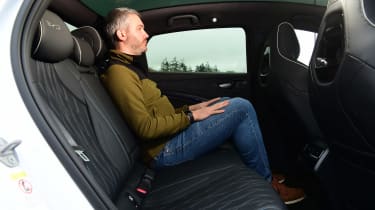
An adult approaching six feet tall can fit in the back in the outer positions, although their head will be quite close to the roof lining. That being said, a Hyundai Ioniq 6 isn’t exactly stellar in this department, especially if you go for a version with a sliding glass sunroof. If you need to fit taller teenagers or adults in the back, consider the Volkswagen ID.7. It provides ample head and limo-like legroom for rear-seat occupants. It’ll be more comfortable on longer trips, too, because the high floor in the Seal and relatively flat seat base means it doesn’t have much under-thigh support.
The Seal comes with Isofix child seat mounting points on the front passenger seat, and the outer positions on the rear bench.
Boot space
The Seal initially offered 400 litres of boot space, but as part of the facelift, capacity was increased to a rather more handy 485 litres. Folding rear seats were also added, which will be a welcome for those likely to carry longer objects, such as skis. Regardless, the saloon body style means the boot opening can be restrictive when loading taller items.
The 53-litre ‘frunk’ was already convenient for storing dirty charging cables, but this has also been expanded to 72 litres.
Even though it’s grown in size, the BYD’s boot is still some way off the 532 litres of capacity you get in a Volkswagen ID.7. You can’t drop the rear seats in the Seal, so it won’t be very useful for a trip to IKEA compared with the more versatile ID.7, or BMW i4.
Reliability & safety
Pros |
|
Cons |
|
BYD’s long six-year/93,750-mile manufacturer’s warranty should provide some reassurance about the Seal’s durability. The battery pack is also covered by an eight-year or 125,000-mile warranty, which is longer than most of its rivals.
The BYD Seal didn’t appear in the most Driver Power owner satisfaction survey, but the BYD brand languished in 30th place out of 31 manufacturers. It's just ahead of MG (31st), but a very long way behind Tesla (11th) and BMW (8th).
The Seal should at least be a safe car, because it was awarded a maximum of five stars out of five by the safety experts at Euro NCAP in 2023. It matched the BMW i5 in adult occupancy rating, and did better in terms of child protection. It couldn’t match the Volkswagen ID.7, which did better across the board.
| Euro NCAP safety ratings | |
| Euro NCAP safety rating | Five stars (2023) |
| Adult occupant protection | 89% |
| Child occupant protection | 87% |
| Vulnerable road user protection | 82% |
| Safety assist | 76% |
Buying and owning
- Best buy: BYD Seal Design
We think the entry-level rear-wheel drive Design version is the best model to buy because it has the greatest range, and only misses out on a head-up display compared with the pricier Excellence trim. The rear-wheel drive car is also plenty quick enough in the real world that we don’t think it’s worthwhile spending the extra on the four-wheel drive Excellence trim.
BYD Seal alternatives
It isn’t just the traditional German saloon car choices or the Tesla Model 3 with which the Seal must do battle. There’s an array of other EV saloon offerings, such as the BMW i4, Hyundai Ioniq 6, and Volkswagen ID.7, that are all available with over 300 miles of range.
Plus, you could also consider EVs like the Hyundai Ioniq 5, Kia EV6, Nissan Ariya, Volkswagen ID.4 and Skoda Enyaq that, while perhaps not offering quite the same overall driving range due to having less aerodynamic SUV-style shapes, do all offer greater versatility than a saloon.
Key updates of the BYD Seal review
Wednesday 25 March 2026: Updated to include details of the MY26 facelift.
Frequently Asked Questions
The BYD Seal provides excellent range and lots of equipment for the money, although some rivals offer faster charging speeds and a sharper drive for less money.
Deals on the Seal and alternatives