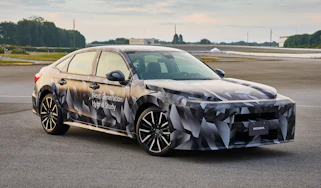
Honda’s wireless EV charger means no plugs and you won’t even need to stop!
In collaboration with two other companies, Honda is due to start testing a road surface with embedded wireless charging technology

Rapid charging speeds are getting faster all the time. There are already a few cars capable of 400kW, while BYD’s Flash Charging tech supplies a whopping 1,500kW. But even the latter system involves stopping, plugging in and waiting for about 10 minutes. Honda, meanwhile, is envisioning a future in which you won’t have to stop at all.
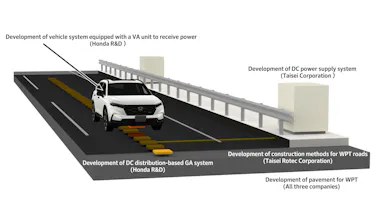
The Japanese manufacturer is working with The Taisei Corporation and its Taisei Rotec subsidiary on wireless, road surface-integrated charging technology that’s capable of keeping an electric car topped up as it drives along. This isn’t a new idea, but the Honda project stands out firstly because of the potential output of up to 150kW, intended to charge up the especially large batteries of electric commercial vehicles on the go.
Another notable aspect is a planned test on a public road from April 2027 onwards. The Tateyama Expressway in Chiba, Japan is the chosen site, although the assessment will be preceded by testing at the Taisei Group’s Future Technology Field in Fukushima Prefecture starting later this year.
Each of the three companies will provide one key piece of the puzzle. It’s Honda’s job to sort the power receiver and transmitter units, while Taisei is developing the DC power supply system, and Taisei Rotec will work on the technology necessary for sticking all of this into the asphalt.
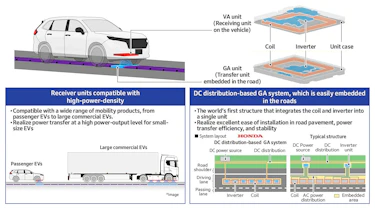
The initial test at Future Technology Field has several aims, including assessing the long-term durability of the road surface with the equivalent of a million wheel loads acting upon it, and figuring out ways to deal with electromagnetic field leakage.
The tech works using a series of power transfer units in the road surface, which Honda says are the first of their kind to integrate an inverter and a coil in one unit. They’ll need to withstand the around 20-tonne weight of a heavy goods vehicle trundling over them, too.
The design allows the unit to be embedded within the road surface, while its DC nature means less wiring and thus fewer components needed for the installation, Honda says.
It’s still early days for technology like this, so don’t expect to see it cropping up on the M1 any time soon. The Honda project is certainly worth keeping an eye on, though, along with the many other manufacturer-backed wireless charging endeavours.
Don't miss the best of Auto Express on Google! Make us a preferred source. Click here...