Huge EV pay-per-mile tax details revealed: GPS tracking and price increases confirmed
In its response to the consultation on eVED, the Government says its plans will “support a fair and sustainable motoring tax system”

Major details of the controversial eVED pay-per-mile tax have been unveiled, arriving to mixed responses from across the automotive industry. The Government has confirmed that drivers of electric and plug-in hybrid cars will be able to opt-in to submit GPS data to get accurate readings, while the cost per mile is set to increase further from April 2029.
Opt-in telematics scheme
Following an industry consultation lasting several months, the Government says the proposed eVED road-tax system will feature an opt-in telematics feature when it is launched in April 2028. This will enable those with cars featuring 4G and 5G telematics technology – most cars sold post-2018 – to transmit mileage data wirelessly from their vehicle to Government databases.
The Government says such technology has the potential to “simplify the operation of eVED and reduce administrative burdens on motorists” – but it also has the potential to go much further than that. Not only could telematics data enable more accurate road pricing for those driving their car internationally – the DVLA would only tally miles if GPS readings show the driver is within the boundaries of the UK – but it could also make things fairer for plug-in hybrid drivers.
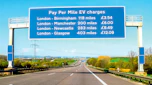
As outlined in the plans for eVED, electric car drivers will be charged three pence per mile, while plug-in hybrid drivers will be charged one-and-a-half pence. This pricing structure is based on the assumption that PHEVs lean on their petrol and electric powertrains in equal measures – one that studies, such as the one conducted by the Fraunhofer Institute, have rejected as incredibly optimistic in real-world driving.
Speaking to Auto Express in May, a key contributor in the eVED consultation, the Campaign for Better Transport’s director of policy and research, Silviya Barrett, explained: “You’d be able to tell what proportion of people are driving in electric mode, versus petrol.”
However, the implementation of this looks unlikely, with the Government stating in its consultation response that such a concept “would require motorists to report mileage driven in different modes, which would not be a practical or proportionate approach. A reduced rate for PHEVs strikes the right balance between fairness, protecting motorists’ privacy and minimising administrative burdens on motorists”.
Nevertheless, Barrett welcomed the Government’s choice to implement telematics technology in the first place, saying: “We’re pleased that the Government has listened to stakeholders about the need to provide more choice in how vehicle mileage can be reported. Drivers opting to use their vehicle’s existing telematics technology will benefit from a quicker, easier-to-use and more accurate system.”
No mileage checks for new cars
For those choosing not to submit telematics data to the DVLA, the Government says it won’t require annual mileage checks in the years leading up to a car’s first MOT test. Instead, drivers will be asked to submit and pay for their mileage each time they renew their annual standard VED, with the two prior years of submissions being validated when it’s time for that first MOT. The Government will have the authority to demand mileage checks for those suspected of fraud, though.
In reaction to this change, CEO of Electric Vehicles UK, Tanya Sinclair, said: “The Government has listened where it matters. Dropping mandatory mileage checks for cars under three years removes a significant speed bump that would have been a burden on new drivers and big fleets.”
For those that have underpaid, they will be asked to pay the difference. However, those that have overpaid – whether it be over the course of one year or the three years leading up to the first MOT – will be reimbursed. This will typically be in the form of credit towards the driver’s next eVED payment, although the Government says if the difference is more than £100 or if the person in question is experiencing financial hardship, they will be refunded in cash.
It won’t be 3p per mile for long
The eVED scheme won’t be fixed to 3p and 1.5p for long; as part of its consultation response, the Government says that “the rate will be uprated in 2029-30 and in future years in line with CPI (Consumer Price Index) inflation”. At the moment CPI is set just shy of three per cent, meaning that we likely wouldn’t see a huge impact on the price per mile for at least a few years.
Nevertheless, the general reaction from carmakers to the pay-per-mile scheme has been overwhelmingly negative. Chief executive of the Society of Motor Manufacturers and Traders, Mike Hawes, told Auto Express: “We recognise the need for a new approach to motoring taxes, however, the absence of full consultation on eVED has created some confusion in the market. It remains the wrong measure at the wrong time with the OBR [Office for Budget Responsibility] expecting 440,000 fewer BEVs to be sold as a result.”
Did you know you can sell your car through Auto Express? We’ll help you get a great price and find a great deal on a new car, too.