Public EV charger numbers jumped by 20% in 2025, but growth is actually slowing
More than 14,000 new chargers were deployed in the UK last year, but that’s still fewer than in 2024

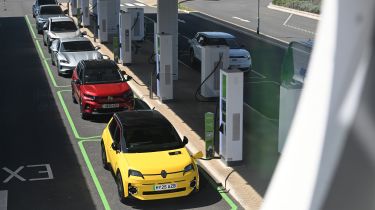
The number of public electric car chargers in the UK has leapt by almost a fifth in the past year. This increase, while impressive, marks a minor slowdown overall in public charging deployment, coming alongside a seeming stifling in demand for EVs.
Statistics from EV charging website ZapMap indicate that, as of January 2026, there are now 88,513 public electric car charging points scattered across the UK. That’s over 14,000 more than there were this time last year, representing a 19 per cent year-on-year increase from January 2025.

However, this growth pales in comparison to 2024, when nearly 20,000 new chargepoints were installed, and even 2023 when over 16,000 new chargers joined the network. Similarly, while the number of EV sales in 2025 increased by 24 per cent to around 470,000, market share only crept up by four per cent year-on-year, signalling a stalling in appetite for electric models.
Regardless, the UK’s some 88,500 chargepoints possess over 122,000 connectors – some devices boast more than one cable to plug in with – and are spread across 45,242 locations nationwide. As you’d expect, Greater London is the home of the greatest proportion of the UK’s EV charging network; ZapMap says almost 28,000 (31 per cent) of the country’s chargepoints can be found in or around the capital, despite the latest motorparc stats from the Society of Motor Manufacturers and Traders suggesting that London is home to just 11 per cent of the UK’s EVs.
While slow-speed chargers remain the most commonplace, rapid and ultra-rapid examples have seen consistent and suitably fast deployment over the last couple of years; in 2025, for example, the number of ultra-rapid units (those outputting electricity at over 150kW) leapt up by 40 per cent to just shy of 10,000.
Instavolt and Tesla remain the largest rapid charging networks, with the former just edging out the latter in terms of size. While Greater London dominates in terms of the number of overall public chargers, it’s the South East that has the greatest proportion of these devices, at just over 14 per cent versus the capital’s eight per cent.

Head of insights at ZapMap, Jade Edwards, said: “Growth continues to be highest for en-route, ultra-rapid charging provision[s]... This not only provides convenience and confidence to existing EV drivers but also, due to their typically visible locations, assures the next wave of drivers looking to make the switch that the infrastructure is there where it’s needed most.”
As of the time of writing, the Government is said to be reviewing the current cost of public EV charging, which greatly outweighs that of charging at home. With ZapMap quoting the current average rapid charging cost of 77 pence per kilowatt hour, it’s hoped that slashing VAT from 20 per cent to match the five per cent of domestic electricity would encourage more drivers into EVs and build upon the 3.9 million public charging sessions conducted last year.
Rollout of Local Electric Vehicle Infrastructure (LEVI) funding will also pave the way for the installation of on-street chargers, serving those without the luxury of a driveway. “We look forward to more announcements around LEVI funded projects getting underway and translating from contracts into near-home charging provision, to increase equitable access for those without access to off-street parking,” added Edwards.
Get even more from Auto Express, follow our channels...
• Google
• Reddit
• Whatsapp